Interview: John Carney
A conversation with the writer-director of the new film Flora and Son.
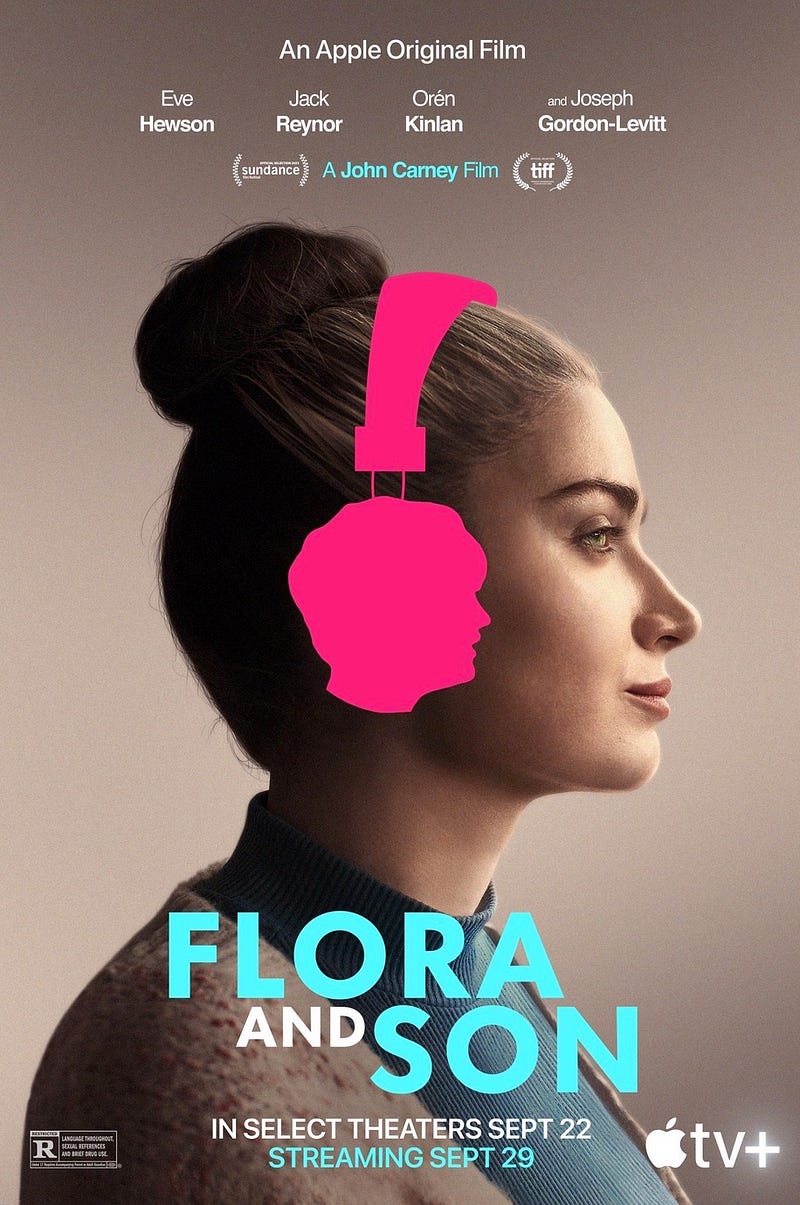
A conversation with the writer-director of the new film Flora and Son.
This looks like a good movie:
Here are excerpts from an interview with the film’s writer-director John Carney. Via A.Frame:
For writer and director John Carney, his new film, Flora and Son, began very simply. “It all started with the image of a woman pulling a guitar out of a dumpster,” he says. “I thought that was a great starting point for a film, and especially one of my films — something that either had to have or was likely to have a musical component.” True to his word, very little time passes in the film before Flora (Eve Hewson), the young Irish woman at the center of its story, has found herself impulsively rescuing a beat-up acoustic guitar from the metallic maw of a garbage truck.
It’s a moment that was partly inspired, at least, by Carney’s own life. (“It’s sort of based on something I do myself, which is recycle and repurpose other people’s trash all the time,” the Irish-born filmmaker reveals.) As those who watch Flora and Son will inevitably discover, though, it’s also a befitting inciting incident for a film that is, in many ways, the most unpolished musical that Carney has made since his breakout hit, 2007’s Once, which won the Oscar for Best Original Song.
Flora and Son, which premiered at this year’s Sundance Film Festival, follows a single mother (Hewson) who decides to repair a used guitar for her teenage son, Max (Orén Kinlan), in hopes that it might inspire him to abandon his burgeoning criminal impulses. Ultimately, the guitar not only creates a bridge between mother and son but also sparks an unexpected relationship between Flora and Jeff (Joseph Gordon-Levitt), the L.A.-based musician who gives her weekly guitar lessons over Zoom.
Like in all of Carney’s films, music proves to be an unlikely means of salvation for Flora and Son’s characters. Its thematic connections to his past efforts aside, there is one thing that separates Carney’s latest film — his first since 2016’s Sing Street — from all of his other musicals. “Usually, I make films about people who are competent musicians, but I didn’t want to do that with this film,” he tells A.frame. “I wanted to make a movie about somebody who gets given the gift of music later in life, someone who only starts to see the magic of how music is created as an adult, how much it means to other people, and — this is important — that music isn’t about winning The Voice or The X-Factor. It’s not about getting an award or being №1.”
Hence a battered guitar in a dumpster.
A.frame: As someone who clearly loves music and has made numerous movies about people who love music, what was it like making a film about a woman who, at first, doesn’t?
It was the reason to do it. I’m kind of tired of people who are really good at what they do. I’ve made movies about those people a few times now, and it’s a bit boring. You know, there’s always that scene where someone’s like, “Oh, I don’t want to hear this girl from Dublin. Oh wait, hey! She’s really good!” Or there’s a skeptical person who suddenly hears the voice of an angel singing across the room. We’ve seen that so many times, and I’ve done that scene myself numerous times as well. I’m guilty of it, too.
I just thought, “What would it be like to hear someone play a song in a movie and it’s not ‘Falling Slowly’ [from Once] or ‘Singin’ in the Rain’? What would it be like to make a scene where someone hears something and it’s not the best thing in the world? What would it be like to hear something that needs the help and collaboration of somebody else? What would it be like to hear somebody fail?” That was an idea that was really interesting to me, and partly because of some of the failures I’ve experienced in my own life. The fantasy version of life that we have in our heads never really happens. It just never does.
It does feel like a subversive choice to make in a musical.
Well, it seem like there’s something happening even on TV at the moment, where more and more shows and films are subverting expectations and surprising audiences with their narrative choices. The tropes of Hollywood are really being circumvented. You see it even in a show like Poker Face, where you watch an episode and you’re like, “That’s the last thing I expected to happen.” It’s good practice to do those kinds of things and go, “No. I know that when somebody sings onscreen you expect to see a positive reaction of some kind, but what if that’s not what happens? What’s that like?” It’s interesting to explore and describe what it feels like to tell a joke that falls flat on its face because, generally speaking, we’re obsessed with success stories.
Here is a clip from the movie:
To read the rest of the interview, go here.
For 100s more interviews with screenwriters and filmmakers, go here.