Interview: James Cameron
Writer-director Robert Rodriguez in conversation with the filmmaker behind the Avatar movie series.
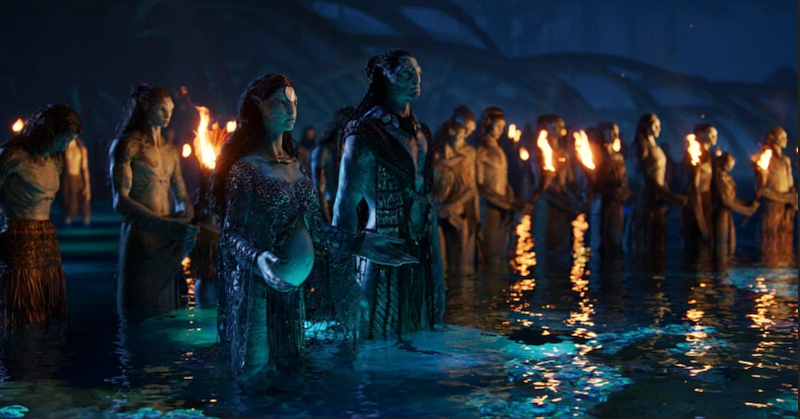
Writer-director Robert Rodriguez in conversation with the filmmaker behind the Avatar movie series.
It’s been a long time coming (the Avatar sequel was originally scheduled to be released in 2014), but Avatar: The Way of Water is finally hitting movie theaters. James Cameron, the creator of the series of Avatar movies and their director, has been making the rounds doing interviews. I thought this one was particularly insightful: a conversation with fellow filmmaker Robert Rodriguez.
Here is a excerpt transcript of the conversation:
Robert Rodriguez: This movie is a long time coming.
James Cameron: Yeah, no kidding.
Rodriguez: But you did it again, man. Even though there’s enough spectacle in the film to drive people to the theater, the real power of it is, once again, the emotion. You reach new dramatic heights with this film. What was important for you to focus on?
Cameron: I wrote the first film in 1995. And I wasn’t thinking about being a husband, father, family guy or any of that stuff. But sitting down in 2012, I said, “What story do I want to tell?” Of course, I’m going to go back to Pandora — I’m going to go back to Jake and Neytiri. And it’s like: What if Romeo and Juliet didn’t die? What if they married and had kids, and they had a family, and they had to think about something besides each other?
Jake and Neytiri have taken it upon themselves to try to save their world from these hostile colonizers from Earth. But at what point do you have to lay down your guns? And they’ve got boys coming up who want to be warriors; they’re 14 or 15 years old, and they’re feeling that testosterone and that sense of mission. How do you tell them, “Don’t be like me”?
When I was writing the new films, I was going through that as a father of teenagers. And my conclusion was, no matter what you go through in terms of dysfunction, the family’s your fortress. And I wanted to somehow, through my art, convey that, because I thought it was a big missing piece in action movies these days.
It’s fascinating how often those two words — what if — appear in interviews with screenwriters and writer-directors when talking about the inspiration or genesis of the story: “What if Romeo and Juliet didn’t die? What if they married and had kids, and they had a family, and they had to think about something besides each other?”
In another interview (with ScreenRant), Cameron talked about the writers room he used to create the scripts for multiple movies:
James Cameron: But starting from development, I thought that this time I want to work with a team of writers. We are doing multiple scripts. I’d already decided I wanted to do a trilogy, turned out now I guess it’s a quadrilogy, if that’s the right word. But I had to have a starting point.
I set down and just made a bunch of notes for six months. Literally, just every day sitting at my desk, talking about the world, the characters, trying to fill in what happened the day after Jake woke up in a Navi body, and just was carrying the story forward. I knew I had certain goals in mind.
I walked in on the first day with the whole writers room, and I plopped down 800 pages of notes, single spaced. I said, “Do your homework, and then we’ll talk.” And then we got together, and the first thing I challenged them with was, “Before we start talking about new stories, let’s figure out how the first story worked. What were people keying into, what was working for them?” We had a lot of discussions about that, and every idea we came up with as we went along had to measure up against that standard.
It had to hit the heart, had to hit the mind, had to hit the imagination, and it had to hit something even deeper, which we had a hard time quantifying. Something you could call spiritual, or you could call subconscious. Some kind of connection that you can’t even really describe in words. And I said, “If we can’t do that again, then we are going to fail.”
Two things:
- The six months of work Cameron did — “talking about the world, the characters” — is reminiscent of what I have my students do. Not six months! But I give them a set of character development and brainstorming exercises to immerse themselves in their story universe. The process is not only about learning as much as they can about the place and the individuals who inhabit, it’s primarily about enabling those characters to take agency in the story-crafting process. Empower them to drive that process.
- For all the spectacle of the Avatar movies, it’s interesting to note the prime directive Cameron gave to the writers room: Heart. Mind. Imagination. Subconscious. The story has to connect with the audience on all of those levels, even the Spiritual. Short of achieving that, “then we are going to fail.”
I’ve always been impressed by James Cameron movies because for all the action and visual sophistication, he always keeps a storytelling spotlight on the emotional and psychological core of the narrative. And that plays out through the characters amidst the events of the plot.
By the way, here are the credited writers on Avatar: The Way of Water:
Screenplay by James Cameron & Rick Jaffa & Amanda Silver, story by James Cameron & Rick Jaffa & Amanda Silver & Josh Friedman & Shane Salerno
I imagine that’s who comprised the Avatar writers room. I know Shane Salerno pretty well. Sometime I’ll see if he can go on the record about that experience, although I wouldn’t be surprised if the writers signed NDAs.
Here is a trailer for Avatar: The Way of Water.
For 100s more interviews with screenwriters and filmmakers, go here.