Interview: Denise Meyers
How her film The Dark of Night came to debut at the Cannes Film Festival.
How her film The Dark of Night came to debut at the Cannes Film Festival.
Sometimes the story behind the story is equally as compelling as the movie itself and the journey of Denise Meyers with her short film project The Dark of Night is precisely one of those tales. It ends with her movie premiering at the 2018 Cannes Film Festival. Where does it the saga begin? Read on:
It’s quite a journey from working as a literary agent’s assistant in 1982 to seeing your movie The Dark of Night debut at the Cannes Film Festival. When and why during those years did you start to focus on screenwriting?
I didn’t know anything about how Hollywood worked when I first decided to pack up my 1972 Volkswagen bug and drive from Corvallis, Oregon to Los Angeles in 1982.
I came because I’d met Joel Douglas on the set of “One Flew Over the Cuckoo’s Nest” when I was fifteen and too stupid to know you didn’t call a film production office and ask the production manager to come speak to your psychology class about the book you were reading in high school. Much to my surprise, he not only came, he invited me to stop by the set whenever I wanted.
Years later as I was just about to graduate from college, I contacted him through the mail and he put me in touch with Nikki Grosso (Michael Douglas’ business manager), Nikki said if I moved to Los Angeles she would help me get a job, so a few weeks later, I packed up everything I owned and hit the road. I slept on a friend’s couch in West L.A, and went to work for Judy Scott Fox, a motion picture literary agent at the William Morris Agency. I started the same day as the current head of CAA, Bryan Lourd.
Since I didn’t want to be an agent, an actress or a director, I decided I would become a screenwriter. I thought that since I’d watched hundreds of movies growing up, I understood what went in to a good screenplay. I wasn’t a terrible writer, but I wasn’t a great writer either. Friends who had become junior executives would meet with me, but they never took my work seriously, so twelve years later I threw in the towel and moved to Utah to become a gourd artist. Strange transition, I know, but it turns out, I was one hell of a good artist. As a matter of fact, I am still the top selling gourd artist in the nation. I sold gourds for between $500 and $25,000 (that’s not a typo, by the way). I was in magazines, on television, in art galleries all over the world, and even made it into the pages of the Wall Street Journal and had an episode on my work appear on HGTV.
When the economy crashed it took my career down with it. And then a funny thing happened on the way to the movie theatre. I went back to writing. I won an eight week screenwriting scholarship at the New York Film Academy in Los Angeles, and I took the opportunity seriously. If there was a seminar, I was in the front row taking notes as if my life depended on it. If an agent or manager gave a lecture I went. I joined meet-ups, and watched movies, and read everything from Save the Cat to the loglines for upcoming movies in the Los Angeles Times, just to get a feel for what stories interested me, and what didn’t.
I set a goal for myself to learn how to write screenplays the way they are supposed to be written, with no expectation that I would ever get any farther in the film business than I had ever been before. I wanted to master the art form, in the same way I taught myself how to work with gourds. There is a process to both and I wanted to keep at it until I could write the way I’d always wanted to, so if it turned out that my writing career never went anywhere, at least I would know that I’d gotten out of it what I wanted, which was to become a better writer.
How have you gone about learning the craft of screenwriting?
Screenplays follow a specific formula, yet the key to being a successful screenwriter is knowing the formula, avoiding it, sticking to it and reinventing it all at the same time. Diane Drake, a screenwriting instructor at UCLA who wrote the script for the film, “Only You” says there are hundreds of screenplays that are good so it takes a strong writer to break away from the pack and hit the expected marks in such a way that the formula remains both intact and invisible at the same time. That’s what makes an exceptional screenplay, but the only way to get there is to write, and write, and write some more.
The Dark of Night started out as a short screenplay for a writing competition with three separate heats. The competition organizers gave each block of participating writers a character, genre and setting, and eight days to write a twelve-page script (then eight days to write a five-page script, and 24 hours to write a three page script). It can be overwhelming to write the words “fade in” when you know it could take months to finish a 110 page screenplay, so I signed up to keep my creative juices flowing in between projects. I finished the first draft of The Dark of Night in an hour, and it was really good. The story felt like it came out of nowhere, and even though we had to cut a few pages to fit the time we had to make the film, the basic premise of the story is still 98 percent there.
Having said that, I still struggle mightily with structure. I participated in two online screenwriting challenges last year (including Zero Draft Thirty) to write three pages a day, every day, so that, at the end of the month, I had a 90 page that was the springboard for a script that took four additional months to wrestle into shape. It turns out, all the scenes were there, but every single scene was in the wrong place and it took me forever to move all the pieces around until I finally hit the perfect combination.
That’s when I go back to the lessons I learned with I was at the New York Film Academy about conflict (it has to be in every scene, even if you are writing a comedy), plot development (somebody wants something and is having trouble getting it), and having the courage to cut things you may love that aren’t just aren’t working. When I get really stuck, I study films to figure out what I am doing wrong, so I know how to go back and fix them.
What were some of the key milestone moments for you from the time you came up with the idea for The Dark of Night to watching it get produced?
I decided to enter Table Read My Screenplay Austin and was the Grand Prize winner in 2015, so when I met Nini Le Huynh, Robin Wright’s assistant and an actress in her own right. I gave her the script for her show reel since she was looking for material. She called a few days later to say she’d read it, loved it, and by the way, the crew from ‘House of Cards’ shoots a short film every season for people to add to their resumes, and would I mind terribly if they shot The Dark of Night as their short film project this season?
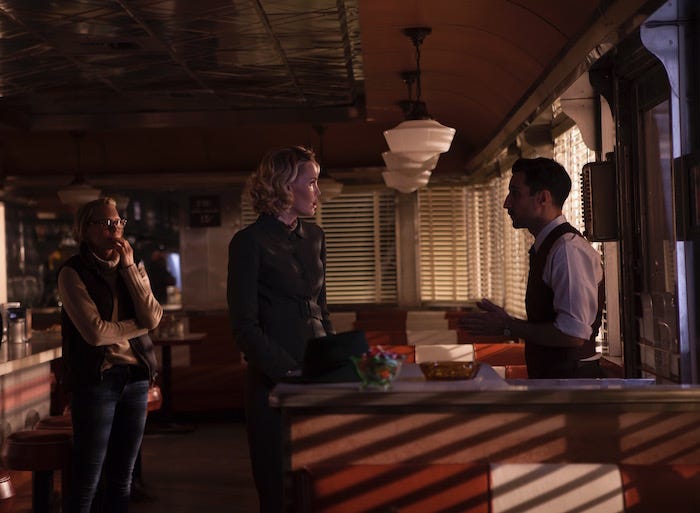
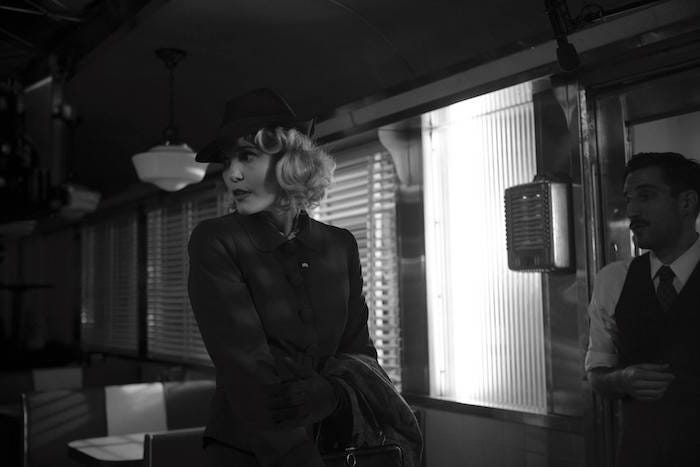
Then Nini called to say Robin read the script and wanted to direct and from there, things just exploded. 80 crew members from ‘House of Cards’ signed on to work on the film including the Director of Photography, Dave Dunlap, and costume designer, Jessica Wenger. Boris Maldin, the producer of ‘House of Cards’, loaned us cameras and equipment, and we raised money to pay for things like insurance, security and for the location itself. We shot at the Hollywood Diner in Baltimore, which was originally built for the Barry Levinson film, DINER.
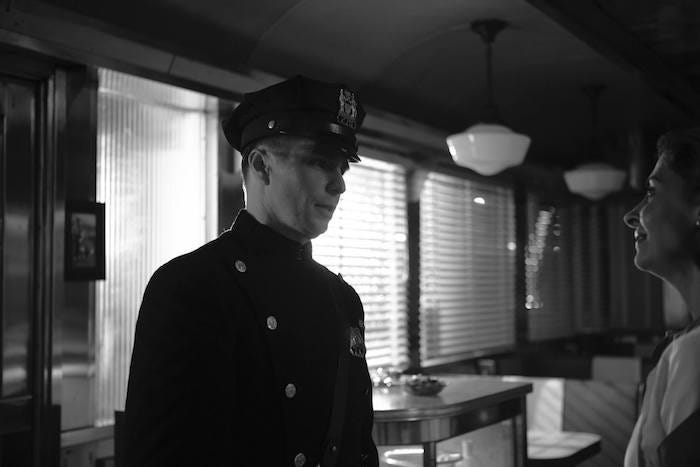
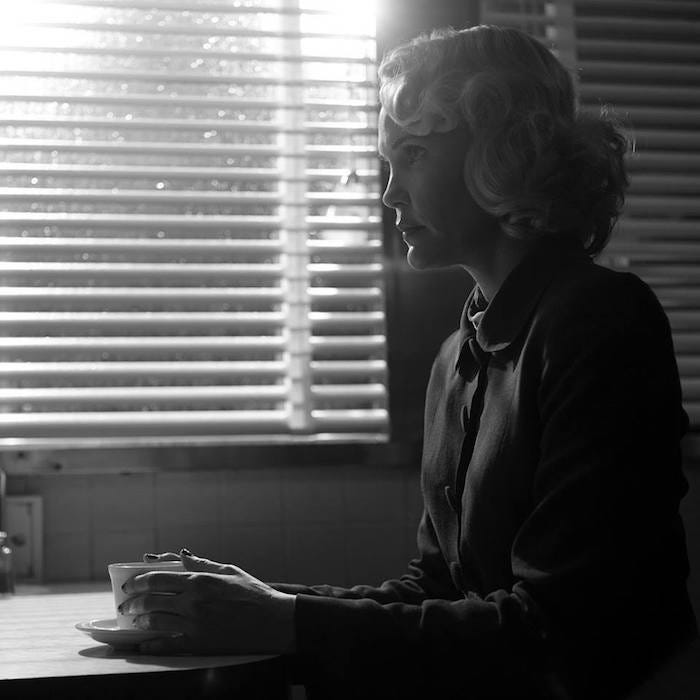
Nini met Leslie Bibb on a flight to Los Angeles and told her about the film. Leslie read the script, and so did Sam Rockwell, Callie Thorne and Michael Godere. They all agreed to do the film for scale, so on December 3, 2016, filming began and it was marvelous. What really surprised me were the people who thanked my husband and I for investing money in the production, and for giving THEM the opportunity to make MY dream a reality. We shot in black and white to capture the film noir feel of the piece, and it is beyond gorgeous. I can’t wait to see what people think of it.
What was it like to be on set with all that great talent surrounding you?
Oh my God. I have been a fan of Robin’s for so long that when Nini told me Robin wanted to talk to me about the script, I had a panic attack. I tried telling Nini I was fine communicating via email because I was afraid I was going to laugh at the wrong time, or embarrass myself by going on and on about how much I have always admired her. She put me at ease right off the bat, so by the time I got to the set, I wasn’t nervous at all. I was surprised by how much she involved me in the decision-making process, and the actors were all so well prepared and so laid back I felt right at home. It sounds cliché, but I was born for this. I feel more at home among people in the film industry than I do anywhere else on earth.
You are passionate about writing stories which feature female leads. Tell us about why that is an area of focus for you?
I grew up watching old movies back when it wasn’t considered at all strange for an actress to headline a production, back when it never occurred to the studios to shy away from material like THE WOMEN, or NOW VOYAGER, when Bette Davis, Norma Shearer, Rosalind Russell, Joan Crawford, Claudette Colbert and Marlene Dietrich were bigger stars than the men they appeared with. I am not sure what’s happened all these years later that screenwriting programs are offering classes in how to write women, and diversity initiatives are popping up all over the place to provide women with a seat at the table, but gradually, so as not to startle men.
My theory has always been that if girls grew up knowing what generations of women before them had accomplished, they would start their lives with the same building blocks boys take for granted. Look at all the young women who have decided on careers in space and mathematics after the success of Hidden Figures for example.
There are stories all over the place about great women in history no one ever knew about before, like Bessie Stringfield, a Jamaican American motorcycle legend who travelled the lower 48 by motorcycle in 1930 by herself. I wrote a script about Bessie Stringfield called RIDE THE WIND that was an Athena List winner in 2016, and last year, a two-and-a half minute Timeline video about Bessie Stringfield’s life debuted on Facebook that got 16,000,000 views, three hundred thousand shares and over eight thousand people asking why a movie about her life has never been made. Even if only half the people who viewed the video went to the movie, that’s $80,000,000, but I can’t get anyone to read the script because “movies with female driven leads don’t make any money”.
I am just bullheaded enough to believe that if I stick with it long enough, and do what feels right, I will gradually bring people over to my side through sheer force of will.
With the box office success of female-centric movies like Hidden Figures and Bad Moms that Hollywood maybe is finally starting to get the message: There is a big audience for movies with female leads?
Women make up 51 percent of the population and 52 percent of the box office receipts so I think the greater question here is why Hollywood is the only business on the planet that looks at a successful product and willfully refuses to capitalize on it. You would never see Pepsi, or Ace Hardware make $229 million off a new beverage or a screwdriver and decide not to make another product like it because “it was an anomaly”. The minute Hidden Figures hit the $100 million-dollar mark, executives were scratching their heads over the “surprising success” of the film, and now that its hit $229 million, those same executives still aren’t convinced that a movie with female leads can make money at the box office. How insane is that?
With The Dark of Night debuting at the Cannes Film Festival, what do you hope that means for you and your screenwriting career?
I hope it’s a game changer. I don’t have an agent or a manager, and right now I am looking at coming back to the business I own with my husband and going right back to what I was doing before. I haven’t quite wrapped my head around the fact that one week after walking the red carpet with Robin Wright and Nini Le Huynh nothing will have changed, but I’m still writing like mad and just finished a one hour pilot episode based on The Dark of Night that I am developing with a TV producer named Michelle Rubenstein, plus I recently completed an amazing new feature about Frank Lloyd Wright and Mamah Cheney that I hope to get in front of Brad Pitt. I’m currently working on a World War Two drama with a writer named Kevin Milligan about one hell of a battle in the Pacific only a handful of people know about, and a web series based on my experiences as an award-winning screenwriter who still fixes toilets for a living. With any luck, managing to get a film of this caliber before an audience at Cannes will send my career through the roof.
Finally here’s an excerpt from a post you wrote on your blog ‘Screenwriting Ain’t for Sissies’:
You launch yourself at this adventure like you have nothing to lose, because at the end of the day, you don’t. And how many times in my life am I ever going to get to say I had this kind of experience? I am 57 years old and I work hard. Harder than most people I have ever met in my life. I don’t give up and I don’t take no for an answer. I didn’t get here by myself, but I sure as hell didn’t wait around for someone to hand it to me either.
Could you speak to the importance of persistence in the life of a screenwriter?
I have walked away from plenty of things in my life. I walked away from what was once a very successful art career when I realized the art world was changing and it was never going back to the way it had once been. I gave up on the film business when I realized I’d spent twelve years of my life working my way to the middle and I was never going to go any farther. But every time I have let go of what I wanted, I did it because I knew I had given it everything I had. I came back to writing because I knew I could do better. It was unfinished business and until I studied and practiced and wrote and rewrote, and studied and practiced some more I would never be able to let it go. I am going to die someday, so what on earth do I have to lose by giving writing, or living, or relationships, or anything else for that matter 100 percent of my effort. It’s not like holding back is going to give me more time, because it’s not.
If I had advice for writers it would be this; keep at it until you have done everything you can possibly do to be a better writer, and if you never sell a script, or get an agent, or win a competition at least you will have the satisfaction of knowing you did the best you could and gave writing — or anything else you are passionate about — your all.
If you are passionate about it, do it for you.
You never known when you might just wind up having your film screened at the most famous film festival in the world.
After a run in the festival circuit, the film went public yesterday. Here it is:
Congratulations, Denise! Enjoy the experience and here’s to good things coming your way!