Interview: Brian Andrews
A conversation with the creator of cutting edge VR film which debuted at the 2020 Sundance Film Festival.

A conversation with the creator of cutting edge VR film which debuted at the 2020 Sundance Film Festival.
One of my colleagues at the DePaul University School of Cinematic Arts is Brian Andrews. Some background:
Brian Andrews is a storyteller and visual technologist who has produced media for the visual effects, animation, and fine-art markets for the past 17 years. His works have been exhibited at Le Marché du Film Festival de Cannes, Hong Kong Convention and Exhibition Centre, the Queens Museum, and the California Academy of Sciences, among many others. Currently he serves as the chair of Post-Production at DePaul University’s School of Cinematic Arts.
For the last 2+ years, Brian has been working on a project called Hominidae. It debuted at the 2020 Sundance Film Festival. Here is a trailer of the short film:
Because of the cutting edge nature of this VR project, I interviewed Brian both before and after the Sundance Festival. Here is that conversation:
Scott: What was the inception for this project?
Brian: I actually started working with this content over a decade ago. I revisited this world several times. For the first time, I was doing more visual‑based work. I was just taking veterinary and human Xrays and Photoshopping them together to create alternative evolutionary human forms.
It was just seen as a visual art exercise, that was a gallery exhibition, and this is back in 2004. They were successful and they went off and they lived in that world.
Then in 2012, when I started moving toward animation, it just felt like these were characters. That these weren’t just monsters. They’re characters. I wanted to investigate the characters. I created an animated shot called “Hominid.” It was only 75 seconds long and it was more of a technical test for me.
The story test, I put it out there and it went viral. It went huge. It got picked up in all this press, it got into all these specials on me pushing it, and would show a lot of interest in these characters in this world but never was the story I wanted to tell.
Brian: Then when I came to DePaul [University School of Cinematic Arts], obviously, because there’s big projects here, it was like, “It’s time for me to finally not just do an action sequence like I did in the previous short, but really get into these characters and explore this idea of what it’s like to be human if your body is different and you have this different physiology. Then also use the physiology to tell stories.”
I started working on it, and actually, I had a terrible time. I was struggling with the story left, right. It wasn’t working. I was talking to people just getting feedback about how they’d seen the previous film and everybody I talked to, almost the entire animation department here was like, “Oh, we’ve already seen that.”
I’m like, “You’ve already seen the movie that I haven’t made yet?” That turns out that little teaser filled that role for people as an audience. They already started to have that. Then I was like, “Why make a movie if everybody thinks they’ve already seen it?” [laughs]
Around the same time, on the side, I started working in VR [Virtual Reality], experimenting with other people in a very quick and dirty horror film project just to learn how it works.
Through that process, I started making all these discoveries about how that worked. There was something in that about being in the same physical space with these bodies, these transparent bodies that we can see inside of them.
I started translating that idea into VR. Then all of a sudden, story ideas started clicking. [snaps fingers] It just made sense once I translated it over. it wasn’t something that already existed, it was something that was new, and then that became the spark into making this piece.
Scott: Technically, what would you call this platform?
Brian: Technically, it’s a 360 video. It’s interactive since you can look wherever you want, the audience member, you are in control of your visual experience ‑‑ but it’s not interactive VR. Technically, it’s 360 video, which is a subsection of virtual reality.
Scott: The story evolved. You have a beginning, middle, end. You have birth, life, death. How did that play out in the creative process for you?
Brian: This is the first film I ever made where I wrote a script. I’d never written a script for any of my other projects. Because I came from such a visual background, I would usually start with beat boards, so drawings that convey key story moments.
Then my process definitely would be to start with those key drawings, start rearranging them, maybe make some sub drawings, and start sequencing visually. Start making animatics and things to see how that happens to develop a story.
I did start with that. It’s five vignettes. I really wanted these moments. I wanted to explore them across their life and I knew certainly for this, there’s no possible way I’d be doing a feature or anything like that, so big and quickly, that I wanted to focus on key moments.
Then I sat down to write the script, which was a struggle because it’s newer to me in terms of translating things to dialog because I usually think so visually. What I ended up doing, because, of course, it’s in a language that we invented for this, when I wrote the script,
I wrote the dialogue as the subtext, was the actual dialogue I wrote. Because we don’t know what the dialogue is going to be, but this is the meaning. This is what I want to communicate with everyone with that.
As I was doing that concurrently, I started creating little moments, little scenes. We’d create a few drawings, and I’d bring them into a really rudimentary VR and see how they play. Because the one thing that I learned on the project is all the assumptions, just because something works well in film doesn’t necessarily work there, and the only way you know is to try it.
Scott: When you say “we,” who’s we?
Brian: I wrote and directed it, but I had student assistance. One thing I can’t do is draw. I got some undergraduate research assistants who had lots of good story‑boarding skills. I started working with them, describing the visual moments and the story moments that I wanted, and they would come up with a range of sketches to try to figure it out.
Then what I would do, because of course, they’re sketching in a flat 2D way, I would cut them up and then put them into this three‑dimensional space and start moving them around. There’s a very weird, inversional process with this because the story and how things move in space are so integrated in order to give a continuous experience to the viewer.
They all have to go together because you have complete control. I had to do things to make sure that you’re seeing the story, that you’re not looking behind you.
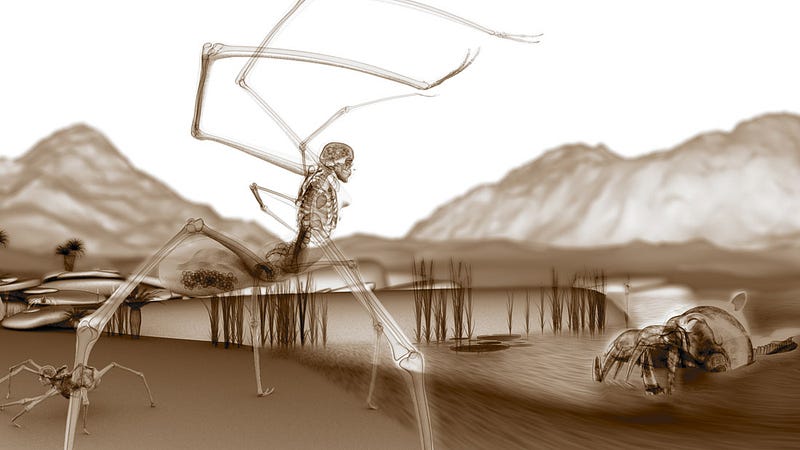
Brian: They’re being designed in that there’s a primary visual path that tells the main story. There’s a secondary visual path which has secondary characters things in there, which capture and reinforce the story, but then is designed to take you to the main points when you get there.
Then there’s tertiary information, like if you’re just lost, at least populating the rest of the space with things that contribute to the character, that tell the character’s world.
Scott Myers: Primary, secondary, tertiary ‑‑ was that something you knew before you started this process or is that something that emerged during?
Brian: It emerged during it. It’s so new. People weren’t doing that. But then to go back to that original question, I had to start figuring out how all that works together as I’m still figuring out what the main story points were.
It took a lot. Originally, this picked up right after the end of the other previous short where she brought home something that she had hunted as food to sustain her during this process. Obviously, we had a scene with that didn’t work.
We tried a number of different scenes with the children on the beach scene. Some things, we did have great story concepts, but they wouldn’t translate well or what we would need to do physically in our period of time just didn’t quite work.
It was a very interpretive process of ideas, drawing, bringing it in there, trying it out, re‑timing it. It’s very much a studio interactive process to focus down on what we needed to get for the story to work.
Scott: Out of the crew, the credits there, how many of those people were DePaul students and faculty?
Brian: Almost all. We did hire a few professionals. I would say probably 90 percent of all the people involved are DePaul connected.
Scott: And the language, how was that created?
Brian: What I ended up doing is going to a linguistic generator. Linguistics is a whole field of science. If you want a language, that was a huge, biggest point to me. People see these as monsters and I wanted to make them have humanity, hence the song, hence the emotional connection we’re trying to get. A big part of that is it had to have a believable language.
I found a generator online. There’s lots of cheesy ones for sci‑fi and stuff, but I found one that had a lot of roots in linguistic science.
I imported my dialogue and then played around with the phonemes and things and spent a good week just trying to get a sound I would like, but something that would then feel like it has grammar rules. Like, this is a language. This is a language that a human could speak.
The challenge with that, of course, is then getting my actors, not only to get the meaning of their lines, but then say those lines, but then sing and have meaning in another language. Those are all the DePaul actors as well. The lead is Phyllis Griffin. She’s faculty over in the theater school, and then all the other roles, except for one, were BFA students.
It’s interesting to go over that over there and work with them. They’re really devoted. Then we had to get one outside person just for the hippo. We just needed somebody with a lot more mass than any of our students have. We had to get one more guy for that.
Scott: It’s six‑plus minutes long. Have you ever calculated the man‑hours involved in creating this the thing?
Brian: Man hours? I don’t know. I worked on this for two‑and‑a‑half years. I know the computer render time total of our process, which is 1,138 CPU‑years of processor time. [laughs] That’s a lot of work in progress, but fortunately, we have big computers.
In terms of people who were involved, I was on a pretty much almost 60 to 100 hours a week for two‑and‑a‑half years. Then there’s a really focused period of time where we did the Project Blue Light [a DePaul sponsored program] where we had a full team of 20 people working nearly full time on it. Then, for an extended year, I probably had eight or nine other people puffing on on the project.
Scott: You submitted this to Sundance and the film festival accepted it.
Brian: Yes.
Scott: You’re going to be going out next week spending time there, what are your expectations?
Brian: This world, we are so weird. I’m not coming in like a first feature director at Sundance expecting to make some crazy eight‑figure deal and walk away with distribution, although those things are going to happen. At Sundance last year, one of the most talked‑about deals was the first seven‑figure VR film deal, actually happened last year.
What are my expectations? I want us to get visibility. I want this project to be out there. I would like to have a long festival run, but also I want to get in front of the other parts of the VR community. There are some distribution networks that I’m interested in working with. Those ones that are choosing good content.
It makes me think about my experience at Cannes [Film Festival]. We were fortunate enough at Cannes to present the film as a work‑in‑progress for a demonstration and pitch. Cannes, of course, is this huge rigamarole, similar in scale maybe to Sundance, but different certainly in texture, and surrounded by all of that media, and clamor, and all the stuff at Cannes.
I discovered this community of XR, is the term for all kinds of interactive filmmaking. The XR film community was there and it was small. It’s still small enough that everybody can know each other and it’s intimate, and it’s not super competitive yet.
It’s still mostly collaborative and supportive. I kept in touch with a lot of that community and they’ve been very helpful for me figuring out questions because we’re all figuring it out.
I’m very excited to bring this film to that community and to people who are really interested in this and see how we’ve pushed storytelling. I’ve tested it with audiences. I want to see how audiences react to it.
Then ideally, I’m very interested in critical feedback. I want to know what people think of it and then get it out there for people to see.
Scott: You’re submitting this to other festivals?
Brian: Yeah. I’m looking at a larger festival run now. Obviously, with Sundance, that may change how I want to do these things because we’re really honored with that, but ultimately, the goal is to get this seen by people.

Here is my conversation with Brian after his stint at the Sundance Festival:
Scott: So Sundance. What was that like?
Brian: A constant overwhelming experience. I’d never been to Sundance before. Obviously, you’ve heard the reputation and you hear about it, but the city’s packed. Everybody there is just so focused on it. Even every Lyft driver’s got a feature. [laughs]
My experience there was wonderful overall. It was screened in the VR Cinema 2 theater. It had the 45 synced VR systems, which provided an audience experience for the film that I never had seen possible. Just simply because before, you’ve got a VR system in a room, you can see one person at a time. Do it.
Here, I got to watch 45 people emotionally respond to the film finally all in sync.
Scott: Are they wandering around? Because it’d seem like they’d be bumping into each other or are they stationary?
Brian: What they did is they had armless but sort of office chairs. People could kind of slide and spin. They were given a remote headset, so there’s no cables or anything to the headset, so a headset with headphones.
It was super‑interesting, because in my film you have some very prescribed, choreographed action, some movement that’s very clear. As that movement went through, it was like watching a flock of birds, because everybody in the audience would move in the same way.
It was also interesting, because unlike when you’re screening a moving in a traditional feeder, you can kind of watch from the side. I could walk through the audience. I was standing in the middle of them. They had no idea I was there, being able to observe them through the story. In that sense, it was really great.
Scott: How many screenings did you do?
Brian: I think it screened seven times. I was there for four of them. One of the advantages of having such a specialized space is they’re not running a lot of other content. They only ran three things in it. They ran my program, which was a narrative shorts program. They had a doc shorts program. Then they had one longer feature‑length program, and they basically played all three every day.
Scott: A feature‑length?
Brian: Not quite feature‑length. It was probably more about an hour, which sounds like a lot to be in a headset. I did not get a chance to see that one.
In my program, there were four pieces. I led off. Very, very eclectic. Very different. Very experimental, I think, in all of their work that they had there.
Most of the pieces were about the same length, about 7 minutes. The final piece was 24 minutes, and that a very meditative, beautiful, contemplating nature kind of thing. That definitely felt like a bit of a stretch, being there for that long.
Scott: If you were to do this again, or just moving forward with this type of thing, what did you learn out of your interactions with these other filmmakers?
Brian: The other filmmakers were great. What amazes me is how fast this technology’s moving, yet also how slow this technology is moving. My piece was called “old‑school VR,” which is hilarious, because it’s so new, but at least looking at all the other work there, there’s a lot of interesting ideas. There’s a lot of interesting storytelling, but so little of it is fleshed out.
The level of detail that I put into my piece was atypical. Shari Frilot, the curator, referred to my piece as the pinnacle of the craft of making VR film, which felt pretty good to hear.
What I learned is that there’s a lot of interesting people doing this, but there’s still so much just basic creative learning to do about how to tell stories and what kind of stories can be told in the medium.
Yeah, and then learning about audiences. Audiences, they really wanted strong emotional connections. The pieces that did that had much better responses than a lot of the other work that was there.
The pieces that people were drawn to had stronger characters, stronger emotional arcs, less visually experimental, which is not to say mine isn’t, but less abstractly experimental pieces. Those were the ones you could really see the audiences gravitating towards.

Scott: Did you have time for Q&A with the audience after each screening?
Brian: Yeah, we did a Q&A after all four. Probably the most common questions that I got was the language in the song. People wanted to know about the song that she sings, where it comes from, how we wrote that about the performers with that.
I would say that’s what the general audience wanted. The other VR filmmakers, there was lots of tech questions and comparing notes of how we did it kind of stuff.
Scott: Any movement toward making this a way that you could make money, distribution platforms?
Brian: 20 minutes ago, before you walked in here, I just signed a contract for representation for distribution. What’s interesting is that’s specifically for Asian and European market, distribution there seems to be a lot more advanced than it is in the US.
Interestingly, through, it’s the telecom companies. It’s Verizon, Sprint, Orange, Dutch Global that are all looking to package VR content for their cell users. I signed a contract for that. Nothing yet, just representation for that.
Got some other festival interests as well. That hopefully should start coming forward for…have a festival run for a while until it makes sense to take it off the market and maybe put it on a whole bunch of phones in Korea.
I look forward to taking it to more festivals and seeing more audiences experience it.
I actually got a chance to view the film. That involved putting on the VR goggles and man, it was quite an experience. As Brian indicated, I couldn’t change anything that was happening on screen, however, I could look around the 360 degree environment. It was a fascinating experience.
Congratulations, Brian!
For 100s more interviews with screenwriters and filmmakers, go here.