Interview: Anton Outkine
My Q&A with Russia-based filmmaker on his award-winning web series It’s Complicated and half-hour VR film Kessler Effect.
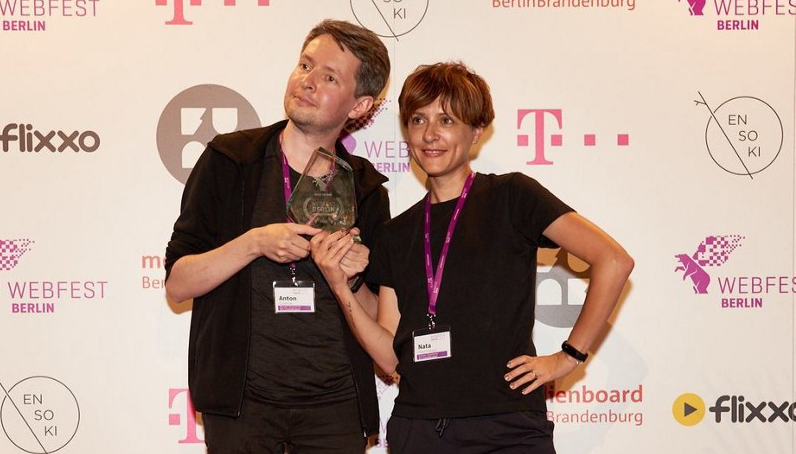
My Q&A with Russia-based filmmaker on his award-winning web series It’s Complicated and half-hour VR film Kessler Effect.
I got to know Russian filmmaker Anton Outkine in 2017 when he signed up to take all eight of the Craft courses I offered at the time through Screenwriting Master Class. Subsequently, he’s had quite a nice run of things on the creative front, so I reached out to Anton for an interview.
You’re a screenwriter, director, and producer based in Russia. Did you have any formal training or did you learn by doing?
I stumbled upon filmmaking by accident — before that I worked for over a decade in UX / UI (user experience / user interface) design for Russian and US companies. A highly visual field, so when an inspiration struck me to do a sci-fi short, I mostly visualized it, and played by ear. Here’s out debut sci-fi short, I think it still holds as an adequate little piece of storytelling that did its rounds at international film festivals: https://en.summerfilm.ru
So I did a few experimental shorts like that, more like etudes, and then I realized that it’s time to tackle longer forms and more serious and fleshed-out stories. Alas, I quickly learned that no one would write quirky sci-fi stuff for an up-and-coming director, because there aren’t many accomplished screenwriters in Russia, especially in sci-fi, and most of them are highly paid and extremely busy and booked for years in advance. So I decided to learn the ropes and learn screenwriting. It wasn’t easy, but career-wise it was the best decision one can do, especially if you plan a career in film or TV.
Around 2015 I picked up a course with Alexander Molchanov, who is basically your Russian counterpart — he wrote quite a lot of TV series back in the day and now runs a successful online screenwriting school. I like his model — it’s 3 months of brutal learning-by-doing, writing the actual script, taking notes, incorporating them into your script and moving on. At the end you either give up or you leave with a fully realized first draft, rough but structurally sound. It’s a tremendous first step.
Then I wrote and shot more stuff, because the best feedback you can get as a writer–director is to actually shoot what you write and see for yourself what works and what doesn’t. It’s not as expensive if you do, say, an indie short.
After awhile, I realized that it’s time to dig deeper into the craft, and that’s when I enrolled into your course (CRAFT, ironic, eh?), and it really helped me to hone a lot of different skills and aspects of screenwriting craft.
Is the film and TV business in Russia more like the European model, i.e., mostly government funding, some private studios and production companies, or like the Hollywood model?
It’s a bit of both. The Ministry of Culture supports filmmakers with different funding schemes. For example, you can finance your debut feature for up to around $400,000 — mind, though, that the financial situation in filmmaking is different here, so I’d say it’s more or less equivalent to a $15 mln US film, and recently we’ve seen quite a few Academy award nominees and winners that were shot for that sum or less, right? So it’s adequate.
You can also finance more expensive productions through the Film Fund, also govt-run, but that’s more of an investment, and in many cases you will have to return that money.
TV is relatively big here. I don’t work for TV so I don’t know particulars, but European producers say it’s a big market, bigger than several Western European countries combined. There are budgets for decent TV shows, not as brilliant as, say, US or UK productions, but the situation is improving every year. There are a few Russian shows on Netflix now: The Method, Silver Spoon, Trotsky, The Sniffer, Better than Humans, Fartsa. Some are good, some decent, some aren’t; Fartsa (“black market”) is by far my favorite, and Better than Humans is an interesting reimagining of UK show Humans, which is an adaptation of a Scandinavian show.
It seems that there’s going to be a SVOD boom in Russia this year; several local platforms are picking up new projects: TV-like series, web series etc. It’s an interesting time to be a filmmaker.
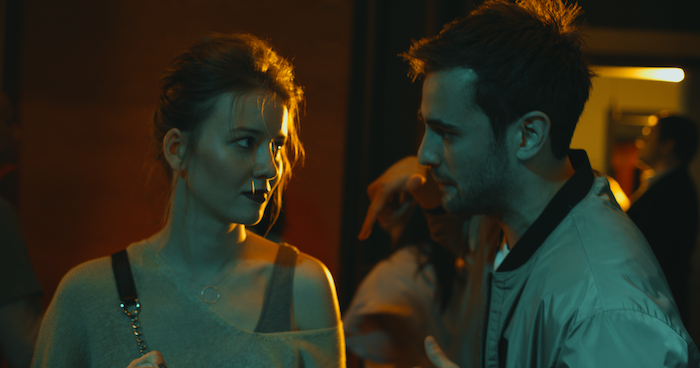
Let’s talk about two projects, both of them cutting edge for a variety of reasons. First, there’s It’s Complicated, a Russian-language young adult interactive miniseries. It’s a multiple-choice story which was actually produced earlier than Black Mirror’s Bandersnatch. What can you tell us about this project, its genesis, and your involvement in it?
Roughly 2 years ago we were approached by Takie Dela (it’s a Russian translation of “so it goes”, Vonnegut’s catchphrase), it’s something like… I dunno, The Guardian — Takie Dela is a very popular Russian-language website/media attached to a charity fund, they cover a variety of social issues and they help raise money for charitable causes. They have several projects on HIV, and they approached us with an idea to do a project about HIV-positive youth. Now, there’s an epidemic going on in Russia, over 2 million HIV-positive people in a country of around 135 million people. The issue for some reason is not very popular with the government, so we people gotta stand up for it.
Okay, so HIV and youth. You can’t report on HIV-positive youth because you will out people, and the topic is not lighthearted, so whatever we could do as a documentary won’t be popular with youth. So we decided — okay, let’s do something lighthearted and interactive, because kids love games, and we as authors, we also play games and we like them. We used our favourite games as references: Oxenfree, Firewatch, Kentucky Route Zero, Life Is Strange. And we came up with an idea to “test” what people know about HIV by presenting them with questions that affect the life of Kate, our HIV-positive protagonist.
Takie Dela did a tremendous job of reaching out to various organizations in Russia that tackle HIV and AIDS, and did a thorough research. We picked up what amounted to a synthesized “study” about Kate, a story of a 20-something HIV-positive girl in Russia being stigmatized, falling in love and trying to live a happy life, and we turned that study into a working script. There were four screenwriters on the project: me and my co-founder, TD’s editor-in-chief and, interestingly, our male lead Rinal who turned out to be a great dialogist. And then we planned it out and shot it.
Here’s a schematic of all the interactive choices of It’s Complicated: https://www.dropbox.com/s/x3j71fp84p12kue/ItsComplicated-GameFlow.png?dl=0

How long was production and post?
April 2017 — first meetings.
May 2017 — we work on the script, it’s 40 minutes long.
June 2017 — we lock the script and we begin shooting.
July 2017 — we’re done shooting.
Aug 2017 — rough cut is done.
Nov 2017 — we’re done but we postpone the release, we mostly add polish to the project.
Feb 2018 — it’s live.
Again, this might look like a crazy schedule, but we’ve had a well-researched study in April of 2017, and we gathered a stellar cast of actors; most of actors of It’s Complicated are A-list celebrities in Russia who were kind and very supportive of the project; we can’t thank them enough; they’ve helped to speed up the production.
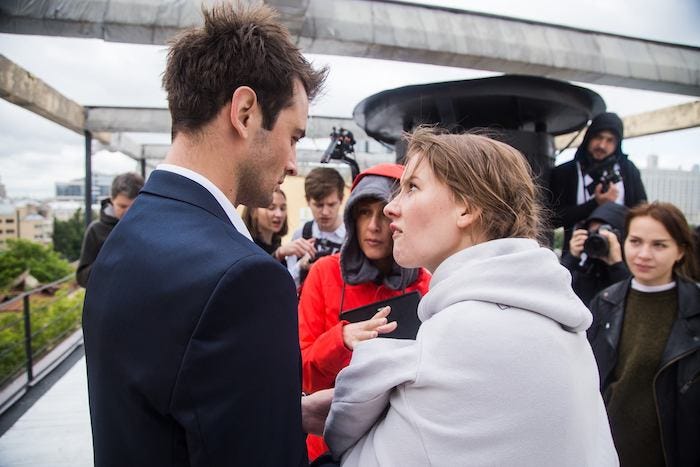
The series was not only an official selection for the Berlin Webfest, it also won the Best Drama Award. That must have been both exciting and gratifying.
Totally. I’d say that what people said of the project on social media was even more exciting and gratifying. People loved it! They pointed out that they are excited to meed their favorite film stars in a very unusual project, they liked their performances, they liked how we tackled the issue, they actually learned a lot about HIV but it almost never felt didactic.
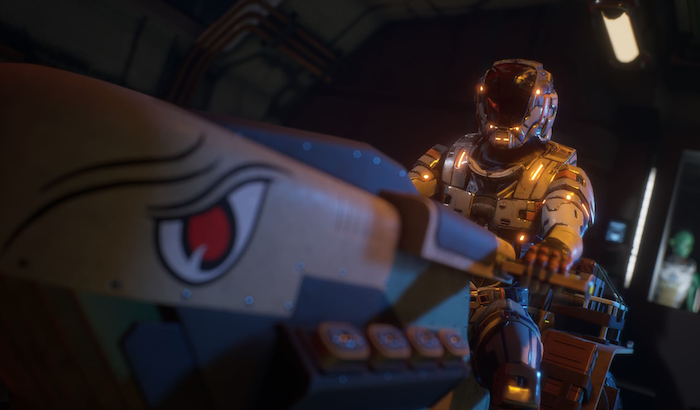
The second project is Kessler Effect, a 30-min “cinematic Virtual Reality” sci-fi thriller. You co-wrote and directed it. What can you tell us about the story and its origin?
It was mid-2018 and I was already involved in Biennale College — Cinema VR, it’s a study programme that is tied to Venice Film Festival in Italy. Cinema VR targets VR projects as VFF is famous for its stellar coverage of VR projects. I think that’s why I was approached by several ambitious guys from Impulse Machine, a local VR startup led by several ad industry vets. They’ve locked in a generous funding for a cinematic VR project, and when I say “generous” I mean that it’s adequate for an international-level project, which is uncommon for Russia. Of course I said yes.
When I jumped on board there was a brief outline of the story and a few characters; Kessler Effects is a 30-min long hybrid of Firefly, Star Trek, and some local humor, because sci-fi as a genre is strong with Russia. I rewrote most of the stuff by using your Narrative Throughline, basically giving each character his/her own story, intertwining them and allowing you as a spectator / player to participate in the bigger picture; you make several choices that ultimately lead to several endings, not all of them are “good”.
What were some of the unique challenges of prepping, shooting, and doing post on a VR film?
Oh, tons!
The project itself is realized in Unreal Engine, that’s what game industry devs use for AAA titles — technically it’s a computer game of sorts, but adapted for VR. VR is very limiting: you can’t “move” camera around, you block your “stage” around the player and allow him/her to experience and influence things. It’s really tough and exciting at the same time to write and direct in VR.
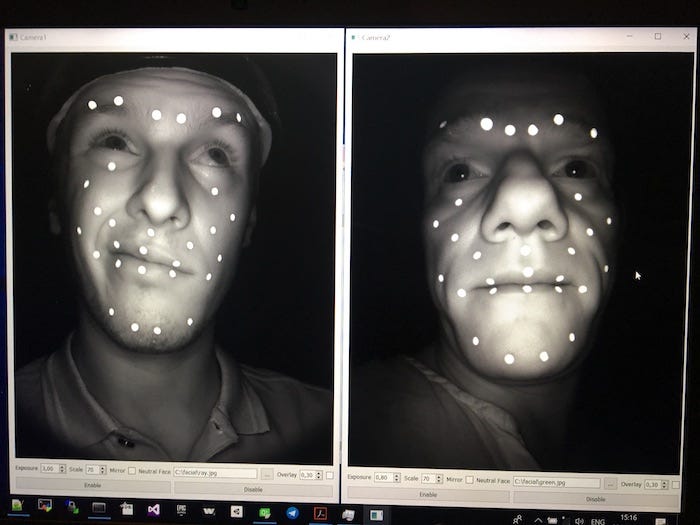
Then I had to direct several layers of performance capture. Bodies — well, body animations we shot at Soyuzmultfilm, which is basically Soviet era Pixar, the biggest animation studio in Russia. They have decades of mocap experience, so we did most of body capture there.
Then we had to record facial performances and voices separately, so we brought in our main talent for that. Irina Starshenbaum was the main lead of It’s Complicated, fans of Russian sci-fi know her as a female lead of Attraction, one of Russia’s biggest blockbusters to date, which was apparently popular in China. Coming from It’s Complicated, Irina already knew how to do interactive stuff. Our male lead Yuri Kolokolnikov is well-known to Western audiences because he played a giant cannibal Styr in Game of Thrones. So yeah, it’s a delight to work with talented and knowledgeable actors that know their craft.
After that there were months of animation interpolation, modelling, rigging, lighting, sound work, you know, the usual gamedev stuff.
Based on your experience with Kessler Effect, where do you think VR goes in relation to cinematic storytelling?
Well… funny thing is, after these projects people asked us to write a textbook on interactive storytelling, so we did exactly that. The book comes out in Russian sometime in August, and it encompasses not only our own experiences with interactive storytelling, but also the experience of our esteemed colleagues from all over the planet. For example, our VR section features thoughts and suggestions from Niantic and Baobab Studios, our immersive theater section features Rimini Protokoll and Ontroerend Goed etc etc. So what I’m saying here is not just my personal observation but a popular opinion from the industry.
“Cinematic”, narrative-driven VR could be somehow compared to modern cinema, but it’s much closely related to immersive theater. I think what we will see in years to come is a very interesting melange of interactive immersive theater, MMORPGs, location-based VR experiences and social VR. The potential for impactful, emotional storytelling in VR and related fields in immense, and largely untapped to date, so I’d say it’s the field to be in coming years.
Oh, and we hope to translate the textbook into English later this year, because we kinda realized that we couldn’t find anything remotely like it on Amazon. I wish we could reach out to Charlie Brooker and several other nigh-unreachable people for the book, but otherwise I think it’s a solid slab of material as it is, and it could be useful to anyone and everyone who want to try and do an interactive film project, because, for example, the process of screenwriting for interactive media is noticeably different. The basic stuff is the same, you still have to make sure that your project, given all your choices, would “unfold” into a proper linear dramatic arc, but on top of that you have to add an entirely different level of complexity.
What’s in the work as far as wider distribution for both It’s Complicated and Kessler Effect?
I think Impulse Machine plan to do several language translations and a Steam adaptation later this year, and It’s Complicated did its round of festivals and is now available for free with English subtitles at https://takiedela.ru/vseslozhno/en
Are you interested in continuing to work in the web series and/or VR space, or do you also have an interest in pursuing more traditional forms of visual storytelling such as feature films and broadcast or streaming television?
This year we’re doing two longer-form interactive web-series, both are much more complex and ambitious than It’s Complicated and I dare say even Bandersnatch, and we’re slowly developing two narrative VR projects and one theatre/VR hybrid. Bandersnatch really boosted the appeal of interactive film-like projects, that’s for sure, but, alas, VR is much harder to finance than interactive web series, at least in Russia, so time will tell how that’ll go.
We’d also love to do a proper microbudget sci-fi feature film, but that’s in the works for 2020.
We’d really love to do more interactive stuff for wider audiences, that’s for sure. I hope someday our projects might end up on Netflix, at least we’re planning around the possibility to be distributed on interactive platforms.
Back in 2017, you took all eight of the Craft classes I offer through Screenwriting Master Class and you told me it was an “inflection point in my career.” Obviously, I’m happy to hear that, but I’m curious in what ways that content benefited you as a create and professional filmmaker.
Oh, wow. Well, first of all, I can’t thank you enough for CRAFT! When I picked up CRAFT in 2017, I was trying to come up with my first VR story, I was an adequate filmmaker at that point in time but what I lacked was subtlety. What CRAFT did for me, and what you did for me and many others on the course is you helped us to really dig deeper into ourselves and find more facets and aspects to the craft itself and to us as storytellers. I saw screenplays and stories in black and white, and I left the course seeing in Technicolor. That’s just tremendous.
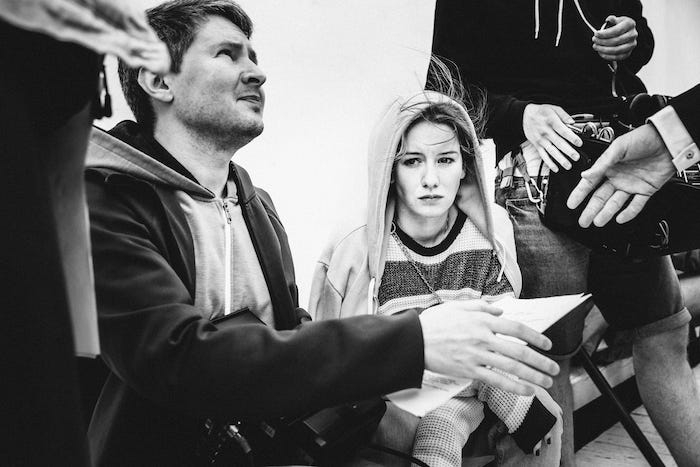
Finally, what advice do you have for aspiring screenwriters and filmmakers, especially those who do not live in the United States and are trying to make their way in their home country such as you have in Russia.
Learn English if it’s not your mother tongue. Pick up screenwriting even if you don’t intend to (actively) write; it’ll positively impact your career as a producer, director, basically every other role in film and TV. Learn to work fast and on a tight budget. Experiment. Do something for a good cause.
I concur with every point Anton makes relative to his advice to aspiring filmmakers, specifically learning to work fast and on a tight budget. There’s a special kind of creativity which emerges when you work with those type of constraints.
You can watch the first episode of It’s Complicated, test out various choices, and see where they lead by going here [Russian language with subtitles].
Continued best of luck, Anton!
You can read 100s more Go Into The Story interviews with screenwriters, TV writers, filmmakers, and Hollywood insiders here.