Interview: Alli Haapasalo
A conversation with the director of Girl Picture, winner of the Audience Award for World Dramatic Competition at the 2022 Sundance Film…
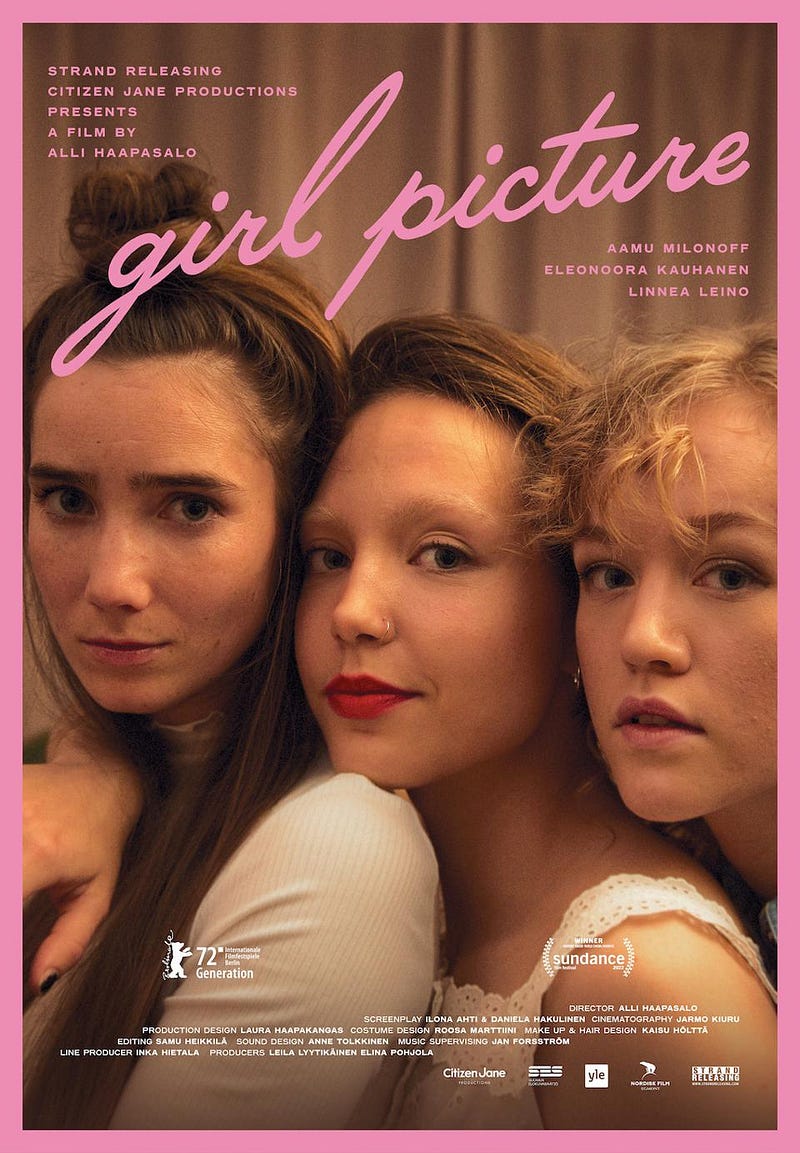
A conversation with the director of Girl Picture, winner of the Audience Award for World Dramatic Competition at the 2022 Sundance Film Festival.
Girl Picture was my favorite movie at the 2022 Sundance Film Festival. It goes into limited release this weekend and I highly recommend it.
Normally, I feature interviews with a movie’s screenwriter(s), however I could not fine one for Girl Picture, co-written by Ilona Ahti and Daniela Hakulinen. But I did discover an interview in Forbes magazine online with the film’s director Alli Haapasalo and she spends a considerable amount of time in the conversation discussing the writers and the story’s evolution over time. Here are some excerpts.
Risa Sarachan: What drew you to this project?
Alli Haapasalo: Screenwriters Ilona Ahti and Daniela Hakulinen approached me with a treatment in 2014. Their idea for a story of adolescent girls with a condensed time frame immediately felt relatable and modern. We were all frustrated about how few girl characters we had been able to identify with growing up. I got very excited about the opportunity to take a stab at redefining the representation of young women on the big screen.
The script went through a long development process, during which time not only did the screenplay change, but also we changed and the world around us changed. A conversation about whose stories we are telling, and who gets to tell them, strengthened. We all had to acknowledge and deconstruct unconscious bias — and when I say we, I mean the whole Finnish film industry, and that includes us, the creators of this film. Starting with the question of what kind of story about girls is “big enough” or “important” to put on the big screen. We wanted to not get too plot-driven, keep the story on the skin and allow time to focus on the intimate experiences of seventeen to eighteen-year-old girls. My biggest motivation was to try to be very realistic and truthful.
Sarachan: What was your casting process?
Haapasalo: The script was exceptional in the sense that it had no definition of these girls’ habitus — throughout the writing process, we were always focused on their actions, not what they looked like. So moving from the page to real people, I got to start with a totally open mind. I deliberately took casting slowly in order to allow time for the conversation that happens between the script, the directorial vision and the talented actors at auditions. I wasn’t just looking for three great and charismatic actors, but really I was looking for a trio that would play together seamlessly. I also wanted a cast who was willing to dedicate themselves fully and feel ownership for their characters.
— —
Sarachan: It was refreshing to watch three women unapologetically explore their sexuality. What was important for you and the team to get right about capturing those experiences?
Haapasalo: I really wanted to show sexuality as something that’s very natural, both beautiful and problematic, a human and an animal need that belongs to everybody. Female desire and female pleasure should be something that we can look at without shock, judgment or fetishizing. We are used to seeing women as objects of desire in countless films. But even when women are subjects, they very often end up having a punishment for exactly that, being a subject. Being active, having desire, or even simply trying to figure these things out often leads female characters to danger. We didn’t want to enforce the stereotype of a girl as a victim, so we quite simply removed all threats and dangers. Mimmi, Emma and Rönkkö explore their identities and sexualities without ever becoming belittled, shamed, patronized or victimized. The same goes for queer representation. Heterosexual couples enjoy an enormous privilege in not needing to answer anyone’s questions (or worse) about their sexuality. We wanted the relationship of Mimmi and Emma to have that same privilege, so their sexual orientation is not brought up once, nor is it an issue for anyone around them.
I don’t want to question the importance of coming out stories, but I think that mainstream film should be ready for queer characters who represent themselves as individuals and not just as characters of sexual identities. As for Rönkkö’s story arch, it is left open whether her not feeling pleasure is about asexuality or about her not having found what she likes yet. I don’t want to give away the ending of her quest for pleasure, but I promise that it’s unlikely to be the one you’d expect.
Here is a trailer for Girl Picture:
For the rest of the Forbes interview, go here.
The movie has an interesting structure: It all takes place in three consecutive Friday nights. The story, characters, acting, and directing are excellent.
For 100s more interviews with screenwriters, TV writers, and filmmakers, go here.