Humanize Your Nemesis
We don’t need to sympathize with an Antagonist, but it we empathize with them, that makes for a more compelling character.
We don’t need to sympathize with an Antagonist, but it we empathize with them, that makes for a more compelling character.
If you craft a Nemesis who has human qualities with which a script reader can identify, in effect you put that character in closer proximity psychologically to the reader.
Thus, as opposed to keeping our distance from the Nemesis because they feel somehow less than human, now that we can identify with the character, connected by whatever aspects of personhood we share, we can no longer just push them away, rather they evolve in our experience into someone with whom we can relate, even identify.
One way of thinking about this is through the paradigm presented by the 20th century Jewish philosopher Martin Buber. His most notable book is “Ich und Du,” usually translated “I and Thou”. Buber asserted we encounter existence in two ways:
- That of the “I” towards an “It”, an object separate in itself, which we either use or experience.
- That of the “I” towards “Thou”, in which we move into existence in a relationship without bounds.
Transplanted into our discussion of the reader’s experience of a Nemesis, if the character is merely a one-dimensional caricature, then we relate to it as I-It, person-to-object.
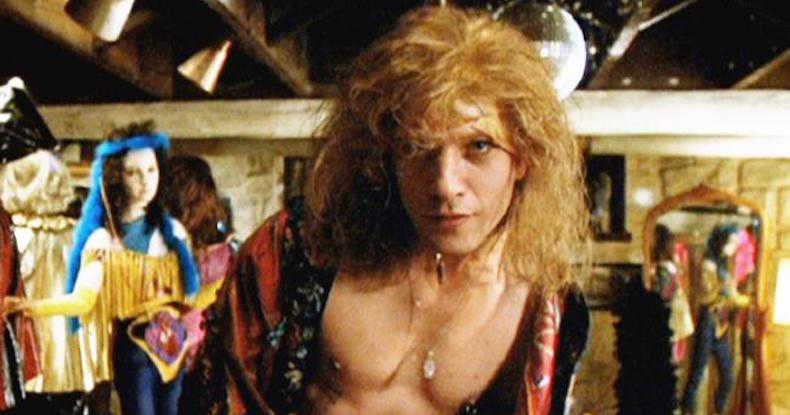
A great movie example is this unforgettable in The Silence of the Lambs where Buffalo Bill instructs kidnap victim Catherine Martin to rub lotion onto her skin:
BUFFALO BILL
It rubs the lotion on its skin, it does
this whenever it’s told.
It rubs the lotion on its skin or else
it gets the hose again.
Now it places the lotion in the basket.
It places the lotion in the basket.
Put the fucking lotion in the basket!
By referring to Catherine Martin as an It, Buffalo Bill manages to distance himself from her, dehumanizing the victim. In fact, this is a trait among many serial killers.
If, on the other hand, when reading a story we discover that the Nemesis has some genuine human qualities with which we can identify, then we move into an I-Thou [I-You] plane, person-to-person.
This creates tension, even conflict in the reader. The Nemesis may be a Bad Guy, yet we can’t help but feel some fundamental human connection to them. That is a much more compelling reading experience than simply boxing up the character as a stereotype.
As a corollary, consider how in Hollywood development circles, there is an obsession with creating sympathetic Protagonists. The conventional wisdom is this is critically important in order to lock down the character as a rooting interest for an audience.
While this is not the case with Nemeses, one way to craft a worthy foe is by surfacing what aspects of the character elicit empathy in a reader.
While sympathy and empathy may seem like the same thing, in the context of character development, they are not:
- Sympathy: Harmony of or agreement in feeling, as between persons or on the part of one person with respect to another.
- Empathy: Identification with or vicarious experiencing of the feelings, thoughts, or attitudes of another.
Sympathy = Agreement.
Empathy = Identification.
We do not need to sympathize with a Nemesis, that is agree with what they believe and how they act, but we can empathize with them, identify with some human quality.
Consider some well-known Nemesis figures in movie:
- Broken: Mr. Potter [It’s a Wonderful Life / wheelchair bound], Darth Vader [Star Wars / disfigured], Joker [The Dark Knight / scarred]
- Lonely: The Wicked Witch of the West [The Wizard of Oz], Nurse Ratched [One Flew Over the Cuckoo’s Nest], Alex Forrest [Fatal Attraction]
- Jealous: Helen [Bridesmaids], Annie Wilkes [Misery], John Doe [Se7en]
- Greedy: Gordon Gekko [Wall Street], Noah Cross [Chinatown], Hans Gruber [Die Hard]
We can all relate to feeling broken… lonely… jealous… greedy.
And what of the psychopath Buffalo Bill in the movie The Silence of the Lambs? He is convinced he needs to change, specifically switch genders from male to female. Unfortunately for him, he has been turned down by the three sex-change centers available at that time. Hence, his kidnapping-sewing-a-female-body-suit plan. It definitely is pathological, but it is grounded in a human desire we all share: To change, to be better versions of ourselves.
Who among us hasn’t fantasized about who we would like to be? So does Buffalo Bill as this scene here:
That final image with the long hair, his penis stuck between his legs so he resembles a female represents who Buffalo Bill wants to become. Yes, he’s a psychopath, but again, the desire to change is something we can empathize with.
We may not agree with these characters and their goals, but these emotions or psyche states are universal, something each of us has doubtless experienced at one time or other in our lives. No matter how small, this enables us to empathize with these Nemeses. And when this happens, we can not help but be pulled into their world and world view. Even if only a little bit, this makes for a much more dynamic experience for a script reader.