How to Write a Marketable Screenplay: Part 2 (Character)
Tips from a presentation at the Pittsburgh Shorts Filmmaker Conference.
How to Write a Marketable Screenplay
Tips from a presentation at the Pittsburgh Shorts Filmmaker Conference.

I was invited by the fine folks who oversee the Pittsburgh Shorts Film Festival to speak at their inaugural Filmmaker Conference. The subject they requested I cover: How to Write a Marketable Screenplay. I focused my comments on three areas: Concept. Character. Voice.
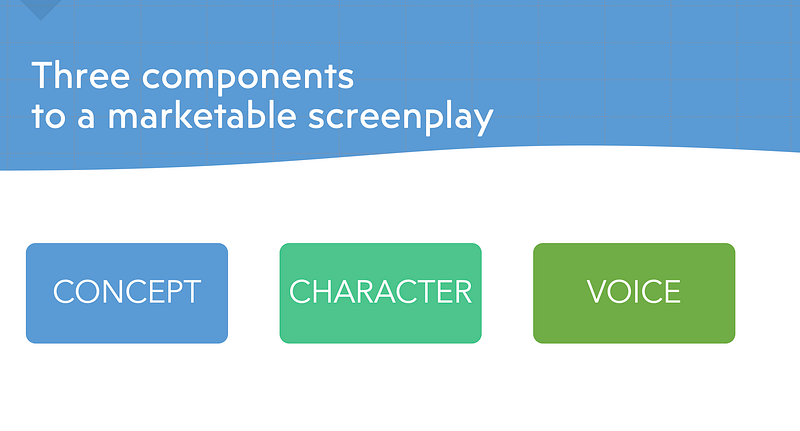
I thought I’d share highlights from my presentation. Today: Character. Specifically, Character-Driven Screenwriting and Storytelling.

If this sounds familiar, it is. I spent nearly two years (and many years before that in research) writing a book: The Protagonist’s Journey: An Introduction to Character-Driven Screenwriting and Storytelling. It will be published in the next few months.
I have a colleague at DePaul University (Brad Riddell) who says this about screenplays: “They are actor bait.”

Unless you’re writing a $200M franchise movie in which spectacle is the star, what you as a screenwriter are hoping for is to get actors interested in your project. And you do that by writing a great script with characters actors want to play.
This is especially true in the indie film world. Having a name actor attached to your project is often an early step in being able to secure funding for the movie.
Of all the characters in your story, the single most important one is…
Of all the characters in a story, there is one which rises above the others, whose importance is so great that they demand a writer’s immediate and sustained attention. That character is the Protagonist. Their Journey is the foundation of a story. Hero or antihero. Underdog or overlord. Lone figure or multiple accomplices. The role of the Protagonist is of such influence, it touches all aspects of the unfolding narrative.
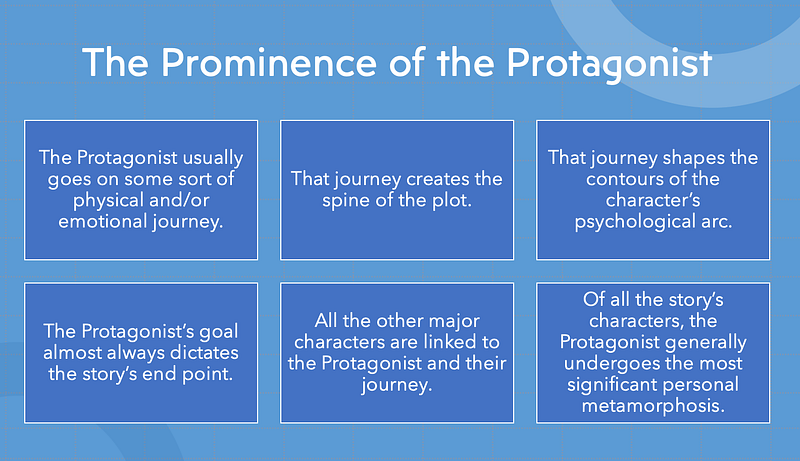
Plus there’s this…
Symbolically, the Protagonist functions as you, often imbued with universal human qualities to maximize the character’s reach to the widest possible audience. Your goal?
Create a compelling Protagonist.
A Protagonist an actor will want to play. A Protagonist who will engage a manager, agent, producer, or development executive. A Protagonist who an audience will want to see.
How to do that?
Over the last twelve years, I have taught a six-week workshop called Prep: From Concept to Outline. It was the very first class I created when I launched my unique online educational platform ScreenwritingMasterClass.com. I have road-tested this approach to breaking story with over 1,000 writers. It has proved hugely successful.
In fact, just the other day, a writer who had taken my prep workshop tweeted this.
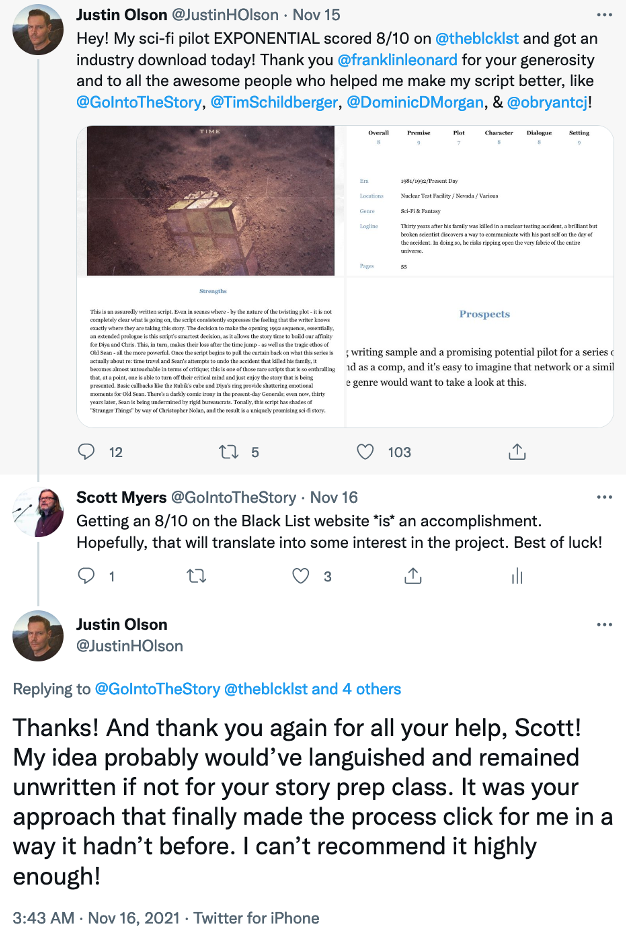
I devote the entirety of Part III of my book The Protagonist’s Journey to this approach to story prep. It begins with a Protagonist Character Treatment in which a writer uses eight foundational questions to delve into this central character’s psychological journey — their metamorphosis.
Metamorphosis. Transformation. Whatever you want to call it, a Protagonist almost always goes through some sort of psychological change.
In fact, Joseph Campbell whose book The Hero with a Thousand Faces proposed the idea of the hero’s journey — one story which is universally shared throughout the world and all of human history — Campbell said that the entire point of the hero’s journey is transformation.
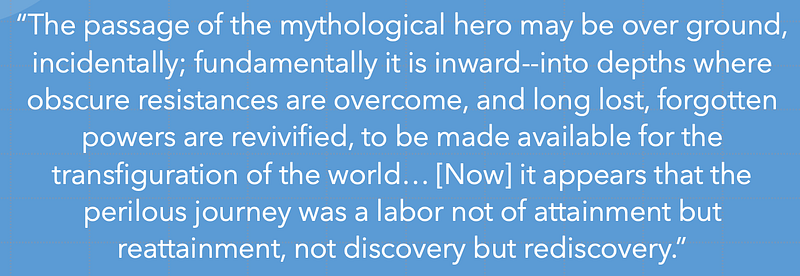
That process of reattainment, of rediscovery lies at the heart of the most prominent narrative archetype in all of storytelling… the Unity Arc. Where the Protagonist experiences a psychological journey leading them from a disconnection from their authentic life toward a state of wholeness.
This is my language system, one I explore to great depth in my book The Protagonist’s Journey.

At the story’s beginning, the Protagonist is living in their ordinary world, a place they have inhabited for some time, what writers refer to as backstory. The Protagonist has developed habits and attitudes, they have a personal history and their own distinctive world view. But from a writer’s perspective and in almost all cases, the story would not be worth telling were it not for this simple fact: the Protagonist is going to change. Hence movement — psychological, emotional, spiritual — is implied in a story from the very beginning.
Sometimes the Protagonist is conscious of their desire for change; other times, they are unaware of it. But in almost every story, the Protagonist starts off in a state of Disunity: they are living their life one way, when they should be living it differently.
The Protagonist is living an inauthentic life. They are just making do and whether they realize it or not… they need to change.
As the meme goes: “Your current situation is not your final destination.”

Something happens which transitions the Protagonist out of the ordinary world, thrusting them into what Joseph Campbell calls the “world of adventure.” At first, the Protagonist is a stranger in a strange land — new faces, places, rules. They try using the methods they have learned in the ordinary world — their Old Ways of Being — but they find their old ways don’t cut it in this new environment. The onslaught of events assaults the Protagonist, physically, psychologically, or both, and causes them to start abandoning their old ways. Although this may be experienced as a negative, the effect of these events allows the Protagonist to get in touch with their authentic nature. I call this movement Deconstruction.
Their old ways of being are found wanting in the new world and the Protagonist sheds them in their journey.

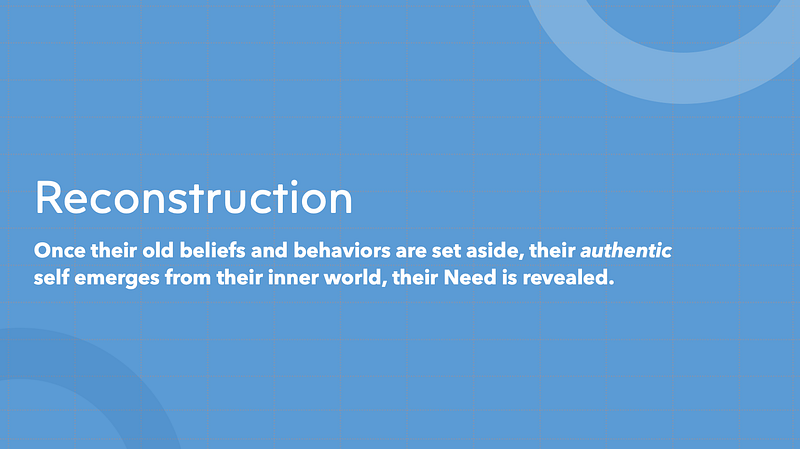
Something significant happens around the story’s midpoint where the Protagonist finally sets aside their old behaviors, relying more and more on what they are discovering within their Self. As they do, they usually release a heretofore untapped reservoir of innate power, previously repressed in their old way of living. Events happen which test them and give the Protagonist opportunities to practice using their newfound power and knowledge. As a result, the flow shifts, not so much events against the Protagonist causing them to react, but rather the Protagonist becoming proactive. I call this movement Reconstruction.
Once their old beliefs and behaviors are set aside, their authentic self emerges from their inner world, their Need is revealed.
A story usually culminates in a big test to determine if what the Protagonist has learned along the way has taken hold or not. If the Protagonist succeeds in this Final Struggle, typically against a Nemesis, they do so in large part because of the merging of the their want and need, resulting in their end state: Unity.
As the Protagonist connects with their true nature, they move toward a state of wholeness.

The interesting thing is the Protagonist does not go on this journey alone. As compelling as their metamorphosis is, it occurs within the context of a series of relationships, what I call…

This group of characters serves and supports the Protagonist’s metamorphosis, each with a specific function.

Protagonist: forward moving dynamic toward a goal
Nemesis: oppositional energy
Attractor: character most connected to the Protagonist’s emotional growth
Mentor: character most connected to the Protagonist’s intellectual growth
Trickster: shapeshifter, tests the will of the Protagonist
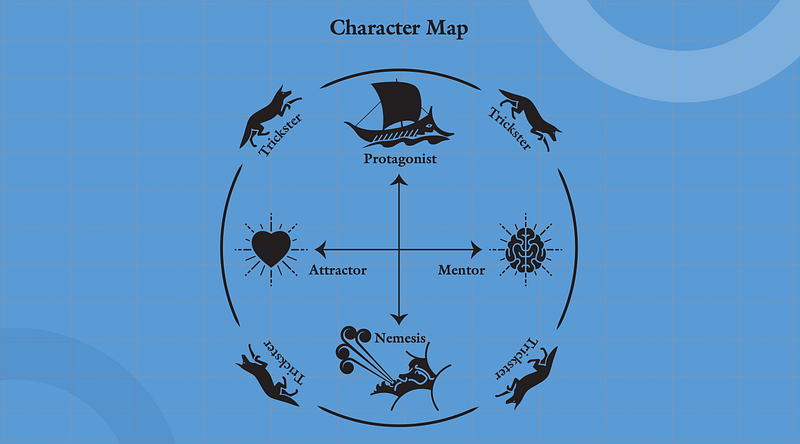
This is a visual representation, a kind of map of character relationships. And you see they are all tied to the Protagonist.
Protagonist-Nemesis
Existential Connection: Who are you?
Protagonist-Attractor-Mentor
Behavioral Connection: How are you?
Protagonist-Trickster
Testing Connection: What are you?
In my book The Protagonist’s Journey, I analyze dozens of movies and television series including The Silence of the Lambs, Spider-Man: Into the Spider-Verse, Casablanca, The Wizard of Oz, The Apartment, Breaking Bad, Killing Eve, and on and on and on. There seems to be a pattern of these five character archetypes and their interrelationships as they support the Protagonist’s journey from Disunity to Unity.
That’s all fine theoretically, but pragmatically, how can a writer develop characters so they are compelling, distinctive, and multilayered figures? In my story prep workshop, we use six character development exercises.
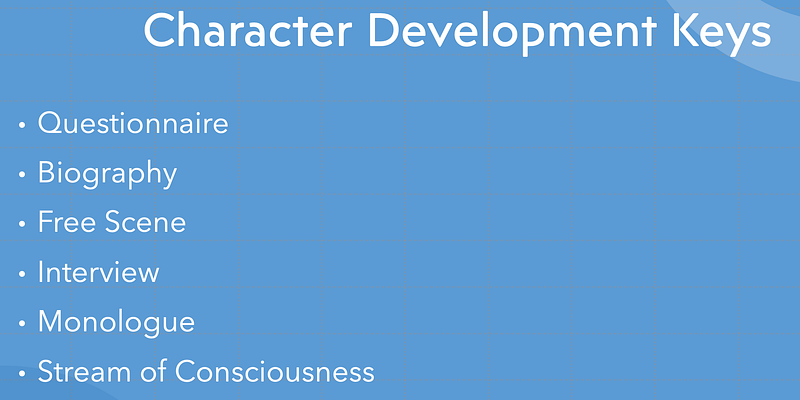
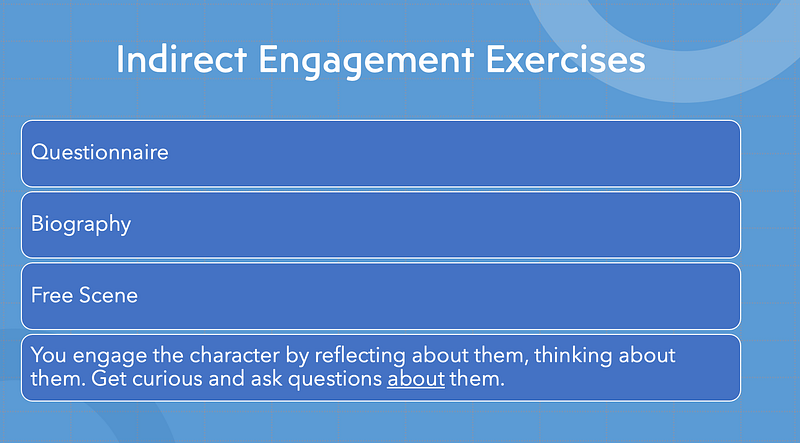
The first three are what I call Indirect Engagement Exercises (Questionnaire, Biography, Free Scene) in which the writer engages the character by reflecting about them, thinking about them.
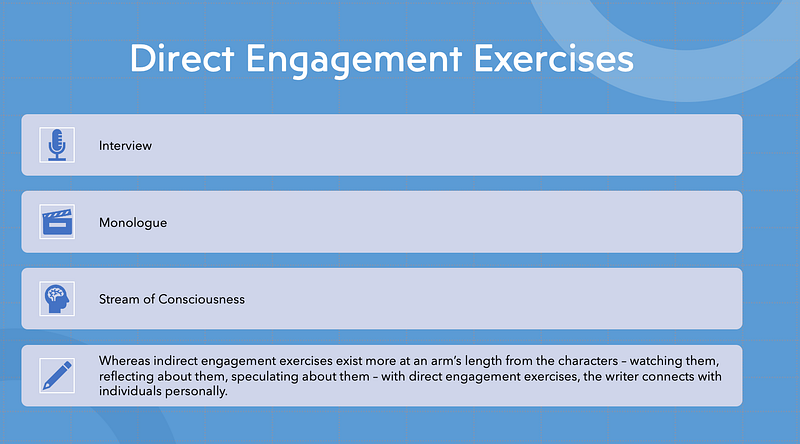
The next three are what I call Direct Engagement Exercises (Interview, Monologue, Stream of Consciousness) in which the writer connects with the character personally.
Since 1987 when the spec script K-9, which I co-write, sold to Universal Studios, going on to become a hit movie with two sequels, I have written over thirty film and television projects for nearly every major Hollywood studio and broadcast network. Through my blog GoIntoTheStory.com, named Best of the Best Scriptwriting Website by Writers’ Digest, I have interviewed hundreds of professionals in the film and television business and interfaced with thousands of writers. After teaching screenwriting as a hobby since 2002, I am now an assistant professor at the film school at DePaul University. During that time, I have taught countless writers from beginners to advanced, undergraduate and graduate students. Based upon my experience as a writer and educator, here is what I have discovered: The best writing is character-driven writing.
For the first part of my presentation How to Write a Marketable Screenplay where I focused on Concept, go here.
The third and final part of my presentation was on Voice. If you’re interested in seeing an overview of that content, let me know in comments. If enough folks speak up, I’ll see about picking up on that subject.