How to Use Dashes and Ellipses in a Screenplay
Examples from movie scripts demonstrate these two tiny forms of punctuation can be a valuable asset for a screenwriter.
Examples from movie scripts demonstrate these two tiny forms of punctuation can be a valuable asset for a screenwriter.
In my work as an assistant professor at the DePaul University School of Cinematic Arts, I get asked a lot of screenwriting questions by my students. The other day, this subject came up:
Are there any rules about using dashes and ellipses?
I led with my usual caveat: There are no screenwriting rules. If there were, there would be a rule book.
In my ensuing conversation with this student, it occurred to me I don’t think I’ve ever written a Go Into The Story article on the subject, perhaps because it’s such a seemingly innocuous aspect of writing a screenplay.
However, each day at 9:20AM (Central), I tweet the first page of a notable movie script along with the title of the movie, the year it was released, and the names of the screenwriters. Example:
In reviewing dozens of scripts these last few months I’ve been running the series, I noticed how many ways writers use dashes and ellipses in their writing. So here are examples of how to use these forms of punctuation.
ELLIPSIS
One of the most common uses of an ellipsis is to indicate a pause in dialogue as with this from the screenplay (500) Days of Summer, written by Scott Neustadter and Michael H. Weber:
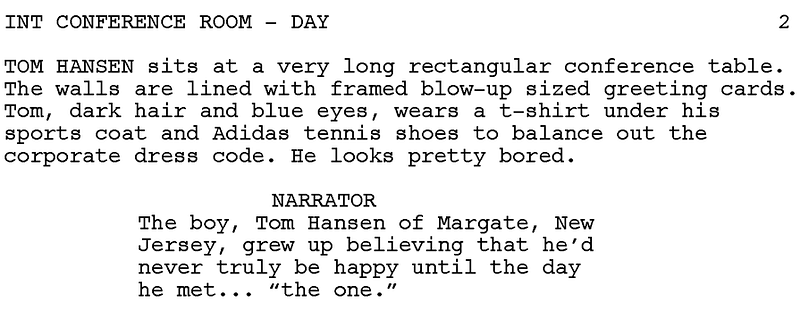
The pause there to set off and indicate the importance of “the one.”
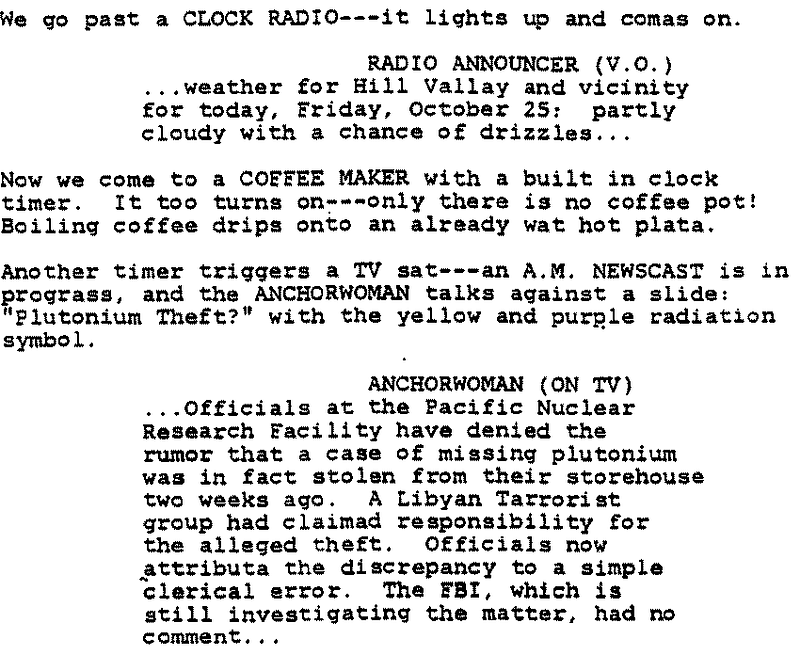
You can use ellipses to signal to the reader that a character’s dialogue drifts off or a character’s dialogue begins in mid-sentence. Here are examples from the screenplay for Back to the Future, written by Robert Zemeckis and Bob Gale:
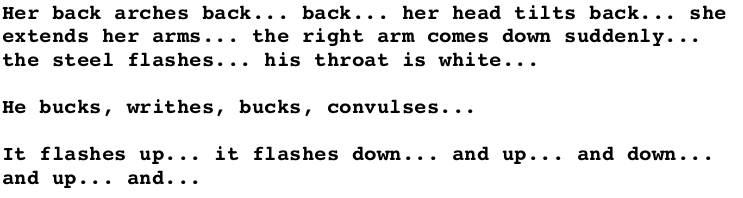
Many screenwriters use ellipses in scene description as well to suggest movement. An example is the screenplay for Basic Instinct written by Joe Eszterhas, the opening scene in which a woman in mid-sex with a man murders him:
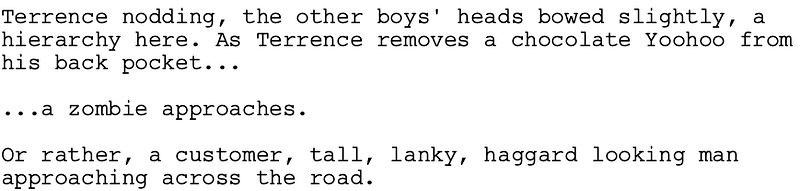
Some writers use ellipses in scene description to suggest camera shots without using directing jargon as here in the screenplay Moonlight, screenplay by Barry Jenkins, story by Tarell Alvin McCraney:
DASH
Some screenwriters use dashes to convey the same thing as ellipses. For example, here is a pause from the screenplay for Chinatown, written by Robert Towne:

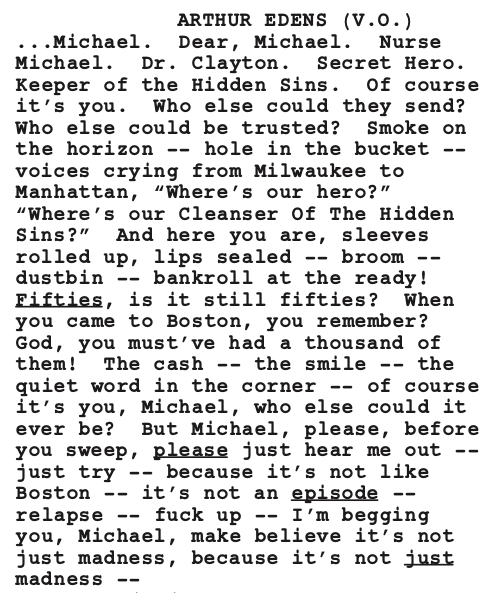
Note how the dashes in the opening monologue from Michael Clayton, written by Tony Gilroy, indicate a character interrupting themselves and changing to another line of thought:
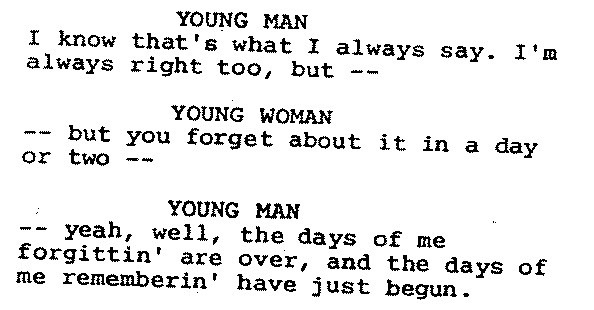
In Pulp Fiction, Quentin Tarantino uses double dashes to indicate one character interrupting another, even finishing their thought:
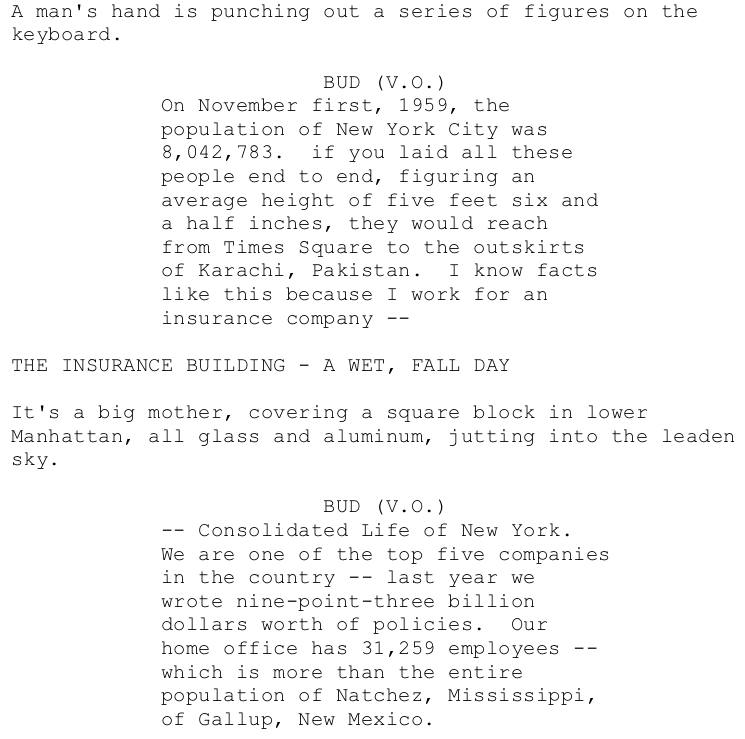
We can use double dashes to denote when a side of dialogue is ‘interrupted’ by lines of scene description, it continues over the scene description, then is ‘picked up’ in the next side of dialogue. An example from the opening page of The Apartment, written by Billy Wilder and I.A.L. Diamond:
We can also use dashes in scene description. In Out of Sight, screenwriter Scott Frank uses double dashes to set off a thumbnail sketch of the Protagonist when he is introduced:

In JoJo Rabbit, screenplay by Taika Waititi, novel by Christine Leunens, Waititi uses a single dash to suggest a quick series of camera close-ups:
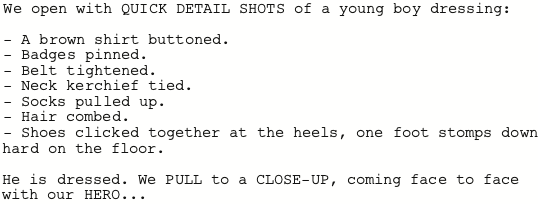
It’s pretty standard to use a single or double dash when writing a montage or series of shots.
As you see, there are plenty of uses of these two forms of punctuation and no official rule of law about how to use them. Two pieces of advice:
- Read movie scripts. Lots of them. As part of your analysis, study how various writers use punctuation, then play around with it in your own writing.
- Over time, your goal should be simple: Be consistent. Use ellipses for these purposes and dashes for these purposes.
This type of punctuation in dialogue and scene description may seem like a small thing, but used well, it can contribute the pace and flow of the page.
Do you have some other examples of how to use ellipses and dashes? Click RESPONSE and hit me up in comments.
Finally, if you’re on Twitter, make sure you follow me there as I tweet there several times per day: :(@GoIntoTheStory).