How To Read A Screenplay (Part 6): Themes
There are multiple layers to any story. The more you dig, the deeper your understanding.

There are multiple layers to any story. The more you dig, the deeper your understanding.
I can’t remember exactly how this subject came up on the blog, but it did, and when I asked whether people would like to explore how to read and analyze a screenplay, the response was quite positive. So here we are with yet another GITS series on screenwriting.
Let me be clear up front: I am not suggesting you have to read scripts precisely this way. Nor am I saying if you choose to use this overall approach that you do so in the order presented. These are not steps so much as they are analytical tools which you can use any way you see fit.
I begin with this supposition: There are multiple layers to any story. The more you dig, the deeper your understanding. Moreover there is a special kind of learning you can experience only by cracking open a story and exploring its many moving parts, a knowledge that settles into your gut where you start to develop an innate sense of what works and what doesn’t. From the standpoint of being a professional screenwriter, when often you are working against a ticking clock, either to assess a story and come up with a take to pitch, or do a writing assignment, having that internal sense of story is critical to your success as it can help you feel your way through the process.
So at the very least, I would encourage you to try out these approaches I will be detailing in this series to see if and how they fit with your own writing sensibilities. Look at each as a different ‘lens’ through which you can examine a story, providing a unique perspective and insight into the overall narrative.
Note: This series is not in any way, shape or form an attempt to train people how to be a professional script reader. They have their own approach and I am almost positive would not have nearly the time to go through as many steps as I’m suggesting here. Rather this is for writers who want to learn their craft better.
Today, Part 6: Themes.
My take on theme is comprised of two major points: (1) Theme = Meaning. Theme is the glue that binds together a story and gives it meaning. (2) A story will have multiple themes.
So theme is not just the moral of the story, the story’s premise, or its proposition, but rather the narrative dynamics tied to the psychological impact of what transpires in every event and every scene.
It is critical for a writer to understand, at least in part, the themes in their own stories. One of the best ways to learn how to do that is read screenplays, analyzing them to see how the writers use themes and how themes emerge in the context of the narrative.
For purposes of script analysis, I zero in on two types of themes: The central theme [the overriding meaning of the story] and sub-themes [a specific aspect or variation of the central theme that sheds a distinctive light on the narrative’s significance].
So for example in The Silence of the Lambs, we might say that its central theme is this: To silence the nightmare of the past, Clarice must confront it. Some sub-themes would be: (1) Death — its power to inflict pain [the murder of Clarice’s father]; its power to provide redemption [the killing of Buffalo bill]. (2) Transformation — Buffalo Bill seeks to become a woman (i.e., his obsession with moths, sewing a female body suit made out of his victim’s skin, dressing like a woman); Clarice seeks to resolve the guilt she feels about her father’s death and become a whole person.
Continuing with our analysis of the movie Up, how would we go about surfacing its themes? It’s always a good idea to start with the Protagonist, so let’s look at Carl and in particular the nature of his metamorphosis. In the beginning, after the death of his beloved wife Ellie, Carl basically exists in a lifeless state. Think about that word: Life. Less. By the end, he is full of life and enjoying himself. Indeed, there are two images in the script involving food that provide visual bookends to his transformation. The beginning:
The end:
What is the difference? In the first, Carl eats alone at his kitchen table. In the second, he is joined by Russell and Dug, sharing ice cream together.
Thus, we can see that in one way, Carl’s metamorphosis is about finding connections. We might typify the story’s central theme as this: In order to find new life, Carl needs to open himself up to the possibilities life offers.
Indeed in my interview with Mary Coleman, head of Pixar’s story department, we discussed this very point:
SM: We see that point of personal connection in Up very profoundly, don’t we? We start off with Carl as a boy, meeting young Ellie, then losing her in that poignant sequence of their married life together. And having experienced the loss of Ellie, Carl is almost ‘life-less,’ left to string out the remaining days of his life. Then he goes on this big journey to South America, accompanied by Russell, who is an adventurer and full of life. And here again, strange sojourners — an old man fading from life, a young boy full of life. Yet each has their own shadow: Carl who has a void where Ellie used to be, Russell who has a void where his father used to be. Those internal dynamics push the pair as they go on their external journey, all the while overcoming obstacles and over time forming a connection. And per this idea of the philosophical stakes, for Carl isn’t it finally a story of resurrection?
MC: Absolutely. Carl has been living the past, not even living, just biding his time until he dies and joins Ellie. He stopped living when she died. So yes, it’s a rebirth story because by the end he’s able to have a new relationship in the present. And it’s sweet because while the primary relationship is with Russell, by accepting the unconditional love of the dog Doug, letting him come in, jump on him, and be his dog, you’ve got a satisfying B-plot of another present-tense relationship.
We could even shorthand the central theme of Up as being about resurrection.
But what about sub-themes? One of the best ways I know to explore a story’s multiple themes is by examining its subplots. Remember how in this post, I identified Up’s subplots? Each of them, as we noted, is comprised of a relationship (e.g., Carl-Ellie, Carl-Real Estate Developer, Carl-Russell, Russell-Kevin). Since each subplot offers a slightly different access point to a story’s Themeline, it make sense that a subplot can provide a sub-theme related to the story’s central theme.
Picking up on Mary Coleman’s point about Dug — “accepting the unconditional love of the dog Dug, letting him come in, jump on him, and be his dog, you’ve got a satisfying B-plot of another present-tense relationship” — there you have a sub-theme: Dug shows Carl the meaning of unconditional love.
Remember this moment when Dug first intersects with Carl and Russell [P. 46]: “I have just met you and I love you.”
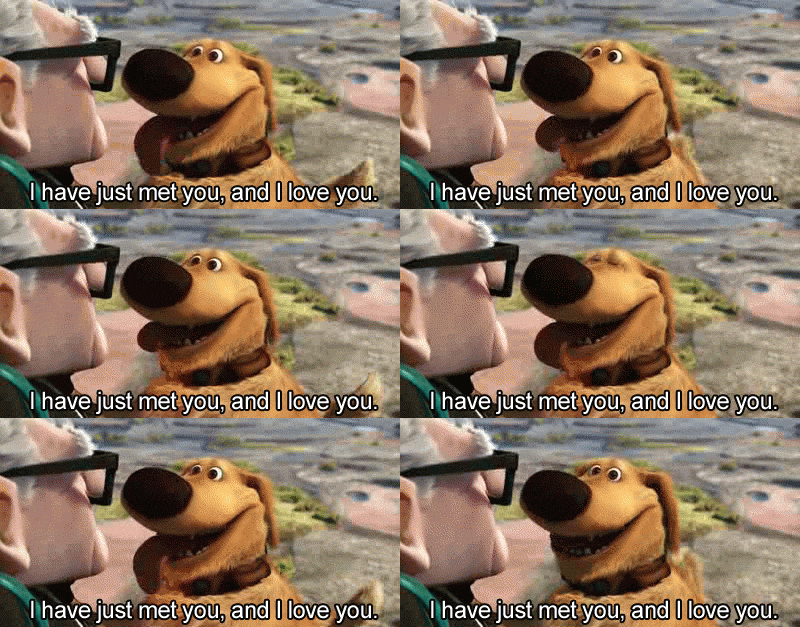
That is the essence of unconditional love. Which is why I think Dug functions as a Mentor, conveying to Carl two important lessons: (1) The ability to be open to connection with another being. (2) The joy of giving and receiving love. Carl needs to learn both of these things in order to move out of his Life-Less state, where he has been so attached to Ellie, he can’t move on. And what better way to physicalize the reality of unconditional love than a slobbering dog full of boundless ardor for his newfound Master?
Themes represent another lens through which we can read and analyze a screenplay. The more we learn about them and see how they work in the context of many scripts, the more we can bring that understanding to our own writing.
Reminder: This is just one approach to analyzing a screenplay. Everyone is different and has different needs, either personally or per project. If you resonate with any ideas here, feel free to use. If not, feel free to lose.
For Part 1: The First Pass, go here.
For Part 2: The Scene-By-Scene Breakdown, go here.
For Part 3: Plotline Points and Sequences, go here.
For Part 4: Subplots, Relationships and Character Functions, go here.
For Part 5: Metamorphosis, go here.
Upcoming post:
Part 7: Style and Language