How To Read A Screenplay (Part 5): Metamorphosis
There are multiple layers to any story. The more you dig, the deeper your understanding.
There are multiple layers to any story. The more you dig, the deeper your understanding.
I can’t remember exactly how this subject came up on the blog, but it did, and when I asked whether people would like to explore how to read and analyze a screenplay, the response was quite positive. So here we are with yet another Go Into The Story series on screenwriting.
Let me be clear up front: I am not suggesting you have to read scripts precisely this way. Nor am I saying if you choose to use this overall approach that you do so in the order presented. These are not steps so much as they are analytical tools which you can use any way you see fit.
I begin with this supposition: There are multiple layers to any story. The more you dig, the deeper your understanding. Moreover there is a special kind of learning you can experience only by cracking open a story and exploring its many moving parts, a knowledge that settles into your gut where you start to develop an innate sense of what works and what doesn’t. From the standpoint of being a professional screenwriter, when often you are working against a ticking clock, either to assess a story and come up with a take to pitch, or do a writing assignment, having that internal sense of story is critical to your success as it can help you feel your way through the process.
So at the very least, I would encourage you to try out these approaches I will be detailing in this series to see if and how they fit with your own writing sensibilities. Look at each as a different ‘lens’ through which you can examine a story, providing a unique perspective and insight into the overall narrative.
Note: This series is not in any way, shape or form an attempt to train people how to be a professional script reader. They have their own approach and I am almost positive would not have nearly the time to go through as many steps as I’m suggesting here. Rather this is for writers who want to learn their craft better.
Today, Part 5: Metamorphosis.
Author Malcolm Cowley said this: “In the end something has changed. If nothing has changed, it isn’t a story.”
At a fundamental level, stories are about change. Events change, circumstances change, locations change, time changes. But perhaps the single most important change in a movie is this: metamorphosis.
Joseph Campbell said that at some level, the entire point of the Hero’s Journey is metamorphosis [he used the term “transformation”]. Whose metamorphosis? The Hero, of course, a character screenwriters refer to as the Protagonist.
Therefore another lens through which we can read and analyze a screenplay is to study the Protagonist’s metamorphosis arc. There is the physical journey they go through in the External World [Plotline], but that is accompanied by the psychological journey in the Internal World [Themeline].
We can ask these questions as we dig into a screenplay:
- Where does the Protagonist begin their psychological journey?
- Where does the Protagonist end their psychological journey?
- What stages of development do they go through from beginning to end?
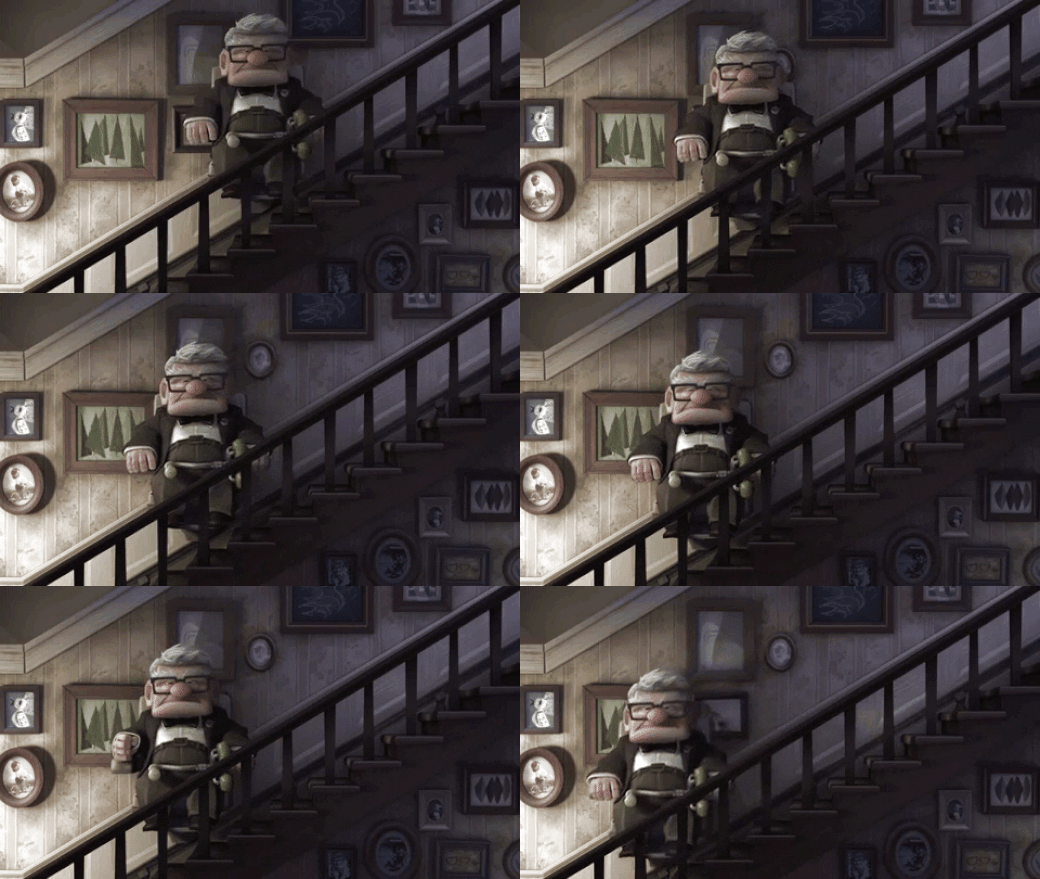
In the screenplay for Pixar’s Up, the Protagonist Carl Fredricksen begins the story in a profound state of Disunity:
- He is an old man living alone.
- He struggles with a body that works against him [e.g., bad back, needs to use a cane to walk, must ride an escalating seat up and down the stairs].
- He wakes in the morning, eats his bran cereal, ties his bow tie, walks out the front door, then proceeds to plop onto a seat on the front porch, nowhere to go, nowhere to be.
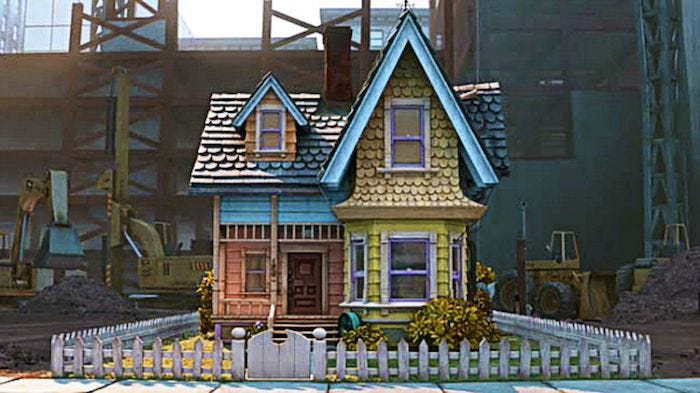
- Even his house exists in a state of Disunity, surrounded on all sides by mammoth skyscrapers, the last vestige of the past amidst the pull of the future.
But of course, the single most significant aspect of Carl’s Disunity is the fact he is a widower. His beloved wife of many years Ellie has died. In my interview with Mary Coleman, head of the Pixar story department, she described Carl’s circumstance this way: “Carl has been living the past, not even living, just biding his time until he dies and joins Ellie. He stopped living when she died.”
He stopped living when she died. This is an apt description of where Carl begins his psychological journey, a deep, dark state of Disunity.
Once Russell intervenes in his life and the narrative shifts to South America, Carl goes through a process of Deconstruction. Between the boy, Kevin and Doug, and finding himself forced to drag his floating house all the way across the other side of the valley to reach Paradise Falls, Carl’s old ways — beliefs and behaviors — get knocked about and pushed around.
- His ingrained behavior is to be alone, but Russell, Kevin and Doug won’t let him.
- He habit is to be a curmudgeonly old man, but Russell’s boundless enthusiasm for exploration, Doug’s immediate and unconditional love, and Kevin’s tricks constantly assault his ability to wear his gruff mask.
- Even his old body is forced to accommodate itself to new circumstances, oftentimes setting aside his walker, even running albeit trying to escape Kevin and Doug [to no avail].
At a psychological level what is happening is this: Russell, Kevin, Doug and his hero’s journey poke holes in Carl’s defenses, opening the way… to his heart.
This is the core of what transpires in the next stage: Reconstruction. If we track the course of Carl’s subplot relationships in the second half of Act Two, we find:
- Carl listening to Russell talk about his favorite memory of his now absent father [sitting outside the ice cream parlor counting cars].
- Carl promising Russell they will help Kevin get back to her babies.
- Carl begrudgingly accepting Doug as a companion.
What happens here is an ad hoc family is forming, one that becomes a surrogate for Carl’s relationship with Ellie with the potential to fill that void he feels inside.
In Act Three once Carl has achieved his original goal — get the house to Paradise falls to fulfill his promise to Ellie — he has a choice: Accept the fact he has accomplished what he set out to do or take on a new goal by going after Russell and trying to save Kevin from Muntz’s clutches. In the end, of course, the Good Guys win the day. And if you want a snapshot of a pivotal moment in Carl’s metamorphosis, there is this moment on P. 96:
A house which symbolized Ellie so much, Carl used to talk to it as if speaking to his wife. Now after all is said and done, it’s just a house.
That signifies metamorphosis. And with the denouement when Carl shows up at Russell’s merit badge award ceremony to give him the Ellie Badge [the grape soda pin Ellie gave Carl when they were kids], then the pair sit outside Fenton’s Ice Cream Parlor counting cars with Doug [“Grey one”], we see Carl in a state of Unity, a new family to replace his old one, a man who had stopped living transformed into one who has embraced life again.
Almost every single movie has some sort of metamorphosis going on. Positive metamorphosis, negative metamorphosis, resistance to metamorphosis, Protagonists who change, Protagonists who change others. If you want to understand a screenplay when you read it, this is an important set of eyes to use to do just that.
Reminder: This is just one approach to analyzing a screenplay. Everyone is different and has different needs, either personally or per project. If you resonate with any ideas here, feel free to use. If not, feel free to lose.
For Part 1: The First Pass, go here.
For Part 2: The Scene-By-Scene Breakdown, go here.
For Part 3: Plotline Points and Sequences, go here.
For Part 4: Subplots, Relationships and Character Functions, go here.
Upcoming posts:
Part 6: Themes
Part 7: Style and Language