How To Read A Screenplay
If you’re serious about learning the craft, here are 7 exercises you can use to make the most of your script-reading and analysis.
If you’re serious about learning the craft, here are 7 exercises you can use to make the most of your script-reading and analysis.
There are certain aspects of the craft of screenwriting you can best learn by reading screenplays. Visual writing. Effective and entertaining scene description. Scene transitions. Balance between action and dialogue. The look of a screenplay page. And so on.
There’s also this: There are multiple layers to any story. The more you dig, the deeper your understanding. There is a special kind of learning you can experience only by cracking open a story and exploring its many moving parts, a knowledge that settles into your gut where you start to develop an innate sense of what works and what doesn’t. From the standpoint of being a professional screenwriter, when often you are working against a ticking clock, either to assess a story and come up with a take to pitch, or pound out a writing assignment, having that internal sense of story is critical to your success as it can help you feel your way through the process.
So at the very least, I encourage you to try out these exercises detailed below to see if and how they fit with your own writing sensibilities. Look at each as a different ‘lens’ through which you can examine a story, providing a unique perspective and insight into the overall narrative.
This article is not intended to train you to be a script reader, but rather to provide a set of tools for writers to dig deep into screenplays and learn as much as possible from the reading experience.
The First Pass
This is pretty easy — with one proviso [see below] — because it is basically what you do now: Sit down and read the script. Try to turn off your analytical mind as much as possible and simply read the story for what it is. Obviously, if you have thoughts and observations, don’t chase them away. Rather, quickly jot them down, then move on.
The main point of a first pass is to read it straight-through in one sitting, trying as much as possible to stay within the story universe. Save the analysis for later.
Here is the proviso: Perhaps the single hardest aspect of reading a screenplay in today’s world is simply finding the time, space, and quiet in which to do it. If you are thumbing through a script on your smart phone while standing in line at the grocery store, you are ‘reading,’ so to speak, but what are your eyes really seeing? If you read a script yet allow yourself to get interrupted every five minutes by emails or Tweets, again you are ‘reading,’ but how can you enter into a story universe if this one keeps yanking you back?
And so the hard part: If you really want to read a script in order to analyze it, you have to shut everything else down. I know, I know, how can you possibly give yourself permission to set aside 90 minutes or so to read a script with no breaks, no interruptions, no distractions, just you and the story?
Let me put it to you this way: Are you serious about learning the craft? If you are, then you will find the strength of will to shut everything down when you read and engage a script. If you aren’t, well… go ahead and answer you email.
In order for stories to reveal themselves to us requires a mindfulness on our part. We have to be here now in order to enter fully into a story universe, muck around in there, break things apart, and explore the vital parts of the whole. Indeed this is great training for us and our writing because it requires the same immersion and intensity as sitting down to write.
So try this: Pick a screenplay for a movie you think you know well. If reading a script as a PDF on an electronic device makes it too tempting to slip over onto the Internet, you may have to break down and print out a copy. [Bad for the environment, I know, but the next time you go into town, don’t drive your car, ride your bike to balance out the impact.]
Then go into a quiet room, shut the door… and read. Give yourself over to the characters. Let yourself flow into the story universe. Read all the way through from FADE IN to FADE OUT.
And that is your first pass. Here you form general impressions, make initial observations, but perhaps the most important thing is to note what you felt while reading the script. Then ask yourself this: “Why did the story make me feel the way I did?”
Scene-By-Scene Breakdown
After a first pass, it’s time to crack open the script for a deeper analysis and you can do that by creating a scene-by-scene breakdown. It is precisely what it sounds like: A list of all the scenes in the script accompanied by a brief description of the events that transpire.
For purposes of this exercise, I have a slightly different take on scene. Here you are looking not just for individual scenes per se, but a scene or set of scenes that comprise one event or a continuous piece of action. Admittedly, this is subjective and there is no right or wrong, the point is simply to break down the script into a series of parts which you then can use dig into the script’s structure and themes.
Here is a scene-by-scene breakdown of the movie Up, one of my all-time favorite Pixar stories. The scenes are pegged to what pages they occur in the script. When characters are introduced, I bold their names. I note some bits of business that suggest thematic relevance, but mostly it is the story’s narrative broken down by scenes.
P. 1–3: Newsreel footage of Charles Muntz, “The Spirit of Adventure,” and Paradise Falls. Watched by young Carl Frederickson in a movie theater. Muntz accused of fabricating skeleton of “The Monster of Paradise Falls.” Muntz’s goal: To “capture the beast alive.”
P. 4–7: Carl imagining himself as Muntz, then hears a voice: “Adventure is out there!” From a rickety, abandoned house. It’s Ellie, who is as big a fan of Muntz as Carl is. [She gives him her grape soda pin and says, “You and me, we’re in a club now.”] Trying to retrieve his balloon, Carl falls. Ambulance.
P. 7–10: Carl in his room at night with broken arm. Ellie shows up with his balloon and shares with Carl “My Adventure Book.” [“Cross your heart!”] Her goal: To go to Paradise Falls. [“Only I just don’t know how I’m going to get to PF.”] Carl sees his balloon. “That’s it. You’ll take us in a blimp. Swear you’ll do it. Cross your heart. Cross it!” And Carl’s first word: “Wow.”
P. 10–14: Carl and Ellie’s life together montage. Key plot points: (A) Wedding. (B) He gets a job at a zoo selling helium balloons. © They want to have children, but find out they can’t. (D) Set sights on Paradise Falls, but those plans laid aside due to a series of financial setbacks. (E) Now old, Carl plans to surprise Ellie with tickets to go to PF, but Ellie dies.
P. 14–15: A day in the life. Carl wakes up — alone. Descends the stairs. Breakfast. Cleans artifacts of Ellie. Note: Grape soda pin. [Note: Multiple locks on door to suggest trying to keep the world out]. Heads outside and sits on his porch, revealing his house is surrounded by mammoth construction zone.
P. 15–17: Carl watches construction all around him. “Quite a sight, eh, Ellie,” looking skyward. Mail: “Shady Oaks retirement home.” Conversation with construction foreman where he learns that the Boss will double last offer to buy Carl’s house. Carl: “You can have my house… when I’m dead.”
P. 17–20: Carl watching TV. Knock on door. Meet Russell, member of the Wilderness Explorers. He’s missing merit badge: “Assisting the elderly” badge. His goal: To get the badge in order to become a Senior Wilderness Explorer. Note: “There’s a big ceremony and all our dads come…” Carl sends Russell away to look for a “snipe,” a big bird Carl makes up to get rid of the kid.
P. 20–21: A construction truck hits Carl’s mailbox. Carl accosts a worker, who is trying to help, injuring the worker. Witnesses gather, along with police car, and Boss stares at Carl and his “hand rests on Carl’s fence” [symbolic of intent].
P. 22: Carl summoned to court. Dropped back home by policewoman — “You don’t look like a public menace to me.” Touching the mailbox, Carl asks, “What do I do now, Ellie?”
P. 23: Getting his suitcase down to pack for the move to the retirement home, Carl finds Ellie’s “My Adventure Book.” He hits the “Stuff I’m Going to Do” page, sees the photo on the mantel of young Ellie, then her painting of her clubhouse atop Paradise Falls, considers the brochure for the retirement home, and staring at the painting of PF, Carl crosses his heart — he’s made a decision.
P. 23–24: Retirement home guys show up. Carl wants one last chance to say good-bye to his house. Then balloons. And the house goes airborne. He calls out to the guys, “I’ll send you a postcard from Paradise Falls!”
P. 24–25: Airborne travel montage ending with Carl kissing a photo of Ellie: “We’re on our way, Ellie.” Heading south to South America.
P. 25–26: A knock-knock-knock at the door. Carl doesn’t answer. Then frantic knocking. Carl gets up. It’s Russell. He asks to be let in. Carl relents.
P. 26–28: Russell immediately gets into Carl’s stuff, curiosity run amok. Carl fantasizes about getting rid of Russell. But Russell is nothing compared to what happens next.
P. 28–30: Storm scenes.
P. 30–32: After the storm, it seems that Russell has miraculously guided the house to Paradise Falls (using his Wilderness Explorer GPS, which he then accidentally flings out the window).
P. 32–35: They descend through the clouds and land — roughly — almost losing the house and their lives. But the clouds part and indeed, they are at Paradise Falls. Looking up, Carl says, “Ellie, we made it.” Note: Russell saves Carl from dying, chipping away at Carl’s mistrust of the boy. When Russell can’t climb to the house to haul up Carl, Carl thinks they’re stuck — so close, yet so far. Then Russell has a suggestion: “We could walk it over, just like a parade balloon.”
P. 36–37: Walking the house. Exposition: Have about 3 days before the helium wears out (ticking clock). Carl lays down rules for Russell’s behavior.
P. 37: Three dogs, led by their pack leader Alpha, chase a mysterious big bird, but the feedback from Carl’s hearing aid drives the dogs away.
P. 38–39: As they continue to plod along, Russell whines about how tired he is, body aches, bathroom needs. Finally Carl tells him to go to the bathroom.
P. 39–40: Having handled his bathroom needs, Russell sees some bird tracks. “Snipe!” Then eats some chocolate and woos the mysterious bird. “Giant snipe!”
P. 40–44: Russell appears to Carl with the bird in tow. Naming the bird Kevin, Russell asks to keep it. Carl says no. “Do you believe this, Ellie?” Hearing that, Russell has a ‘conversation’ with Ellie, stating that Ellie said, “To let me.” Carl: “No. N-O.”
P. 44–48: Continuing their trek toward PF, Russell drops chocolates on the ground so Kevin will keep following them. Then a voice: “Hey, are you okay over there?” It’s a dog — Dug. He has a collar that allows him to talk. He mentions his “master” and how he’s been sent out to find the “bird.” Seeing Kevin, Dug asks to take the bird prisoner — and off the four go toward PF.
P. 48–51: The dogs have picked up Kevin’s scent, Russell (“chocolate”) and Carl (“prunes”). They contact Dug via video monitor system, see Kevin and Russell (“Why is he with that small mailman”). Locating Dug’s position on the tracking device, they take off to find and capture the bird.
P. 51–54: The Foursome continue their trek, but Carl is having troubles keeping them in line (Note: House crashes against rock wall, breaking a glass window — deconstruction of the house). Pointing to Dug and Kevin, he says, “I don’t want you here and I don’t want you here,” then at Russell, “And I’m stuck with you.” [Note: Carl fighting the inertia toward bonding with his new ‘family’]. Carl throws a ball for Dug to chase and chocolate for Kevin. Running away from Dug and Kevin. Doesn’t work as the two creatures find Carl and Russell. [Note: Carl tries to challenge the emergence of his ‘family,’ but their allegiance is stronger than his efforts].
P. 54–57: That night, the four prepare to sleep in the rain. Russell fails with building a tent, then confesses he barely has a relationship with his father. “But he promised to come to my Explorer ceremony to pin on my Assisting the Elderly badge. So he can show me about tents then, right?” And now we know why this whole thing was really so important for Russell: Not to be a Senior Wilderness Explorer, but to win the attention of his father. Then Russell asks Carl to promise to take Kevin with them. “Cross your heart?”
P. 57–59: Waking up the next morning, Dug explains that Kevin is calling out to her babies who live in the “twisty rocks.” Kevin departs.
P. 59–60: Then Alpha and the other two tracking dogs show up. They confront Dug asking where the bird is and not getting a satisfactory answer, ‘escort’ Carl, Russell, and Dug back to Muntz’s headquarters.
P. 60–63: Brought to Muntz’s place, the mood shifts quickly as Carl recognizes Muntz and Muntz acknowledges a fan. Now they are guests.
P. 63–64: After parking his house, Carl and the others are invited into the “Spirit of Adventure.” Meanwhile Dug is put in the “cone of shame.”
P. 64–65: Muntz shows off some of his hunting trophies.
P. 66–70: Muntz insists that he needs to bring back “this creature” to clear his name — and Carl realizes that he’s talking about Kevin. Then Muntz talks about “bandits” who have tried to get the bird instead of him. Not paying attention, Kevin pipes up that the bird looks like Kevin, how he’s domesticated her by using chocolate. Carl attempts to end the conversation, “She’s gone off now” re Kevin. But Muntz isn’t buying it, knows that Carl knows something about the bird. Then Carl sees Kevin through the window on top of his house. Finally Kevin cries out and Muntz sees the bird as well. But Carl has raced away with Russell.
P. 70–73: Chase. Dug and Kevin prove to be worthy allies in helping the group escape Muntz’s dogs. Kevin, whose leg was bit by Alpha in the chase scenes, is hurt. She hears her babies’ cry and try to respond, but can’t. Kevin asks Carl, “Can’t we help her get home?” Carl is torn between his goal and Kevin (and Russell’s) goal — but he agrees. “But we gotta hurry.”
P.73–74: Back at Muntz’s lair, Muntz is livid that Carl and the others escaped. They blame Dug — “He helped them escape.” And it is his location signal that Muntz thinks will help them find Kevin.
P. 74–75: With Dug confirming that the pack isn’t following them and Kevin lying in the house with his injured leg, Carl and Russell pull the house in the direction of Kevin’s babies. Russell tells a story about how his father used to take him for ice cream and they would sit on the curb counting red cars and blue cars. “It might sound boring, but I think it’s the boring stuff I remember the most.”
P. 75–77: Hearing her babies, Kevin and the group take off, getting close to Kevin’s home. But Muntz arrives in the blimp and casts a net catching Kevin. Then he sets fire to Carl’s house. Carl has to choose — and chooses to save the house. Muntz takes off with Kevin while Carl douses the flames.
P. 77: The group is fractured. Russell feels like Carl gave away Kevin, but Carl is angry — he didn’t ask for any of this — and tells off Dug. He sets out to take the house to Paradise Falls, even if “it kills him.”
P. 78: Travel scenes. Even the house is ‘low,’ scraping the ground, underscoring the downer mood. Arrival at Paradise Falls. A pyrrhic victory for Carl with little satisfaction at having achieved his goal. Then an angry Kevin flings down his achievement belt — “I don’t want this anymore” — in effect, denying his goal.
P. 78–79: Carl enters the house. It’s a mess — just like his dreams / goal. Seeking solace, he sits in his chair, next to Ellie’s chair, and pulls out “My Adventure Book”. When he comes to the “Stuff I’m Gonna Do” page, at first he is crushed. But then sees that she filled in the book with photos and memorabilia from her marriage with Carl. Then a message: “Thanks for the adventure — now go have a new one. Love, Ellie.” Picking up Russell’s merit sash, Carl crosses his heart.
P. 79–80: Carl exits to find Russell floating in mid-air, connected to a bunch of balloons. “I’m going to help Kevin even if you’re not.” Using a leaf blower as propulsion, he zooms away. Carl tries to lift the house, but it won’t raise up. Frustrated Carl tosses a chair off the front porch — which gives him an idea. He throws everything inside the house out, reducing the house’s weight so it can fly away.
P. 80–81: Knock at the door. It’s Dug. Carl and he bond once again. “You’re my dog, and I’m your master.”
P. 81–84: Alpha informs Muntz that Russell is on board. Muntz confronts Russell — who says that Carl isn’t his “friend” anymore. Seeing Carl approaching in the balloon house, Muntz sets Russell on a ramp that opens toward the sky.
P. 84–85: Spotting Russell sliding down the ramp, Carl veers over and just catches Russell in the nick of time. Carl deposits Russell, still tied to a chair, in the house. Russell wants to help save Kevin, but Carl says no: “I want you to be safe.” He and Dug head into the blimp.
P. 85–87: Carl and Dug head through a tunnel and find Kevin. But Alpha deposits a bevy of guard dogs there. Inspired by Dug chewing on a tennis ball on Carl’s walker, Carl throws a ball down the hall which the guard dogs chase, then Carl locks them out. He frees Kevin.
P. 87–88: While Muntz tries to decipher several dogs crying out for help on the blimp intercom system, Kevin hops in his chair out to the front porch of the house — “I want to help.” Russell barely saves himself by grabbing onto the front porch hose. Then Muntz sees him and sends out three dogs in airplanes to attack Russell with bullet-darts.
P. 88–91: Carl, Dug, and Kevin are stopped by Muntz, who locks Dug out of the room with he and Carl. Dug chased by Alpha and other dogs. Muntz and Carl fight. Just when Muntz is about to slice Carl with his sword, Dug slides onto a control that sends the blimp tumbling sideways, knocking Muntz off his feet. Carl almost falls out, then he and Kevin climb onto the outside of the blimp onto a wall ladder, pursued by Muntz.
P. 91–92: Dug chased by Alpha and other dogs, but Dug get Alpha trapped with Cone of Shame and his voice device messed up as before. The other dogs laugh at Alpha’s voice, then Dug becomes the new alpha dog.
P. 92–93: Seeing Carl and Kevin in danger on the side of the blimp, Russell pushes himself to climb the hose, then as the dog planes zero in on him, he points and yells, “Squirrel!” The planes crash into each other.
P. 93–95: Dug opens a hatch and appears on the outside of the blimp, joining Carl and Kevin. Russell appears with the balloon house. All aboard — then Muntz shows up, shooting a rifle, bursting some balloons, causing the house to drop onto the blimp. Carl grabs hose to stop house from falling off edge of blimp while Muntz blasts his way into the house. Carl tells Russell and Dug to hold onto Kevin, then waves chocolate, causing Kevin to fly (with Russell and Dug) over to the blimp. Muntz leaps after them, but his foot catches in balloon strings, and he plummets to his death.
P.96: Safe on the blimp, Carl watches his house float away and disappear into the clouds. Russell says, “Sorry about your house, Mr. Frederickson.” Carl responds, “You know, it’s just a house.”
P. 96–98: Kevin reunites with her babies. Carl and Russell co-pilot the blimp away into the sky.
P. 98–100: Russell stands in line with other Wilderness Explorers as he’s about to receive his final merit badge. He looks up expectantly, hoping his father will show up — then Carl appears: “I’m here for him.” He awards Russell the “highest honor I can bestow — the Ellie badge,” the grape soda badge Ellie gave Carl the day they first met. Russell shows it off with pride to his mother, who is with Dug, and all the other dogs in the back join in the celebration.
P. 100–101: Carl and Russell sit on the curb in front of Russell’s favorite ice cream place (that he mentioned earlier), counting red and blue cars. Then into the clouds where we see Carl’s house, which has landed in Ellie’s dream spot atop Paradise Falls.
Armed with a scene-by-scene breakdown, you can dig into the next layer of analysis.
Plotline Points and Sequences
What can you do with a Scene-By-Scene Breakdown? The first thing is identify the major Plotline points. By doing that, you not only discover where something significant happens that twists the narrative in a new direction, you also determine the beginning and end points of the screenplay’s sequences. [For background on the sequence approach, go here].
Picking up with the scene-by-scene breakdown of Up from yesterday’s post, I have filled in my take on the screenplay’s major Plotline points and sequences.

ACT ONE
(Set up, establish initial predicament)
THE OPENING
P. 1–3: Newsreel footage of Charles Muntz, “The Spirit of Adventure,” and Paradise Falls. Watched by young Carl Frederickson in a movie theater. Muntz accused of fabricating skeleton of “The Monster of Paradise Falls.” Muntz’s goal: To “capture the beast alive.”
P. 4–7: Carl imagining himself as Muntz, then hears a voice: “Adventure is out there!” From a rickety, abandoned house. It’s Ellie, who is as big a fan of Muntz as Carl is. [She gives him her grape soda pin and says, “You and me, we’re in a club now.”] Trying to retrieve his balloon, Carl falls. Ambulance.
P. 7–10: Carl in his room at night with broken arm. Ellie shows up with his balloon and shares with Carl “My Adventure Book.” [“Cross your heart!”] Her goal: To go to Paradise Falls. [“Only I just don’t know how I’m going to get to PF.”] Carl sees his balloon. “That’s it. You’ll take us in a blimp. Swear you’ll do it. Cross your heart. Cross it!” And Carl’s first word: “Wow.”
P. 10–14: Carl and Ellie’s life together montage. Key plot points: (A) Wedding. (B) He gets a job at a zoo selling helium balloons. © They want to have children, but find out they can’t. (D) Set sights on Paradise Falls, but those plans laid aside due to a series of financial setbacks. (E) Now old, Carl plans to surprise Ellie with tickets to go to PF, but Ellie dies.
The Opening summary: Carl has made a promise to Ellie to take her to Paradise Falls because of her childhood dream of building a clubhouse right next to the falls. Major Plotline Point: Ellie dies. How to fulfill that promise?
SEQUENCE 1
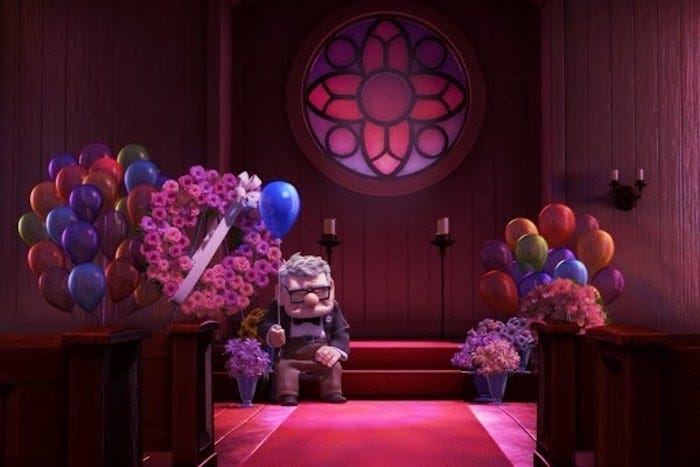
P. 14–15: A day in the life. Carl wakes up — alone. Descends the stairs. Breakfast. Cleans artifacts of Ellie. Note: Grape soda pin. [Note: Multiple locks on door to suggest trying to keep the world out]. Heads outside and sits on his porch, revealing his house is surrounded by mammoth construction zone.
P. 15–17: Carl watches construction all around him. “Quite a sight, eh, Ellie,” looking skyward. Mail: “Shady Oaks retirement home.” Conversation with construction foreman where he learns that the Boss will double last offer to buy Carl’s house. Carl: “You can have my house… when I’m dead.”
P. 17–20: Carl watching TV. Knock on door. Meet Russell, member of the Wilderness Explorers. He’s missing merit badge: “Assisting the elderly” badge. His goal: To get the badge in order to become a Senior Wilderness Explorer. Note: “There’s a big ceremony and all our dads come…” Carl sends Russell away to look for a “snipe,” a big bird Carl makes up to get rid of the kid.
P. 20–21: A construction truck hits Carl’s mailbox. Carl accosts a worker, who is trying to help, injuring the worker. Witnesses gather, along with police car, and Boss stares at Carl and his “hand rests on Carl’s fence” [symbolic of intent].
P. 22: Carl summoned to court. Dropped back home by policewoman — “You don’t look like a public menace to me.” Touching the mailbox, Carl asks, “What do I do now, Ellie?”
Sequence 1 summary: To establish Protagonist, exposition, flow of life and inciting incident. We learn about Carl’s life (post-Ellie), primarily his solitude and his pessimism. Inciting incident: Carl assaulting the construction worker.
The Hook summary: We meet two ‘outsiders’ to Carl’s little world — the Boss and his construction crew, who want Carl out of the house so they can bulldoze it and add to their project, and Russell. Major Plotline Point: Carl is to be transferred from his house to the retirement home. As Carl asks, what will he do now?

SEQUENCE 2
P. 23: Getting his suitcase down to pack for the move to the retirement home, Carl finds Ellie’s “My Adventure Book.” He hits the “Stuff I’m Going to Do” page, sees the photo on the mantel of young Ellie, then her painting of her clubhouse atop Paradise Falls, considers the brochure for the retirement home, and staring at the painting of PF, Carl crosses his heart — he’s made a decision.
P. 23–24: Retirement home guys show up. Carl wants one last chance to say good-bye to his house. Then balloons. And the house goes airborne. He calls out to the guys, “I’ll send you a postcard from Paradise Falls!”
P. 24–25: Airborne travel montage ending with Carl kissing a photo of Ellie: “We’re on our way, Ellie.” Heading south to South America.
P. 25–26: A knock-knock-knock at the door. Carl doesn’t answer. Then frantic knocking. Carl gets up. It’s Russell. He asks to be let in. Carl relents.
Sequence 2 summary: To create a predicament, establish the main tension and pose the dramatic question of the second act. The predicament is what will Carl do about being forced out of his house? He becomes a balloon house. Will he succeed in getting to Paradise Falls?
The Lock summary: It’s Carl en route to Paradise Falls with an interloper — Russell who will be accompanying him. Major Plotline Point: Carl’s decision to take off with his balloon house.

ACT TWO
(Complicating action, rising and descending)
SEQUENCE 3: DECONSTRUCTION TESTS
P. 26–28: Russell immediately gets into Carl’s stuff, curiosity run amok. Carl fantasizes about getting rid of Russell. But Russell is nothing compared to what happens next.
P. 28–30: Storm scenes.
P. 30–32: After the storm, it seems that Russell has miraculously guided the house to Paradise Falls (using his Wilderness Explorer GPS, which he then accidentally flings out the window).
P. 32–35: They descend through the clouds and land — roughly — almost losing the house and their lives. But the clouds part and indeed, they are at Paradise Falls. Looking up, Carl says, “Ellie, we made it.” Note: Russell saves Carl from dying, chipping away at Carl’s mistrust of the boy. When Russell can’t climb to the house to haul up Carl, Carl thinks they’re stuck — so close, yet so far. Then Russell has a suggestion: “We could walk it over, just like a parade balloon.”
P. 36–37: Walking the house. Exposition: Have about 3 days before the helium wears out (ticking clock). Carl lays down rules for Russell’s behavior.
P. 37: Three dogs, led by their pack leader Alpha, chase a mysterious big bird, but the feedback from Carl’s hearing aid drives the dogs away.
Sequence 3 summary: The Protagonist makes initial attempts at solving the problem. They’ve made it to South America within sight of Paradise Falls, but can’t fly anymore. So they decide to walk the house over to PF.
Deconstruction Tests summary: What’s being deconstructed is Carl’s solitude, by virtue of his forced relationship with Russell, and his pessimism, by virtue of his big adventure. Major Plot Point: They have to walk the house to PF.
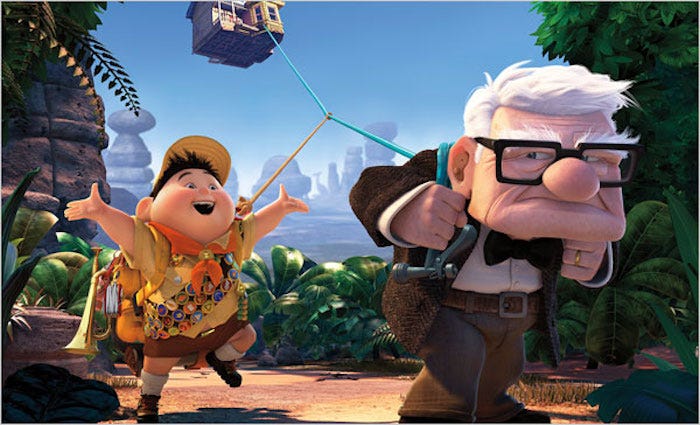
SEQUENCE 4: TRANSITION
P. 38–39: As they continue to plod along, Russell whines about how tired he is, body aches, bathroom needs. Finally Carl tells him to go to the bathroom.
P. 39–40: Having handled his bathroom needs, Russell sees some bird tracks. “Snipe!” Then eats some chocolate and woos the mysterious bird. “Giant snipe!”
P. 40–44: Russell appears to Carl with the bird in tow. Naming the bird Kevin, Russell asks to keep it. Carl says no. “Do you believe this, Ellie?” Hearing that, Russell has a ‘conversation’ with Ellie, stating that Ellie said, “To let me.” Carl: “No. N-O.”
P. 44–48: Continuing their trek toward PF, Russell drops chocolates on the ground so Kevin will keep following them. Then a voice: “Hey, are you okay over there?” It’s a dog — Dug. He has a collar that allows him to talk. He mentions his “master” and how he’s been sent out to find the “bird.” Seeing Kevin, Dug asks to take the bird prisoner — and off the four go toward PF.
P. 48–51: The dogs have picked up Kevin’s scent, Russell (“chocolate”) and Carl (“prunes”). They contact Dug via video monitor system, see Kevin and Russell (“Why is he with that small mailman”). Locating Dug’s position on the tracking device, they take off to find and capture the bird.
Sequence 4 summary: The Protagonist makes more desperate attempts to solve the problem. Carl forced to deal with the addition of Kevin and Dug to his group of fellow travelers.
Transition summary: Carl doesn’t even know it, but this group gathering around him is the first step toward a de facto family. Major Plotline Point: Finding Kevin sets off a whole chain of events leading into its own subplot.

SEQUENCE 5: RECONSTRUCTION TESTS
P. 51–54: The Foursome continue their trek, but Carl is having troubles keeping them in line [Note: House crashes against rock wall, breaking a glass window — deconstruction of the house]. Pointing to Dug and Kevin, he says, “I don’t want you here and I don’t want you here,” then at Russell, “And I’m stuck with you.” [Note: Carl fighting the inertia toward bonding with his new ‘family’]. Carl throws a ball for Dug to chase and chocolate for Kevin. Running away from Dug and Kevin. Doesn’t work as the two creatures find Carl and Russell. [Note: Carl tries to challenge the emergence of his ‘family,’ but their allegiance is stronger than his efforts].
P. 54–57: That night, the four prepare to sleep in the rain. Russell fails with building a tent, then confesses he barely has a relationship with his father. “But he promised to come to my Explorer ceremony to pin on my Assisting the Elderly badge. So he can show me about tents then, right?” And now we know why this whole thing was really so important for Russell: Not to be a Senior Wilderness Explorer, but to win the attention of his father. Then Russell asks Carl to promise to take Kevin with them. “Cross your heart?”
P. 57–59: Waking up the next morning, Dug explains that Kevin is calling out to her babies who live in the “twisty rocks.” Kevin departs.
P. 59–60: Then Alpha and the other two tracking dogs show up. They confront Dug asking where the bird is and not getting a satisfactory answer, ‘escort’ Carl, Russell, and Dug back to Muntz’s headquarters.
Sequence 5 summary: New complications force the protagonist into a descending spiral. Being taken hostage has deviated them from the goal of Paradise Falls.
Reconstruction Tests summary: Bonding with Russell signifies a big moment in Carl’s emotional reconstruction. The fact that he makes a promise and crosses his heart evokes the memory of Ellie. In effect, Carl’s heart, which was broken when Ellie died, is being revived through his growing connection to Russell. Major Plotline Point: Being taken hostage.
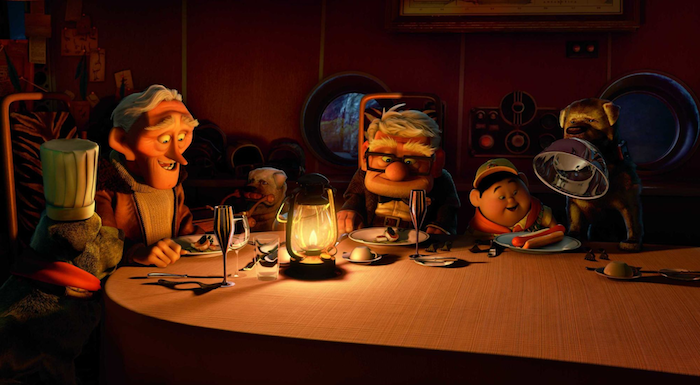
SEQUENCE 6: ALL IS LOST
P. 60–63: Brought to Muntz’s place, the mood shifts quickly as Carl recognizes Muntz and Muntz acknowledges a fan. Now they are guests.
P. 63–64: After parking his house, Carl and the others are invited into the “Spirit of Adventure.” Meanwhile Dug is put in the “cone of shame.”
P. 64–65: Muntz shows off some of his hunting trophies.
P. 66–70: Muntz insists that he needs to bring back “this creature” to clear his name — and Carl realizes that he’s talking about Kevin. Then Muntz talks about “bandits” who have tried to get the bird instead of him. Not paying attention, Kevin pipes up that the bird looks like Kevin, how he’s domesticated her by using chocolate. Carl attempts to end the conversation, “She’s gone off now” re Kevin. But Muntz isn’t buying it, knows that Carl knows something about the bird. Then Carl sees Kevin through the window on top of his house. Finally Kevin cries out and Muntz sees the bird as well. But Carl has raced away with Russell.
P. 70–73: Chase. Dug and Kevin prove to be worthy allies in helping the group escape Muntz’s dogs. Kevin, whose leg was bit by Alpha in the chase scenes, is hurt. She hears her babies’ cry and try to respond, but can’t. Kevin asks Carl, “Can’t we help her get home?” Carl is torn between his goal and Kevin (and Russell’s) goal — but he agrees. “But we gotta hurry.”
P.73–74: Back at Muntz’s lair, Muntz is livid that Carl and the others escaped. They blame Dug — “He helped them escape.” And it is his location signal that Muntz thinks will help them find Kevin.
P. 74–75: With Dug confirming that the pack isn’t following them and Kevin lying in the house with his injured leg, Carl and Russell pull the house in the direction of Kevin’s babies. Russell tells a story about how his father used to take him for ice cream and they would sit on the curb counting red cars and blue cars. “It might sound boring, but I think it’s the boring stuff I remember the most.”
P. 75–77: Hearing her babies, Kevin and the group take off, getting close to Kevin’s home. But Muntz arrives in the blimp and casts a net catching Kevin. Then he sets fire to Carl’s house. Carl has to choose — and chooses to save the house. Muntz takes off with Kevin while Carl douses the flames.
Sequence 6 summary: The main tension is resolved or reframed. Carl’s goal of getting the house to Paradise Falls is compromised by attempting to reunite Kevin with her babies.
All Is Lost summary: Just when success was in sight, Kevin is taken away by Munta, Carl’s house has been damaged, and the group is back on their heels. Major Plotline Point: Muntz takes Kevin.
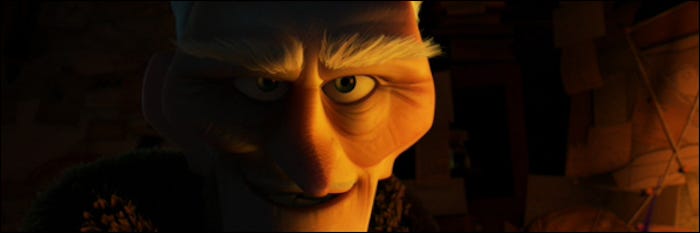
ACT THREE
(Acceleration towards resolution)
SEQUENCE 7: ON THE OFFENSIVE
P. 77: The group is fractured. Russell feels like Carl gave away Kevin, but Carl is angry — he didn’t ask for any of this — and tells off Dug. He sets out to take the house to Paradise Falls, even if “it kills him.”
P. 78: Travel scenes. Even the house is ‘low,’ scraping the ground, underscoring the downer mood. Arrival at Paradise Falls. A pyrrhic victory for Carl with little satisfaction at having achieved his goal. Then an angry Kevin flings down his achievement belt — “I don’t want this anymore” — in effect, denying his goal.
P. 78–79: Carl enters the house. It’s a mess — just like his dreams / goal. Seeking solace, he sits in his chair, next to Ellie’s chair, and pulls out “My Adventure Book”. When he comes to the “Stuff I’m Gonna Do” page, at first he is crushed. But then sees that she filled in the book with photos and memorabilia from her marriage with Carl. Then a message: “Thanks for the adventure — now go have a new one. Love, Ellie.” Picking up Russell’s merit sash, Carl crosses his heart.
P. 79–80: Carl exits to find Russell floating in mid-air, connected to a bunch of balloons. “I’m going to help Kevin even if you’re not.” Using a leaf blower as propulsion, he zooms away. Carl tries to lift the house, but it won’t raise up. Frustrated Carl tosses a chair off the front porch — which gives him an idea. He throws everything inside the house out, reducing the house’s weight so it can fly away.
P. 80–81: Knock at the door. It’s Dug. Carl and he bond once again. “You’re my dog, and I’m your master.”
Sequence 7 summary: Protagonist addresses a new obstacle or objective. Carl heads off to help Russell and Kevin.
On The Offensive summary: Moving from low and defeated, Carl taps into a deeper level of energy to leap into a new adventure. Major Plotline Point: Russell takes off after Kevin, causing Carl to follow Russell.
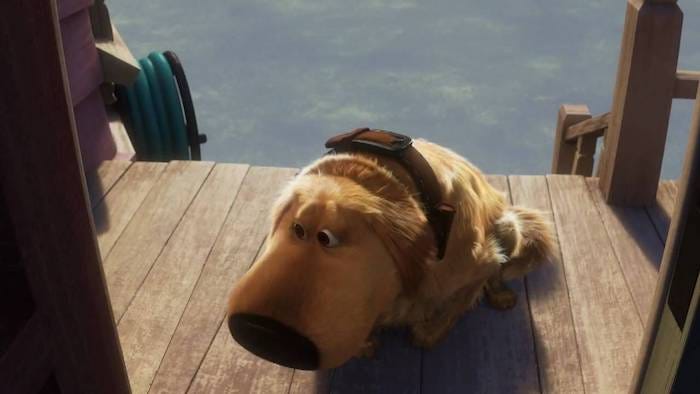
SEQUENCE 8: FINAL STRUGGLE
P. 81–84: Alpha informs Muntz that Russell is on board. Muntz confronts Russell — who says that Carl isn’t his “friend” anymore. Seeing Carl approaching in the balloon house, Muntz sets Russell on a ramp that opens toward the sky.
P. 84–85: Spotting Russell sliding down the ramp, Carl veers over and just catches Russell in the nick of time. Carl deposits Russell, still tied to a chair, in the house. Russell wants to help save Kevin, but Carl says no: “I want you to be safe.” He and Dug head into the blimp.
P. 85–87: Carl and Dug head through a tunnel and find Kevin. But Alpha deposits a bevy of guard dogs there. Inspired by Dug chewing on a tennis ball on Carl’s walker, Carl throws a ball down the hall which the guard dogs chase, then Carl locks them out. He frees Kevin.
P. 87–88: While Muntz tries to decipher several dogs crying out for help on the blimp intercom system, Kevin hops in his chair out to the front porch of the house — “I want to help.” Russell barely saves himself by grabbing onto the front porch hose. Then Muntz sees him and sends out three dogs in airplanes to attack Russell with bullet-darts.
P. 88–91: Carl, Dug, and Kevin are stopped by Muntz, who locks Dug out of the room with he and Carl. Dug chased by Alpha and other dogs. Muntz and Carl fight. Just when Muntz is about to slice Carl with his sword, Dug slides onto a control that sends the blimp tumbling sideways, knocking Muntz off his feet. Carl almost falls out, then he and Kevin climb onto the outside of the blimp onto a wall ladder, pursued by Muntz.
P. 91–92: Dug chased by Alpha and other dogs, but Dug get Alpha trapped with Cone of Shame and his voice device messed up as before. The other dogs laugh at Alpha’s voice, then Dug becomes the new alpha dog.
P. 92–93: Seeing Carl and Kevin in danger on the side of the blimp, Russell pushes himself to climb the hose, then as the dog planes zero in on him, he points and yells, “Squirrel!” The planes crash into each other.
P. 93–95: Dug opens a hatch and appears on the outside of the blimp, joining Carl and Kevin. Russell appears with the balloon house. All aboard — then Muntz shows up, shooting a rifle, bursting some balloons, causing the house to drop onto the blimp. Carl grabs hose to stop house from falling off edge of blimp while Muntz blasts his way into the house. Carl tells Russell and Dug to hold onto Kevin, then waves chocolate, causing Kevin to fly (with Russell and Dug) over to the blimp. Muntz leaps after them, but his foot catches in balloon strings, and he plummets to his death.
P.96: Safe on the blimp, Carl watches his house float away and disappear into the clouds. Russell says, “Sorry about your house, Mr. Frederickson.” Carl responds, “You know, it’s just a house.”
P. 96–98: Kevin reunites with her babies. Carl and Russell co-pilot the blimp away into the sky.
Sequence 8 summary: Resolution. Loose ends are tied up. Kevin subplot resolved. Muntz taken care of.
Final Struggle summary: Carl’s ‘family’ works together to defeat the Antagonist. So Carl achieves Russell’s goal of saving Kevin and reuniting her with her family. Major Plotline Point: Carl et al save Kevin.

THE DENOUEMENT
P. 98–100: Russell stands in line with other Wilderness Explorers as he’s about to receive his final merit badge. He looks up expectantly, hoping his father will show up — then Carl appears: “I’m here for him.” He awards Russell the “highest honor I can bestow — the Ellie badge,” the grape soda badge Ellie gave Carl the day they first met. Russell shows it off with pride to his mother, who is with Dug, and all the other dogs in the back join in the celebration.
P. 100–101: Carl and Russell sit on the curb in front of Russell’s favorite ice cream place (that he mentioned earlier), counting red and blue cars. Then into the clouds where we see Carl’s house, which has landed in Ellie’s dream spot atop Paradise Falls.
The Denouement summary: Carl fully embraces the role of substitute father to Russell and in so doing cements his revitalization as a person. And the house atop Paradise Falls fulfills his original goal. But Carl doesn’t know — and doesn’t care. He’s found a new adventure: A life as Russell’s paternal figure.
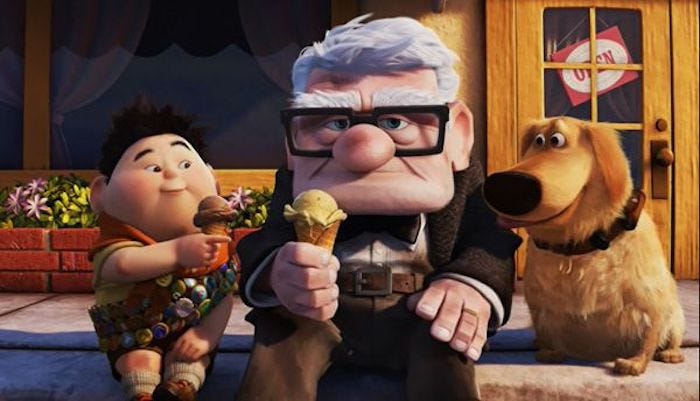
When you get to the point of breaking down a script into major Plotline points and sequences, you have exposed much in the way of its structure, but not all of it. There is the External World [Plotline], but there is also the Internal World [Themeline]. The best way into that world is to delve more deeply into the characters.

Subplots, Relationships and Character Functions
It’s impossible to emphasize enough how important subplots are for… well, I suppose every screenplay. At their most basic level of value, they provide a way for the writer to cut away from the Plotline which is hugely important on many fronts including time management and pace. But their significance is multifaceted.
Here’s how I think of subplots: Relationships. If you want to track down subplots in a screenplay, locate all the primary and even key secondary characters, especially the ones who directly connect with the Protagonist, and you’re almost assuredly looking at a subplot.
Continuing with our study script Up, let’s list the various relationships in the story:
Carl — Ellie
Carl — Russell
Carl — Kevin
Carl — Doug
Carl — Muntz
Carl — Real Estate Developer
Muntz — Kevin
Russell — His Father
Russell — Kevin
Kevin — Her Babies
Doug — Alpha and the Other Dogs
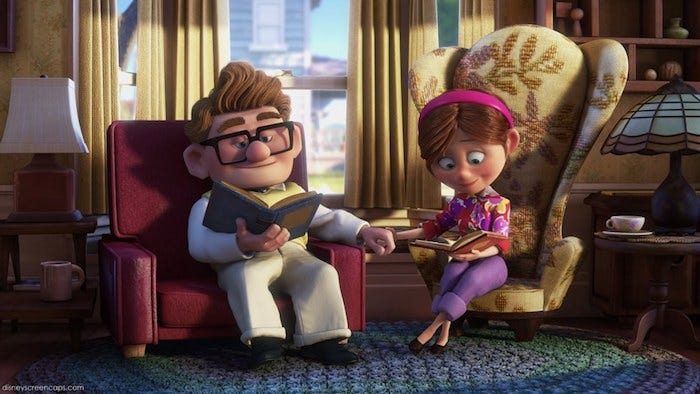
The Plotline: Carl getting the house up to Paradise Falls. All the above relationships represent subplots that tie into and impact the Plotline. For example:
- Carl — Ellie: Carl would not have a Want [Conscious Goal] to get the house to Paradise Falls were it not for his promise to Ellie, and of course the love and affection he has for his late wife, as well as the shadow of guilt about never having fulfilled this shared dream.
- Carl — Real Estate Developer: Carl acts on his goal when the Real Estate Developer manages to get Carl set to move into an old folks home, relinquishing the rights to his house and the valuable land on which it sits.
- Carl — Russell: Once airborne, the surprise appearance of Russell enables Carl to get the house to Paradise Falls [Russell steers the house there while Carl is knocked out], but then the boy’s presence creates disruptions in Carl’s plan.
- Russell — Kevin: The first disruption occurs when Russell finds and befriends Kevin, who then follows the pair until he becomes an ad hoc member of the expedition.
- Carl — Kevin: Kevin creates a secondary goal of getting the bird to her babies.
- Carl — Doug: Doug intersects with Carl, Russell and Kevin because he is searching for the bird, then he joins the traveling troop.
- Doug — Alpha [and the Other Dogs]: Alpha intersects with Carl and company because Doug is with Carl and company.
- Carl — Muntz: Carl intersects with Muntz because of all the previously noted connections.
Note how the subplots in Up create a seamless path from Carl’s home in the city to Carl being chased by Muntz, one group [Carl, Russell, Kevin, Doug] vs. the other [Muntz, Alpha, Other Dogs]. So at one level, that is their character function — to create that narrative path.
But there is much more to the function of characters and their relationships as they help take us from the Plotline into the Themeline and the soul of the story. And that leads us to a fascinating way to view the Plotline and subplots: Look at them through the lens of Character Archetypes.
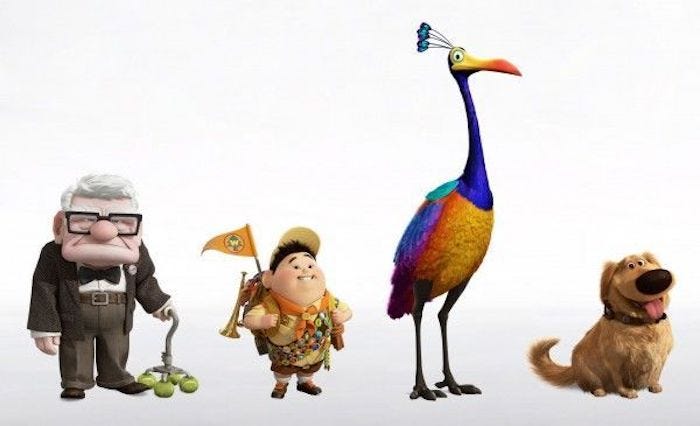
Here is my take on the character archetypes in Up.
Protagonist — Carl
Nemesis — Muntz, Alpha and the Other Dogs, Real Estate Developer
Attractor — Russell, Ellie
Mentor — Doug
Trickster — Kevin
For a deeper analysis of these archetypes, you can go here to a previous Go Into The story post.
With regard to reading and analyzing a screenplay, the point is this: Another tool at your disposal is to identify and break down the story’s subplots:
- Subplots can be intimately connected to the Plotline.
- Subplots are generally tied to individual characters who have unique relationships with the Protagonist and sometimes with each other.
- Subplots are typically shaped the way they are by virtue of their character’s narrative function.
- Subplots can be explored in terms of primary character archetypes.
- Subplots provide sub-themes that amplify and widen the meaning of the story’s central theme.
In sum, subplots open doorways into the soul of a story, a presence that is intimately connected with a dynamic Joseph Campbell said lies at the center of The Hero’s Journey.
Metamorphosis
Author Malcolm Cowley said this: “In the end something has changed. If nothing has changed, it isn’t a story.”
At a fundamental level, stories are about change. Events change, circumstances change, locations change, time changes. But perhaps the single most important change in a movie is this: metamorphosis.
Joseph Campbell said that at some level, the entire point of the Hero’s Journey is metamorphosis [he used the term “transformation”]. Whose metamorphosis? The Hero, of course, a character screenwriters refer to as the Protagonist.
Therefore another lens through which we can read and analyze a screenplay is to study the Protagonist’s metamorphosis arc. There is the physical journey they go through in the External World [Plotline], but that is accompanied by the psychological journey in the Internal World [Themeline].
We can ask these questions as we dig into a screenplay:
- Where does the Protagonist begin their psychological journey?
- Where does the Protagonist end their psychological journey?
- What stages of development do they go through from beginning to end?
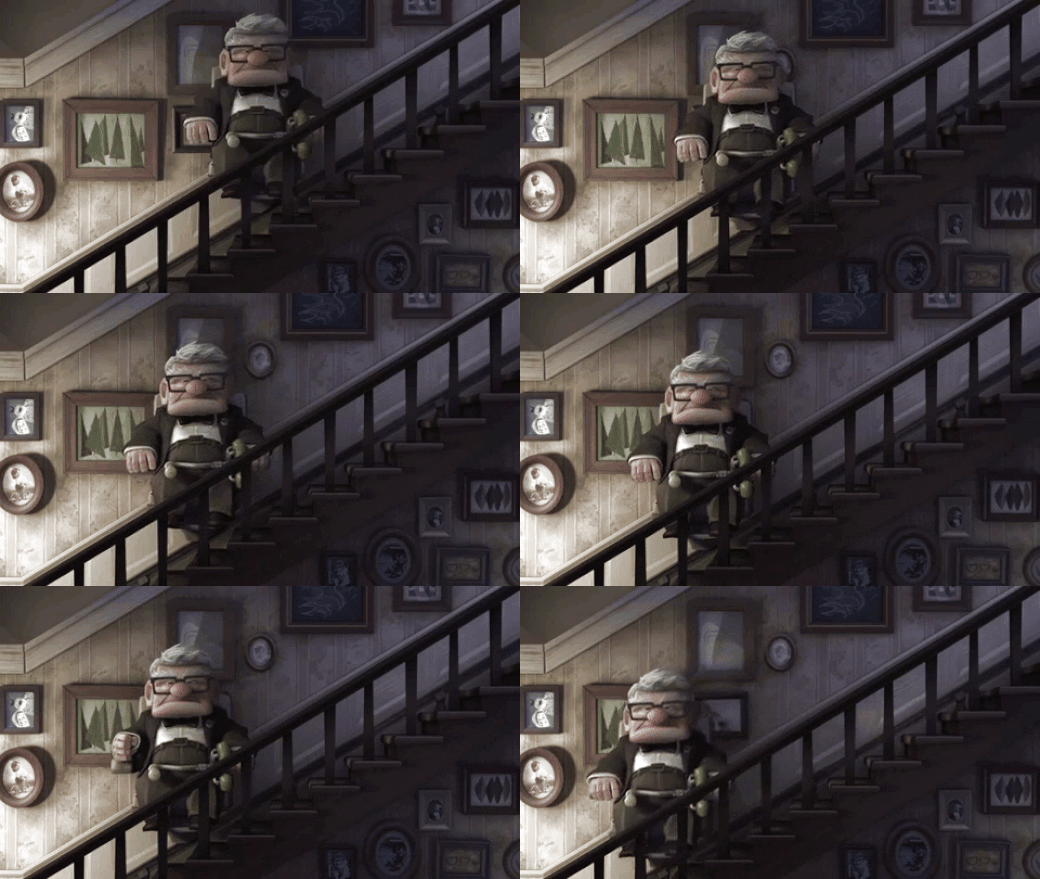
In the screenplay for Pixar’s Up, the Protagonist Carl Fredricksen begins the story in a profound state of Disunity:
- He is an old man living alone.
- He struggles with a body that works against him [e.g., bad back, needs to use a cane to walk, must ride an escalating seat up and down the stairs].
- He wakes in the morning, eats his bran cereal, ties his bow tie, walks out the front door, then proceeds to plop onto a seat on the front porch, nowhere to go, nowhere to be.
- Even his house exists in a state of Disunity, surrounded on all sides by mammoth skyscrapers, the last vestige of the past amidst the pull of the future.
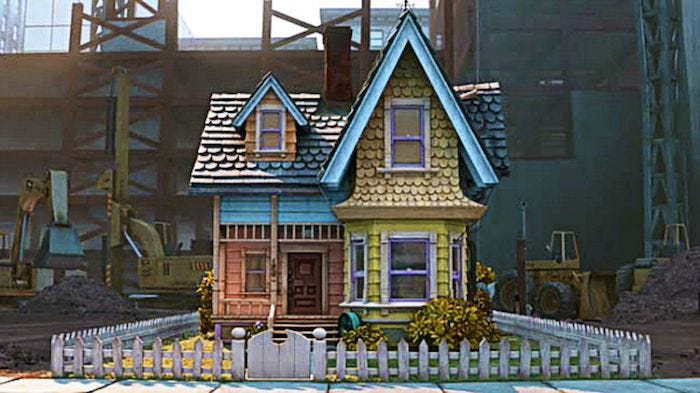
But of course, the single most significant aspect of Carl’s Disunity is the fact he is a widower. His beloved wife of many years Ellie has died. In my interview with Mary Coleman, head of the Pixar story department, she described Carl’s circumstance this way: “Carl has been living the past, not even living, just biding his time until he dies and joins Ellie. He stopped living when she died.”
He stopped living when she died. This is an apt description of where Carl begins his psychological journey, a deep, dark state of Disunity.
Once Russell intervenes in his life and the narrative shifts to South America, Carl goes through a process of Deconstruction. Between the boy, Kevin and Doug, and finding himself forced to drag his floating house all the way across the other side of the valley to reach Paradise Falls, Carl’s old ways — beliefs and behaviors — get knocked about and pushed around.
- His ingrained behavior is to be alone, but Russell, Kevin and Doug won’t let him.
- He habit is to be a curmudgeonly old man, but Russell’s boundless enthusiasm for exploration, Doug’s immediate and unconditional love, and Kevin’s tricks constantly assault his ability to wear his gruff mask.
- Even his old body is forced to accommodate itself to new circumstances, oftentimes setting aside his walker, even running albeit trying to escape Kevin and Doug [to no avail].
At a psychological level what is happening is this: Russell, Kevin, Doug and his hero’s journey poke holes in Carl’s defenses, opening the way… to his heart.
This is the core of what transpires in the next stage: Reconstruction. If we track the course of Carl’s subplot relationships in the second half of Act Two, we find:
- Carl listening to Russell talk about his favorite memory of his now absent father [sitting outside the ice cream parlor counting cars].
- Carl promising Russell they will help Kevin get back to her babies.
- Carl begrudgingly accepting Doug as a companion.
What happens here is an ad hoc family is forming, one that becomes a surrogate for Carl’s relationship with Ellie with the potential to fill that void he feels inside.
In Act Three once Carl has achieved his original goal — get the house to Paradise falls to fulfill his promise to Ellie — he has a choice: Accept the fact he has accomplished what he set out to do or take on a new goal by going after Russell and trying to save Kevin from Muntz’s clutches. In the end, of course, the Good Guys win the day. And if you want a snapshot of a pivotal moment in Carl’s metamorphosis, there is this moment on P. 96:
A house which symbolized Ellie so much, Carl used to talk to it as if speaking to his wife. Now after all is said and done, it’s just a house.
That signifies metamorphosis. And with the denouement when Carl shows up at Russell’s merit badge award ceremony to give him the Ellie Badge [the grape soda pin Ellie gave Carl when they were kids], then the pair sit outside Fenton’s Ice Cream Parlor counting cars with Doug [“Grey one”], we see Carl in a state of Unity, a new family to replace his old one, a man who had stopped living transformed into one who has embraced life again.
Almost every single movie has some sort of metamorphosis going on. Positive metamorphosis, negative metamorphosis, resistance to metamorphosis, Protagonists who change, Protagonists who change others. If you want to understand a screenplay when you read it, this is an important set of eyes to use to do just that.
Themes
My take on theme is comprised of two major points: (1) Theme = Meaning. Theme is the glue that binds together a story and gives it meaning. (2) A story will have multiple themes.
So theme is not just the moral of the story, the story’s premise, or its proposition, but rather the narrative dynamics tied to the psychological impact of what transpires in every event and every scene.
It is critical for a writer to understand, at least in part, the themes in their own stories. One of the best ways to learn how to do that is read screenplays, analyzing them to see how the writers use themes and how themes emerge in the context of the narrative.
For purposes of script analysis, I zero in on two types of themes: The central theme [the overriding meaning of the story] and sub-themes [a specific aspect or variation of the central theme that sheds a distinctive light on the narrative’s significance].
So for example in The Silence of the Lambs, we might say that its central theme is this: To silence the nightmare of the past, Clarice must confront it. Some sub-themes would be: (1) Death — its power to inflict pain [the murder of Clarice’s father]; its power to provide redemption [the killing of Buffalo bill]. (2) Transformation — Buffalo Bill seeks to become a woman (i.e., his obsession with moths, sewing a female body suit made out of his victim’s skin, dressing like a woman); Clarice seeks to resolve the guilt she feels about her father’s death and become a whole person.
Continuing with our analysis of the movie Up, how would we go about surfacing its themes? It’s always a good idea to start with the Protagonist, so let’s look at Carl and in particular the nature of his metamorphosis. In the beginning, after the death of his beloved wife Ellie, Carl basically exists in a lifeless state. Think about that word: Life. Less. By the end, he is full of life and enjoying himself. Indeed, there are two images in the script involving food that provide visual bookends to his transformation. The beginning:
The end:
What is the difference? In the first, Carl eats alone at his kitchen table. In the second, he is joined by Russell and Dug, sharing ice cream together.
Thus, we can see that in one way, Carl’s metamorphosis is about finding connections. We might typify the story’s central theme as this: In order to find new life, Carl needs to open himself up to the possibilities life offers.
Indeed in my interview with Mary Coleman, head of Pixar’s story department, we discussed this very point:
SM: We see that point of personal connection in Up very profoundly, don’t we? We start off with Carl as a boy, meeting young Ellie, then losing her in that poignant sequence of their married life together. And having experienced the loss of Ellie, Carl is almost ‘life-less,’ left to string out the remaining days of his life. Then he goes on this big journey to South America, accompanied by Russell, who is an adventurer and full of life. And here again, strange sojourners — an old man fading from life, a young boy full of life. Yet each has their own shadow: Carl who has a void where Ellie used to be, Russell who has a void where his father used to be. Those internal dynamics push the pair as they go on their external journey, all the while overcoming obstacles and over time forming a connection. And per this idea of the philosophical stakes, for Carl isn’t it finally a story of resurrection?
MC: Absolutely. Carl has been living the past, not even living, just biding his time until he dies and joins Ellie. He stopped living when she died. So yes, it’s a rebirth story because by the end he’s able to have a new relationship in the present. And it’s sweet because while the primary relationship is with Russell, by accepting the unconditional love of the dog Doug, letting him come in, jump on him, and be his dog, you’ve got a satisfying B-plot of another present-tense relationship.
We could even shorthand the central theme of Up as being about resurrection.
But what about sub-themes? One of the best ways I know to explore a story’s multiple themes is by examining its subplots. Remember how in this post, I identified Up’s subplots? Each of them, as we noted, is comprised of a relationship (e.g., Carl-Ellie, Carl-Real Estate Developer, Carl-Russell, Russell-Kevin). Since each subplot offers a slightly different access point to a story’s Themeline, it make sense that a subplot can provide a sub-theme related to the story’s central theme.
Picking up on Mary Coleman’s point about Dug — “accepting the unconditional love of the dog Dug, letting him come in, jump on him, and be his dog, you’ve got a satisfying B-plot of another present-tense relationship” — there you have a sub-theme: Dug shows Carl the meaning of unconditional love.
Remember this moment when Dug first intersects with Carl and Russell [P. 46]: “I have just met you and I love you.”
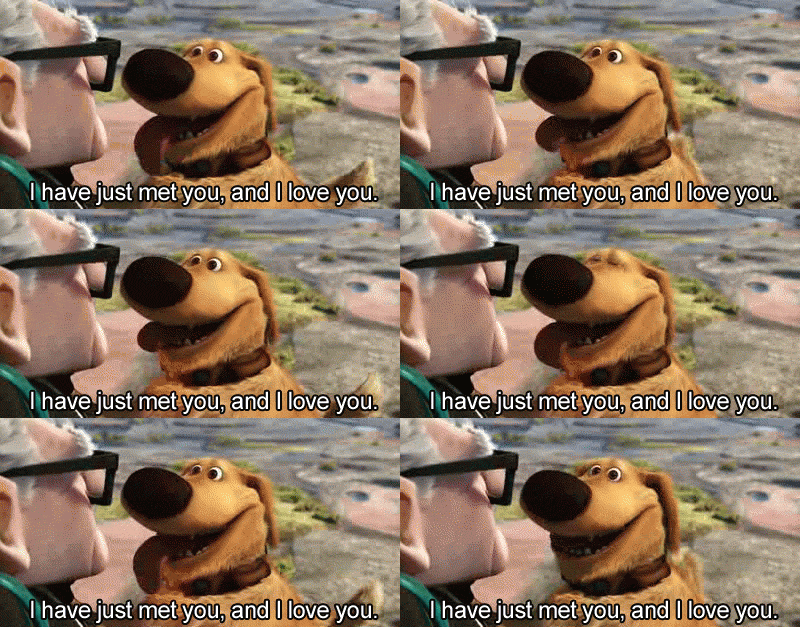
That is the essence of unconditional love. Which is why I think Dug functions as a Mentor, conveying to Carl two important lessons: (1) The ability to be open to connection with another being. (2) The joy of giving and receiving love. Carl needs to learn both of these things in order to move out of his Life-Less state, where he has been so attached to Ellie, he can’t move on. And what better way to physicalize the reality of unconditional love than a slobbering dog full of boundless ardor for his newfound Master?
Themes represent another lens through which we can read and analyze a screenplay. The more we learn about them and see how they work in the context of many scripts, the more we can bring that understanding to our own writing.

Style and Language
his one is easy. And you need go no further than this quote from Shane Black:
“I studied William Goldman’s writing style, especially the scripts for Marathon Man and Butch Cassidy and the Sundance Kid. I found both of those to be really riveting, entertaining in their own right, as if you were reading a condensed novel good for one sitting. Similarly, Walter Hill’s scripts for Alien and the original 48 Hours when they were looking for a Clint Eastwood kind of pairing — I thought these were wonderfully written scripts. I studied the language and the style. I didn’t realize as I was reading them, that these were very unusual. That most people wrote scripts much differently. I assumed there weren’t many rules and you just sort of did whatever you wanted to stylistically and had fun with it. So, I took those two writers as examples and mentors.”
I studied William Goldman’s writing style [emphasis added].
Point made. Hopefully point taken.
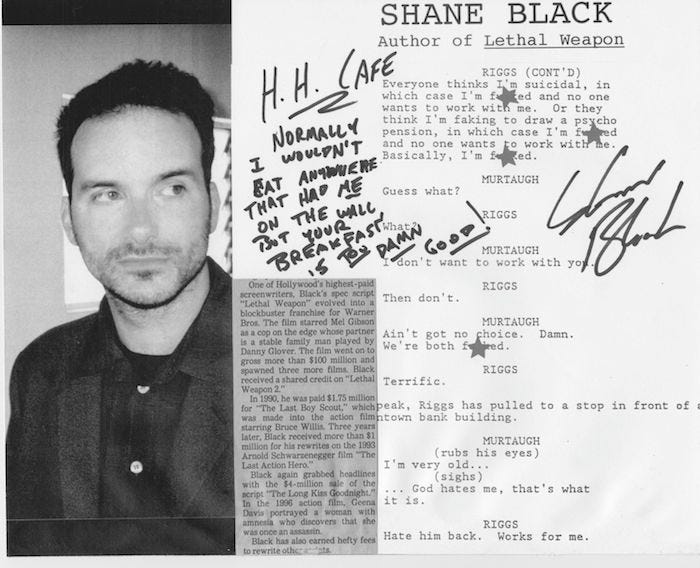
In the past, I’ve mentioned how I immersed myself in scripts when I first broke into Hollywood, reading everything I could get my hands on. In fact, that’s where I came up with many of the ideas about script analysis I’ve laid out in this series. Here’s another one: Go through a script and excerpt all the good, strong visual writing.
In a nice bit of synergy, here is what I did what Shane Black’s script for The Last Boy Scout about 20 years ago:
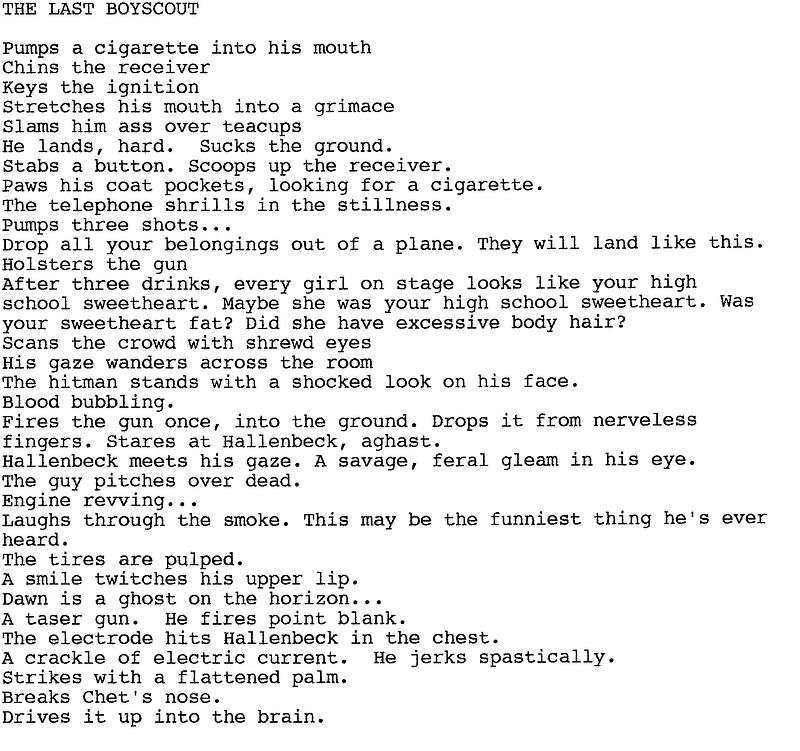
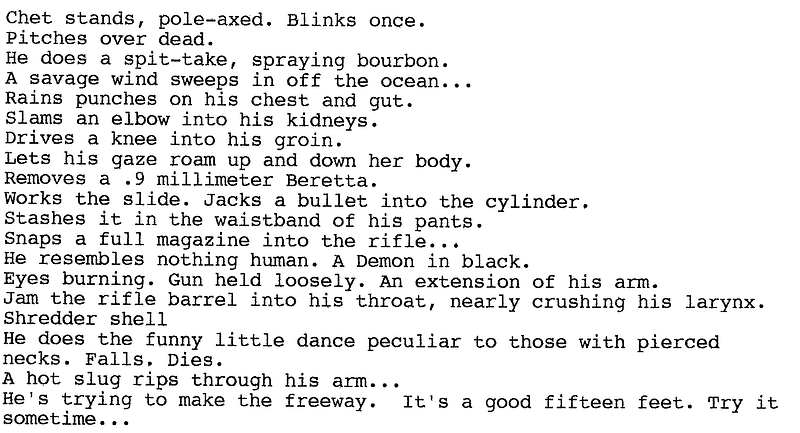
See, I wasn’t lying when I said I did all that script analysis! And check out that action writing and scene description. It’s taut and efficient, yet visual and cinematic. Clearly Black is a writer who loves language and understands the power of words. That is something to which we should all aspire.
You should feel free to play around with your writing style. Read a bunch of scripts, pick up some ideas, then test them out. Eventually you will settle into a style that suits you.
Plus don’t forget the importance of considering your story’s Narrative Voice. You must make choices about style within the context of your story’s genre.
So yet another lens through which to read a screenplay: style and language.

How to Read a Screenplay?
To be clear, I am not proposing you have to read every script to this level of comprehensiveness, however, you should be able to do that. Stories are complex if for no other reason than characters are complex. Therefore, it stands to reason the more screenplays you read, the more you learn. Likewise, the more screenplays you read to depth…
The more depth of understanding you acquire about the look and feel of a screenplay and Story itself.