How to Generate and Critique Story Ideas (Part 5): Gender-Bending
Changing the gender isn’t a minor thing, rather it can alter the entire landscape of a story.

Changing the gender isn’t a minor thing, rather it can alter the entire landscape of a story.
“The best way to have a good idea is to have lots of ideas.” Those are the words of Dr. Linus Pauling, the only person to ever win two Nobel Prize Awards. This is sage advice, especially for writers. A strong story concept is one key to the commercial viability of a novel, short story, or screenplay.
Over the next two weeks, I will run a ten-part series: How to Generate and Critique Story Ideas.
Today in Part 5: Gender-Bending.
What is gender-bending? It’s where you take a story concept and switch a character’s gender.
Gender-bending has been in vogue in Hollywood for decades. Thelma & Louise (1991) is a female variation of Butch Cassidy and the Sundance Kid (1969), two anti-heroes on the run. A League of Their Own (1992) is a female spin of Major League (1989).
Changing the gender isn’t a minor thing, rather it can alter the entire landscape of a story. One of the greatest examples of that is the movie Alien (1979). Its Protagonist Ripley is played by Sigourney Weaver, however the role was originally envisioned for a male actor. Check out this GITS post here about the development of the Ellen Ripley character. Here is a quote from Weaver:
I think what attracted me to Ellen Ripley was she… first of all, a character that was written as a man. So it was written in a very straight-forward way, a kind of direct person where she didn’t have these scenes where she’s suddenly vulnerable, she didn’t throw her hands up and wait for someone to save her. She was a thinking, moving, deciding creature.
By switching genders, Hollywood has taken mundane roles and transformed them into movie vehicles such as Mr. Mom (While Caroline works, Jack stays at home and tends to the family) and Private Benjamin (A sheltered young high society woman joins the army on a whim). Or prestigious positions such as First Monday in October (For the first time in history a woman is appointed to the U.S. Supreme Court).
So what can you do with the gender-bending technique? As an exercise, let’s consider two hit movies from the 1980s and see if we can spin some new life into them. The first one is 3 Men and a Baby, a huge hit in 1987 starring Ted Danson, Tom Selleck, and Steve Guttenberg. Its synopsis:
Three bachelors find themselves forced to take care of a baby left by one of the guy’s girlfriends.
What if we did a gender bend: Three single professional women get stuck with a baby. Or maybe better yet, three college sorority girls. Less mature. More combustible.
As long as we’re on stories with three Protagonists, what about 9 to 5, the 1980 hit comedy starring Jane Fonda, Lily Tomlin, and Dolly Parton. Premise:
Three female employees of a “sexist, egotistical, lying, hypocritical bigot” find a way to turn the tables on him.
What about a contemporary gender bend: Three hectored male employees seek revenge against their tyrannical female boss. Hey, wait. They basically did that with Horrible Bosses!
Consider the newest trend: Shequels! Like Ocean’s 8.
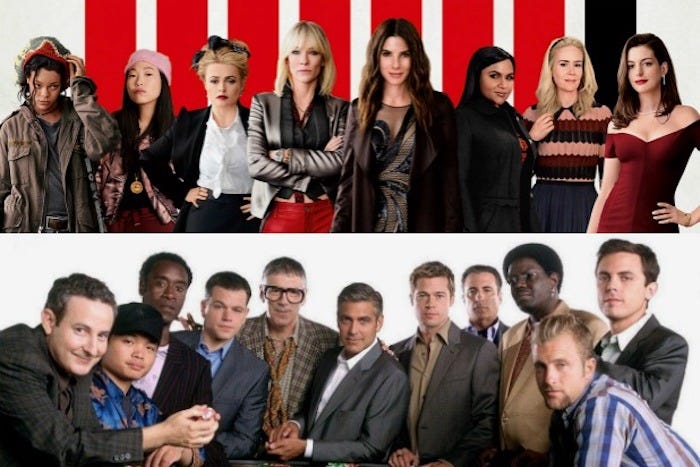
Certainly gender-bending is something to keep in mind when going through Halliwells or just generally brainstorming ideas. A concept may seem rather flat, but then by swapping genders, it takes on a new life. Indeed, you can use gender-bending when developing characters for a story on which you’re working. Perhaps you’re working with a cop and he feels rather cliché, all the way down to the donut habit. What is he is a she? Or there’s a nurse in your story and she feels like a watered down clone of Nurse Ratched. What is you make her a him? Gender-bending can spark new life in a character.
Part 1: What if…
Part 2: Halliwell’s Film Guide
Part 3: Images
Part 4: Titles
Monday: Part 6 of the series How to Generate and Critique Story Ideas.