How to convey a character’s emotional state in scene description?
How much latitude does a screenwriter have to editorialize or comment on a character’s inner state of being?
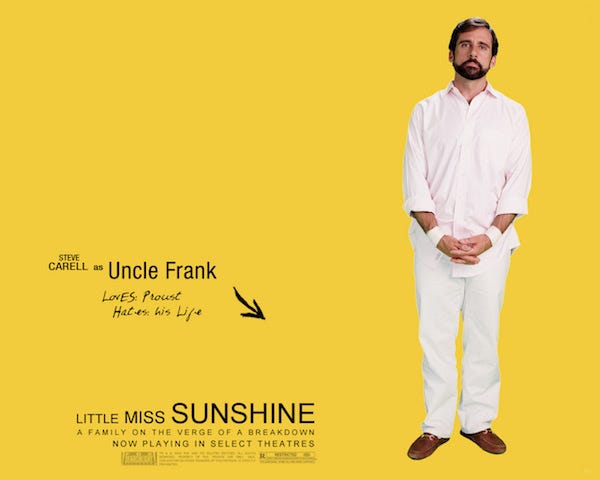
How much latitude does a screenwriter have to editorialize or comment on a character’s inner state of being?
A question from Lalithra Fernando:
So, as a director, I know not to tell actors to be a little angry here, or more happy there. This leads to generic responses in the acting, rather than specific, layered emotional responses.
When you are writing, do you also want to avoid such language?
ie. He stared at the door, angrily.
vs.
He glared at the door.
(pretty wack example, but w/e)
I suppose its about adverbs.
Anyways, when I write it out, it always seems pretty foolish, but the question comes back every time I think I’ve answered it for myself. In need of some clarification.
Lalithra, you raise a good question. On the one hand, there’s the adage about not writing anything in scene description that an actor can’t act and that the moviegoer can’t see — that basically the only thing we, as screenwriters, can include in scene description and parentheticals, is specific directions re a character’s actions. Unfortunately in working with actors, it’s preferable to describe the character’s emotional / psychological state, tied to what plot elements are impacting them at the moment, then allow the actor to translate that into action, as opposed to telling them specifically how to act.
Which is a big reason why the old adage — “only describe what a moviegoer can see” — isn’t a hard and fast rule. In a selling script, it’s almost as important, sometimes even more so to convey the mood and feeling of the moment rather than specific character actions.
Let’s look at some examples from the wonderful script by Michael Arndt for Little Miss Sunshine. First, here is the introduction of Grandpa:
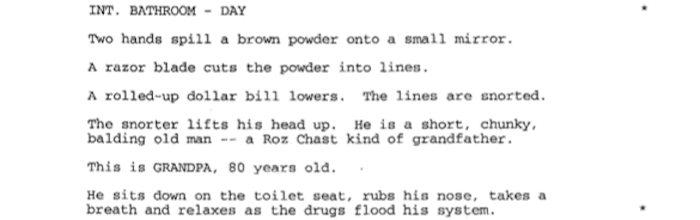

Very straight ahead description. Now let’s look at how Frank is introduced in the hospital after a failed suicide attempt:

With his “empty eyes,” the last line is a bit more about conveying Frank’s mood. This next example is even more inside the character, Frank’s first moment in his new home — Dwayne’s room:
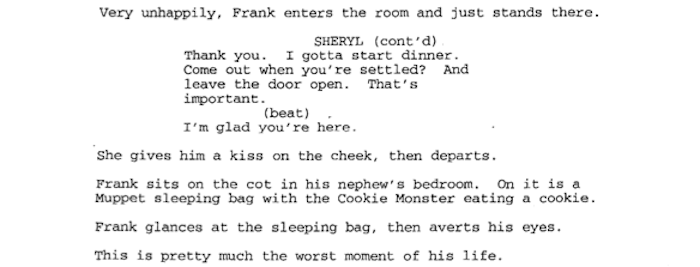
“This is pretty much the worst moment of his life.” Not something a moviegoer could see. Not a description of a specific thing an actor can act. Rather going inside the character to convey to the reader (and the actor) what they’re feeling, the mood of the moment.
Again Arndt uses scene description to comment on a character’s inner emotional state. Here is a moment as the family gathers for dinner:

“He seems to have met someone who is at least as unhappy as he is.”

The reality is this: It is acceptable for a screenwriter to go beyond mere action description and write about the emotional status quo, even to go inside characters to reveal to the reader what they’re feeling. That said, a screenplay is not a novel, so we have to pick our spots.
My advice: Read scripts. Especially Black List and movie scripts from the last ten years. Pay attention to how writers use this type of psychological writing to convey a sense of the moment’s emotion.