How They Write A Script: Walter Bernstein
Walter Bernstein was born 1919 and thankfully is still with us, a screenwriter with a lengthy career in which he managed to survive 4 years…
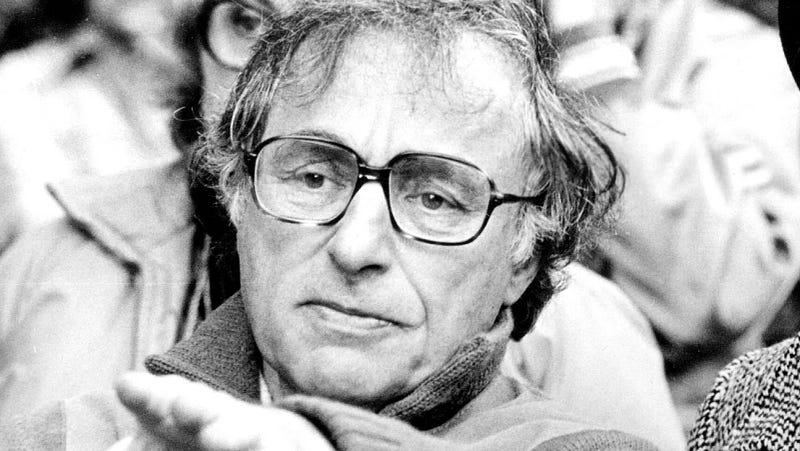
Walter Bernstein was born 1919 and thankfully is still with us, a screenwriter with a lengthy career in which he managed to survive 4 years in the Army during World War II and a stint during which he was blacklisted. Notable films for which Bernstein received credit: Fail-Safe (1964), The Front (1976) for which Bernstein won a WGA Award for best original screenplay, and Semi-Tough (1977).
These interview excerpts are taken from the excellent “Backstory 3: Interviews with Screenwriters of the 1960s”, one of a 4-part series edited by Patrick McGilligan.
ON HIS LIFELONG LOVE OF MOVIES
I didn’t quite know what I was going to do after the war, actually. When I came back from overseas, I found myself a father with a year-old daughter. It was tough to get adjusted. But what I really wanted to do was to go to Hollywood. Movies had always been very important to me… That’s where I lived my real life. My fantasy life was at home. Starting Friday evening, after school and going through till Sunday afternoon, I lived in the movies. There was always this sense of weight dropping off me when they took the ticket and I walked into a moviehouse. It was very palpable, very important. I loved the movies.
ON WHAT HE LEARNED ON HIS FIRST HOLLYWOOD JOB WITH WRITER-DIRECTOR BOB ROSSEN
I learned about moving a story in terms of action — a kind of movie storytelling. At one particular point [in the script of All the King’s Men ] — it sticks in my mind — Rossen was trying to figure out how to tell the audience that the Huey Long character was not just a marvelous idealist. He wrote a scene — he didn’t like it; it was too wordy. Then he came up with some idea of a scene with no dialogue, where Broderick Crawford is eating a piece of chicken as people are extolling him — cutting to him and his indifferent reaction — so that we know that he’s not buying any of it. Things like that — visual detail, not dialogue — I learned that from Rossen.
ON BEING BLACKLISTED
I was blacklisted because my name was in Red Channels. That’s the only thing. I was never named, at least publicly. I was subpoenaed later on, but I never appeared.
For the next eight years, it was a question of getting different fronts and working that way. Around that time, Abe Polonsky came east, and along with another man I had become friends with, named Arnold Manoff, we formed a kind of group, the three of us, trying to get fronts and helping each other get work. We wrote many of the subsequent Danger shows. Then they started a show called You Are There, and we wrote almost all of those under various names.
I also worked on Studio One, Westinghouse, Phiico Playhouse — mostly the one-hour dramatic shows. I did everything from Thomton Wilder’s The Bridge of San Luis Rey to, I remember, an adaptation of F. Scott Fitzgerald’s short story “Rich Boy,” which starred Grace Kelly and was a very successful show.
The front that worked the best for me was an old friend of my brother’s, someone I had known since I was ten years old, who had a job on a trade paper, didn’t want to take any money for being a front, and kind of liked the whole idea of going up to story conferences — the playacting part of it. He was the one I used mostly. He was very helpful.
You think of that period as being such an awful period, and it was. But within that, that sense of friendship and helping each other.
ON “THE FRONT”
I had always wanted to do a comedy. Humor was very much a part of me. In college I was editor of the humor magazine. Even in high school, I wrote a humor column for the school newspaper. It was always there. I just kept it down. I didn’t think it was serious, just as nobody thought going to Hollywood was serious. If you were going to be a writer, you should write plays or novels.
But for a long time, Marty [Ritt] and I had been talking about doing something about the blacklist. We wanted to do a straight dramatic story about someone who was blacklisted. We could never get anybody interested at all. It wasn’t until we came up with the idea of a front and making it as a comedy that we were able to get the film done. The Front became my first true comedy.
We went to David Begelman, who was the head of Columbia then. Being the kind of perverse guy that he is, David gave us some money to do a first draft. It was only after we had a first draft that discussions began about a star. We talked about Dustin Hoffman, A Pacino, or Warren Beatty. Certainly, I saw somebody in the role who was not a conventional leading man. I remember, we were talking about it, and Marty said, “What about that . . . kid?” I said, “What kid?” He said, “Woody Allen.” I said, “What a very interesting idea.” So we sent the script to Woody, and he said yes.
It was a very happy experience for all of us. Whether he would acknowledge it or not. Woody got a great deal from Marty in terms of his acting. He was on the film purely as an actor. He didn’t write anything. He only contributed a couple of jokes. The one time he tried something on the picture was the sequence at the end [of the film] where he’s testifying before the committee. We shot the scene and looked at the dailies, then decided we should make it funnier than it was. Woody said, “Let’s shoot it again, and let me improvise.” Marty set up the camera, and Woody improvised. He was hilarious. Only it had nothing to do with the picture. It was like ten minutes of stand-up comedy. Reluctantly, we couldn’t use it.
In some way, I think that picture released me, because I could do comedy after that. I loved doing Semi-Tough, which was really a social satire — not just about football. Things like The Molly Maguires and The Front, which came from scratch, are very important to me and mean a lot to me. But so does Semi-Tough, although it came from a book [Semi-Tough, by Dan Jenkuis (New York: Atheneum, 1972)]. [The director] Michael [Ritehie] and I threw out the story and wrote one of our own. Michael and I did our own movie, just like Marty and I did our own movies.
ON “THE HOUSE ON CARROLL STREET”
The original script was good — and it was the script that I started out to write. The script that was shot was also my script, however. There’s nothing in it that isn’t mine, so I can’t very well say they took it and changed it. But it got unfortunately watered-down and became kind of a one-note thing that happens to have unfelicitous casting. It doesn’t work.
In general, I’ve been very lucky with directors about my scripts. None of them ever wanted to write or to direct their own stuff. With Sidney, he’d read the script, he’d have very strong ideas about certain things, and that would be it. Marty would always spend more introspective time on a script. The difference is also in their personalities and their characters. Michael’s full of ideas. Sidney’s responses are very quick. Marty was always slower, he thought more, chewed it around.
On The House on Carroll Street, I am tempted to say to people . . . there was more to the original script . . . there was a scene that should have been there and is out . . . and there’s a scene they shot, which they didn’t use. But I feel terrible doing that. I hate myself for it.
ON HOLLYWOOD TODAY
I really try not to fall into the nostalgia trap and say, “Gee, it was better twenty years ago.” One of the last times I had dinner with Marty, he was saying that he felt, in his experience there of the last thirty years, that he has never seen studio executives more incompetent, venal, or corrupt than now. But I don’t have that much to do with people in Hollywood. I find it depressing when I have to go out there and meet with them. I never found it exhilarating, particularly. I do find the standards lower. I really do. I find the standards of literacy lower — film literacy, let alone intellectual literacy. There was never, in my experience, this marvelous Golden Age where all that was done was so sacred. And I feel Hollywood today reflects where this country has been going for the last eight, ten, fifteen years. Why shouldn’t it?
It’s fascinating. Some years ago, I went out to Los Angeles to pitch story ideas. My agent set up meetings with Mike Medavoy, Jeff Katzenberg, and Ned Tanen — whoever. You have these meetings with them and always their two assistants. At the end of the day, I couldn’t remember who was who of the assistants. With beards, without beards — whatever. Depressing. They’re bright but interchangeable.
ON WHY HE KEEPS AT IT
I love movies. I love movies. I still get that frisson when I go on a movie set — the most boring business in the world — but I feel that same thing I felt when I walked on the lot of Columbia in ’47: I’m here! It’s always meant that to me. I’ve always wanted to be part of making movies.
The originals — The Molly Maguires and The Front; Semi-Tough; even though the credit is shared with Collin [Welland], Yanks, which I feel very strongly about; and Fail-Safe. The good ones. But the ones that are not so good I feel are mine too, in the sense that I can’t point to any of the ones I’ve done and say, Well, somebody crapped up my script, because that’s not me up there.
I accept the cooperative nature of filmmaking. It’s one of the things that attracts me to movies, that idea. I love working with other people, so that I never feel, or have never felt — maybe it’s a lack of ego — bitter. I accept the nature of that beast — not just accept it, I like it. When I’m working with people I respect, who add creatively to the whole of the thing, I find it exhilarating. I’m a sucker for any kind of communality or community, anywhere but especially, when it’s working well, within a film.
For more articles in the How They Write a Script series, go here.