How much is enough backstory?
An analysis of the movie ‘Taxi Driver’.
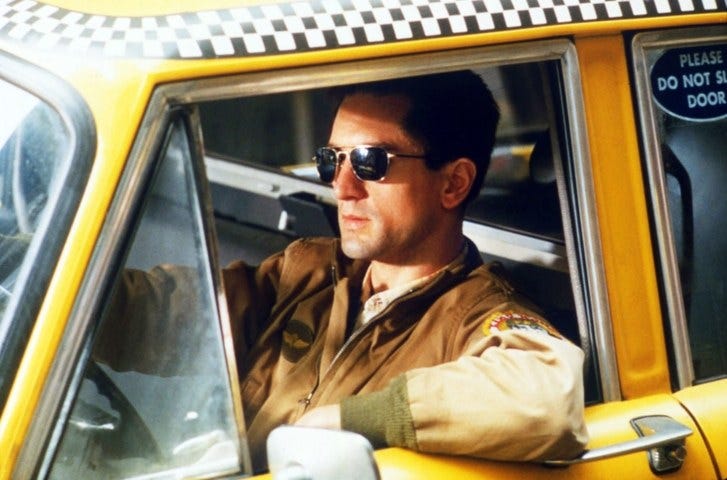
An analysis of the movie ‘Taxi Driver’.
Chris Fanelli sent me an email about the movie Taxi Driver. I thought his comments were quite interesting and asked to reprint them here:
Scott,
I thought you’d appreciate this experience I had the other day. I found it instructive.
Browsing the TV listings, I ran across “Taxi Driver,” a movie I’ve seen probably 10–15 times. I read the guide’s description, which is often a good way to see how someone describes a movie’s logline. I was curious because Taxi Driver has a bit more complexity to its structure than a lot of other movies. On first viewing, the viewer may not connect the dots between the Betsy, Iris, and campaign stories.
The guide’s description read: “After a bad date, a New York cab driver haunted by memories of his time in the service buys several pistols and descends toward madness as he accidentally becomes a hero by shooting an armed robber and killing the pimp of a 12-year-old girl.”
Not a bad summary, except for maybe the part where they give away the climax. But, what really stuck out for me was the phrase “haunted by memories of his time in the service.” I don’t remember that part of the move. Or do I?
How do we know that Travis was haunted by his time in the service? Did Paul Schrader write flashbacks showing Travis in the rice paddies of Viet Nam? Did he have him wake up in cold sweats shouting commands to his platoon? Was there a voiceover where Travis said: “One day a real rain will come and wash all the scum off the street like the scum I saw when I was in VietNam.” Okay. No.
So, I took the opportunity to read the screenplay. As an aside, it’s interesting how much of the film is actually in the screenplay. A lot of the nuanced line readings are actually on the page. Travis has a really awkward way of speaking which is on the page and in the film. Schrader really captures the character. And, as always, it’s instructive to see what was cut out and how much better the film is: for example, the date scene with Betsy is very talky and has a lot of exposition; so is the scene with Andy, the gun dealer; both are much better in the film. In general, the film gives us that air of mystery and disturbing implication about Travis’s character that makes it so compelling.
So, now I’m back to Travis’s backstory and what’s not in the film and/or the screenplay. His description in the opening includes his “Army jacket with a patch reading, ‘King Kong Company 1968–70.’” When applying for the taxi job, he says he had an honorable discharge in the military. There’s a reference to a Vietnamese flag in the scene description of Travis’s apartment. There’s dialogue that’s cut-out of the movie where Andy the gun dealer asks about Travis’s jacket and whether he was in Vietnam. Travis’s answer: “Yeah. I was all around. One hospital, then the next.”
The Army jacket is prominent in the movie. Maybe the flag is in there, too. I’m not sure. But the point is that the backstory is perfectly placed in service of character. I’m not surprised that the person who wrote the cable guide description says Travis was “haunted by memories of his time in the service.” If you saw the movie once you might swear it was in there.
I remember reading something where Schrader describes how he arrived at Travis’s character. To paraphrase, he said he wanted to capture a certain type of loner, a guy who was hanging around during the early 70s, a product of the war and the malaise of the time.
It’s in the script, but it’s not in the script. The audience can connect the dots. They don’t need to be hit over the head with it.
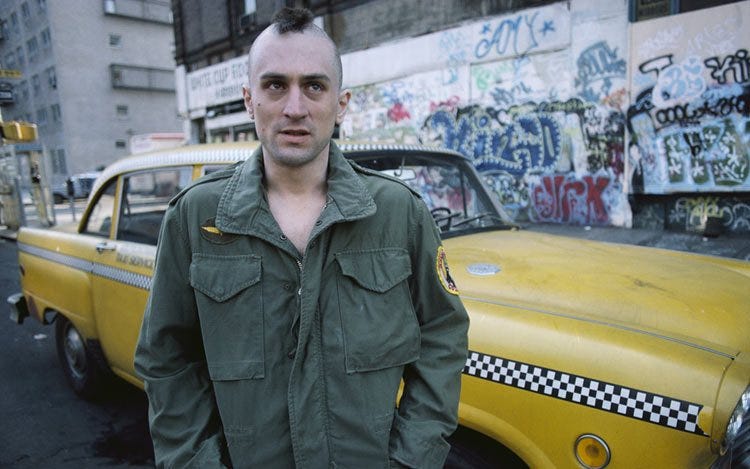
A few things. First, doesn’t this make you want to see Taxi Driver again?
Second, for a writer, the issue of backstory and exposition in a script often boils down to this question: How much is enough / How much is too much? What Chris discovered in reading the script is that there are only a handful of references to Travis Bickle’s past in Vietnam. The effect is to create a ‘shadow,’ the character’s Vietnam experience not impacting him — apparently — in an overt, upfront fashion, but rather looming over him like a ghost. As Chris says, it’s “there, but not there.”
Now I would point out that from what I understand, Schrader worked very closely with the film’s director Scorcese and actors, especially De Niro, so I suppose one could argue that Schrader could afford to go light in terms of backstory in the script, much of the nuance on screen deriving from presumable conversations about Bickle’s character between the filmmakers. However, I think Chris has grabbed onto an interesting distinction here with his analysis: This isn’t a story so much about a Vietnam vet as it is about someone who plumbs the depth of mental illness. Some notes re the movie from IMDB:
The story was partially autobiographical for Paul Schrader, who suffered a nervous breakdown while living in Los Angeles. He was fired from the AFI, basically friendless, in the midst of a divorce and was rejected by a girlfriend. Squatting in his ex-girlfriend’s apartment while she was away for a couple of months, Schrader literally didn’t talk to anyone for many weeks, went to porno theaters and developed an obsession with guns. He also shared with Bickle the sense of isolation from being a mid-Westerner in an urban center. Schrader decided to switch the action to New York City only because taxi drivers are far more common there. Schrader’s script clicked with both Martin Scorsese and Robert De Niro when they read it.
This is corroborated in Marc Norman’s book “What Happens Next: A History of American Screenwriting”:
“[Paul] Schrader probed the edges of Hollywood, working as a reader at Warners for fifteen dollars a synopsis and teaching himself screenwriting by working on an original called Pipeliner, something he hoped to direct. Then [Pauline] Kael called him from New York — a critic’s position was about to open in Seattle and she wanted him to take it, to spread the Kael doctrine. he told her about his screenplay and said he needed to think about it, but she demanded an answer on the spot, yes or not. He told her not, and their friendship ended. Then [Beverly] Walker walked out on him. He was devastated, lonely, stone broke — he’d left his wife for Walker, now he’d made two women miserable. He pondered leaving L.A. but then decided to hurl his bottled rage, his wounds, and his frustration into one more screenplay. He pounded it out in Walker’s empty Silverlake apartment:
Each day I waited for the food to run out and the power to be cut off. There was like three weeks left on the rent. These violent self-destructive fantasies that one normally holds at bay started to prey upon me. I had this old Chevy Nova. I drove around at night drinking scotch and going into the peep shows — those damn 8mm loops where you threw a quarter in to keep the loop going. You passed the point where there’s pleasure involved, and it just became a kind of abnegation. I got an ulcer. I finally went to an emergency room, in enormous pain… While I was in the hospital, I had this idea of the taxi driver, this anonymous angry person. It jumped out of my head like an animal. It was like, ‘Oh, this is a fiction; it isn’t you. Put it in a picture where it belongs and get it out of your fucking life where it doesn’t belong.’
Taxi Driver took him seven days to write.”
To have included more backstory in the script related to Bickle’s experiences in Vietnam could have shifted the narrative away from where Schrader wanted to keep it — on a character’s slide into mental illness. Vietnam no doubt influences Bickle, but his mental illness has its own independent energy at work on him.
That said, if you read a lot of scripts that have gotten produced as movies, you will find this to be true: Almost all of them have more backstory and exposition than the movies themselves. Again that question — How much is enough / How much is too much — comes into play. When we write a selling script, what we call a ‘spec script,’ we often have to include more exposition and backstory in order to translate the story from the printed page into the reader’s mind. Once the movie gets shot and moves into post-production, the director and editor often find that the movie does not need all that exposition, that a viewer, as Chris says, can “connect the dots.”
Which brings me to the third and final point of this point: Reading a script while watching the movie is one of the best exercises you can do to expand your understanding of screenwriting. There are multiple benefits including the fact that you are constantly put into a position of thinking along with the screenwriter, confronting the question of exposition and backstory: How much is enough / How much is too much (i.e., Why did they include this backstory element from the script in the movie, but cut that one). The more you see how it’s handled in scripts and on film, the better equipped you will be to handle it in your own writing.
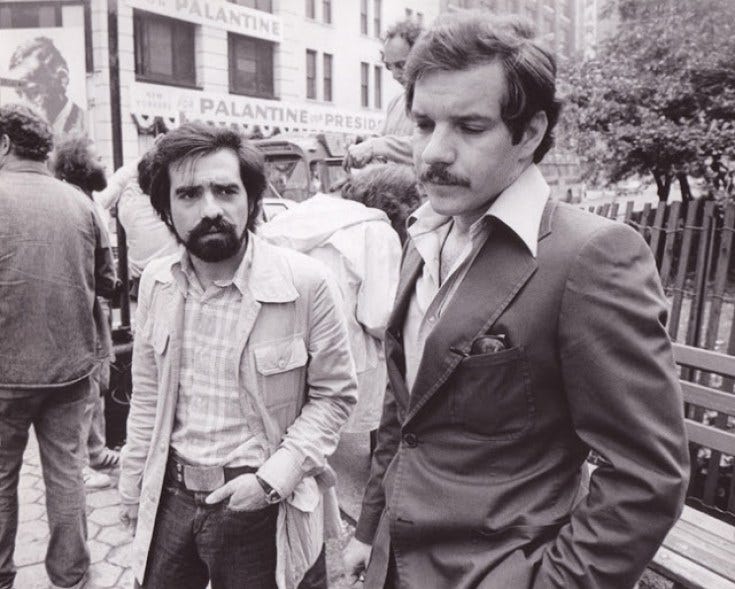
Here are some quotes from a Schrader appearance in Boston last year:
Schrader said there are three movies every director is influenced by: “The Searchers,” “Vertigo” and “Citizen Kane.”
“‘The Searchers’ is one of the top three or four American films ever made,” he said. “It examines a certain kind of man from the darkness of the American psyche, and it’s an extraordinary performance by [John] Wayne.”
— —
Schrader said he has always been drawn to flawed characters.
“Contrast is the heart and soul of character,” he said. “If the characters are really interesting, then that’s enough.”
— —
“When writers make dialogue too punchy, too realistic and too linear, it’s not convincing,” he said. “The mistake that first time writers make is the dialogue is all too linear.”
Good dialogue is about the disconnection, Schrader said.
“[Typical problems might be] answering questions too quickly, not at all, with body language, or a different question all together,” he said. “Dialogue is a tool not to talk to each other, and the audience adds the connective tissue.”
— —
“When writers make dialogue too punchy, too realistic and too linear, it’s not convincing,” he said. “The mistake that first time writers make is the dialogue is all too linear.”
Good dialogue is about the disconnection, Schrader said.
“[Typical problems might be] answering questions too quickly, not at all, with body language, or a different question all together,” he said. “Dialogue is a tool not to talk to each other, and the audience adds the connective tissue.”
For the rest of the article, go here.