How Being a New York Mets Fan Prepared Me to Be a Screenwriter
Is it their two World Series championships? Their five pennants? Their star players like Tom Seaver and David Wright? Nah. It’s their…

Is it their two World Series championships? Their five pennants? Their star players like Tom Seaver and David Wright? Nah. It’s their losing.
I’ve been meaning to write this for a long time. With spring training upon us, I figured… let’s do this.
I have been a lifelong baseball fan. When I was five years old, I was a Yankees fan because everybody rooted for them. In 1958 when the Giants moved to San Francisco, about ninety minutes away from Atwater, California where I lived (my father was stationed at Castle Air Force Base), I switched allegiance to Willie Mays, Willie McCovey, Juan Marichal, and crew. THAT was a team!
Then we moved to Montgomery, Alabama, my father selected for a year-long training at the Air War College. That was a culture shock. Segregation. George Wallace as governor. When John Kennedy was assassinated, some of the boys in my schoolroom class applauded when they heard the news.
On a day to day basis from spring through fall, however, the most startling difference was there was no Major League Baseball team anywhere near Alabama. The Washington Senators and the St. Louis Cardinals were the closest teams, and I didn’t have an interest in either.
However, there was one team which caught my eye, a newly formed National League squad dubbed the New York Mets. In their inaugural season, the team lost a record 120 games.
They lost 3 games for every 1 game they won.
They had moments like this:
During the 1962 season, New York Mets center fielder Richie Ashburn and Venezuelan shortstop Elio Chacón found themselves colliding in the outfield. When Ashburn went for a catch, he would scream, “I got it! I got it!” only to run into Chacón, who spoke only Spanish. Ashburn learned to yell, “¡Yo la tengo! ¡Yo la tengo!” instead. In a later game, Ashburn happily saw Chacón backing off. He relaxed, positioned himself to catch the ball, and was instead run over by left fielder Frank Thomas, who understood no Spanish and had missed a team meeting that proposed using the words “¡Yo la tengo!” as a way to avoid outfield collisions. After getting up, Thomas asked Ashburn, “What the heck is a Yellow Tango?”.
And this:
In one unforgettable game against the Cubs that year, Marvelous Marv, trying to atone for an error the previous inning, came up with a couple of Mets on base and boomed a long triple up the right centerfield alley at the old Polo Grounds. Marv neglected one minor detail — he failed to touch second base — and was called out. As manager Casey Stengel came out to argue, first base coach Cookie Lavagetto grabbed the Ol’ Professor and said, “Don’t bother arguing Casey, he missed first base too. ” The Mets lost, 8–7.
For some inexplicable reason, I chose to become a Mets fan. That’s right. I wasn’t fated to live with this misery. Sixty years I’ve followed the team. During that time, they miraculously won two World Series and five pennants. But their overall winning percentage is .480. That means they lose more than they win. And THAT right there is the first reason why being a Mets fan prepared me to be a screenwriter:
Whenever I go up for a writing assignment… whenever I pitch a project… whenever I write a spec script…
I expect to lose.
Being a Mets fan trained me to be able to live with that… which in Hollywood is a good thing because more often than not… way more often… that’s exactly what happens.
You lose.
Wait. There’s more. My favorite athlete, not just baseball player, overall athlete is this superstar:
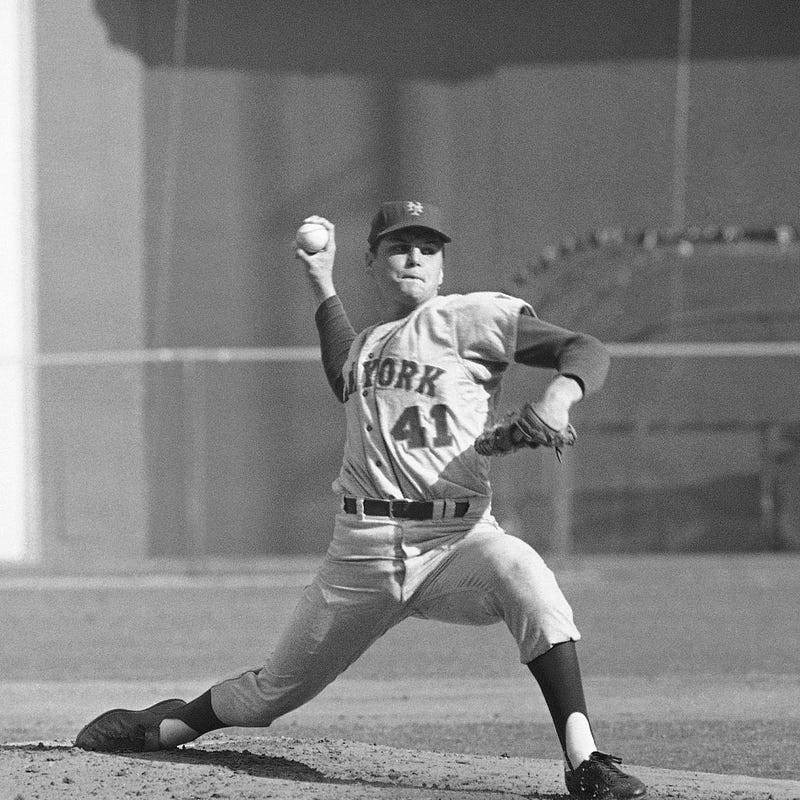
Tom Seaver. In 1967, he was the National League Rookie of the Year with a 16–13 record and a 2.76 ERA for a last place team. The next year, he again won 16 games and struck out 200 batters while the Mets nudged their way up to 9th place, the first time in club history they had not finished in last.
But it was in 1969 when Seaver shined like a golden god. He not only won a league-high 25 games, including 9 consecutive complete-game victories and the Cy Young Award, Seaver led the lowly Mets to their first World Series championship.
A personal anecdote. At the time, I was attending high school in Moreno Valley, California (my father was stationed at March Air Force Base). One of my classes was German. My teacher was Fraulein Gaertner. Back in those days, the World Series was played during the daytime. That was a problem. With the Mets playing the Baltimore Orioles for the championship, how could I follow them while in school?
Here’s where my adolescent genius came into play. Part of German class was to don headphones, listen to tapes, and repeat language lessons dictated by a recorded voice. I thought, “What if I bring my small transistor radio to class, hide it in my pocket, and snake the earphone wire up through my shirt, then stick the earphone under one of the headphones?”
Which is exactly what I did. Things were going along fine until this happened:
The Mets won the game on a crazy play. This after Ron Swoboda, who was absolutely allergic to leather, made an unbelievable catch to save two runs.
Well, when the Mets won, I was overcome with excitement and apparently yelled something like, “YEAAAAAAHHHH!”
Because the next thing I knew, Fraulein Gaertner was standing next to my desk with palm extended. After I deposited my transistor radio and earphone into her hand, she quietly invited me to meet with her after class. In that one on one meeting, this is how our conversation went:
Fraulein Gaertner: Here’s your punishment. You must learn the Pledge of Allegiance in German.
Me: The Pledge of Allegiance? In German? That makes no sense.
Fraulein Gaertner: That’s precisely the point.
So it was that one week later, I found myself standing in front of the class, my hand across my chest, facing the U.S. flag reciting these words:
“”Ich verspreche der Flagge der Vereinigten Staaten von Amerika, und der Republik, für die sie steht, eine Nation unter Gott, unteilbar, mit Freiheit und Gerechtigkeit für alle.”
I doubt any Mets fan has had to suffer this type of ignominy.
I digress.
Back to Tom Seaver. Of course, he would become my favorite athlete. He was The Star of the Mets who led them to World Series fame. Eventually, he would be selected to the Hall of Fame. But he is intimately tied to the second reason why being a Mets fan prepared me to be a screenwriter.
You see, the Mets traded Tom Seaver. Not just once… but twice. The team absolutely crushed my heart two times.
Those two gut-wrenching moments, combined with thousands of other defeats on a daily basis every April through October prepared me for…
Getting replaced on a project by another writer.
Learning that a spec script just sold with the exact same idea I was writing.
To be a screenwriter, you have to expect you will lose more than you will win.
You must be ready to have your heart broken by the whimsy of the business.
The Mets taught me that. They also taught me this:
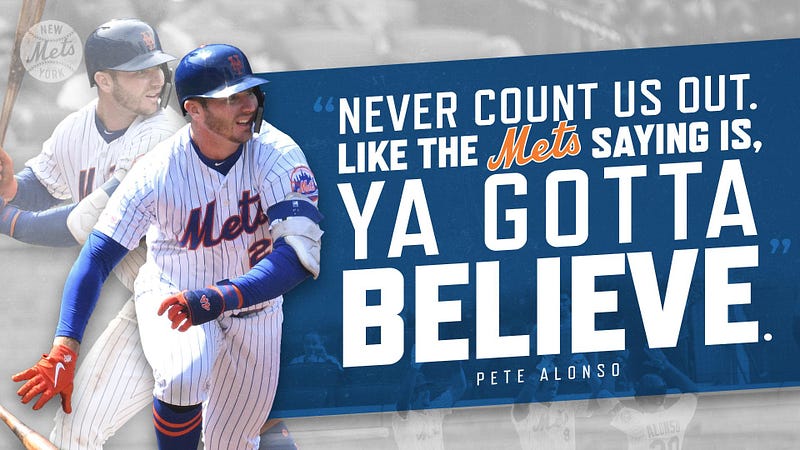
In 1973, the Mets made an improbable run to the World Series and almost won it. They were fueled by a saying coined by reliever Tug McGraw: “Ya gotta believe.” That has been the Mets mantra ever since.
If you’re a screenwriter, you know you’re going to lose more than you win. You know you are going to get your heart broken. But in spite of that…
Ya gotta believe.
Ya gotta believe in yourself… in your creativity… in your voice… in your abilities as a writer… so when someone finally DOES say, “You’re hired”…
You are damn well ready to nail the project.
That’s why being a fan of the New York Mets prepared me to be a screenwriter.