“How 50 Famous Female Characters Were Described In Their Screenplays”
A journey through many scripted female character introductions, both fascinating… and educational.
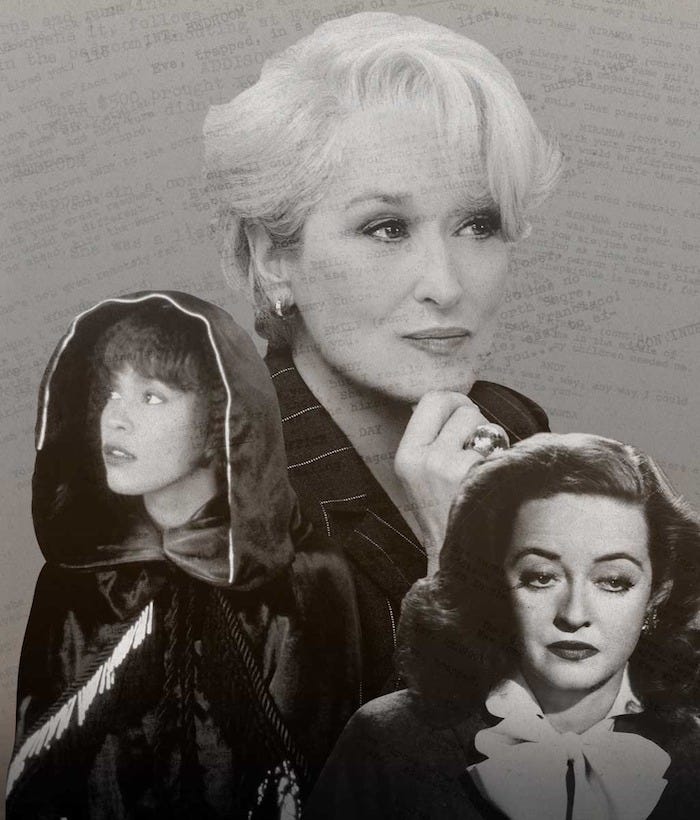
A journey through many scripted female character introductions, both fascinating… and educational.
I’ve written a 12 part series on character introductions which provides basically everything you need to know on the subject. It’s an important topic because first impressions are key, both in real and screenplays, per the latter creating a “lens” through which the reader initially sees each character.
With that as context, check out this excellent Vulture article: How 50 Famous Female Characters Were Described In Their Screenplays. Some excerpts:
How do you create a memorable female character? It helps if you get it right from the very beginning, as Joseph L. Mankiewicz did in his screenplay for All About Eve when he introduced the woman who would be played by Bette Davis. “The CAMERA follows the bottle to MARGO CHANNING,” wrote Mankiewicz in his stage directions. “An attractive, strong face. She is childish, adult, reasonable, unreasonable — usually one when she should be the other, but always positive.”
It’s an indelible description of a complicated woman, one so persuasive that you’d even think Margo exists outside the margins of Mankiewicz’s pages … and in a way, she would, since Davis eventually brought to life what the writer first put to words. Not every screenwriter takes the time to pen such a vivid character introduction — some include few details other than an estimated age or a few quick adjectives, preferring instead to let their dialogue do the talking — but many of our most famous screen women were originally created in those carefully composed sentences that few besides the actress, her writer, and their crew were lucky enough to read.
It’s always fun to get a peek behind that curtain, but why settle for just a peek? Vulture has rifled through countless old screenplays to find the descriptions for 50 notable female characters, which we present to you below. The women are young and old, heroine and foe, star and supporting character, but they were all born on the page. Some interesting, sometimes frustrating trends emerge in the details; you may not be shocked to learn that most of these writers spend far more time describing the female character’s level of beauty than they do her male counterpart’s. But whether the descriptions are well-written or problematic, they offer plenty of insight into how Hollywood views women and creates roles for them.
Right off the bat with the Margo Channing introduction from the 1950 Oscar-winning movie All About Eve, we have yet more proof to shoot down anyone who states there’s a rule that screenwriters can only describe a character’s physical traits, not veer into so-called ‘unfilmables’ by providing a sense of their psychological nature. “She is childish, adult, reasonable, unreasonable — usually one when she should be the other, but always positive.” That it NOT physical description, rather it describes her PERSONALITY.
Other examples from the Vulture article:
NORA CHARLES, Nick’s wife, is coming through. She is a woman of about twenty-six… a tremendously vital person, interested in everybody and everything, in contrast to Nick’s apparent indifference to anything except when he is going to get his next drink. There is a warm understanding relationship between them. They are really crazy about each other, but undemonstrative and humorous in their companionship. They are tolerant, easy-going, taking drink for drink, and battling their way together with a dry humor. — The Thin Man
Lydia is cool, Lydia is sullen, Lydia is her father’s daughter by his first marriage. Lydia is usually about half-pissed off. But underneath… we like her a lot. — Beetlejuice
Words flow from her Southern lips with ease, but her view of the world crosses Southern, National and International borders. She’s cosmic. — Bull Durham
A few years back in a week-long Black List / Women In Film Feature Writers Lab for which I was one of the mentors, we spent ninety minutes with Aline Brosh-McKenna (The Devil Wears Prada, Crazy Ex-Girlfriend) who specifically said about character introductions to focus more on the “vibe of the character” than physical description. Her suggestion was for writers to use this prompt when writing a character introduction: “She’s the kind of person who…”
So PLEEEEAAAASSSEEE, for the love of God, let’s dispense with this nonsense about a rule restricting what you can write when introducing a character.
If you ARE going introduce a female character — or male for that matter — by focusing on their physical attributes or attire, do what many of the examples cited in the Vulture article do: Make a connection between those physical attributes and how they reflect the personality of the character. Like these:
Lisbeth Salander walks in: A small, pale, anorexic-looking waif in her early 20’s. Short black-dyed hair — pierced eyelid — tattoo of a wasp on her neck; probably several more under her black leather jacket — black t-shirt, black jeans, black Caterpillar boots … This isn’t punk fashion. This is someone saying, Stay the fuck away from me. — The Girl With the Dragon Tattoo
MARY — INCREDIBLY LARGE, OILY SKIN, UNKEMPT HAIR, AND WEARING A GRIMY HOUSE DRESS sits on the couch with her back turned to Precious. This mass of woman looks as if she is one with the furniture — if not the entire apartment. — Precious
Leaning against the back of the elevator is Corky, a very butch-looking woman with short hair and a black leather jacket. She is a lesbian and wants people to know it. — Bound
KAT STRATFORD, eighteen, pretty — but trying hard not to be — in a baggy granny dress and glasses. — 10 Things I Hate About You
We see more flashes of MIRANDA… $2,000 crocodile Manolos, Chanel jacket, perfect hair, fabulous Harry Winston earrings… [until] MIRANDA steps out of the elevator and for the first time we see her head-on. MIRANDA PRIESTLY, in all her glory. She is stunning, perfectly put together, a white Hermes scarf around her neck. MIRANDA’S look is so distinctive you can spot her a mile away. She is unlike any other beautiful woman, singularly MIRANDA. — The Devil Wears Prada
I don’t mean to suggest you cannot opt to introduce a character strictly describing them physically. More examples from the Vulture article:
Phyllis Dietrichson stands looking down. She is in her early thirties. She holds a large bath-towel around her very appetizing torso, down to about two inches above her knees. She wears no stockings, no nothing. On her feet a pair of high-heeled bedroom slippers with pom-poms. On her left ankle a gold anklet. — Double Indemnity
Her name is NOMI MALONE. She looks from a distance like a kid. She stands along the Interstate, outlines in the shadows of the setting sun. She’s got a big American Tourister in front of her with a sign on it that says: “Vegas.” The suitcase looks like it’s been dropped from a plane or something. She’s wearing a baseball cap, a worn black leather jacket, torn jeans, and time-kissed cowboy boots. She’s got her thumb out. — Showgirls!
In both cases, we’re learning something about the characters via what we can see in the physical realm. Everything about Nomi suggests she’s definitely on the low-end of the socio-economic strata, all of her clothes and suitcase suggest well-worn. Meanwhile, while screenwriters Billy Wilder and Raymond Chandler stick pretty much to the attire, such as it is, that Phyllis wearing when she’s introduced, that combined with a few crafty descriptors — “her very appetizing torso… wears no stockings, no nothing” — evoke a sultry, seductive tone.
Bottom line, treat each time you introduce a new character as a way to securely place them in the reader’s minds-eye. Be intentional about how you want the reader to THINK and FEEL about the character, tipping them off to something ESSENTIAL and IMPORTANT about them. The secondary benefit of approaching character introductions in this way is by presenting each character as unique in their own way, you help the reader distinguish between each of them in putting together the ‘roster’ of your story’s players.
For the rest of the Vulture article, go here.