Hollywood and the ‘Similar But Different’ Business Model
The saga of K-9 and Turner & Hooch provides an object lesson into the mindset of movie development executives.
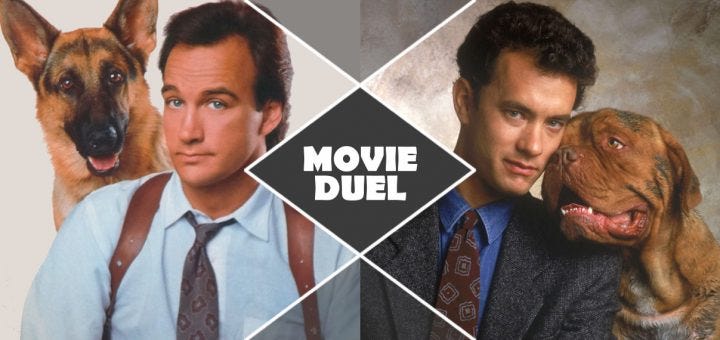
The saga of K-9 and Turner & Hooch provides an object lesson into the mindset of movie development executives.
Every few weeks, it seems like I’ll get an email from a writer which goes something like this:
Fuuuuck! This spec script I’ve been writing for the last three months, I just found out there’s another project just like it already in development. I’m screwed!
My response is pretty much always the same: Hollywood has operated with a ‘similar but different’ business model almost since its inception. For example, one of the first notable narrative films was The Great Train Robbery which was released in 1903.
In 1905, the Thomas Edison company released The Little Train Robbery:
You know, it’s similar to The Great Train Robbery… only the trains are little!
The question is why does Hollywood operate with the ‘similar but different’ model, as evident in all the remakes, reboots, prequels, and sequels?
There are many reasons. Here are the biggest two.
The increasing importance of marketing: The simple fact is after the acquisition of a project, years of rewrites, talent falling in and out, battles over budget, months of pre-production, production, post-production, none of it matters one whit unless the studios can sell the movie. And in an increasingly noisy world with consumers bombarded by advertisers on all sides, a studio’s task of getting the message out about a movie has become harder and harder.
If the movie’s concept or storyline has a familiar ring to it, so the marketing theory goes, it’s more likely to connect with consumers. And if a consumer remembers some aspect of a movie’s ad campaign, the odds increase exponentially they will be motivated to get off their fanny, drive to the local Cineplex, and actually buy a movie ticket.
Think of the sport of stock car racing. A competitor can position themselves after the leader and benefit from reduced air resistance by taking advantage of the slipstream. Likewise if a studio can position a movie similar to a preexisting property — (e.g., movie, TV series, book, graphic novel), the movie can reduce the amount of ‘drag’ in the marketplace because consumers will already have some awareness of the title.
Hence the value of similar. The different component should be obvious: the story can’t be exactly the same as the preexisting title, it has to be spun enough to make the consumer think they’ll be viewing something… well… different.
So from a purely marketing standpoint, similar but different is supposed to make selling the movie easier and more effective. That’s the first reason. The other reason lies at the heart of the studios’ decision-making process regarding movie deals:
Fear of making a mistake: Studio executives are afraid to commit to projects because if a movie they’re associated with bombs, it doesn’t bode well for their careers. This is especially true with the current climate where the major Hollywood studios are all part of major corporate conglomerates which means pretty much everything boils down to profits.
Flops make bad things happen.
The 1981 historical epic Heaven’s Gate, subject to massive cost overruns, essentially killed United Artists. The 1987 comedy Ishtar was perceived as being such a bomb, it led to Coca Cola selling Columbia Pictures to Sony.
And a studio exec’s fear is not only based on the prospect of giving a green light to a project that flops; they also have to be worried about passing on a project that turns out to be a big hit elsewhere such as the case of the Twilight movie series to which Paramount once had the rights, but let slip away to Summit Entertainment. That’s over $500 million in box office receipts Paramount could have included in their revenues, but did not because their execs decided to pass on it.
Big budgets. Pressure if they say yes and a movie tanks. Pressure if they say no and a project does well elsewhere. All of that translates into a subtext of fear. And that translates into yet another reason why similar but different rules the roost in Hollywood today. If a studio green lights a body-switch project that is similar but different to a movie that was successful, they have a built-in excuse: “Hey, their body-switch movie was a hit.”
So when a writer confronts a situation in which one project is similar to another one already in development, it’s not necessarily a negative. In fact, sometimes it can be a positive.
Here’s a personal anecdote as an example.
When Universal bought my spec script K-9, my writing partner and I did the whole bottle water tour around town, met just about everybody. At Disney, we met with an exec who after the requisite 5 minutes of schmoozing, said, “You know, we were gonna sue you guys.”
I blinked. Huh?
“Yeah, we’ve got this project in development… Turner and Hooch. About a cop and a dog.”
Of course, we’d never heard of it and for good reason. The project was DOA, languishing in development hell. The exec said he was joking, but this is no joke: After K-9 sold, the execs at Disney in effect went, “Wait a minute, if Universal sees potential in a cop and dog story, maybe we should resurrect Turner & Hooch.”
Which is precisely what they did. So the fact K-9 was similar to T&H was the big reason they resuscitated that project. Then it became a race to see who would get their cop and dog movie into theaters first.
A few years back, I met Jack Epps, Jr. who co-wrote Turner & Hooch with his writing partner Jim Cash. We had a few laughs about the hectic competition between the two cop-and-dog projects, and he confirmed that it’s likely Disney would never have made Turner & Hooch if Universal hadn’t bought the spec script K-9 in a splashy high-six figure deal.
So whenever someone emails me saying, “OMG, I just learned about this project in development and it’s similar to mine,” I always tell them check it out, see how similar and how different. If it’s different enough, the similarity can be a strength to the project.