Here’s to Us Night Owls!
“The conventional wisdom is that morning people are high achievers, go-getters, while late risers are lazy. But what if going to bed in the…
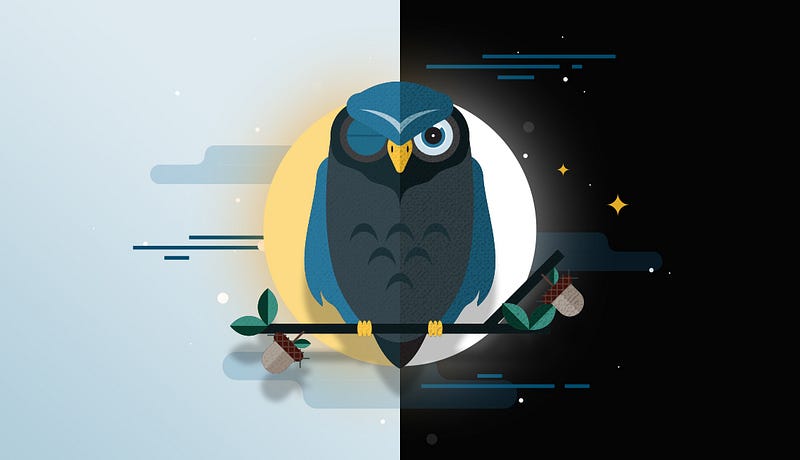
“The conventional wisdom is that morning people are high achievers, go-getters, while late risers are lazy. But what if going to bed in the wee hours is actually an advantage?”
To my recollection, I have always been a night owl. In junior high school, the family routine may have been for me to go to bed by 9PM, that didn’t mean I went to sleep until a few hours later. By the time I reached high school, lights out translated to midnight. As far as college and graduate school were concerned, I rarely went to sleep before 2AM.
Setting aside my interest in creativity, I guess it’s no surprise I followed this ‘career’ path:
Musician → Stand-Up Comedy → Screenwriter
Each of them involved performing and/or writing at night, oftentimes into the wee hours.
Let me put it this way: I have gone to sleep as the dawn was breaking more times than I have awakened at sunrise.
The way society is structured has made me feel at odds with ‘normal’ people almost my entire life. But perhaps normal is going through a transformation. That is the conclusion of this New York Times article: Maybe Your Sleep Problem Isn’t a Problem.
I hate that Delta Air Lines commercial, the one called “4 a.m.,” that mocks me from my in-seat screen.
It starts off with a montage of perky professionals, rising before dawn in homes and executive-class hotel rooms around the world, stretching their gym-toned bodies and firing up coffeepots at an hour usually reserved for mating fruit bats.
“Here’s to all 180 million of you early risers, go-getters and should-be sleepers,” the voice-over says, as Disney’s “Heigh-Ho” swells in the background. “Because the ones who truly change the world are the ones who can’t wait to get out in it.”
Yes, I get it. I have heard this all my life: Society likes morning people. Loves them, actually. Early risers tend to be more punctual, get better grades in school and climb up the corporate ladder. These so-called larks are celebrated as the high achievers, the apple polishers, the C.E.O.s.
It’s basically the idea that Ben Franklin touted more than 250 years ago — “early to bed, early to rise” — with everyone else cast as lazy or self-indulgent.
But what if they are wrong? What if night owls are actually the unsung geniuses? What if we are the ultimate disrupters and rule changers, the ones who are better suited to a modern, postindustrial society ruled by late-night coders, digital nomads, freelance moguls and co-working entrepreneurs?
Perhaps it is finally time for the night owls of the world to rise! (Just not too early, of course.)
The article goes on to discuss Delayed Sleep Phase Syndrome (D.S.P.S.), Chronotypes, and that “employees who started work earlier in the day were rated by their supervisors as more conscientious, and thus received higher performance ratings.” There’s even a gene mutation which suggests that night owls are in effect mutants.
Decades of leading a life schedule against the tide of ‘normal’ people has already convinced me of that, so nothing new there. But this is new:
But what if the modern-day workplace no longer operates under that formula? What if being a night owl is no longer a handicap, but an asset?
Enter the concept of ‘hacker hours’:
“I was never a morning person,” Mark Zuckerberg, the Facebook founder, said in a 2016 Facebook video interview with Jerry Seinfeld. He reportedly rises around 8 a.m., hours later than traditional executives, but perfectly in line with hacker hours that prevail in Silicon Valley.
“The most productive coders I know — and writers and probably a lot of other creatives,” said Tim Ferriss, the life-hacking author and tech investor, “tend to do a lot of their best work when others are asleep, at times that coincide with the fewest inbound distractions.”
Tech entrepreneurs are even advertising their night owl tendencies as a status symbol.
Aaron Levie, the chief executive of Box, told Fast Company that he usually sleeps between 3 and 10 a.m. “I don’t use many apps,” he said. “I use naps.”
Another next-generation tech titan, Alexis Ohanian of Reddit, is similarly boastful about his late hours, saying that he usually goes to bed around 2 a.m. and rises around 10 a.m., or whenever when his cat wakes him.
The traditional 9-to-5 workplace is starting to fall out of favor, especially in Silicon Valley and creative sectors where the workday is no longer tied to daylight hours. And, with robots and artificial intelligence further eroding the old system by taking over the routine tasks, the new workplace culture is less about punctuality and more about creativity and breaking the rules.
— —
This may not be a coincidence. The very essence of our chronotype makes us oddballs, prone to looking at life through a different lens. We are the weirdos who feel most alive skulking through the darkness, secure in the illusion that we own the world for at least a few precious hours every night while everyone else slumbers.
In those wee hours, we feel the freedom to think any thought, dream any dream, safe from the scrutiny and judgment of the strait-laced world.
Now we’re TALKING! A little love for us night crawlers, stalking through the evening’s murk into our creative nooks and crannies. Something about the deep, dark silence brings us alive like productive little vampires sucking on the marrow of our creativity.
I use the morning to prepare myself for the rest of the day. Read a poem. Journal. Exercise. Handle emails. Late breakfast. I write in the afternoon and after midnight. I never schedule a class before noon. Toss in an occasional 20 minute nap, I’m good to go for several more hours.
Takeaway: If you’re a writer, it’s critical to determine when you are at your best creatively. Morning. Afternoon. Night. Late night. Whatever your circadian cycle, try to organize your life so you can tap into that prime time for your writing.
If you’re a night owl, you don’t need to shame yourself into waking at 4:30AM and writing before heading to the office. That works for some people. Not you. Align your writing time with your body’s creative time.
Perhaps as society shifts from an agrarian to a hacker’s time schedule, we may be witness to this:
Fast-forward to 2025, say, and I settle into my seat on a Delta flight, perhaps a supersonic one, to be greeted by a new commercial. It starts off with a montage of perky professionals in executive-class hotel rooms around the world, firing up the kettle for chamomile tea and furiously tapping away at laptops as they race to meet deadlines at an hour usually reserved for James Corden’s “Carpool Karaoke.”
“Here’s to all 180 million of you late risers, night crawlers and can’t-get-to-sleepers,” the voice-over says, as Eric Clapton’s “After Midnight” swells in the background. “Because the ones who truly change the world are the ones who are still at it when everyone else is fast asleep.”
For the rest of the New York Times article, go here.