Happy Birthday, Joseph Campbell!
Joseph Campbell’s birthday is today. If he were alive, he would 117 years old. His physical body died in 1987, but his ideas live on.
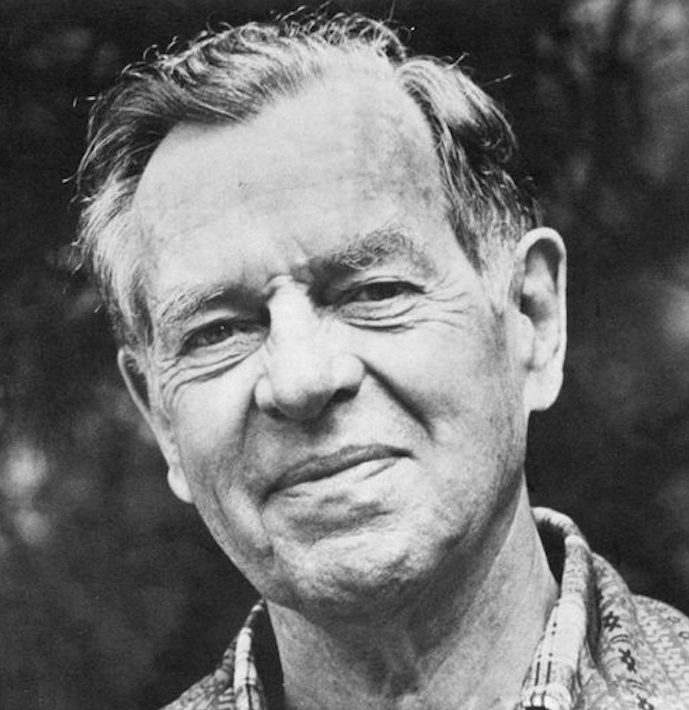
Joseph Campbell’s birthday is today. If he were alive, he would be 117 years old. His physical body left us in 1987, but his ideas live on.
He was a fascinating guy. I first studied Campbell’s work as an undergraduate at UVA, so originally I thought of him strictly in terms of academics. Then when I first made the rounds of studio execs and producers in 1987, I was shocked to see Campbell’s seminal book “The Hero With A Thousand Faces” in their offices. That’s when I discovered that George Lucas had used Campbell’s ideas in shaping the original Star Wars movie.
Beyond Campbell’s articulation of character archetypes and mythic elements, I think that the core reason why his idea of The Hero’s Journey, or as it’s sometimes called the “monomyth”, has taken root in the culture of contemporary screenwriting is the dynamic of transformation. The arc of the Protagonist, starting out the story in one state of being, then ending up in a different psychological “place,” is prevalent in most mainstream commercial Hollywood movies and television series.
In the wonderful PBS series “Joseph Campbell and The Power of Myth”, which I highly recommend, Campbell provides a succinct version of the hero’s journey. Here it is in his own words:
The Hero is found in the ordinary world…
In ancient myths it used to be the cottage or village…
In films, it is usually the suburbs or common urban environment.
The Hero is making do, but feels something missing from their life…
a sense of discomfort or tension.
The Hero needs to change, even if they are unaware of that need.
Something happens…
Maybe the Antagonist enters the Protagonist’s world, disrupting it.
Or maybe someone comes, a Herald, who calls the Protagonist to action.
The call to adventure is about transformation and that’s terrifying.
The Hero has to confront fear.
Will the Hero survive?
Will they change for the Good or the Bad?
During the first half, the Hero is tested…
The Hero has to determine the rules of the Extraordinary World into which they are moving.
Who can the Hero trust?
Along the way, the Hero meets “threshold guardians,” people who guard the entrances.
The trick to facing any opponent is to get into their skin, understand their habits… maybe make them friends and allies.
The midpoint from a mythological standpoint is that moment when the Hero confronts that which they fear most, often related to entering the headquarters of the enemy.
Afterwards, the Hero feels the consequences of the Midpoint…
Reflects on their task, often a chance to rest…
Then a chase scene often occurs…
The enemy has been struck a mighty blow, but recovers enough to mount one final act.
A black moment where it looks like all is lost, there is no way to defeat the enemy.
The final test…
To demonstrate whether the Hero has learned his lesson or not…
The process has purified him to ensure that he hasn’t become part of the Other World… but will he succeed?
The Hero returns home with some booty, an elixir, the source of power from the Other World, i.e., treasure, Holy Grail, knowledge, gold, love, wisdom, humility.
In the end, the Hero is a transformed individual.
We may tend to think of the hero’s journey as a series of events, however, Campbell was clear: The entire point of the journey is the transformation of the hero. They need to change. The specific happenings of the plot and the characters with whom the heroine intersects serve and support their journey into and through metamorphosis.
Here are links to a series of posts I wrote featuring Campbell quotes:
Day 1: “We must be willing to get rid of the life we’ve planned, so as to have the life that is waiting for us. The old skin has to be shed before the new one can come.”
Day 2: “The privilege of a lifetime is being who you are.”
Day 3: If we fix on the old, we get stuck. When we hang onto any form, we are in danger of putrefaction.”
Day 4: “When you follow your bliss… doors will open where you would not have thought there would be doors; and where there wouldn’t be a door for anyone else.”
Day 5: “The warrior’s approach is to say ‘yes’ to life: ‘yes’ to it all.”
Day 6: “When we quit thinking primarily about ourselves and our own self-preservation, we undergo a truly heroic transformation of consciousness.”
Day 7: “Your sacred space is where you can find yourself again and again.”
Day 8: “It is by going down into the abyss that we recover the treasures of life. Where you stumble, there lies your treasure.”
Day 9: “All the gods, all the heavens, all the hells, are within you.”
I begin every university class I teach — Day 1, Week 1 — with my “sermonette” about “Follow your bliss.” I end every class the same way. I tell my students, “This may be the single most important thing you learn from our time together.”
Find that which enlivens you. Gives you joy. Something for which you have talent. Something you can share with the world. That is your bliss and if you find it, follow it, whether vocation or avocation. It may not bring you financial success, but it will align you with the most authentic version of your Self… and give you a chance to live a deeply meaningful life.
Here is the man himself talking about “follow your bliss.”
For more on Joseph Campbell, go here.