Great Scene: “The Shawshank Redemption”
Red’s parole board scenes — three of them — are their own mini-story.
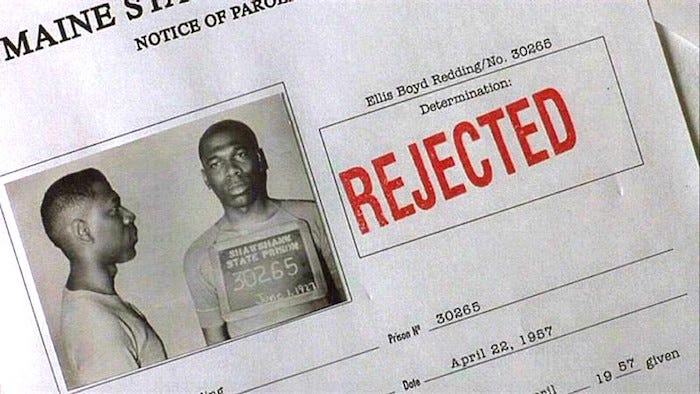
Red’s parole board scenes — three of them — are their own mini-story.
Perhaps my very favorite movie experience was attending the premiere of The Shawshank Redemption. At the time, I was writing a movie for Castle Rock which produced Shawshank, thus the invite for my wife and me. I remember stumbling out of the theater, driving straight home, and composing an email to Martin Shafer, then president of Castle Rock, extolling the movie.
And then… the movie tanked at the box office grossing a mere $28,428,150. So how did Shawshank become such a beloved movie and end up as the #1 rated film on the IMDb Top 250?
Largely on multiple airings on the cable network TNT.
Today, we focus on a great scene in The Shawshank Redemption. But which one? The trial? Suds on the roof? Mozart? Brooks’ suicide? Andy’s escape? So many memorable scenes. And I’ve chosen this one — Red’s final parole board hearing — because it represents perfectly a payoff scene. Twice before, Red sits in the same chair in front of the same type of soulless, dreary people — the first time we meet Red in the movie in 1947:
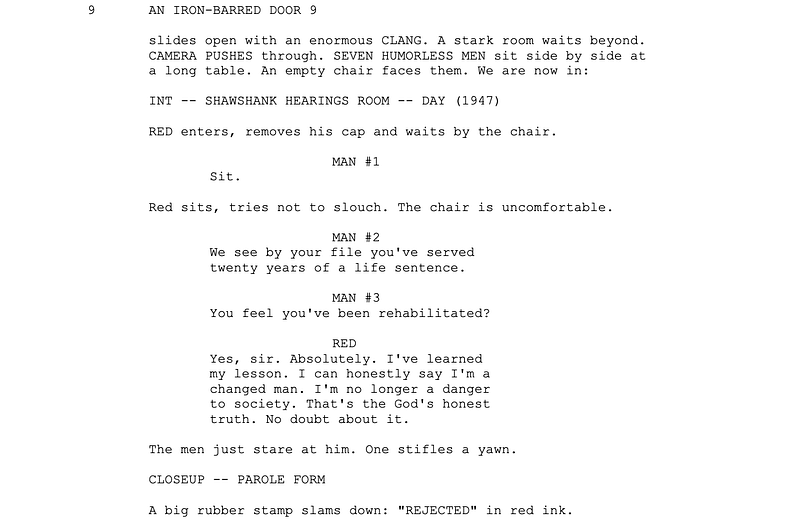
Then again in 1957:
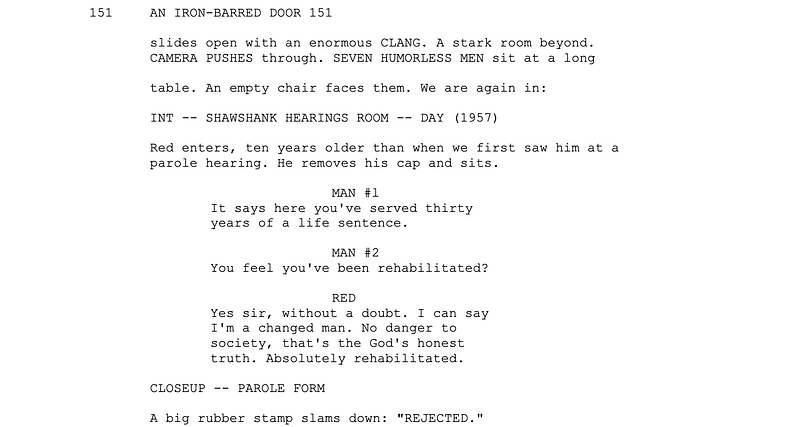
Both times, the scene ends with a big rubber stamp slamming down: “REJECTED.”
Now it’s the third time in front of the parole board in 1967:
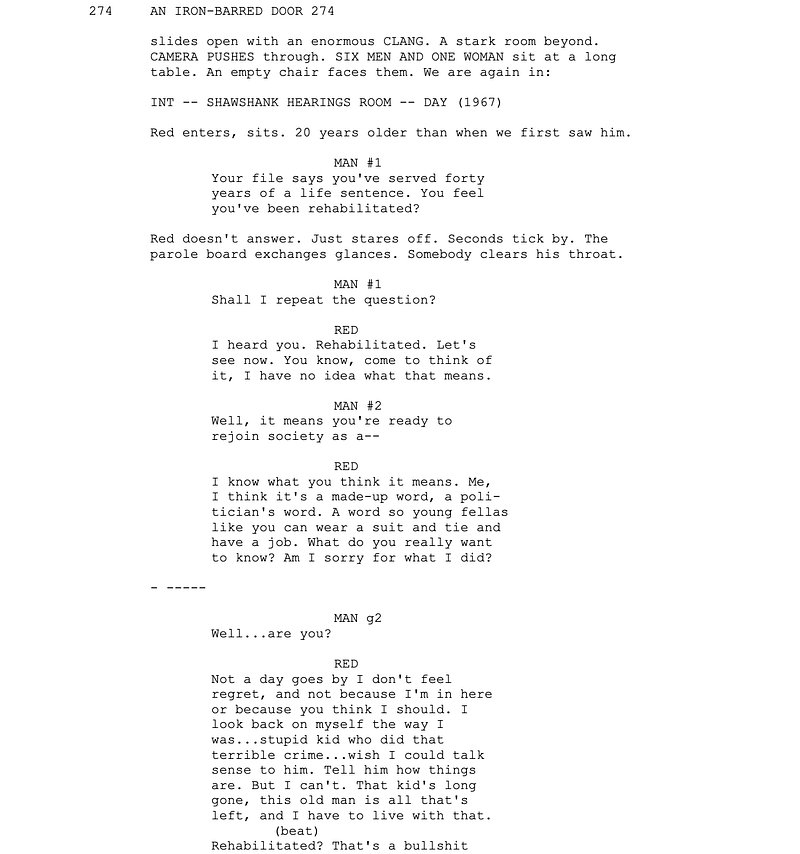

Red comes clean, no more spouting off what he thinks the boards wants to hear, but a true confession from his soul leading to this:

Here’s the movie version of all three scenes back to back to back:
What is different about Red the third time around? Why does he change his tune with the board? Here’s my theory. Remember, Red’s third parole scene is after his final interaction with Andy before Andy’s escape.
The writing in this scene is remarkable because it covers so much territory including planting the “seed” of Zihuatanejo in Red’s mind. But before that key point, there is this:
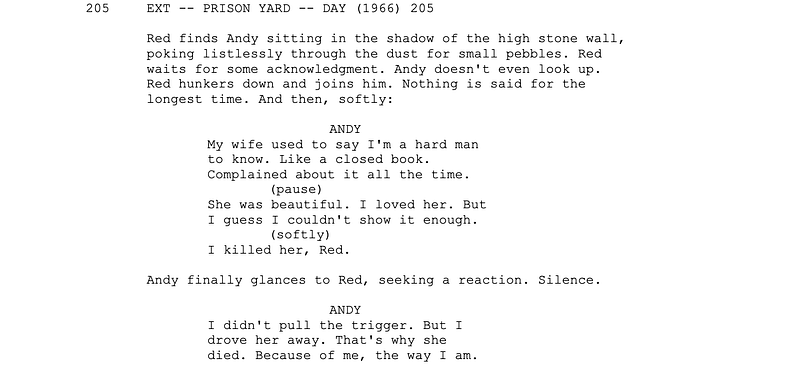
Andy makes a confession: He bears responsibility for the crime of his wife’s death. In other words, he tells the truth.
What does Red do in that third parole hearing? He tells the truth. In fact, check out how he caps off his “confession”:
Truth is, I don’t give a shit.
That’s telling the truth.
I think Red was inspired by Andy. Of course, Andy inspired Red on many occasions, so this particular lesson about the importance of “confessing” one’s innermost truths is not surprising. But it is impactful witness Red’s change of attitude in his third and what turns out to be final parole hearing.
For more articles in the Great Scene series, go here.