Great Scene: “Se7en”
One of the most darkly compelling endings in recent movie history.
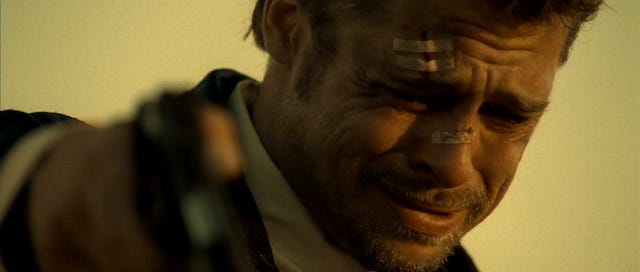
One of the most darkly compelling endings in recent movie history.
When a movie builds to the climactic face-off between Protagonist and Nemesis, I call that the Final Struggle. Typically it’s a case of fists-versus-fists or guns-versus-guns. But the movie Se7en (1995), written by Andrew Kevin Walker, provides an unorthodox twist — befitting a movie with so many plot surprises: The Final Struggle takes place largely within the Protagonist, a battle between will and hatred, logic and the desire for revenge.
Young Detective David Mills (Brad Pitt) and veteran Detective Lt. William Somerset (Morgan Freeman) have escorted serial murder suspect John Doe (Kevin Spacey) to a remote desert location. From nowhere, a van rolls up. Somerset heads off to stop the van. The driver emerges, there to deliver a box. And that’s where this scene begins:
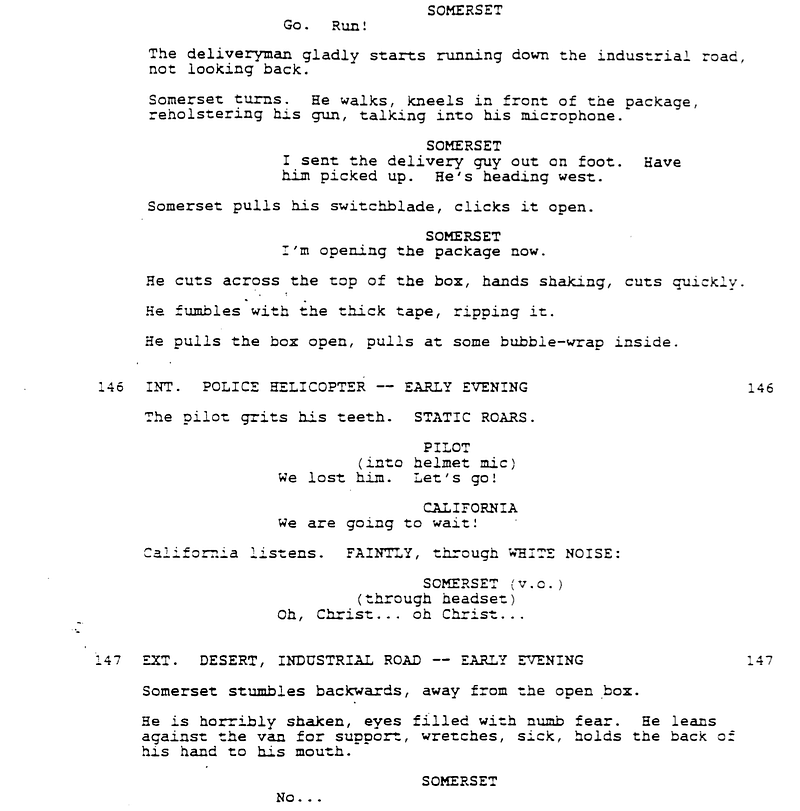
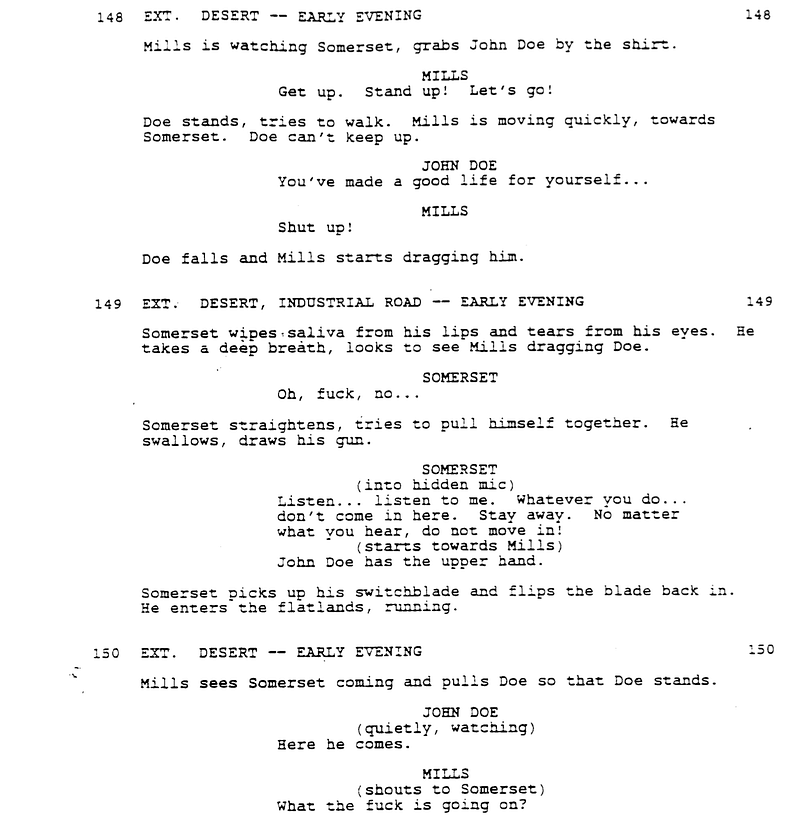
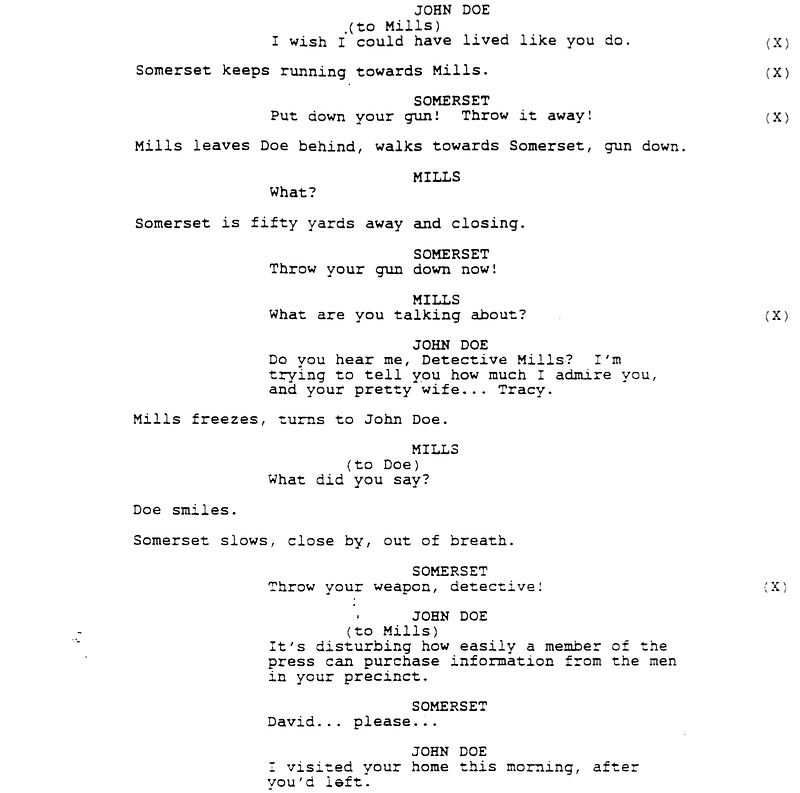
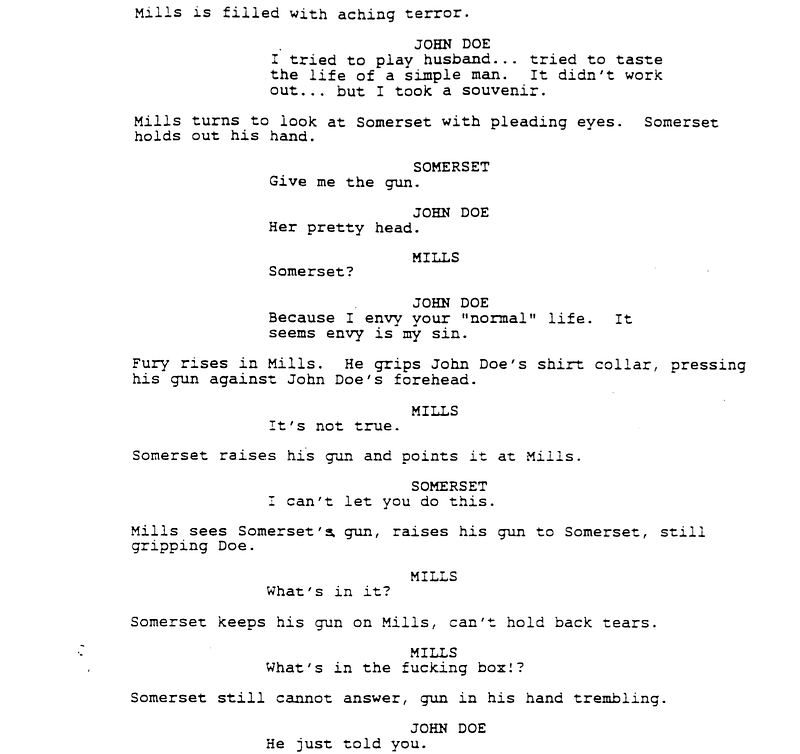
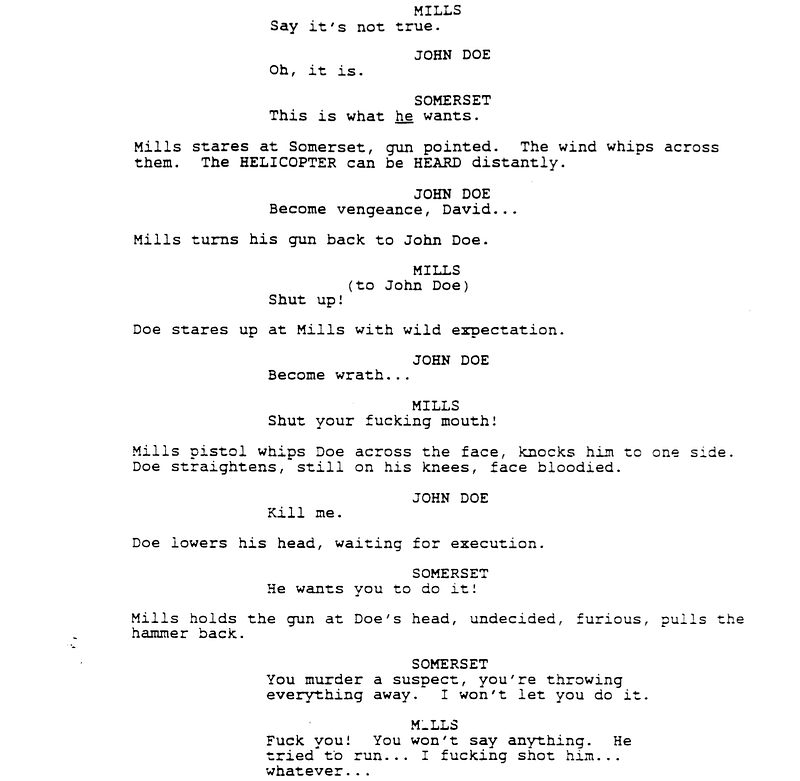
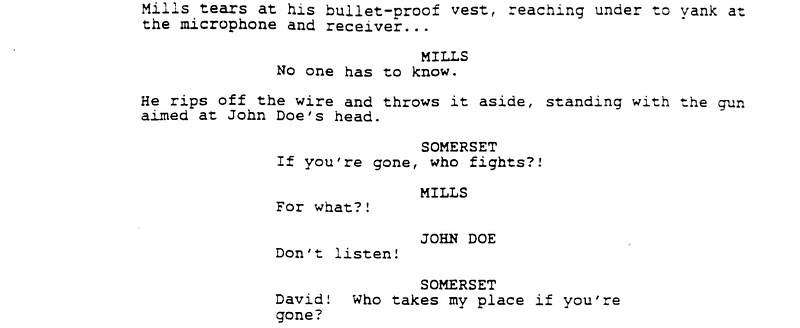

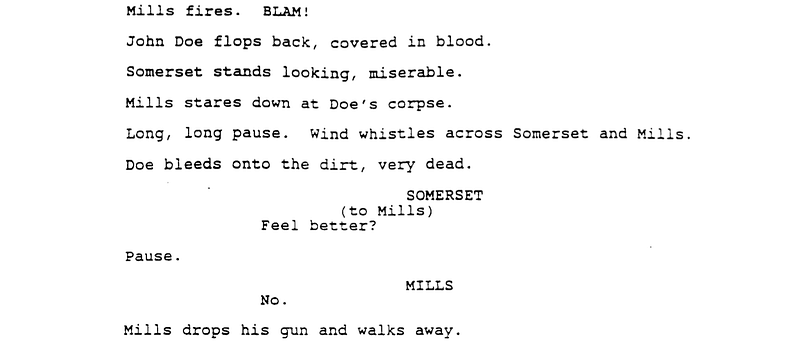
Wow. The pacing in that scene is absolutely brilliant. And notice how Walker doles out information from one character to the next, each revelation ratcheting up the tension and conflict a notch:
- Somerset discovers the box contains the head of Mills’ wife
- John Doe reveals to Mills that he knows Mills’ “pretty wife”
- John Doe reveals that he visited Mills’ house that morning
- John Doe reveals that he “took a souvenir… her pretty head”
- Somerset’s silent actions corroborate what John Doe has said
- John Doe reveals his goal: He wants Mills to “become vengeance” and kill Mills
- John Doe reveals that Mills’ wife “begged for her life”
- John Doe reveals that she begged for the life of “the baby inside her”
- Mills reveals he didn’t know his wife was pregnant
As heinous as Doe has been in the whole movie, it’s this final revelation — how he killed Mills’ wife who was pregnant — that sends Mills over the edge.
There are so many interesting levels to this sequence. One that really strikes me as I re-read these pages is that each character operates out of their own sense of logic:
- John Doe tried to live a normal life and failed, and kills Mills’ wife as a means to achieving ‘victory’ on two counts: (A) By having Mills murder him (John Doe), he turns an innocent man into a killer — like John Doe; (B) He dies the way he wants to.
- Somerset’s uses one logical point after another — “This is what he wants / He wants you to do it! / You murder a suspect, you’re throwing everything away / If you’re gone, who fights / Who takes my place if you’re gone / If you kill him… he wins” — to no avail.
- Mills’ logic is based on a simple rage-based calculation: The fucker killed my wife / I’m going to kill him. He doesn’t feel better afterward, the murder doesn’t bring back his wife, but at that precise moment when he mutters, “Okay… he wins,” then pulls the trigger, his actions seem justified, even logical.
And of course… we never see the severed head. That decision to leave the visual up to each of our respective imaginations makes the horror of the murder even that much more powerful.
It’s a fantastic sequence. And put yourself into Walker’s mind. What do you think he felt when the idea suddenly struck him: “There’ll be a box… delivered… with Mills’ wife’s head in it.” What an enormous insight that must have been. Hell, I wouldn’t be surprised if he had that revelation early in his process because it provides an immutable end point toward which he could build everything in the script. Truly a great scene. And here is the movie version:
What about you? What do you see in this scene? What lessons about screenwriting can we learn from it?
For more articles in Great Scene series, go here.