Great Scene: “Schindler’s List”
There are many scenes from the 1993 film Schindler’s List that are seared into my memory, but perhaps the most haunting one involves the…

There are many scenes from the 1993 film Schindler’s List that are seared into my memory, but perhaps the most haunting one involves the little girl in red.
If you’ve seen the movie, you know the scene to which I’m referring. A plot summary from IMDb:
Oskar Schindler is a vain, glorious and greedy German businessman who becomes unlikely humanitarian amid the barbaric Nazi reign when he feels compelled to turn his factory into a refuge for Jews. Based on the true story of Oskar Schindler who managed to save about 1100 Jews from being gassed at the Auschwitz concentration camp. A testament for the good in all of us.
Here is the scene as written in an early script draft, screenplay by Steven Zaillian, based on the book by Thomas Keneally:
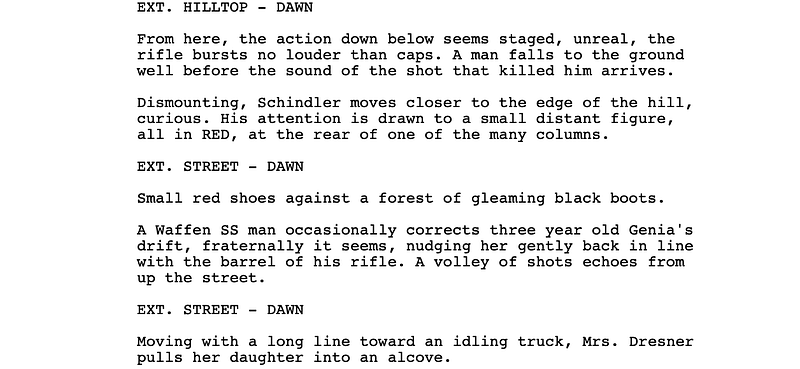
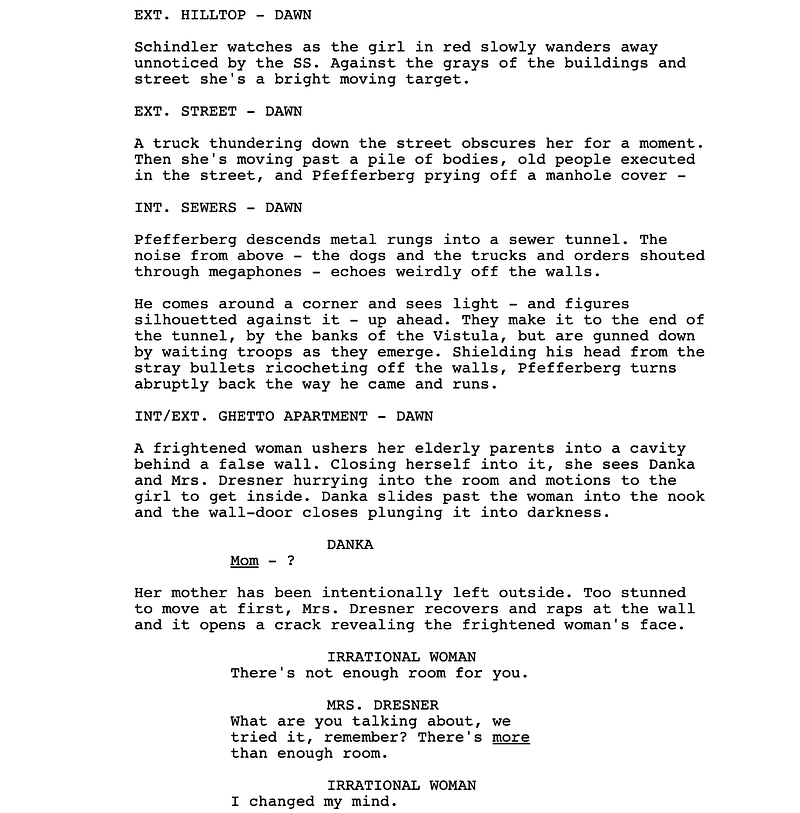
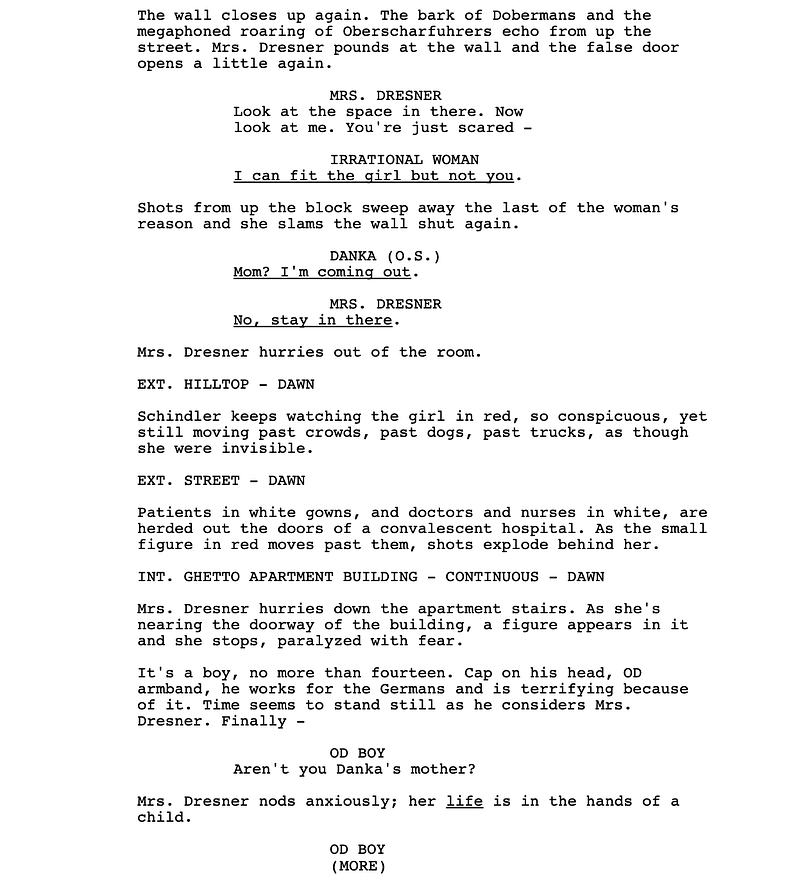
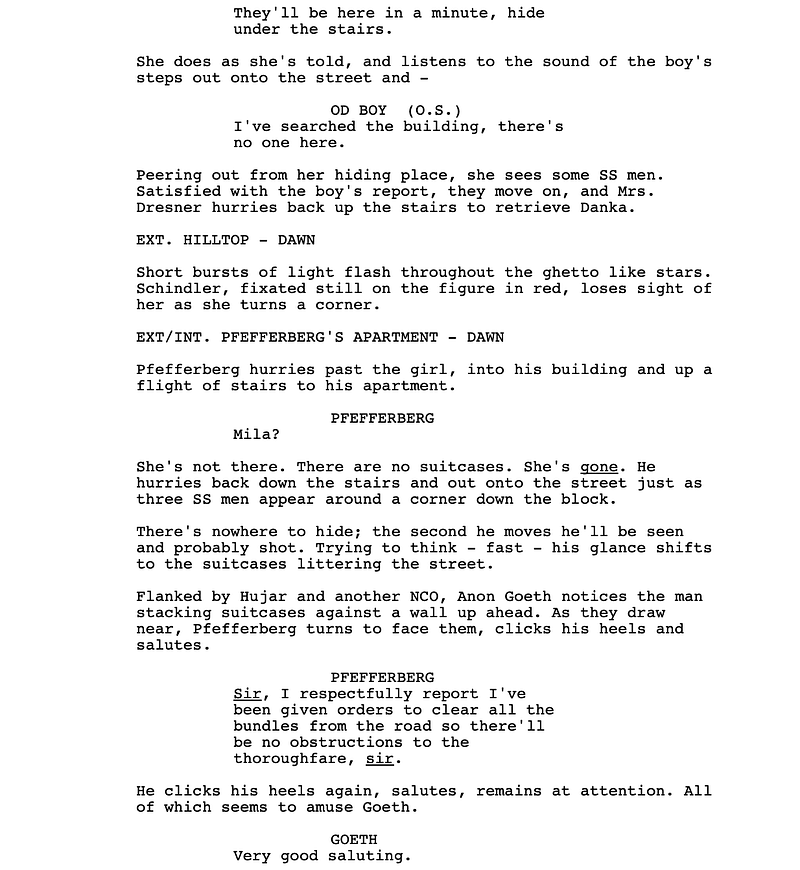
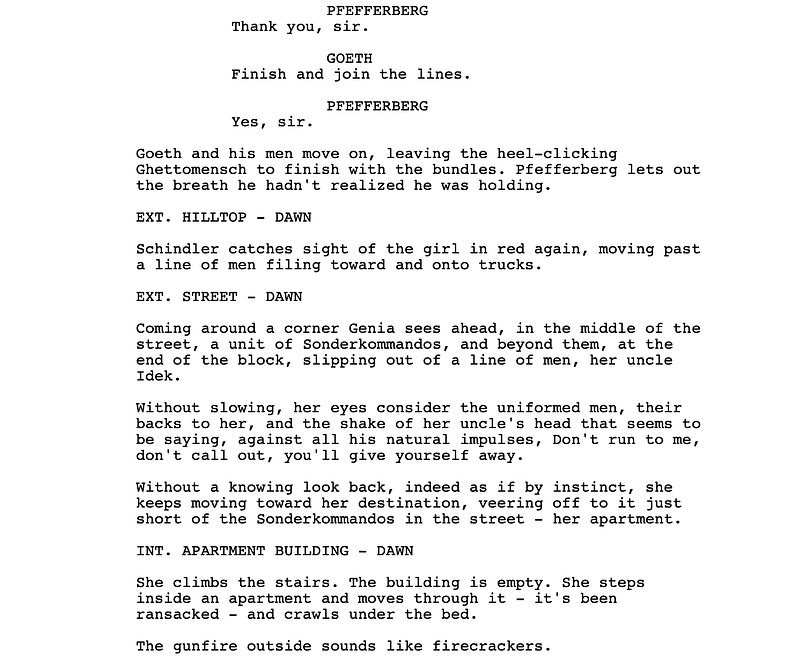
There is a later draft which cuts much of the dialogue.
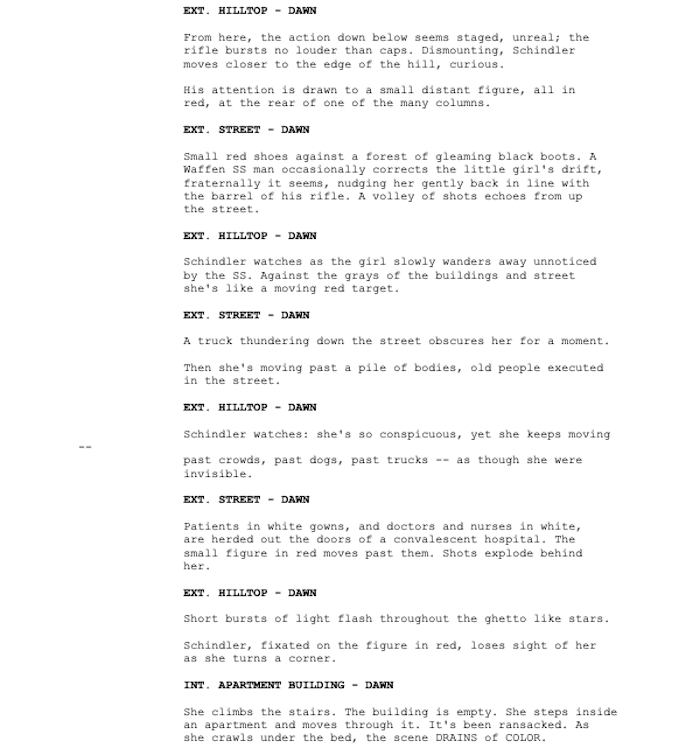
The decision to tint this one character with the color red in an otherwise black-and-white movie was a profound one, as if we are seeing what Oskar Schindler is seeing, amidst all of the chaos on the city street below, how he zeroes in on this one little girl. It is her terrifying journey — “she’s like a moving red target” — the specificity of this single character that allows, even forces the horror of what’s happening in the ghetto to pierce through the veil of normalcy that has been shrouding Schindler’s vision. Indeed, it’s probably safe to say that the seeds of who Schindler becomes, a man who saved the lives of 1,100 Jews, take root in the very moment of this experience. Here is the scene from the movie:
And the girl in red’s tragic ending:
The history of the movie’s development is a fascinating one. Here is an excerpt about it from Wikipedia:
Poldek Pfefferberg was one of the Schindlerjuden, and made it his life’s mission to tell the story of his savior. Pfefferberg attempted to produce a biopic of Oskar Schindler with MGM in 1963,[2] with Howard Koch writing,[3] but the deal fell through. In 1982, Thomas Keneally published Schindler’s Ark, which he wrote after he met Pfefferberg. MCA president Sid Sheinberg sent director Steven Spielberg a New York Times review of the book. Spielberg was astounded by the story of Oskar Schindler, jokingly asking if it was true. Spielberg “was drawn to the paradoxical nature of [Schindler]… It was about a Nazi saving Jews… What would drive a man like this to suddenly take everything he had earned and put it all in the service of saving these lives?” Spielberg expressed enough interest for Universal Pictures to buy the rights to the novel, and in early 1983 Spielberg met with Pfefferberg. Pfefferberg asked Spielberg, “Please, when are you starting?” Spielberg replied, “Ten years from now.”[2]
Spielberg was unsure of his own maturity in making a film about the Holocaust, and the project remained “on [his] guilty conscience”. Spielberg tried to pass the project to director Roman Polanski, who turned it down. Polanski’s mother was killed at Auschwitz,[4] and he had lived in and survived the Kraków Ghetto. Polanski eventually directed his own Holocaust film, The Pianist, in 2002. Spielberg also offered the film to Sydney Pollack,[3] and Martin Scorsese, who was attached to direct Schindler’s List in 1988. However, Spielberg was unsure of letting Scorsese direct the film, as “I’d given away a chance to do something for my children and family about the Holocaust.” Spielberg offered him the chance to direct the 1991 remake of Cape Fear instead.[3] Billy Wilder expressed interest in directing the film “as a memorial to most of [his] family, who went to Auschwitz.”
Spielberg finally decided to direct the film after hearing of the Bosnian Genocide and various Holocaust deniers.[2] With the rise of neo-Nazism after the fall of the Berlin Wall, he worried that people were too accepting of intolerance, as they were in the 1930s. In addition, Spielberg was becoming more involved with his Jewish heritage while raising his children.[5] Sid Sheinberg greenlit the film on one condition: that Spielberg make Jurassic Park first. Spielberg later said, “He knew that once I had directed Schindler I wouldn’t be able to do Jurassic Park.”[3]
In 1983, Thomas Keneally was hired to adapt his book, and he turned in a 220-page script. Keneally focused on Schindler’s numerous relationships, and admitted he did not compress the story enough. Spielberg hired Kurt Luedtke, who adapted the screenplay of Out of Africa, to write the next draft. Luedtke gave up almost four years later, as he found Schindler’s change of heart too unbelievable. During his time as director, Scorsese hired Steven Zaillian to write the script. When he was handed back the project, Spielberg found Zaillian’s 115-page draft too short, and asked him to extend it to 195 pages. Spielberg wanted to focus on the Jews in the story. He extended the ghetto liquidation sequence, as he “felt very strongly that the sequence had to be almost unwatchable.” He wanted Schindler’s transition to be gradual and ambiguous, and not “some kind of explosive catharsis that would turn this into The Great Escape.”[3]
Two things. First, the script’s development speaks to the difficulty a screenwriter faces when adapting a novel, how to wrangle all of that material into a coherent whole. Second, think about this line: “He knew that once I had directed Schindler I wouldn’t be able to do Jurassic Park.” Indeed, it took Spielberg four years after Schindler’s List to be in the frame of mind to direct the sequel to Jurassic Park.
For more articles in the Great Scene series, go here.