Great Scene: “North by Northwest”
It was one of the scenes which inspired Hitchcock to make the movie.
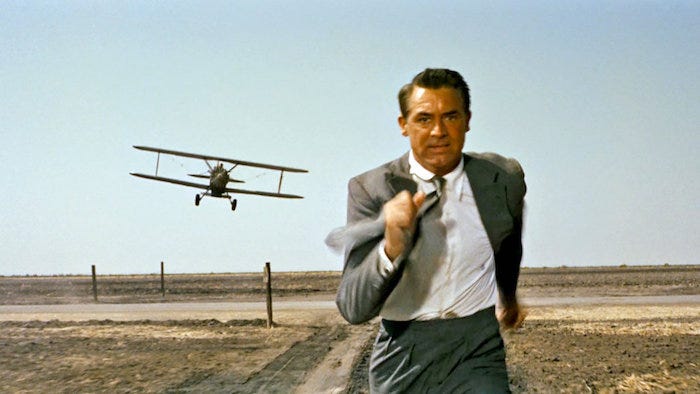
It was one of the scenes which inspired Hitchcock to make the movie.
I’m sure there are Hitchcock experts out there who can correct me if I’m wrong, but I seem to recall that the genesis of North by Northwest (1959), the classic thriller written by Ernest Lehman and directed by Alfred Hitchcock, began with two images from Hitchcock’s imagination: A chase scene atop Mt. Rushmore and the crop duster chase scene. The latter is today’s Great Scene.
Thornhill looks across at the droning plane with
growing suspicion as the stranger steps out onto
the highway and flags the bus to a stop. Thornhill
turns toward the stranger as though to say some-
thing to him. But it is too late. The man has
boarded the bus, its doors are closing and it is
pulling away. Thornhill is alone again.
Almost immediately, he HEARS the PLANE ENGINE BEING
GUNNED TO A HIGHER SPEED. He glances off sharply,
sees the plane veering off its parallel course and
heading toward him. He stands there wide-eyed,
rooted to the spot. The plane roars on, a few
feet off the ground. There are two men in the twin
cockpits, goggled, unrecognizable, menacing. He
yells out to them, but his voice is lost in the
NOISE of the PLANE. In a moment it will be upon
him and decapitate him. Desperately he drops to
the ground and presses himself flat as the plane
zooms over him with a great noise, almost
combing his hair with a landing wheel.
Thornhill scrambles to his feet, sees the plane
banking and turning. He looks about wildly, sees
a telephone pole and dashes for it as the plane
comes at him again. He ducks behind the pole. The
plane heads straight for him, veers to the right
at the last moment. We HEAR two sharp CRACKS of
GUNFIRE mixed with the SOUND of THE ENGINE, as
two bullets slam into the pole just above
Thornhills’ head.
Thornhill reacts to this new peril, sees the plane
banking for another run at him. A car is speeding
along the highway from the west. Thornhill dashes
out onto the road, tries to flag the car down but
the driver ignores him and races by, leaving him
exposed and vulnerable as the plane roars in on
him. He dives into a ditch and rolls away as
another series of SHOTS are HEARD and bullets rake
the ground that he has just occupied.
He gets to his feet, looks about, sees a cornfield
about fifty yards from the highway, glances up at
the plane making its turn, and decides to make a
dash for the cover of the tall-growing corn.
SHOOTING DOWN FROM A HELICOPTER about one hundred
feet above the ground, we SEE Thornhill running
towards the cornfield and the plane in pursuit.
SHOOTING FROM WITHIN THE CORNFIELD, we SEE Thornhill
come crashing in, scuttling to the right and lying
flat and motionless as we HEAR THE PLANE ZOOM OVER
HIM WITH A BURST OF GUNFIRE and bullets rip into
the corn, but at a safe distance from Thornhill.
He raises his head cautiously, gasping for breath,
as he HEARS THE PLANE MOVE OFF AND INTO ITS TURN.
SHOOTING DOWN FROM THE HELICOPTER, we SEE the plane
levelling off and starting a run over the corn-
field, which betrays no sign of the hidden Thorn-
hill. Skimming over the top of the cornstalks, the
plane gives forth no burst of gunfire now. Instead,
it lets loose thick clouds of poisonous dust which
settle down into the corn.
WITHIN THE CORNFIELD, Thornhill, still lying flat,
begins to gasp and choke as the poisonous dust
envelops him. Tears stream from his eyes but he
does not dare move as he HEARS THE PLANE COMING
OVER THE FIELD AGAIN. When the plane zooms by and
another cloud of dust hits him, he jumps to his
feet and crashes out into the open, half blinded
and gasping for breath. Far off down the highway
to the right, he SEES a huge Diesel gasoline-tanker
approaching. He starts running towards the highway
to intercept it.
SHOOTING FROM THE HELICOPTER, we SEE Thornhill
dashing for the highway, the plane levelling off
for another run at him, and the Diesel tanker
speeding closer.
SHOOTING ACROSS THE HIGHWAY, we SEE Thornhill run-
ning and stumbling TOWARDS CAMERA, the plane closing
in behind him, and the Diesel tanker approaching
from the left. He dashes out into the middle of
the highway and waves his arms wildly.
The Diesel tanker THUNDERS down the highway towards
\Thornhill, KLAXON BLASTING impatiently.
The plane speeds relentlessly towards Thornhill
from the field bordering the highway.
Thornhill stands alone and helpless in the middle
of the highway, waving his arms. The plane draws
closer. The tanker is almost upon him. It isn’t
going to stop. He can HEAR THE KLAXON BLASTING
him out of the way. There is nothing he can do.
The plane has caught up with him. The tanker
won’t stop. It’s got to stop. He hurls himself
to the pavement directly in its path. There is a
SCREAM OF BRAKES and SKIDDING TIRES, THE ROAR OF
THE PLANE ENGINE and then a tremendous BOOM as the
Diesel truck grinds to a stop inches from Thorn-
hill’s body just as the plane, hopelessly
committed and caught unprepared by the sudden
stop, slams into the traveling gasoline tanker
and plane and gasoline explode into a great sheet
of flame.
In the next few moments, all is confusion. Thorn-
hill, unhurt, rolls out from under the wheels of
the Diesel truck. The drivers clamber out of the
front seat and drop to the highway. Black clouds
of smoke billow up from the funeral pyre of the
plane and its cremated occupants. We recognize
the flaming body of one of the men in the plane. It
is Licht, one of Thornhill’s original abductors.
A couple of things. First, note how closely the movie tracks per the script, almost shot for shot. Hitchcock was known for blocking out his movies, every shot beforehand — this sequence supports that point. Next notice how well the sequence builds in tension — a flyover, another flyover only this one with machine gun fire, another flyover with machine gun fire, only closer, the mad dash to the cornfields, then a flyover with poisonous dust, the race to the highway and the approaching tanker, building to the climax — each event bigger than the previous. Finally, for all those screenwriting instructors who say that you can only write what an actor can act and a viewer can see, check this out:
Thornhill stands alone and helpless in the middle
of the highway, waving his arms. The plane draws
closer. The tanker is almost upon him. It isn’t
going to stop. He can HEAR THE KLAXON BLASTING
him out of the way. There is nothing he can do.
The plane has caught up with him. The tanker
won’t stop. It’s got to stop.
“It’s got to stop.” How can Cary Grant act that? How can a viewer see that? They can’t. This is a case of the screenwriter Lehman breaking free and providing some commentary on the moment, he is expressing what Thornhill has got to be thinking — and perhaps even what Lehman and Hitchcock hoped the viewer would be feeling: “My God, stop!!!” Lehman makes a ‘novelistic’ choice at possibly the most important point in the story. So if any of your screenwriting instructors tell you you can’t do this, just steer them to Lehman’s script. At the end of the day, who would you rather trust: Your instructor or a screenwriter who was nominated for an Academy Award for writing 5 times?
Here’s the movie version of the scene.
Almost no dialogue. Great visual storytelling.
You can read Lehman’s thoughts about working with Hitchcock here.
For more of the Great Scene series, go here.