Great Scene: “Moneyball”
How the song “The Show” nails a key theme in the story.
How the song “The Show” nails a key theme in the story.
The 2011 movie Moneyball may be the best movie about baseball … that isn’t really about baseball.
Plot summary: Oakland A’s general manager Billy Beane’s successful attempt to assemble a baseball team on a lean budget by employing computer-generated analysis to acquire new players.
While that is a fair description of what happens in the plot, the Themeline provides an emotional resonance that elevates the story and makes it special: Beane had been a top baseball prospect who made it to the Major Leagues, but washed out as a player. It is that shadow of his past which hangs over his character throughout the film, influencing his every mood and action.
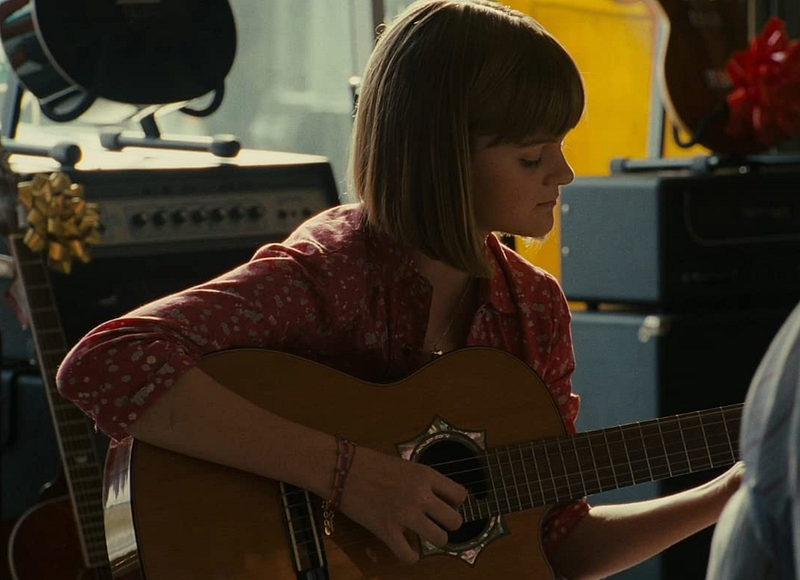
Beane has a teenage daughter Casey who lives full-time with her mother and step-father. When she visits Beane and he picks her up at the airport, they immediately go to a music store to look at guitars for her. He asks her to sing a little something for “dear old dad.” Here is the verse of the song she sings:
Here are the lyrics:
I’m just a little bit caught in the middle
Life is a maze and love is a riddle
I don’t know where to go, can’t do it alone I’ve tried
And I don’t know why
I am just a little girl lost in the moment
I’m so scared but I don’t show it
I can’t figure it out
It’s bringing me down I know
I’ve got to let it go
And just enjoy the show
The song works on so many thematic levels — the riddle of baseball (the movie begins with a quote from New York Yankee great Mickey Mantle, “It’s unbelievable how much you don’t know about the game you’ve been playing all your life”), the maze which is Beane’s life as he tries to find a place in a sport he both loves (childhood passion) and loathes (past failures), how he can’t do it alone (it is his connection with a young Yale economics graduate Peter Brand played by Jonah Hill that sends him on his “quixotic quest” to revolutionize baseball), and so on.
Toward the very end of the movie, when Beane has proved his point and been offered a position with the Boston Red Sox making him the highest paid general manager in all of professional sports, he is driving his car when he puts in a homemade CD recording by Casey. It’s the same song only now with more lyrics including this refrain.
The lyrics we hear in the reprise of the song:
Slow it down, make it stop or else my heart is going to pop
’Cause it’s too much, yeah it’s a lot to be something I’m not
I’m a fool out of love ’cause I just can’t get enough
I’m just a little bit caught in the middle
Life is a maze and love is a riddle
I don’t know where to go, can’t do it alone
I’ve tried and I don’t know why
As a recurring motif, it nails perfectly what lies at the very foundation of Beane’s character — “I’m so scared but I don’t show it” — and the prescription for his life — “Just enjoy the show,” a point which fits the story so well because ball players refer to the Major Leagues as “The Show.”
Oh, and his daughter’s name is Casey? As in the 1888 poem Casey at the Bat:
The outlook wasn’t brilliant for the Mudville nine that day:
The score stood four to two, with but one inning more to play,
And then when Cooney died at first, and Barrows did the same,
A pall-like silence fell upon the patrons of the game.
A straggling few got up to go in deep despair. The rest
Clung to the hope which springs eternal in the human breast;
They thought, “If only Casey could but get a whack at that —
We’d put up even money now, with Casey at the bat.”
But Flynn preceded Casey, as did also Jimmy Blake,
And the former was a hoodoo, while the latter was a cake;
So upon that stricken multitude grim melancholy sat,
For there seemed but little chance of Casey getting to the bat.
But Flynn let drive a single, to the wonderment of all,
And Blake, the much despisèd, tore the cover off the ball;
And when the dust had lifted, and men saw what had occurred,
There was Jimmy safe at second and Flynn a-hugging third.
Then from five thousand throats and more there rose a lusty yell;
It rumbled through the valley, it rattled in the dell;
It pounded on the mountain and recoiled upon the flat,
For Casey, mighty Casey, was advancing to the bat.
There was ease in Casey’s manner as he stepped into his place;
There was pride in Casey’s bearing and a smile lit Casey’s face.
And when, responding to the cheers, he lightly doffed his hat,
No stranger in the crowd could doubt ’twas Casey at the bat.
Ten thousand eyes were on him as he rubbed his hands with dirt;
Five thousand tongues applauded when he wiped them on his shirt;
Then while the writhing pitcher ground the ball into his hip,
Defiance flashed in Casey’s eye, a sneer curled Casey’s lip.
And now the leather-covered sphere came hurtling through the air,
And Casey stood a-watching it in haughty grandeur there.
Close by the sturdy batsman the ball unheeded sped —
“That ain’t my style,” said Casey. “Strike one!” the umpire said.
From the benches, black with people, there went up a muffled roar,
Like the beating of the storm-waves on a stern and distant shore;
“Kill him! Kill the umpire!” shouted someone on the stand;
And it’s likely they’d have killed him had not Casey raised his hand.
With a smile of Christian charity great Casey’s visage shone;
He stilled the rising tumult; he bade the game go on;
He signaled to the pitcher, and once more the dun sphere flew;
But Casey still ignored it and the umpire said, “Strike two!”
“Fraud!” cried the maddened thousands, and echo answered “Fraud!”
But one scornful look from Casey and the audience was awed.
They saw his face grow stern and cold, they saw his muscles strain,
And they knew that Casey wouldn’t let that ball go by again.
The sneer is gone from Casey’s lip, his teeth are clenched in hate,
He pounds with cruel violence his bat upon the plate;
And now the pitcher holds the ball, and now he lets it go,
And now the air is shattered by the force of Casey’s blow.
Oh, somewhere in this favored land the sun is shining bright,
The band is playing somewhere, and somewhere hearts are light;
And somewhere men are laughing, and somewhere children shout,
But there is no joy in Mudville — mighty Casey has struck out.
There is an emotional subtext running through the entire movie of Beane attempting to grapple with the fact that when he had a chance to make it in the Major Leagues as a baseball player, he struck out. He had a whole adult lifetime of negative associations with that experience, yet here he is: a general manager of a baseball team. Beane wanted, as in the words of Michael Lewis who wrote the book upon which the movie is based, “to rethink baseball: how it is managed, how it is played, who is best suited to play it, and why.”
He had another chance at the plate, this time as a GM. The song The Show speaks to that … and to the second chance he’s been given to live his adult life beyond the game. How does the movie end? Does Beane take the position with the Boston Red Sox and leave his old life behind?
Watch the movie and find out!
To read all of the entries in the Great Scene archive, go here.