Great Scene: “Jaws”
It’s the antithesis of ‘show it, don’t say it’… and it flat out works.
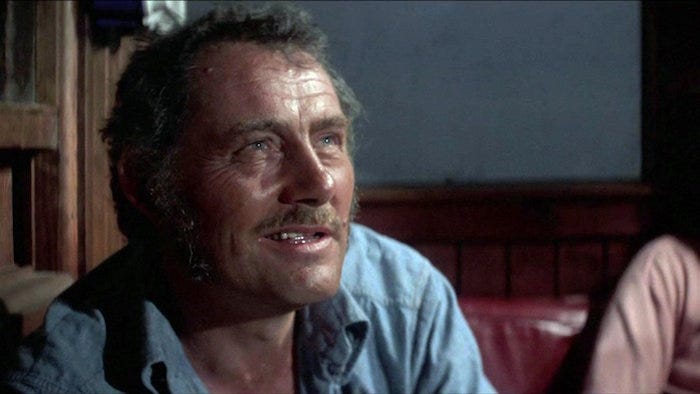
It’s the antithesis of ‘show it, don’t say it’… and it flat out works.
Monologues are common with stage plays, but not so much with movies. Of course, “motion pictures” are primarily a visual medium — motion pictures — so dialogue, while important, is a secondary form of communication cinematically. However, great dialogue can transcend the adage, “show it, don’t say it.” And perhaps nothing better exemplifies that point than this great scene in the movie Jaws (1975), screenplay by Peter Benchley and Carl Gottlieb, based on the novel by Peter Benchley.
Brody is looking at a small white patch on Quint's other forearm. BRODY
(pointing)
What's that one, there? QUINT
(changing)
Tattoo. Had it taken off. HOOPER
Don't tell me -- 'Death Before
Dishonor.' 'Mother.' 'Semper Fi.'
Uhhh... 'Don't Tread on Me.' C'mon --
what? QUINT
'U.S.S Indianapolis.' 1944. BRODY
What's that, a ship? HOOPER
(incredulous)
You were on the Indianapolis? In
'45? Jesus...Quint remembering.CLOSE ON QUINT QUINT
Yeah. The U.S.S. Indianapolis.
June 29th, 1945, three and a half
minutes past midnight, two torpedoes
from a Japanese submarine slammed
into our side. Two or three. We was
still under sealed orders after
deliverin' the bomb...the Hiroshima
bomb...we was goin' back across the
Pacific from Tinian to Leyte. Damn
near eleven hundred men went over
the side. The life boats was lashed
down so tight to make the bomb run
we couldn't cut a single one adrift.
Not one. And there was no rafts.
None. That vessel sank in twelve
minutes. Yes, that's all she took.
We didn't see the first shark till
we'd been in the water about an hour.
A thirteen-footer near enough. A
blue. You measure that by judgin'
the dorsal to the tail. What we didn't
know... of course the Captain knew...I
guess some officers knew... was the
bomb mission had been so secret, no
distress signals was sent. What the
men didn't know was that they wouldn't
even list us as overdue for a week.
Well, I didn't know that -- I wasn't
an officer -- just as well perhaps.
So some of us were dead already --
in the water -- just hangin' limp in
our lifejackets. And several already
bleedin'. And the three hundred or
so laying on the bottom of the ocean.
As the light went, the sharks came
crusin'. We formed tight groups --
somewhat like squares in an old battle --
You know what I mean -- so that when
one come close, the man nearest would
yell and shout and pound the water
and sometimes it worked and the fish
turned away, but other times that
shark would seem to look right at a
man -- right into his eyes -- and in
spite of all shoutin' and poundin'
you'd hear that terrible high
screamin' and the ocean would go
red, then churn up as they ripped
him. Then we'd reform our little
squares. By the first dawn the sharks
had taken more than a hundred. Hard
for me to count but more than a
hundred. I don't know how many sharks.
Maybe a thousand. I do know they
averaged six men an hour. All kinds --
blues, makos, tigers. All kinds.
(Pause)
In the middle of the second day,
some of us started to go crazy from
the thirst. One fella cried out he
saw a river, another claimed he saw
a waterfall, some started to drink
the ocean and choked on it, and some
left our little groups -- our little
squares -- and swam off alone lookin'
for islands and the sharks always
took them right away. It was mainly
the young fellas that did that --
the older ones stayed where they
was. That second day -- my life jacket
rubbed me raw and that was more blood
in the water. Oh my. On Thursday
morning I bumped up against a friend
of mine -- Herbie Robinson from
Cleveland -- a bosun's mate -- it
seemed he was asleep but when I
reached over to waken him, he bobbed
in the water and I saw his body upend
because he'd been bitten in half
beneath the waist. Well Chief, so it
went on -- bombers high overhead but
nobody noticin' us. Yes -- suicides,
sharks, and all this goin' crazy and
dyin' of thirst. Noon the fifth day,
Mr. Hooper, a Lockheed Ventura swung
around and came in low. Yes. He did
that. Yes, that pilot saw us. And
early evenin', a big fat PBY come
down out of the sky and began the
pickup. That was when I was most
frightened of all -- while I was
waitin' for my turn. Just two and a
half hours short of five days and
five nights when they got to me and
took me up. Eleven hundred of us
went into that ocean -- three hundred
and sixteen got out. Yeah. Nineteen
hundred and forty five. June the
29th.
(pause)
Anyway, we delivered the bomb.
And here’s the scene:
Incredible delivery by Robert Shaw. Incredible scene.
[Originally posted September 19, 2008]
UPDATE: In comments, Dan Gagliasso wrote this:
Come on guys — it is very well known that John Milius wrote that scene over the phone as a favor for Steven Spielberg. Then Robert Shaw (who was a fine writer himself) cut it down some and made it his own. That credit is given in all of the books on the making of “Jaws” and Spielberg has been very public about giving Milius the credit, as well.
The Milius connection is well-known, indeed, as well as Shaw’s reworking of the speech. However that is only part of the story. Here is a direct quote from Spielberg himself taken from a 2011 Ain’t It Cool News interview:
I owe three people a lot for this speech. You’ve heard all this, but you’ve probably never heard it from me. There’s a lot of apocryphal reporting about who did what on Jaws and I’ve heard it for the last three decades, but the fact is the speech was conceived by Howard Sackler, who was an uncredited writer, didn’t want a credit and didn’t arbitrate for one, but he’s the guy that broke the back of the script before we ever got to Martha’s Vineyard to shoot the movie.
I hired later Carl Gottlieb to come onto the island, who was a friend of mine, to punch up the script, but Howard conceived of the Indianapolis speech. I had never heard of the Indianapolis before Howard, who wrote the script at the Bel Air Hotel and I was with him a couple times a week reading pages and discussing them.
Howard one day said, “Quint needs some motivation to show all of us what made him the way he is and I think it’s this Indianapolis incident.” I said, “Howard, what’s that?” And he explained the whole incident of the Indianapolis and the Atomic Bomb being delivered and on its way back it was sunk by a submarine and sharks surrounded the helpless sailors who had been cast adrift and it was just a horrendous piece of World War II history. Howard didn’t write a long speech, he probably wrote about three-quarters of a page.
But then, when I showed the script to my friend John Milius, John said “Can I take a crack at this speech?” and John wrote a 10 page monologue, that was absolutely brilliant, but out-sized for the Jaws I was making! (laughs) But it was brilliant and then Robert Shaw took the speech and Robert did the cut down. Robert himself was a fine writer, who had written the play The Man in the Glass Booth. Robert took a crack at the speech and he brought it down to five pages. So, that was sort of the evolution just of that speech.
Per Spielberg, the U.S.S. Indianapolis speech has its roots in three ‘authors’: Sackler, Milius, and Shaw. Interesting backstory for what is in my view the high-water mark for exposition in movies.