Great Scene: “Being There”
The enigmatic ending of the brilliant 1979 satire.

The enigmatic ending of the brilliant 1979 satire.
Screenplay by Jerzy Kosinski based on his novel.
IMDb plot summary: After the death of his employer forces him out of the only home he’s ever known, a simpleminded, sheltered gardener becomes an unlikely trusted advisor to a powerful tycoon and an insider in Washington politics.
Scene setup: After the death of influential billionaire Benjamin Rand, there is a funeral. There amidst the crowd of political figures sits our Protagonist: Chance aka Chauncey Gardener.
Here is the end of the script.

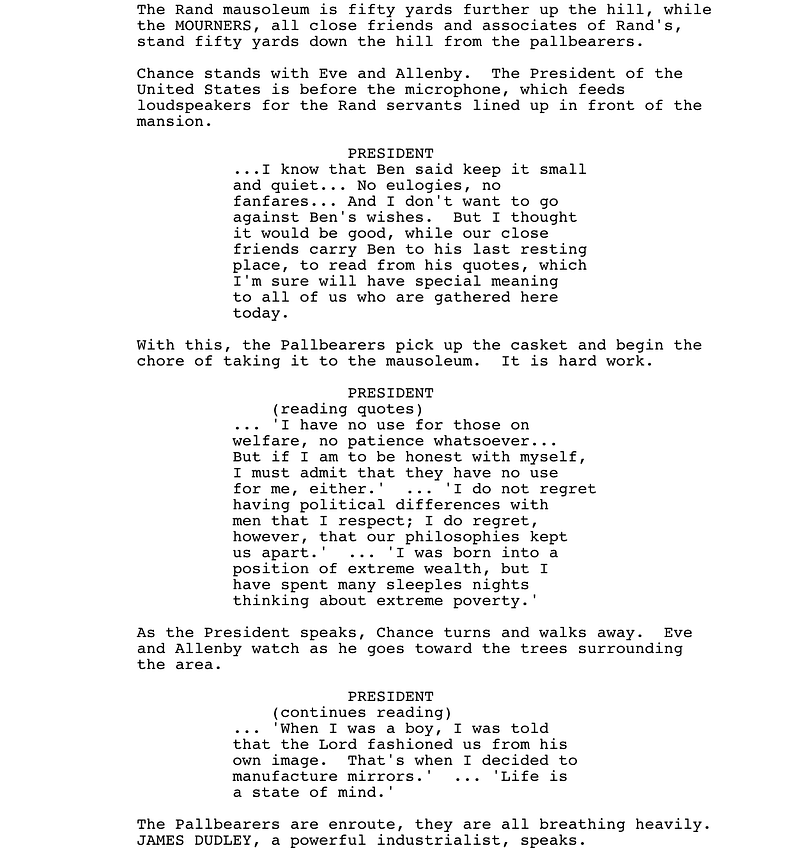
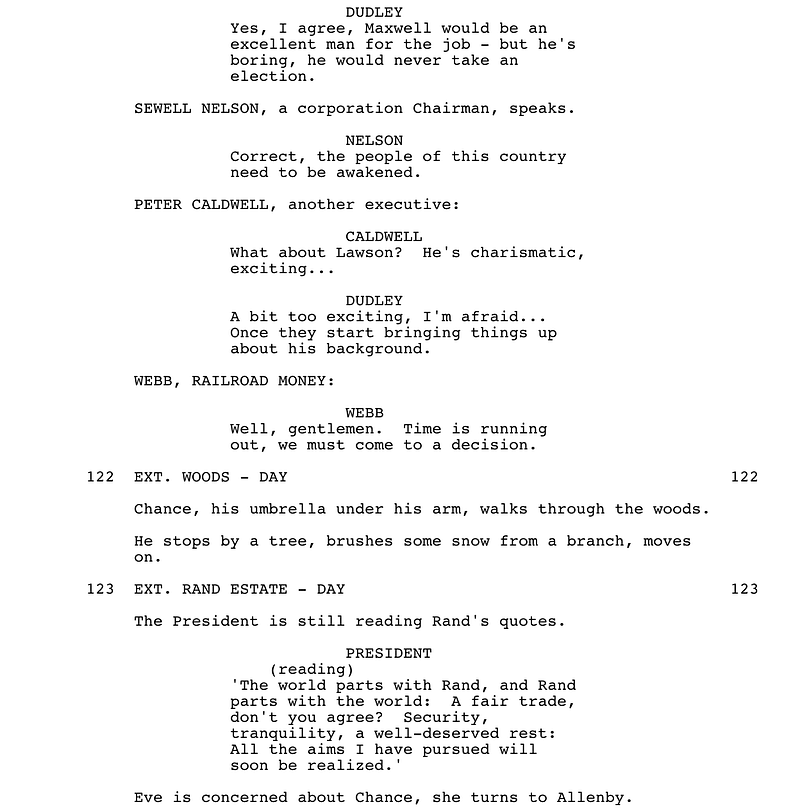
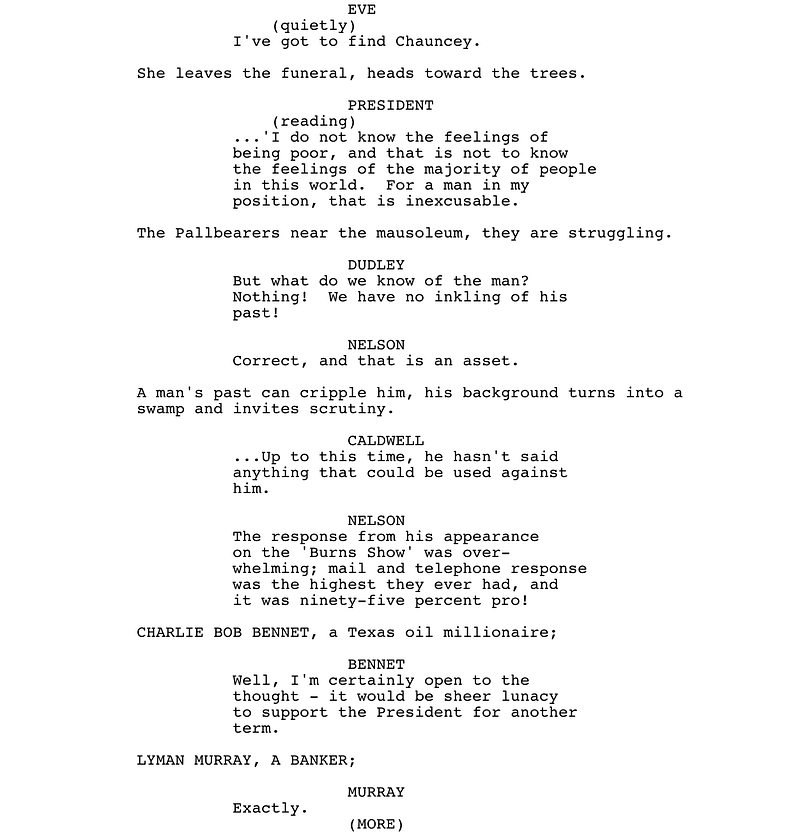
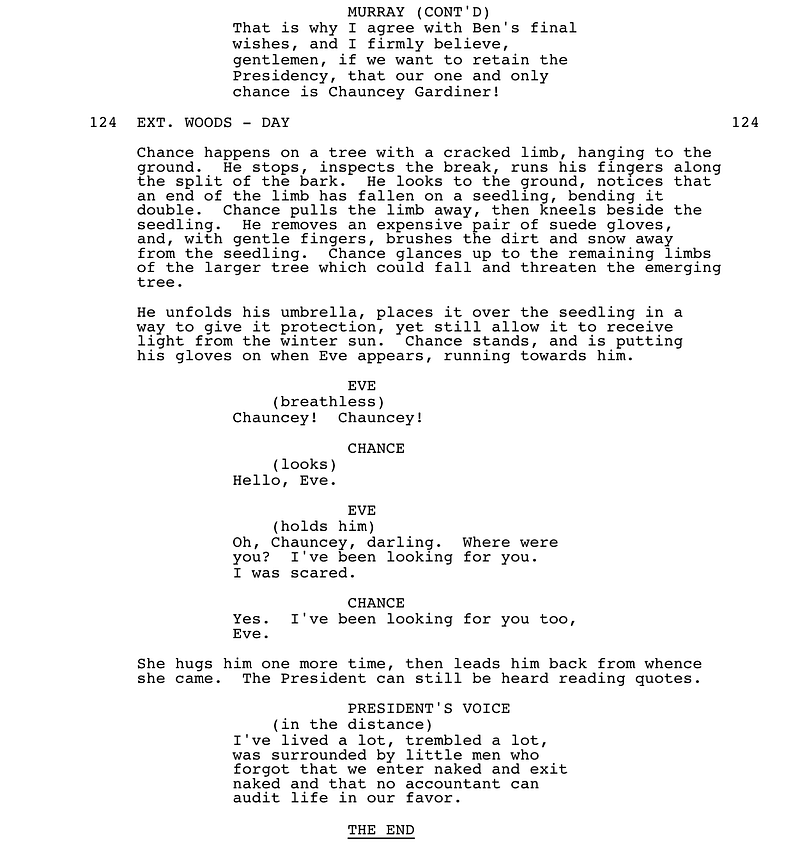
Here is the movie version of the ending:
The movie aligns closely to the script… except for the very ending. Instead of Eve escorting Chance back to the ceremony, the final image consists of Chance — seemingly — walking on water.
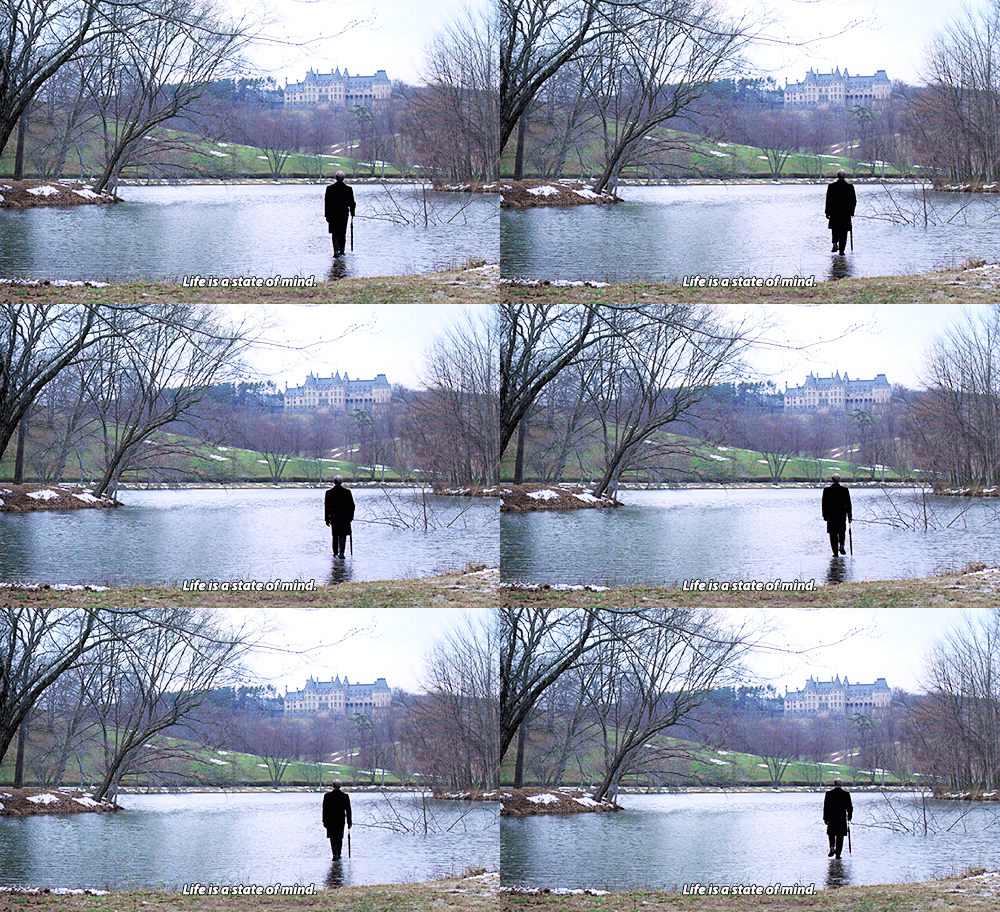
Chance’s footsteps are accompanied by the President’s voice-over offering the final line of the movie’s dialogue: “Life is a state of mind.”
Of course, the image draws to mind the Gospel account of Jesus walking across the water.

Per this article in The Take, there are basically three ways of interpreting the final scene in Being There and what it means about Chance:
- He is walking on water, but it isn’t a religious symbol.
- He isn’t actually walking on water.
- He is walking on water because he is a Christ figure.
While the ending’s meaning is unclear, we do know that director Hal Ashby wanted to change it from the way it was scripted. This excerpt from a Deep Focus Review of Being There:
Ashby was always ahead of the curve in terms of the audience’s taste. When he released Harold and Maude, it flopped because viewers at the time refused to accept a story in which a young man falls in love with an octogenarian. Variety famously panned the film, saying it “has all the fun and gaiety of a burning orphanage.” But audiences eventually warmed to the idea, and over the subsequent decades, it transformed from a cult classic into a widely accepted masterpiece. Beau Bridges, star of The Landlord, told Dawson that Ashby had “a bizarre, crazy sense of humor that people weren’t ready for.” Bridges added, “He would talk about the world, and he could say, ‘Let’s burst this fucking bubble! And let’s do it with a joke.” These remarks underscore how Ashby recognized the injustices and authoritarian crimes occurring around him, and he sought to expose them, yet he would do so with humor. The same level of rebellious humor found its way into Being There, beyond the basic concept of the story. In the script, the film ends as Eve finds Chance walking in the woods, and the two declare that they have been looking for one another. She leads him to a limousine, and they drive off. But Ashby had another idea, something crazy and impulsive. He wanted Chance to walk on water.
Ashby arranged for a platform to be submerged under a half-inch of water so Sellers could walk out, and it would appear Christ-like. Sellers added to the idea, improvising the moment where Chance stops, gently dunks his umbrella in the water to confirm, yes, he is standing on the water’s surface, and then continues to walk. Many in the film’s cast and crew balked at the religious imagery Ashby meant to evoke, including MacClaine. But the scene’s meaning is ambiguous, if pregnant. Does the imagery imply that Chance is a godlike figure and that God is, ultimately, an unthinking moron like Chance? Is Chance a symbol of America’s willingness to put blind faith into someone who obviously has no clue? Or is he nothing more than a holy fool, an innocent who is nonetheless touched by God? It’s entirely possible that if Ashby were alive, he would say he did not know what he meant to evoke, that it’s up to the viewer to decide. Watching the film today, its message seems to reflect a condition in politics and religion present both then and now, where those seeking answers find only what they want to see, a process that requires all manner of mental gymnastics and justifications. Is Chance any different from Ronald Reagan, the actor-turned-politician who became the U.S. President in 1981 yet was caricatured as a witless puppet? And today, one cannot watch Chance without thinking of Donald Trump, a nincompoop who says whatever comes into his mind, often repeating lines he heard on television to the delight of followers who dote on every last word. No matter the time in history, the ideas behind Being There remain prescient.
I think the concept of Chance as a “holy fool” best gets at my own take of the ending. Just as Howard Beale became an inadvertent icon to millions in another great cinematic satire Network (1976), similarly the Washington D.C. “intelligentsia” are wowed by the humble demeanor of Chauncey Gardener. They apply their own meaning to his words and since he has no political agenda, unlike everyone else in the nation’s capitol, he is perceived to be a figure worthy of admiration. He is seen to be a kind of Christ figure, at least metaphorically … and who knows … perhaps he is one in actuality, last seen traipsing across the surface of a lake.
In my view, there are three great movie satires: Dr. Strangelove or: How I Learned to Stop Worrying and Love the Bomb; Network; and Being There. The fact Peter Sellers stars in two of them speaks to his ability as a serious comic actor.
For more articles in the Great Scene series, go here.