Great Example of Handling Exposition
From Season 1 of The Last of Us.
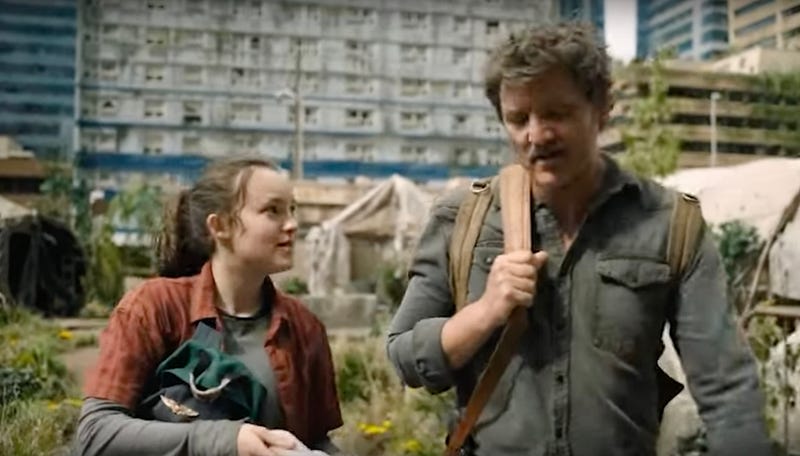
From Season 1 of The Last of Us.
I’m currently teaching my one-week online course called Handling Exposition. As I state right up front in Lecture 1:
It starts off promisingly enough with the root word expose. A few possible meanings: “to lay open to danger, to reveal, to unmask.” That all sounds exciting. Then you hit upon the definition of the word exposition as it relates to writing a story: “dialogue, description, etc., that gives the audience or reader the background of the characters and the present situation.” Exciting? Not so much.
And here the dichotomy writers must live with is laid bare: On the one hand, we need to provide exposition to tell a story and yet most exposition is far from entertaining.
One of the writers taking the class cited this scene from Season 1 of the HBO series The Last of Us.
Here’s what I wrote analyzing why the scene works so well handling exposition: (1) History just after the the zombie breakout. (2) Joel makes two “confessions,” one from his personal backstory, and one happening in the present between he and Ellie.
This scene from The Last of Us (Season 1) is an excellent example of how to handle exposition:
— As per Tip #5 (Put the scene on the move), Joel and Ellie “walk and talk” at the beginning of the scene. Even something as simple as characters in motion is better than a static scene with talking heads.
— Visual exposition: Kudos to the production designer and team for creating an authentic setting which works in tandem with Joel’s dialogue to provide an expansive sense of time and place, and a piece of history just after the zombie breakout.
— Exposition as Revelation: And the scene builds toward the big reveal (spoiler alert: Joel tried to kill himself, but failed).
This is an example of backstory as exposition and crafting it as a Revelation is an excellent way to imbue this fact with an emotional wallop.
— Sometimes the best dialogue is no dialogue. Subtext through silence.
Ellie: So time heals all wounds I guess.
Joel sits … thinking. Then turns to gaze directly at Ellie.
Joel: It wasn’t time that did it.
A long silence between them as that confession settles in, Ellie absorbing the meaning.
— And another example of subtext.
Ellie: I’m glad that … that didn’t work out.
Joel: Me, too.
She could have said, “I’m glad to know the bond you formed with me has helped your healing process,” but that would have been on the nose and clunky. Instead, Ellie redirects the conversation toward the failed suicide attempt … and Joel knows that she knows what he was confessing in subtext.
This scene is not only a great example of how to handle exposition, but also something the writers (Craig Mazin and crew) do well during the entire two seasons (Season 3 to come): They ground the action (e.g., zombie attacks) in the intimate, human experience of the characters. Because action lacking the connection to the psychological and emotional lives of the characters is meaningless.
Go here for The Last of Us series website.