Go Into The Story Interview: T.J. Newman
My exclusive in-depth conversation with the author of her debut novel Falling. The book sold to Simon and Schuster in a seven-figure two…
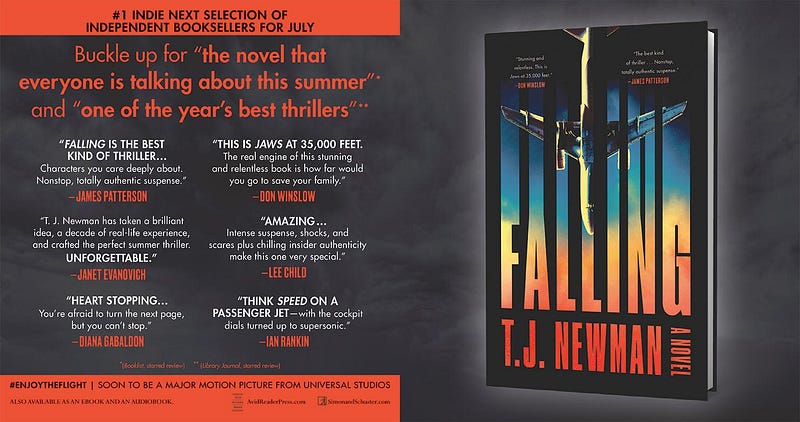
My exclusive in-depth conversation with the author of her debut novel Falling. The book sold to Simon and Schuster in a seven-figure two book deal as well as the movie rights to Universal Pictures.
Recently, I had the pleasure of speaking for an hour with T.J. Newman about her debut novel Falling. It’s a white-knuckle ride from the opening scene to the final pages. As Ian Rankin says, “Think Speed on a passenger jet.” The story behind T.J.’s rise to success is as entertaining as the book, so I am sure you will find this conversation engaging and inspirational.
Scott Myers: Let’s start with this bio: “T.J. Newman, a former bookseller turned flight attendant, worked for Virgin America and Alaska Airlines from 2011 to 2021. She wrote much of Falling on cross‑country red‑eye flights while their passengers were asleep. She lives in Phoenix, Arizona. This is her first novel.”
I’d like to unpack that bio because it suggests two paths. There’s books, and there’s being a flight attendant. Interestingly, they converge in your novel. I suspect that’s not a coincidence. Let’s begin with books. When and how did you develop an interest in writing?
T.J. Newman: I think I developed an interest when I got my first library card and started reading everything I could get my hands on. My parents read to me as a baby. Then, of course, once you learn to read and get your library card, you start checking everything out, and that’s when you start to develop your own personal taste.
It’s really been a lifelong love. I’ve always scribbled down stories my whole life as well. You’re right. That is sort of a CliffsNotes version of my life and the path to get here, but it actually is even maybe a little more complicated than that. There was a detour into the world of theater also.
Scott: Really?
T.J.: Yeah, I studied theater, musical theater, in college. I moved to New York and pursued that professionally for a few years, did the whole starving artist trying to make it in the theater world route, and was met with nothing but nonstop and constant failure, rejection, and nos. I did that for a few years, then I left.
I moved back to Phoenix, moved back in with my parents, and did the whole mid‑20s, “What do I do with my life now?” path for a while. That’s when I got a job at Changing Hands, a local independent bookstore here in Phoenix.
The first step of the full circle moment started then because once I began working in the store, surrounded by books and I’d come off this intense failure and very public failure in New York, it was this nice moment of coming home in a lot of ways.
It was a way for me to get back to being creative and being artistic, but privately for me, personally, in the stories that I was reading, and in the stories that I was coming up within my mind, and in the things that I was scribbling down on paper. Being in the bookstore, it let me get back to that without being such a public thing as I had gone through in New York with theater. I was so happy. I loved my time there.
An opportunity came up to be a flight attendant and being the daughter of a flight attendant and a sister of a flight attendant, I knew the benefits of the job. It was an opportunity I couldn’t pass up, so I left the store.
I wanted to fly, but the stories kept coming. I worked on different writing pieces, but I would abandon them. I couldn’t stick with anything and see it all the way through. Then I had the idea for Falling.
That’s how we’re getting to the full‑circle moment. Once I had the idea for Falling, all of the pieces fell into place. Everything along that path that before seemingly didn’t make sense and didn’t connect at all, suddenly made perfect sense, and everything fell together.
Scott: Reminds me of that Joseph Campbell comment where he says, “When you follow your bliss, the universe will create doors where there once were walls.”
T.J.: Exactly.
Scott: Let’s go back a little bit. That experience of musical theater, did that impact your creative instincts? Did you feel maybe a lessening of confidence in your own creativity?
T.J.: Oh, good grief, yes. I went to New York with an open heart and my dreams on my shoulder. Then you get out into the real world. Theater is a business. It was the first time that I went up against that.
I had pursued theater for the love of it because it made me happy and it brought me joy. Then, all of a sudden, I was met with the concept that, yeah, but this is a business. That taught me some lessons. It brought me to a place I really had to reckon with. That’s part of why I had to leave, too, was to go, “Whoa, hold on. The world is not all sunshine and rainbows.”
I think it’s an important thing to do, to move to someplace like Los Angeles or New York if you’re artistic, and go, “OK, this is what it’s really like.” If you really want to do this for a living, these are the industries, and this is how this works. You find your way in it.
Scott: Is it fair to say then your time at the bookstore was restorative in a way, being surrounded by these books, reading these stories, and bringing back your creative instincts?
T.J.: Absolutely, and also my time in New York, then transitioning into the bookstore. I look at the success I’m having right now and I look at how hard I worked to get here, all the failures I had in New York, and how long it took me to write this book, thirty‑plus drafts, querying forty-some agents. All of that, I think if that had happened to me earlier, when I was younger, I don’t know that I would appreciate it. I needed to go through that experience of nothing is handed to you. You are entitled to nothing, and if you want it, then you have to be willing to do the work for it.
I will forever be grateful for New York, for that experience, and then to go to the bookstore and in a very private way get back to the arts, get back to the work, but be safe and don’t worry about outcome. Don’t worry about end results. Just enjoy the art again. Once I found that re‑centering, I was able to head back into risk-taking again from a more grounded place.
Scott: You went to Illinois Wesleyan and studied theater there?
T.J.: Musical theater, yes.
Scott: How and where along the way did you develop as a writer?
T.J.: I read a ton. I watch a lot of movies, too. I think both of those are excellent ways to look at the way a story is crafted. It’s just by watching other people do it exceptionally well, and watching it over, and over, and over, and reading it over, and over, and over, and trying to figure out, “How did they do that so well? How did they catch my attention within a paragraph, or the first two minutes of this scene? Why am I crying five minutes into a movie for characters I didn’t know about before two minutes ago? How did they do that?”
For me, it was a lot of just watching other people do it well and then trying to figure out what they did. Then, also I read a lot of craft books. Before every writing session, I try to read about twenty minutes of fiction, whatever I’m reading right then, and then twenty minutes of a book on craft.
I think of that as like my time in the gym, to get those writing muscles moving and in that mindset of, “Look, someone is doing this really well. How did they do that?” and then I’ll say, “Aw, there’s the tools they used,” just as a reminder of the basics.

Scott: So for a decade, you were a flight attendant. Suddenly, you have the idea for Falling. Had you, up to that point, been thinking, “I’m going to write a novel,” specifically, or were you thinking short story, or when the idea happened, you just said, “Oh, that’s a novel.”? How did that work?
T.J.: Like I said, I’d been dabbling with lots of different stories. I had short stories, I had stories that I thought would make a great novel, but I abandoned everything because… two reasons. One, I was insecure in my writing, and I was insecure in the stories that I was telling, so it was far easier to abandon them than to keep working on them.
Then, the other thing why I kept leaving these stories unfinished was I knew they weren’t… You know when you have that hook, that moment where you realize you have something, you have a story, that sparks where you’re like, “This is the story I want to write and I need to know what happens in it.” I hadn’t had that yet.
When I had the idea for Falling, it was instant. It was like a lightning strike, and I knew it was a story I had to know what happened to the characters. I had to know what happened at the end of that book. That’s when I knew I wanted to write it.
Originally, I wanted to write a screenplay. My original concept was, “I think this would make a good movie.” I started studying screenplays. I went to the library, and I got some screenplays and read them.
Then I sat down to write it and honestly, it was like maybe the second day of attempting this, and I just said, “Oh, no. No, no, no.” [laughs] This is not a craft you just wander into. I have such a profound respect for screenwriting and the art form it is because it is hard to take a concept and whittle it down to the bare bones of a screenplay and put it on the page. I have such respect for screenwriters.
Scott: Let’s zero in on that “aha” moment you had with the genesis of Falling. The urban legend is you’re there in the airplane, and the pilots are going into the cockpit ‑‑ correct me if I’m wrong ‑‑ and you have this moment where you say to the pilot, “What would happen if…?” Like an epiphany. Any truth to that?
T.J.: There were two steps to that, but yes. I was working a flight. It was a red‑eye and I was standing at the front of the plane. The pilots were taking a bathroom break, so they were behind me going in and out of the cockpit. I’m looking out at the cabin, which is dark and cold, and everyone’s asleep, and it’s quiet.
I have this thought that their lives, the passengers’ lives, my life ‑‑ as crewmates our lives are in the hands of these pilots, too ‑‑ and with that much power and responsibility, how vulnerable does that make a commercial pilot? That thought was something I just couldn’t shake. Over the next couple of days, it solidified into a concrete scenario.
I was working another trip with a different set of pilots, and one day I said to the captain I was flying with, “Hey, what would you do if your family was kidnapped, and you were told that if you didn’t crash the plane, they would be killed? What would you do?”
It was that moment, that was when the lightning strike hit because the look on his face told me he had no idea what he would do, and it terrified him. That was the moment I knew I was going to write this story.
Scott: That speaks to what you were just saying earlier, that you wanted to find out. You wanted to know what was going to happen to the characters and in the plot, right?
T.J.: Exactly. It was the first time I had a story that the fear of inadequacy and the feeling of not being good enough, that didn’t go away, but my need to know what happened to these characters, my need to know that the answer to that question, “What would you do,” that was a stronger feeling than my fear of inadequacy.
Scott: Your debut novel Falling sold to Simon & Schuster in a seven‑figure, two‑book global deal. Here’s how the plot is described in the back cover of the book:
“You just boarded a flight to New York. There are 143 other passengers aboard. What you don’t know is that thirty minutes before the flight, your pilot’s family was kidnapped. For his family to live, everyone on your plane must die. The only way the family will survive is if the pilot follows his orders and crashes the plane. Enjoy the flight.”
I love how it’s put in second person. It’s a great “what if” story concept. “What if your airplane flight is taken hostage?” That’s a truly frightening thought. Were you saying to yourself, “I’m going to write a story which scares the hell out of people because they actually want to be scared?”
T.J.: No, that was never my intention. You hit the nail on the head when you said it’s written so that you just boarded a flight. That was something I did in writing this, was asking myself that. I needed to answer that question for myself, and that’s what I was ultimately trying to do for the readers too, was to say, “What would you do?”
Not all of us are captains on a commercial airline, but most of us have been passengers on a plane. There is a certain amount of relatability to the world of this book that I love, the participatory aspect of being a reader of this story, “What would you do?”
I don’t have a child, so I don’t know what would it be like in ransom situation to have my child kidnapped and then to be faced with that, but I have been a passenger on a plane. I can then go there more easily with the story.
It’s funny people ask me all the time like, “Oh, gosh. Were you so scared writing this on a plane? Thinking of all these scenarios while you were on a plane, wasn’t that weird?”
It’s only after I kept getting that question it started to dawn on me that maybe not everybody thinks the same way I do. The way that pilots and flight attendants think because that’s how we’re trained to think, we’re trained to think of the worst‑case scenario and troubleshoot how we would work our way out of it before it happens because then if, heaven forbid, you have this mechanical issue or this security situation or this threat, you already have a game plan. You already know what you’re going to do.
That’s how the whole industry works. That’s how we’re trained to think. It’s just good, sound, safety, precautionary thinking. This felt like a more intense version of something that I would typically be thinking about, anyway.
Scott: Let’s dig into some of the novel’s key characters. Bill, the plane’s pilot, is the central protagonist. How would you describe this character who’s got such a pivotal role in the story?
T.J.: I’m fascinated by pilots. Pilots are very left‑brain, analytical, checklist‑oriented, logic- and reason‑based creatures. That fascinates me as a person who is primarily right‑brained, and more emotion‑based, and empathetic, and more looking at the world through a more human‑based lens than an analytical lens. Pilots, in general, fascinate me. The character of Bill, the qualities that he personifies, this man of duty, a good man.
I was fascinated to see what someone like that would do. Someone who is checklist‑oriented, very black and white, and analytical, how does a character like act in a world of complete gray, in a world where you have to now make a decision based on emotion. That right there is, it’s impossible for a pilot.
There’s so many times that I would speak with friends of mine, pilots, and I asked a lot of questions over the course of writing this book. None of them knew I was writing a book, so they didn’t know why I was asking them these questions. Some of that was pertaining to technical questions regarding the art of flying and logistics of being in the cockpit.
I asked a lot of pilots, “What does it feel like when you are in the midst of a crisis? When you’re in that moment of handling something that’s gone terribly wrong, what does it feel like?”
To a person, every single one of them said, “You don’t feel. You don’t feel anything. You’re just handling the problem. Once you’re on the ground later, and the crisis is over, yeah, then you think about whatever it felt like and what was happening, but in that moment, you don’t feel.”
That was my central drive in looking at the character of Bill: “What do you do when you put a person like that in that scenario where they have to feel in an environment where they’re not supposed to feel?”
Scott: He has every reason to because he’s not only the shepherd for these 140‑some odd passengers and the flight crew, but his wife, Carrie and two children. Talk about that family dynamic and how that emerged.
T.J.: Aviation is a funny job in that when you go to work, you’re just gone. I grew up in an aviation family. My mom was a flight attendant, as I said. I’m always fascinated by the dynamic I saw of the wives or spouses who stay at home and the bargain they know they’ve had to make to be married to someone with that kind of job.
I’ve always had a profound respect for the loved ones of people in aviation because it’s not always easy, especially if there are little kids. I was fascinated with Carrie, Bill’s wife. Understanding the bargain of being married to someone in aviation, how far does that extend? Carrie knows what she signed up for when she married Bill.
She knew what she was getting, but how far does that go? That’s what I realized was where I found the bedrock of their love, of their relationship, was understanding that Carrie accepted that. From moment one, she accepts Bill for who he is and what he is and that drives every decision that she makes for the course of the book.
Scott: She has quite a bit of agency in the plot in some very significant ways, but that tension, the question, and Bill keeps saying, “I’m not going to crash the plane, and my family’s not going to die.” He keeps clinging to that because that’s whatever his mind had been trained to do.
J.K.: Exactly.
Scott: I’d like to talk about that flight crew: Jo, Kelly, and Big Daddy. How did those characters come about? One’s a veteran, one’s a rookie, and then there’s Big Daddy, who’s this really fun character. How did those characters emerge in your consciousness?
T.J.: A lot of the story’s other characters evolved over the course of the drafts of the manuscript. A lot of characters came, a lot of characters left. There were many adjustments. Those three flight attendants came into my head fully formed, and they did not waver or change at all from draft one to final draft.
They appeared as they were. I knew these people. They’re all fictitious, figments of my imagination, but I knew these people.
What’s been so interesting to see is that in several of the reviews I’ve read from people who say that they are flight attendants, their response is, “I know these people. I have flown with Big Daddy. I have flown with Jo, and we’ve all been Kelly straight off of reserve, getting assigned a trip at the airport.”
They are these archetypes of the flight attendant that came to my head, like I said, fully formed.
Scott: You have an FBI storyline too, featuring a key character named Theo. Was that character one of those things that popped into your consciousness, or was it someone that you had to work out along the way?
T.J.: Theo was a very late addition to the story. When talking about plot lines and plot threads that would come or leave, the FBI Theo plotline came very late. My agent, Shane Salerno, and I, once we started working together, we realized that the ground plotline needed to be beefed up a little bit more. That’s when his character [Theo] entered the picture.
I don’t know. It’s funny, because some characters, you strategically craft and come up with. You design them and you work on them. Then other characters, like the flight attendants, just appear. Theo was like that.
I can remember not knowing exactly where I was going with it. The first moment when we meet Theo is he’s throwing a dead houseplant into the trashcan off of his desk. I remember, for whatever reason, that image popped into my head, and I wrote that image. Then it went from there. He just appeared.
Scott: In reading the book, one thing that’s so impressive to me is that this is a suspense thriller you would expect to be reading on an airplane or on the beach in the summer, and yet the characters are so detailed and vivid, as a reader, we feel a connection to them. It’s like a smart genre story because of the well-drawn characters.
Best-selling novelist Don Winslow has said that Falling is Jaws at 35,000 feet. Earlier, you were talking about the story as screenplay. Being a screenwriter, I have to say it does feel like a movie. You’ve got the persistent sustained action, cross-cutting between multiple storylines, like five or six storylines, which is very typical of conventional screenwriting, even TV writing nowadays. Plot twist upon plot twist.
At first, you said, “Maybe this could be a screenplay,” but then you said, “No.” [laughs] Were you thinking about it cinematically as you were writing it at all?
T.J.: I was. When I write, I listen to music. I was always listening to soundtracks from movies, from thrillers, comic book movies, and things like that. It always played out cinematically in my mind. I’m a visual person to begin with. That’s how I process the world. It always played out very visually.
It’s interesting, while you were saying that, I hadn’t thought about this in a long time, how you were saying that it’s very plot‑driven, but the characters are so detailed. I didn’t know what I was doing when I started writing this. I had no idea what I was doing when I started writing this. I’d never written anything quite like this.
The first draft I wrote, I had no idea what was going to happen. I did not plot this out ahead of time at all, not at all. The scene in the cockpit where Bill first finds out the predicament that his family is in, those were the first pages of the story I wrote. It was literally the only thing I had to go on.
The concept of the book — “My family is in a situation. How do I get them, myself, and this plane out of it?” — that was it. I started there. I wrote until I had written their way out of it. The way that I wrote the first draft was I wrote the view from the cockpit. It was entirely set in the cockpit. It was like a section that went beginning, middle, and end.
Then I went back to the beginning from the back of the plane. I wrote what happened in the back of the plane and layered it into that. There used to be a whole media thing with a news network on the ground, then I wrote that whole storyline.
Each time I went through a different viewpoint, I got a little bit more of the story. Once the final viewpoint came in, it brought them all together, and the reader had the entire story in front of them.
One of the most important notes I received, and one of the biggest changes I made in the revision process was a friend of mine, Brian, who read this story. It was him, my mom, and another friend who read the first draft.
He gave me the note that it works doing it with all those layered viewpoints, but it would be far more effective if I braided it together. That’s when the inter-cutting piece came into play. I broke down the story into beats. Took what was necessary and kept it, and took the beats that were unnecessary and got rid of them.
I literally taped it all to my wall, and then moved them around like puzzle pieces. I did that several times over the course of the book. At the end, I did it on my coffee table and moved it around like puzzle pieces like that, too.
My point is I went about this backwards. I didn’t plot it ahead of time. I didn’t know what was going to happen. It was only through writing it like that. Going back to the characterization, that is why these characters are so vivid, is because it was originally about them. It wasn’t necessarily about the plot, because it wasn’t a plot‑centered focus for me the first draft. It was character‑focused, the first draft.
Then afterwards, I was like, “But I need to actually make this be a good plot. How do I move these pieces around to make it work?”
Scott: That’s a really interesting insight. Had you gone at it in a more typical screenwriter way, “OK, I’m going to get the index cards, and brainstorm, and have these plot points here and there and whatnot,” you may not have delved as deeply as you did into the characters.
You have all these moments in italics where you’re inside the consciousness of characters, and you’re experiencing these feelings, memories, and moments that are really grounded in human emotion. Ye I will say this. In terms of the plot, it kicks ass.
Where were you on that? If it’s more you start off with the character and then you work your way into the plot, now you got your cards on the wall, I’m assuming that plotting process came a little later in it, where you’re like, “I need to have this happen here, this happen here”? Is that how that played out?
T.J.: Definitely. It’s so fascinating to me to look back on it. Like I said, I wrote over thirty drafts. I could have brought that number down quite if I would have had some idea of what my blueprint or my roadmap was going forward.
It felt like I was reinventing the wheel every draft. I’m like, “There’s gotta be an easier way.” I do think there is, which is what I’m finding to be fascinating writing my next book that I’m working on.
An overarching mantra that I had throughout this whole process was pacing. My entire goal was catch them from the first sentence and engage the reader until the final scene. The pacing was my way to do that.
When Shane got on board, he fine‑tuned that to a way that was super helpful for me to know. He’d say, “You’ve got to punch in and you’ve got to punch out, the beginning of every chapter and the end of every chapter. How do you hook in that moment?”
I think a focus on like, “OK, what is the end of this chapter? How can I leave this moment so that the reader has to turn the page? They can’t put the bookmark in and be okay with that.”
An unrelenting focus on those plot moments at the beginning and the end of each chapter, to make sure you have them and then to keep the tension sustained throughout that whole time was my absolute focus and goal, and then the plotting evolved out of that.
Scott: One of our goals as writers is to achieve a sense of authenticity in what we write, that we, as the author, have control over and understand the story universe. Clearly, you understand the flight attendant experience.
How much research did you end up doing where you mentioned that you talked to these pilots, not telling them you’re writing a book, but air traffic control, FBI? How much research did you do in that regard to hit that sense of authenticity that you land so well in the book?
T.J.: The most important piece of research I did was showing up to work every day with my eyes and ears open. I felt like when I was writing this book, it felt like I was on a movie set. Everyone’s in costumes. Everyone’s there. They just don’t have their lines yet. You know what I mean?
I was constantly in this idea of I was in the environment all the time, so we evolved from there. I asked questions incessantly. I was looking at charts all the time. I have several manuals. You can find out pretty much anything on Google. The research I did was to go to the source, first of all, and ask pilots questions about the logistics of flying.
Then also more philosophical and emotional questions. Like I said, I would ask them things like, “How did it feel when this? What does it feel like when you leave your family?” The first chapter of the book is a dream sequence. That’s something fairly common, pilots oftentimes have reoccurring nightmares.
I had a friend who is a pilot, pose a question in one of her pilot Facebook group forums, “Hey, do you guys have reoccurring nightmares, and if you do, what do you dream about?” It was fascinating because all of the hundreds of pilots started chiming in.
It was fascinating to see the common threads they all had similar themes where many people were like, “That’s my dream,” “That’s exactly what I dream,” “That’s exactly what it is.” The best research I found was to go to the source and then to back it up with the textbooks and the manuals which I’d read on my days off.
Scott: I’d like to do a little thought experiment here. T.J. on a red‑eye flight. It’s dark. The passengers are asleep. Crew members are probably looking on their cell phones or flipping through a magazine, but you’re writing. What does that look like? You’re on the flight, you’re writing. How would you describe that?
T.J.: I worked primarily in first class, which meant that I had the forward galley all to myself. People would go to sleep, and the flight attendants would stay at the back. I’d stay up front, and I wrote by hand. We weren’t allowed to have portable electronic devices when we flew, so I wrote things by hand. It depended on the flight.
Sometimes, if it was an early red‑eye and people were up and asking things and moving about, I can only get notes in here and there. Then other times, it’d be full pages and entire scenes, and I wrote by hand sometimes in notebooks that I had brought with me and sometimes on the back of the catering bill or the back of manifest or whatever I had just right there.
Especially if a pilot would come out for a bathroom break and say something, and I think it would be a great idea and I don’t want to forget it, so I just grab a napkin and jot it down. There was no consistent thing. It was a very cobbled together, “What do I have in this moment?”
Maybe I have twenty-five minutes uninterrupted, maybe I’ve got two. Maybe I have nothing except to be able to sit here and daydream about it and then scribble something down. It depended on the flight.
Scott: At some point, you’ve got enough of whatever you think is appropriate to send out query letters. I believe you said you had forty-one queries you sent out, and nothing. Then you queried Shane Salerno at The Story Factory. What was that like?
T.J.: [laughs] That was a long, hard uphill road trying to get representation. I knew no one in the industry. I didn’t know what I was doing. I have this book. I wanted to get it published. I literally bought a book called “The Essential Guide to Getting Your Book Published.” I read it, and I followed the directions. [laughs]
That’s how I found out that I needed a query letter, and this is what a query letter should look like, and this is who you should query, and this is how you should go about doing that. In my research, I found Shane and The Story Factory and knew immediately that it would be the perfect fit. It would just be the perfect fit, but I was very realistic.
I knew who he represented. I knew the work that he does. I did not think that there was any chance in the world he would even give my manuscript a second look. I didn’t query him. I queried forty-one other people, all of whom said, “No.” It was only when I was starting to get into the point of like, “OK, what do I have to lose? Sure. Let’s give it a try.” I sent my material to him.
He didn’t even have submission guidelines. I made it up. I sent him the first twenty-five pages in my query letter and then I wrote a handwritten note on a yellow piece of legal pad, stuck it with my material, put it in a manila envelope, and sent it in the mail. I don’t remember what I wrote on that note.
Like I said, it was such a throwaway moment because I did not think that there was any chance this was going to go anywhere. Cut to several weeks later, I get a phone call I don’t answer because I assume, it’s an unidentified LA number, some telemarketer. I don’t get it. A couple of days later, my phone rings again. I don’t get it for the same reason.
That’s when something clicks in my head after the call ends. I’m like, “Wait, wasn’t that the same number? Didn’t I get an LA unidentified call the other day?”
Then I looked at my voicemails. I have a missed voicemail from The Story Factory, trying to get a hold of me. They’re interested in my manuscript. Then I start freaking out. I’m like, “Oh my gosh, they’re trying to get hold of me. I’ve ignored their call. Oh my gosh. Oh my gosh.”
I’m freaking out. We start playing phone tag. Rather, I start calling them. They’re not calling me back. I had a pre‑planned backpacking trip I was going on with a friend of mine. We were going to Northern Arizona to go into the woods for a week to go backpacking. I would have no cell service.
I call Shane back. I leave a message. I say, “Hi, it’s T.J. I’m trying to get hold of you. I’m going on this backpacking trip. I won’t have cell service, but if I don’t hear from you by the end of the night, I’ll circle back in a week when I come out of the woods.”
I leave it at that. My friend and I are driving from the restaurant that night back to our hotel before we head out the next morning, and my phone rings. It’s that number. Now, my friend that I’m with has no idea that I’ve even written a book.
Scott: Oh, wow.
T.J.: She doesn’t know anything about anything going on. All she knows is that I suddenly pull the car over to the side of the road, put it in park. She’s looking around at the dark woods like, “What’s going on?” I turn to her, and I say, “This is going to be really weird, but I promise I will explain everything as soon as I’m done, but I have to take this phone call.”
She’s just like, “OK. All right.” I answer the call. It’s Shane. We have our first conversation. It goes exceptionally well. He’s very interested in the first twenty-five pages. He wants to see the full manuscript. Could I send it to him tonight? This whole thing. It’s like this incredible conversation.
I hang up the phone. It’s just silent in the car. My friend looks over at me with this look of like, “What was that?” I go, “I don’t know for sure, but I think there’s a really good chance my entire life just changed.”
From there, we race up to the hotel room where I’m frantically trying to… Of course, I don’t have my computer. I only have my phone because I’m going out into the woods. I’m trying to send manuscript attachments from my phone. “Is this right? Is this spelled right?” We’re triple‑checking everything. It was such a crazy, wild event.
Scott: How long was it by the time you intersected with The Story Factory people and the time your manuscript was ready to go out to buyers?
T.J.: Shane and I started working together November of 2019. We worked together almost every day. I would call him. I started doing all the work. Then the pandemic hit. That slowed everything down. Through all of 2020, I was holed up here in my house alone working on this manuscript.
I don’t know exactly how many different drafts I went through, but at least these 15, 17, 18, 19, something like that.
Scott: Basically, as many drafts as you’ve done before or maybe even a little more. We already mentioned the deal with Simon & Schuster. Then there’s the movie rights deal to Universal. Not that we need more competition, T.J., in the screenwriting world, but I mean I’m thinking as I’m reading this, you’d make a hell of a screenwriter.
Gillian Flynn’s done this. She went from novels to screenwriting and teleplays. She gave you a nice little endorsement for the book. “Attention, please. T.J. Newman has written the perfect thriller!”
Apart from all the money deals in seven figures and all that, what does it feel like when you’re getting praise from people like Gillian Flynn, James Patterson, Lee Child, Ian Rankin, Adrian McKinty, and “Publishers Weekly,” and “The Guardian”? Your head must be spinning a bit, right?
T.J.: My head has been spinning nonstop pretty much since Shane took my call. Once he got involved and once I got the ball moving in this direction, everything has just been the most surreal, and incredible, and unbelievable experience.
I still don’t know what to do with the fact that I have those blurbs from James Patterson, and Ian Rankin, and Gillian Flynn. It’s incredible.
T.J.: My mom is super grateful for it. She still says all the time, “See? It’s not just because I’m your mother.”
She read the first draft, and she was like, “Oh, it’s great. It’s good.” The whole time, I fought her tooth and nail. It’s like, “You’re my mom. You have to say those things. You have to like it. You’re my mom.” Every blurb that comes in, my mom would just be like, “See? It’s not just because I’m your mother. I was right. See?”
Scott: Oh, that’s great. The book is already released in the UK, right?
T.J.: Mm‑hmm.
Scott: It’s going to drop here in the US on July 6th. You’re working on a second book. It’s a two‑book deal with Simon & Schuster. Was that an idea you had before? Is this something that came up with when they said, “Oh, here’s a second book,” part of the deal?
T.J.: I have a whole stack of story ideas and things that I have been dabbling in, and working on, and thinking about for a long time. When it became a two‑book deal, it was just incredible that not only was this dream coming true, but this idea that like, “Wait a second, I get to do this again? You’re giving me the green light to keep doing this?” That’s incredible.
Scott: Well, I hope with the second, whatever process you’ve developed now and the plotting that you grounded in your characters because that really makes such a huge difference in your story. Also, too, I noticed you used this word in our conversation several times: “fascinating.” That’s, I think, a clue to your own creativity, that you are driven by things you find fascinating. I hope this second book provides that opportunity for you.
A few craft questions if you don’t mind, T.J.
T.J.: Sure.
Scott: This is an obvious one that I’m sure everybody will be wanting to know. How do you come up with story ideas? You got the stack of ideas. How do you do that?
T.J.: I don’t know. Like you just said, looking for things that fascinate me. Sometimes story ideas, for me at least, I can only speak for myself, but I’ve had several story ideas like Falling that just hit me.
I’ve dreamed, also, several different storylines. I keep a notebook by my bed because more than once I’ve woken up and had a dream that I was just experiencing that I go, “That is something. I think my subconscious is trying to push me in a certain direction.”
If something doesn’t strike like lightning, like I said before, for me it’s, “Where’s the smoke?” What’s going to move me towards what’s interesting, and fascinating, what I’m curious about.
I think that’s usually the first indication, to me at least, that there’s something more here. Keep digging, keep looking, because there’s something in your curiosity and fascination with it. Just keep moving towards it, and then I think the lightning strikes will come sooner or later.
Scott: Because Falling has got such a profoundly simple ‑‑ I mean that in the best sense of the word ‑‑ concept, it’s like so graspable for all these consumers with a million things going on to have an original story that you can get [snaps fingers] like that.
How important do you think that kind of hook is for a good story concepts? How important do you think it is for writers to be looking for those type of story ideas?
T.J.: I think it depends on the type of story that you want to tell, right? Some stories are not grippy and they don’t have big hooks like that, but that’s a different kind of story. That’s just a different journey to take a reader or viewer on.
For me and the stories that I want to tell and the stories that I personally find interesting, I think that’s everything. I think that you have to have that hook because there’s so many good stories out there. There are so many good writers, and there’s so many good movies, and there’s so many good books, why should you as a reader spend your time, and energy, and money on that one?
I respect the reader and the viewer and their time and their money so much that I don’t want to waste it.
That’s an important thing to say, “This is what it is.” Simplest form, “This is what it is.” If you can catch them with that, then they’re probably going to want to go with you the rest of the way. They’re going to want to go into the characters and into the plot and how it gets there. I personally think it’s important because I don’t want to waste anybody’s time.
Scott: Let me ask you again because I was so impressed with the way you engendered empathy for the characters. Do you have a process of developing them or is it just a more of an instinctual thing because they come across as fully formed individuals with distinct wants and needs and all the rest?
T.J.: It’s probably a nurture and a nature situation for me. I’m a people person, and that’s the way I look at human behavior. I am constantly trying to figure out the why. Why is somebody doing something? Why did they say that? Why did they do that? I tried to do that because I want to understand it. Also, once I understand it, then I know how to operate within that world.
That’s how I view the world. I was a flight attendant for ten years, and I’ve often said that being a flight attendant is like getting paid to people watch. That is what you do. You watch human beings behave and react in mundane to extraordinary circumstances, and it’s fascinating. I’m fascinated by people, and why we do what we do.
Scott: What’s your writing pattern? What are the best times a day for you for writing, and to make sure you’re in that writing spirit?
T.J.: For me, my best time for writing is the middle of the night. I’m a night owl by nature. I wrote on red eyes. I’ve noticed all of 2020, I went to sleep at probably 4:00 in the morning and woke up at 1:00 in the afternoon.
In the writing community, I know that there’s a lot of people that wake up at 4:30 and wake up at 5:00 for those uninterrupted hours before everybody is up. It’s the same thing, just the flip side of that because I’m not a morning person. I’m not going to wake up, but I will stay up till 4:30 in the morning. I’m not going to get up at 4:30 in the morning.
For me, my best writing time is middle of the night. I also have found that I write better when I’m cold and when it’s dark. I don’t know what that’s about, but I have noticed that trend.
Scott: I see a move to northern Sweden at some point for you.
T.J.: [laughs] Right. Log cabin in northern Sweden.
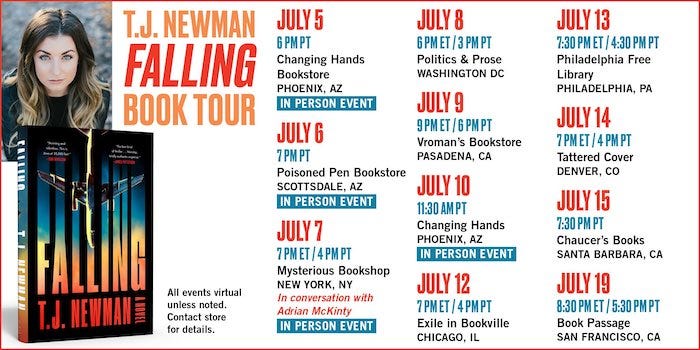
Scott: I’d like to ask one last thing. You’re going on a book tour, many of them virtual, some live. The novel is coming out here in the United States on July 6th. The obvious question I’m sure you’re going to get hit with it thousand times is, what advice can you offer? What would you offer as a piece of advice for aspiring writers on how to go forward, find their voice and do the work?
T.J.: The number one thing is to keep going. I had to come to terms with the fact that those voices that were telling me I wasn’t good enough and then my writing wasn’t good enough and that I should stop doing what I’m doing, I had to accept that those voices were never going to go away. I don’t think they will. I still feel that. That’s a fairly common thing also within the writing world.
I’ve heard many writers also say that. I know I at least thought when I was on the other side of not having a book that was being published and writing and working on stuff was that at some point there would be a magical point in which it would get easier and those things would go away. I would have more time. Everything would fall into place.
I realized at some point that none of that was going to happen and that I needed to keep going. That I guess would be the piece of advice that I would give is that there’s always going to be a reason as to why you think you shouldn’t keep going, but just ignore it. Just keep going.
Scott: That’s great. I hope you’ve enjoyed the conversation.
T.J.: Thank you. This has been wonderful, and that’s one of the best things about this entire process is getting the opportunity to meet people like you and people whose work I respect so much and whose viewpoints I respect so much.
I’m going to end this call and take notes over what we’ve talked about because you’ve given me several things to think about and stuff that I appreciate this opportunity to talk through this. I’ve discovered things about my process that I didn’t even know before this conversation. Thank you!
You may follow T.J. on Twitter: @T_J_Newman.
For more on the book Falling, go here.
For 100s more Go Into The Story interviews with screenwriters, filmmakers, and writers, go here.