Go Into The Story Interview: Sean Malcolm
Sean Malcolm wrote the original screenplay “Mother” which won a 2019 Nicholl Fellowship in Screenwriting. I had the opportunity to chat…
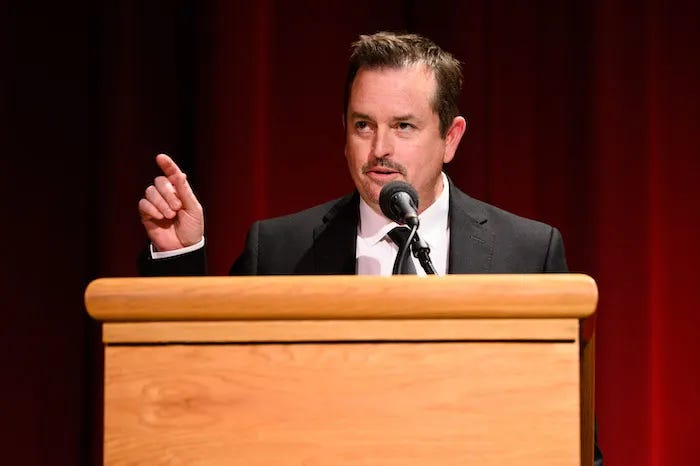
Sean Malcolm wrote the original screenplay “Mother” which won a 2019 Nicholl Fellowship in Screenwriting. I had the opportunity to chat with Sean his background as a screenwriter, his award-winning script, the craft of screenwriting, and what winning the Nicholl has meant to him.
Scott Myers: Where did you grow up and what role did stories play in your childhood?
Sean Malcolm: I was originally born in Gainesville, Florida. A child of the late ’60s and early ’70s. My parents, as I often tell people, were part of a pack of wild hippies. We traveled around quite a bit, never in one place for more than a few years. I lived in a couple of different cities in Florida, then we moved out to Colorado. I spent some time in American Samoa with my dad and his new family in the late 70’s. Then I went back to Colorado, then back to Florida. Then I came out to California in the early ’80s and have been here ever since.
As far as stories, I remember when I was living in Denver in the ’70s — probably from the time I was seven onward, my mom loved going to the movies, and I would pretend to be asleep in her arms so she could sneak me in to all kinds of films, and not have to pay. There wasn’t a lot of ratings enforcement back then, so I saw everything from 2001: A Space Odyssey to Zardoz, Phantom of the Opera, Rollerball, Harold and Maude, all the mainstream, big, ’70s, golden‑era films. Bonnie and Clyde, the Godfather films, The French Connection, Apocalypse Now. I saw a lot of that stuff in the theater when I was very young, and I think it definitely had an impact on me, in terms of my love for film and stories.
I also read Grimm’s’ fairy tales, C. S. Lewis, and things like that. We didn’t have “Harry Potter” and all this YA stuff that kids have today, which is interesting, because my son, who is ten years old, is just discovering Harry Potter, and he’s super into it, which is great to see. It takes incredible writing and world-building to pull a ten-year-old off their devices these days.
So, I suppose I always loved films and great stories, and I always loved telling stories, too. I love setting up the framework and the context of a story, or a great conversation with a great payoff or a great punch line. Sometimes it drives my wife and my friends crazy because I need the audience to have all of the context. The details have to be right. If somebody starts telling their version of a story that I was part of, I’ll might say, “Wait, wait, wait. That’s not exactly how it happened. Let me set the scene for you.” I’m sure it’s annoying sometimes, but that’s just who I am. The setup has to be right to give you the payoff! So yeah, stories have always played a big part in my life, whether films or novels, or anything else.
Scott: I was going to ask why screenwriting as opposed to novels and short stories?
Sean: It’s a great question. I never really wrote any short stories, and I only recently just tried my first novel. When I was younger, in my early teen years, I didn’t write, but I guess I was already creating stories, because I played a lot of role‑playing games. I was one of those “Dungeons and Dragons” geeks. We also played a game called “Top Secret” which was just a 007 version of Dungeons and Dragons. In those games, you would do things like design worlds and design maps and levels, and create goals and obstacles and characters, sometimes just in the moment as the game was unfolding. Sometimes we would play without anything, no dice, no books or maps, nothing but our imaginations. One guy would be the Dungeon Master, essentially God, and the others were the players. You just riffed for hours, setting up mysteries and characters and victories and tragedies. Sometimes God was fair, sometimes vengeful or capricious. We called them “make up games.” I really think that has a lot to do with my love of creating stuff on the fly.
Plus, I really enjoy the architecture of story, plot, setups, payoffs and that type of stuff. Maybe this goes back to my love of architecture in general. In fact, when I was younger, I used to think I might become an architect. “Architectural Digest” is one of the all-time best magazines to me. Anytime I see one, I have to pick it up.
But anyway, in the early ‘90’s, my first roommate, who was a little older than me, he was trying to write a screenplay. He had one of those old box-style amber-screened word processors that folded into a suitcase. I’m dating myself now, but I was so fascinated by that thing! It had a built-in floppy drive and everything. This was before most people had a PC or a Mac, let alone a notebook, and I thought it was so damn cool. Like if James Bond was a writer.
And he had the Syd Field book; I think it was called Screenplay. One of the originals. Now I’ve got a library of all those books that I’ve built up over the last two decades. But I was fascinated and started exploring it.
We would sit up drinking all night and just riff on story ideas. We were going to write a road trip film together; I think it was called “Road Trip to Vegas” or something. We were heavily influenced by David Lynch at that point. Twin Peaks was all the rage. And we wanted it to be super dark and noir and creepy, with a suitcase full of found money, and a femme fatale that kills Billy Zane in the end or something. But we never actually got beyond the outline phase.
I think about a year later in ’93 I just tried writing my own screenplay, because it seemed so cool, and I figured it looked pretty easy. Ha! But that was the era of the big spec sales, and so the idea that you could write 110 or 120-page script and suddenly sell it for a million bucks seemed incredibly possible.
I tried it, and that’s when I first realized I didn’t know what the hell I was doing. I went out and got some books and started to get a little bit smarter about it. The first time, I tried it in WordPerfect. That was just a total nightmare, with all the rules around page breaks and format, and then I discovered Final Draft. I think I had Version 2; it came on like 15 diskettes. That was a lifesaver. Then, it was just really trial and error from there on out.
Scott: Yeah, ’93. You’re absolutely right. That was the heyday of the golden era of the spec script, between Shane Black and David Koepp and Joe Eszterhas and others, all those big specs sales. You say you accumulated a lot of these books.
I know when you did the Nicholl speech, you talked about yourself as being “a self‑taught screenwriter.” What was your process there? How did you teach yourself?
Sean: I mean it really was trial and error. There are certain books that resonated with me from an “unlocking story” perspective. I’m just actually looking at my library here. One that I love is “Stealing Fire from the Gods” by James Bonnet, which is very much about the Hero’s Journey. It’s got those elements that go all the way back to Greek story structure.
I’ve got a lot of older ones here, but the concepts are still timeless. “Screenwriting Tricks of the Trade” by Bill Froug who I think is, or was, a UCLA professor. “How to Write a Movie in 10 days.” What’s this one? “101 Habits of Highly Successful Screenwriters.” I love Karl Iglesias. He’s done some great stuff. I actually had him do some script coaching with me on a script a few years ago. “Adventures in the Screen Trade” by William Goldman, and of course “Story” by Robert McKee. Everyone has to read that. I’ve got a few by Michael Hague. And “Save The Cat” I think is great for having a clear framework to work within, a common language that goes a bit beyond the simple three act structure.
I never took any classes, I just read a lot of books. I read a lot of websites, blogs, that kind of stuff too. Wordplayer.com by Ted Elliott and Terry Rossio is phenomenal. You can learn so much there and it’s just incredibly generous of those guys to leave it up, even if they don’t update it much anymore. John August has a great site and podcast. And of course, reading as many scripts as I could get my hands on. Now days you can just go download screenplays all over the Internet. But in the old days, I would have to go down to Samuel French in Hollywood on Sunset. The first two scripts I bought were The Shawshank Redemption, because obviously, it’s Shawshank, and then Basic Instinct, because that was the highest-selling spec sale at the time.
Not because I wanted to write an Eszterhas film. It was more about, hey, if this is the gold standard for what the level of detail is, and how much or how little is required, and where the beats hit the page count and all that, then that’s the model I want to look at.
When I met my wife, she was at Universal in the physical production department. She would loan me her watermarked copies of scripts in production. So I read a lot of what they were shooting, in real time, from 2004 to 2013 or so.
A lot of that stuff was like Judd Apatow, raunchy comedies, different stuff like that, not in my wheelhouse but very successful box office stuff. It’s interesting, when you look at those scripts while they’re in the middle of production — and I think a lot of writers might do this and I was guilty of this, too — I know now I slaved away far too long over my verbiage and my descriptions, thinking of it as poetry and holding everything so precious.
But when you see working drafts and you see the golden rod versus the pink vs. the shooting copy… I mean there’s lots of typos and super-terse description, because they’re cranking it out in the moment. One of the things I have tried to do is become less precious about the words I’m slaving over, and spend more time on character and story development, and less time on the mechanics of the verbiage on the page.
Scott: I was struck by a comment you made in your Nicholl’s speech. You submitted to the Nicholl quite frequently, beginning in, if I’m not mistaken, 1998 and you made this comment like, “What do these guys want from me?”
As compared to another comment you made later, let’s see if I got that quote, later on, where you talked about, “For the first time in my life, I started writing from my heart instead of my head” when you’re talking about Mother. Can you maybe talk about that evolution a little bit?
Sean: Yes, absolutely. I think for me, prior to Mother…and I wouldn’t say it’s the case every single time, but for the most part, it was sort of the “big idea” that would be the first thing that would come to mind. I would always start with the high concept “what if this scenario or this situation” and that was the thing that always drove me: the concept. I always have different ideas that intrigue me, and so I was jumping around my genres a lot, but basically chasing that high concept.
What I think now in retrospect, I might have spent too many years architecting stories and over-focusing on structure and concept. I would build these intricate plots and spend all this time making sure that logically everything was tight and held water, because I hate movies that have holes where you go, “that would never happen” or “that doesn’t make sense.” Then I would create the characters that were needed around that structure and pull them along like a marionette through the plot, forcing them to hit those gates.
What I now realize is that the organic, emotional, human part of why we watch films and why we love stories was getting second tier in my process.
When I wrote Mother…because the idea came from a photograph of a boy who was about the same age as my son, it was all about the character first. I had a character, but he didn’t have a story. I knew there was this boy I cared about, and I wanted to write about his circumstances, but that was all I had.
I built it from there, but it was always focused on the character first, and the events between him and his mother are a result of their character and their behavior, and not me setting out with a plot saying, “I want them to go here.” The plot developed much more organically from their behavior and response to their environment.
Now I’ve finally begun to understand what it means to say “character‑driven,” because people throw that term around all the time, and I couldn’t ever really understand, “what does that really mean? My story has characters, right? Doesn’t that make it character-driven?”
Maybe if I had gone to screenwriting school or had an MFA or something like that, I would have understood it, but I just had to learn that on my own. It was a like a lightbulb finally went off.
Now when I look back, I still love all the ideas and worlds that I created in my older scripts, but I can see that the characters are not quite as three‑dimensional as they could be if I were to rewrite them, and base it more around the character. And so I probably missed the mark on an emotional level. Maybe I will go back to them someday with that new perspective, who knows?
But you still have to move them through the plot, right? At the same time, it should be a result of their behavior and who they are and the circumstances and choices they make, versus pulling them through because you want to hit certain marks by certain pages or that kind of thing.
With my other stuff, it was always a tight form, from the beginning. You’ve got your plot nice and tight. It’s an interesting concept. It was a page turner, but they never had the type of emotional response in the reader that really sets a piece apart.
With Mother, it was the first time in my life, quite honestly, where there was more than one instance where I was writing, and I actually brought myself to tears while I was writing, because I was so in the scene and feeling what the characters were experiencing. I finally knew I was connecting at a deeper level.
Now, I don’t expect that to happen with every piece of material, but it sets a new bar for me now, where anything I consider, I have to find a way into those characters and try to be true to that. Or I know that I can’t really connect to the material and make it as good as it could’ve been. I don’t have to cry, but I have to feel it, not intellectually, but in the gut. In the heart.
Scott: A perfect segue to your Nicholl winning script Mother, which I’ve read and I was moved by it as well. Logline: “A Syrian mother trapped in Aleppo, becomes a sniper to defend her family.” That’s how it was described by the Nicholl folks.
As you mentioned, there was this photograph that grabbed your attention and moved you to write the story. Could you describe that photograph and then what sort of research did you do about contemporary life in Syria, on the civil war there, that led you to the initial iteration of what the story would become?
Sean: Yeah, of course. I was already very aware of what was going on in Syria before I ever stumbled on the photograph, but, essentially, I had been watching like the rest of the world, and as somebody interested in current events and global politics.
I was watching the Arab Spring as it morphed into the Assad regime attacking its own people, the protesters, and then it just devolved from there. That was the genesis of the war. It was because of how he treated the protesters, just shooting people in the street. Torturing the opposition members and dumping their bodies in the street; an absolutely ruthless fight to stay in power at any cost.
One night in 2016 I was working on another piece and I think I was procrastinating, as all writers do, and I was just looking at some article in “The New York Times” about the war. I stumbled on some photographs from a war photographer. I was just clicking through and they were shots from Aleppo, which was completely surrounded and being bombarded by barrel bombs full of nails and bits of metal and stuff. This is around the time that the Russians had begun to openly back Assad, and we had really done nothing in response. Assad had already crossed the “red line” when Obama was president, used chemical weapons, and we hadn’t responded. And the regime realized that the world wasn’t doing anything, and so it had just escalated to wide-open attacks on civilians.
The specific photograph that I came across was a boy who had just survived an airstrike. He was standing in the street, covered in white soot. He had somehow survived. He had these big dark brown eyes that reminded me of my son, and my son was seven or eight at that time. And I kind of lost it.
That photograph really struck me because I couldn’t believe that innocent children, civilians, were being subjected to this, and that the world was watching it, but nobody was doing anything about it. It wasn’t like, “OK. This is a war far away that I have nothing to do with and can’t see.” They were tweeting about it as it was happening to them. You’ve got people there who have cell phones, trapped in parts of the cities under siege, that are literally tweeting “we’re under attack. We’re civilians and we’re under attack by these military weapons.” Of course, the Russians and the regime were denying it and continue to do so. But they’re bombing hospitals full of babies, all that kind of stuff. It made me so angry, I just couldn’t believe it. I was just blown away that there was so much inaction in the world.
I guess it was a two‑fold combination of wanting to call attention to it, and use the tools of entertainment to maybe shine a little bit of light for people who are maybe less aware of what is going on over there. Plus just trying to imagine what it must be like, and somehow find a story to tell, and maybe some hope in that, if any could be found.
So I started doing research. I realized I would never know who he was. I would never probably go there, although now that could change someday because of the script. But I knew I would never find out what really happened to him. There are thousands of him, really. Tens of thousands. But I began reading a lot of online articles. There are a lot of websites, Syrian resistance and European newspapers, even the BBC covers the war much more in depth, because it’s a lot closer to their doorstep, and they have the whole “refugee migration into Europe” issue.
You just start searching around and finding stuff. I think a few weeks in, or maybe a month or two, and I came across an article about a woman whose children had both been killed in an airstrike. She had become a sniper for the rebels and was fighting the regime. I knew that was really compelling, though a separate story. But now I had a thing to hang the plot on: how does a person go from being a housewife and a mother with children, to becoming a sniper? That became the journey that I wanted to base everything on.
Scott: You put those two characters together then? The boy and the woman, and she’s the mother.
Sean: Yeah, I fused the two ideas together. It became on the surface, like you mentioned, what’s in the log line. It became more about her, and you could capture her arc in a single sentence and see it, which is hard to do. But for me, the emotional core was always the two of them, and their relationship. He was the ultimate empathy point in it, because he’s just a kid. And of course her love for him, and what she will do for him, resonates with us.
Scott: Let’s talk about those two characters in the script. Farida Mohammed you describe her in the script. A Syrian mother, late 30s, traditional hijab covering her hair and neck, guides her six‑year‑old son Sami, S‑A‑M‑I, through the market at a determined pace. The little boy rushes to keep up, his Real Madrid jersey too large, his mangled flip‑flops nearly tripping on the rocky path. Why don’t you describe, if you could, briefly there the circumstances they find themselves in Aleppo in 2016?
Sean: In the story, her husband owns a small electronics shop. They live in their apartment above the shop. The eastern part of Aleppo has become a rebel‑held neighborhood. They are surrounded by the regime or rebels on all sides, and this is exactly what was happening in mid‑2016. Aleppo was split into two parts. You have the regime‑controlled side and the rebel‑controlled side. Of course, you had people and tribes and different groups that had aligned themselves with one or the other. Then you have people who are caught in the middle of all that. In the story, things have deteriorated, but not to the point where every single person has left.
I think this is one of the things that I tried to show, that I know people around the world watching something like this unfold, maybe they’re asking, “Why don’t they just leave? Why don’t they just get out of there because the neighborhood’s being bombed?” I was asking the same questions.
But there are so many forces that push back against that, whether it’s their home, and they’ve been there their whole life, for generations even. So the desire to defend their home, as I think anyone can identify with, is primal. Also, not having the financial wherewithal or the resources to go somewhere else, or anywhere else to go to that will accept you, and everywhere else around them being either occupied by the regime or rebels. Even if they make it out, they end up in a camp in Lebanon, and don’t have any future anyway, and could easily die.
So the setup is that they’re in this mode where she’s torn, and they could have gotten out if they had maybe left sooner. But now things have deteriorated beyond the point of being able to leave safely. Her father has come to live with them. Her mother has died. Her father is ill, and run out of medicine, which is obviously a common problem in a war zone. He needs it for his heart. Her husband has no choice, takes her father to venture out of eastern Aleppo and trade some electronics to try to get to a working pharmacy on the regime-held side, in order to get his prescription filled or he could die, and then they never return. Now she’s trapped there with just her son. She doesn’t know where her husband and her father have gone. They’ve been captured by the regime, and it just goes downhill from there.
Scott: To add to the problem, there’s an explosion midway through act one, where she’s injured but, more importantly, Sami’s injured, his eye. She goes to the hospital. Then there’s another attack there. By the end of act one, it’s a pretty dire situation. The interesting thing is that you’ve got a pretty simple plot with complex characters, which I think are really the best stories in many ways.
It’s like, “Will these characters survive? Will they reunite?” Was that more of a screenwriter instinct? Do you think that, where you ended up by the end of act one, those dual story lines that you could cross‑cut back and forth to, or was that just something that arose out of your working with the characters?
Sean: That’s a good question. I certainly had my screenwriter hat on. With this particular script, once I hit on her story and combined the two and started laying out the beats, I knew what would be the classic inciting incident was actually going to be the barrel bombing where he’s injured, because remember: back to the photograph and surviving that, that was the genesis of the whole thing. So I knew that was going to happen quickly, around page 10 or 12.
But I knew that I wanted her to have her family in there, and not just start out with the two of them. So the subplot got created for her father. I needed to do something to introduce them then remove them, so you end up sort of having two inciting incidents instead of one. The men leave and get captured, then you’ve got the bombing. Now you have this parallel story track. So that was intentional, also because I didn’t see a way to just do 90 pages of purely her story. I wanted there to be some cross‑cutting, so that it would give some contrast, some periodic relief, and hold out hope, and so there would be that question of whether they would be reunited to help drive the narrative forward.
I also wanted to show some of the reasons why people felt trapped. Because if you tried to leave and you did get captured by the regime, if there was any sense that you had ever resisted and been part of the rebels, you would just be disappeared. You’re left with no other choice but to stay where you are, fight back and try to survive.
It became a very simple survival story for both parallel arcs. With the idea being that there needed to be this flicker of hope of either reunion or escape, so that you could get through the darkness of what was happening to them. You’re right. It’s definitely a double whammy when the hospital gets bombed and then of course, the whole thing that happens in act two, which I’m sure you’re headed towards. But that’s war.
Scott: The husband and her father get taken and imprisoned. Again, you’re cross‑cutting back and forth between these two story lines. One thing that I was very impressed with was that you explore the grays in terms of morality, in terms of character choices.
There doesn’t seem to be any really black or white decisions. I think that’s probably largely just out of the character work you’re doing and then understanding the situation in Syria. I’m wondering, if there’s a subtext at work there, that these individual character choices do reflect these larger complexities of the social circumstances and geopolitical circumstances in the country?
Sean: Well, that’s right. I consciously decided that’s how I wanted to approach it, because I have a personal position about who’s right and who’s wrong at a macro level in this whole war, but the reality is much grayer on the ground. There are atrocities occurring on all sides.
Part of what makes it so difficult, and we saw this from the U.S., is wanting to get involved but not knowing what to do, not knowing who to trust. It’s just completely gray, and alliances can be formed and then dissolved. You’ve got terrorists taking advantage of the rebel situation. Some of the rebels are terrorists.
I knew that trying to paint a binary, black and white, these are the “good guys” and those are the “bad guys” was not anywhere close to the reality on the ground. I also wanted it to be more of a human story, that could maybe transcend this particular war, and be a story about the survival of a mother and child, that could maybe be transplanted to a different war or a different era and still have the same meaning. So the principles would be universal and still be true. For that reason, even though I wanted to make it factually accurate — and I did a lot of research to support it ‑‑ I didn’t want to focus too much on the politics. In order to diffuse the politics, I made sure everyone had a bit of conflicted perspectives and choices.
In fact, there’s something you find out in the end about her husband, and the fact that he actually has been providing some support to the rebels. They haven’t just been sticking it out solely for the purpose of their own survival, and that’s something which she wasn’t even a party to. So even at that level of their own marriage, there was some deception and conflict. Of course, the biggest conflict being her own internal one: you have a religious, pious woman who ends up becoming a killer.
Scott: Let’s unpack that because when you read that article, you said where the woman becomes a sniper, she lost both of her kids. I’m sure I would have the same reaction, like, “Wow, how did that happen?” That’s really I thought the emotional core in some respects to this story, how this woman in her 30s takes up a rifle and trains to be a sniper in this guerrilla ground war.
First, you don’t dance around the question of all. In fact, you lean into it. At one point, Farida is talking with this free Syrian army soldier that has befriended her. The boy, one of the rebels fighting against the Russian‑back government, he’s in her apartment and they’re sharing a meal.
At one point she says, his rifle’s leaning up against the wall, “I could never do what you do.” He thinks for a moment and the soldier says, “No one is born a killer. We only fight because we have to.” He stares hurting. He says, “Maybe we’re not so different, you and I.”
She looks at him, not sure she agrees but unwilling to challenge him. Then he says, “I don’t know whether it’s instinct or destiny, but I know it’s His will,” talking about Allah.
The subject matter of being able to kill someone gets raised. She’s obviously got the resources to become what she becomes. That’s the first stage, isn’t it, in laying the groundwork for her transition into the sniper capability?
Sean: Exactly. You hit the nail on the head. That’s foreshadowing her own evolution. In the case of the woman who I had read about in real life, it wasn’t politically driven. It was simply that she had nothing to live for because her family was dead. You would think when you hear somebody becomes a sniper, it seems like a revenge‑driven behavior.
It was as revenge and hatred for the regime, but also no other options and nothing to live for. I wanted to foreshadow ‑‑ that goes back to your comment about everyone having a gray area ‑‑ that even the rebels, and that person turns out to be very ill‑intentioned and it all goes south very quickly, but that even he could still recognize that there was a point in time when he also wasn’t a soldier, or a born killer, that first time that he killed somebody. There was a transition that occurred, and a hardening, a coarsening of the spirit that takes place. It becomes easier. That’s the nature of war.
That’s the nature of any type of scenario where you have war crimes taking place. It’s a gradual transition from a battle over resources or politics, or whatever, to certain elements becoming so hardened and desensitized. There’s a cheapening of human life, so much so that the unthinkable can take place, and people can stare right at it or simply look the other way and let it happen. I wanted to hint that that was coming for her, and show that he had enough self‑awareness to realize that even he had gone through that transition. It doesn’t give him empathy, but it does give him dimension.
Scott: It’s quite dramatic where he says, “Here’s what I can tell you. When it’s your life or theirs, the act is simple.” He leans forward. “Raise the barrel, resting it on your arm or the windowsill,” demonstrating with his arms. Focus the scope, finding the target in the crosshairs. Beat. Hold the butt tight against your cheek to move with the recoil. Beat. Exhale deeply so your breathing doesn’t move the barrel. Beat. When all your breath has left your body, when not one ounce remains, pull the trigger. Physics does the rest.”
That’s, in a way, yet another stage in her process where he’s giving her, unintentionally I guess, a training lesson about how to fire a rifle.
Sean: That’s right. That scene, it’s interesting because originally, when I had him go through those mechanics it was because when she first does it, she’s going to use the rifle and shoot somebody ‑‑ this is in a prior draft ‑‑ on her own. It didn’t seem realistic that she would even know what to do and be any good of a shot at distance, not having ever been trained.
There was a tactical purpose there. Plus I loved the poetry of it. If they want, folks can go on YouTube and see the live reading that was done at the awards ceremony of that scene. It’s quite dramatic. I have to tell you, it was such a thrill to have live actors doing that scene. Tyrese Gibson, who plays the soldier in that scene, milked it for all it’s worth. It was so cool.
I’ve never done table reads or anything for this script. Having it in a theater with a thousand people and have the scene read live, and have him go through that whole scene up to where he fires it, the whole theater shook in their seats when he popped the trigger. It was pretty amazing. I’m pretty proud of that sequence.
And I was lucky. When they asked us what scenes we would recommend for the live reading, and it had to be fairly tight, and X number of pages, and multiple characters, and mostly something dialogue‑heavy, because they’re not physically acting it on the stage, they’re just reading. Some of the other writers ‑‑ we were all talking to each other ‑‑ were struggling to figure out what scene would work. I knew instantly for my script. I was fortunate because I had this scene that captured the entire turning point of her character, her story, and is very heavy. And I think it came over really well.
Scott: There’s a couple more stages in this process. One is this guy who, you said ill‑intentioned, he attempts to rape Farida. She kills him. There’s that. That’s a big step in the process. Then she’s in her apartment and she sees a friend and their son across the way being hassled and threatened by some government soldiers.
She raises the rifle to the window. Your description, “Rita steadies herself breathing in and out. Then with one last exhale holds her breath and the scope is absolutely still, focused right on the first soldier’s chest as he yells, his gun aimed at Amira’s head.” I guess that’s her friend. “Farida pulls the trigger. A single pop and he goes down.”
You know the language system in Hollywood. You got to earn this. You really had to earn that moment where a young mother is going to go from being a religiously devout woman to the point where she’s willing to raise a rifle and kill someone. You did a really good job. My question to you is, how arduous was that? How much work did you put into earning that moment?
Sean: Thank you, first, for the compliment. It was the key part of her journey that had to feel real. So much of the thought was about the stages that led to this, the desperation that she’s feeling with her husband disappearing, the violence that’s around them. Then her son has been nearly killed.
Then they’ve had to flee the hospital. She’s trying to protect her son. They’re running out of food. Then, of course, the prior scene where somebody that she trusted because she needs some food ends up turning into this situation where she’s raped. Then she kills him in self‑defense. The pressure just keeps building, a continual turning of the screw.
It’s foreshadowed by the stuff we just talked about. It’s the setup and the description of how to do it properly. Then she kills somebody, but it’s only out of self‑defense. Then the next step in the progression is defending someone else out of urgency and using the weapon that was left there and the description of how to do it. So it’s this gradual process that turns from reactive to proactive.
I didn’t know for sure, but I hoped that by the time you got to that point, especially if you knew the logline, but even if you were just watching the film, you would buy into it. I later tried to also make that pay off further by having a couple scenes where she misses things. It’s not like she instantly becomes a dead shot.
Scott: Rambo.
Sean: Exactly. That’s cheesy and not realistic. She’s not Stallone. So I try to keep earning it by continuing to have it be a challenge. But by the time you got to that moment, hopefully it felt inevitable.
Scott: This goes back to what Joseph Campbell talks about, “A hero’s journey is not a journey of attainment but reattainment.” All that work you did in building up to these stages we just talked about, how incredibly resourceful she is, how strong she is, how resilient she is in surviving the day‑to‑day life in Syria.
There is this inner strength that she’s got. It’s there already. It gets molded into her essentially becoming a warrior. Isn’t that right? Didn’t you feel like she has to have that capability to be able to pull that trigger beyond just the training, those stages she had?
Sean: Absolutely. I’ll tell you, Scott, one of the things that I changed in the rewrite that I did earlier this year that ended up being a very substantial improvement to the story was that in the earlier drafts, she is sort of running around as a sniper on her own, going on her rooftop, seeing when they’re trying to penetrate the neighborhood, shooting some soldiers.
The situation continues to deteriorate. She didn’t have any training. The whole subplot about the rebel leader, the other female soldier coming in and everything, that did not exist in the original drafts. Quite honestly, I got some feedback. I got some notes from the Nicholl in earlier years, which are incredibly helpful.
By the way, if anybody is asking whether it’s worth paying for the readers’ notes, absolutely do it. It’s so worth the 50 bucks or whatever it is. They don’t know you. It’s the most objective feedback you can ever get. Totally anonymous. All based on what’s on the page.
But anyway, what I think was happening was people were reading the logline. They got an image in their head of what the story is. Then everything leading up to the point we were just talking about was all there. Then she runs around as a sniper. Then things get really desperate. Then you’re in the third act. But it wasn’t quite living up to the “promise of the premise,” as they say.
Then I walked away from the script and went and wrote a novel. My father passed away. I wrote a book that I knew he would have loved, took some time off screenwriting. It was another year before I came back to it. I realized there was a whole 30 to 40 percent of this story that I hadn’t told. That was the part where she formally becomes part of the rebels.
That introduced the whole second half of the film, and changed it, and had her becoming actively part of the rebel forces in order to continue to get food and have protection for her and her son. That completed her journey rather than her scrambling around as a sniper on her own.
Then you’ve got the ability to train her, and give her real equipment, and put her in more significant situations rather than being a solo operator.
Scott: That’s the Nasim character. The interesting choice there is that Nasim is a female. There are two other women. It’s these four women. Where did that come from? Was it inspired by the original article, that the woman becomes a sniper?
Sean: There are female sniper units. There are Kurdish female sniper units that are notorious. There are also female Syrian rebel snipers. Some of them are Kurds. Some of them are Christian. But because of the generally fundamentalist nature of the culture, the women are kept separate from the men. Those units are generally snipers. They’re very good and very lethal. They operate in all-female units. They wouldn’t throw her in with a bunch of guys and stick her out in the field. They sleep separately. They eat separately. They fight separately. They are extremely effective. That was stuff I came across and said, “Wow, that’s what it should be.”
Scott: It was terrific. I’m trying to imagine the script without that. It would suffer.
Sean: It added a lot of substance and gives you an extra window into the war. Plus there are some nice set pieces that came as a result of that, too. Plus comparing her to Nasim makes her feel less superhuman. I also built up her relationship with Amira, the woman she saves in the scene where she first fires the gun, and turned that into somebody she could save in the end also, besides just herself and her son. I also needed a place for Sami to go while she was off fighting, and creating Amira naturally fixed that. It’s like a jigsaw puzzle. You realize what needs to happen. Then you realize, “OK but if she’s gone, what happens to him? OK, well, he can go there. So what happens to Amira? Oh, I see…” Then it all starts falling into place. That’s the architecture part that I love so much.
It is like a giant 3D puzzle. You can see it floating in your head. You know it’s there. But you can’t quite see how the pieces all fit together. You keep playing with it and playing with it. Sometimes you step back. But eventually, if you’re lucky, everything locks in place. That’s just the greatest feeling when it happens.
Scott: You have one of those pieces that locks in with this Nasim character. You’ve got the setup where earlier on she has said to this soldier, “I don’t think I could be like you.” Then Nasim has this theological side where she says, “There is evil in this world all around us. So, God must be real too, right? He has to be. It would not be just if there was evil but no God. So, therefore, God exists. And, since God is all‑knowing, he knows we are fighting the evil, that we are not the evil ourselves. He must know we have no choice. So, he forgives us.”
In a way, it’s providing your protagonist a philosophical framework in which to justify her actions, right?
Sean: That’s right. At that point, Farida’s become fully embedded in this. It’s no longer just once out of self‑defense and then once, out of saving somebody else. She’s now fighting for the cause. But she has doubts. And that logic and that theology appeals to her spiritual side to say, “God gives you a pass. You’re fighting on the right side.” It’s how I imagine religious warriors of all stripes through all of human history must justify what they do. We still have to sit outside of what she’s doing and say, “Yeah, but now she’s shooting people, too. Is that OK?” I don’t know. But those are the big questions.
Scott: As I was working my way through the All Is Lost end of Act Two and then into Act Three, all the sequences. It was one horror after another. I was reminded of a quote from a writer, Janet Fitch, who said, “The writer’s both a sadist and a masochist. We create people we love then we torture them. The more we love them and the more cleverly we torture them along the lines of their greatest vulnerability and fear, the better the story.” Does that resonate with you with regard to writing Mother? You take your characters to Hell and back.
Sean: Yeah, it really resonates. There’s a less harsh version that somebody else wrote which was, “Put your characters in a tree and just keep throwing rocks at them.” There’s different versions of that same sentiment.
Definitely, in this case, in order for the emotional weight to begin to even touch on the reality of this stuff happening in the real world right now, even as we sit here tonight, I felt like I had to go as far as I could without being gratuitous, in order to take them to Hell and back, and take the reader to Hell and back. That was the impetus in the beginning, to say, “This is Hell and it’s happening right now, and it shouldn’t be in the modern world, but it is.”
My hope is that the further you go, the greater the sense of relief and the greater the release of pressure at the end, hopefully, after the last page, you read the end and you feel like you’ve really been somewhere.
Scott: Let’s talk about that ending. It’s not your classic Hollywood happy ending. It’s not ultimately a tragic ending. It’s in the gray. Did you always know you’d end it in that way?
Sean: Yeah, I did. I knew from the beginning that I needed them to survive. It would be too sadistic to have a down ending after all that. That’s not what I wanted. I wanted it to be a survival story, not just a story about death. And I didn’t want it to be a “Hollywood” happy ending as you said. That’s not reality over there right now. I needed to find a way to balance those two requirements.
The fact that ISIS did overtake Palmyra and release all the prisoners from the prison there, essentially because they wanted to cause chaos and it was the regime’s prison, all of that actually happened. When I came across that fact, then I worked backwards and made sure that’s where he ended up, so that there was a way for him to get out. That happened, and of course those refugee camps exist. So it was, to me, that perfect bitter‑sweet combination of survival, but the future is still unknown. Hopeful and fatalistic at the same time.
Scott: I saw, doing some research, that this script made the top‑50 in the Nicholl in 2016. You’ve got a history. I know you said you stepped away from it for a year. When did you…?
Sean: What happened was it was in the spring of 2016 when I stumbled on the photo. I started doing all the research and trying to find my way in. Probably, like I said, a month, month and a half later I stumbled on the female sniper component of the story. Then I knew I had something. I told my wife I was going to bang this out. It was the beginning of April and the deadline was May 1. I’ve never in my life written anything anywhere close to that fast. I wrote the first draft in 2016 in three and a half weeks, before the May 1st deadline. That also forced an extreme economy in the writing, which I liked, because I wanted it to have a very documentary style. I didn’t want the words or the writer to get in front of the story. I wanted to try and make it read like you were looking through a window. Transparent.
I knew the power of the story was going to be in the events, and in the action, and in the characters, and in the journey, and in the reality of it, not so much in the choice of words or description. I really, really tried to strip it down, to give it that super‑economical, super‑lean kind of feel. I actually read some Hemmingway and “iceberg” theory stuff to try and aid in that.
At the same time, I did it out of necessity because I just didn’t have time. That draft was done in three‑and‑a‑half weeks and it made the Top 50. I had been participating in the Nicholl for 17, 18 years prior to that with nine other scripts, and I had never made the Top 50.
That was huge and blew me away. Then in 2017, I resubmitted it with minor tweaks, and I know it made the quarters, it might have made the semis again. But again, I got the readers’ notes, both in 2016 and 2017. I had managers and agents requesting it, because of how far it went.
But it was that similar pattern where people saw the log line, loved the idea, read the script, and then the response was, “There’s just something that wasn’t quite what I thought. It’s good, the writing’s good, but I’m just not sure what’s missing.” I knew that there was a piece missing, but I just couldn’t solve it.
Then, in 2018, I stepped away, wrote a novel, and came back earlier this year. Again, it was one of those race‑to‑the‑deadline situations, but this time I felt like I had finally cracked it. I told my wife, I said, “Here we go again. I’m going to go one more time. Third time’s a charm, but this time I’m going to make this huge change. It’s going to be like 40% better. I can feel it.”
I just mapped it all out, rewrote, and, boom, here we are.
Scott: Quite an experience for you, the Nicholl Week.
Sean: Yeah. It’s a pretty incredible experience. It’s hard to believe it’s already been over a month. It seems like a dream. Quite frankly, the best thing out of that is the networking and the people that you meet. They brought in some winners from prior years to tell us what to do and not to do, what they’ve experienced since, what they would do different if they could do it all over again. Plus, it’s just really cool hanging out with the other winners and the Nicholl team. They’re fantastic. They are so fired up and so professional. They took us on a tour of the Academy archives. You’re in a vault, and you’re standing there with the legal pad that Robert Towne wrote the first draft of “Chinatown” on. [laughs]
You’re looking at the typewriter that “Psycho” was written on. Hand-drawn shots of the crop duster sequence from “North by Northwest.” It’s awe-inspiring. It really gives you that sense of history and, “Wow, our scripts are going to be in that same library, forever, long after I’m gone.”
That stuff is really cool. I love that kind of stuff. I get off on it. But the biggest thing, more than anything, was connecting with all the other writers. Now we honestly are part of a family. There’s an alumni dinner the night after the awards. It was kind of like a high school reunion. Where there’s all these prior fellows from different eras and decades. Susannah Grant came in and had breakfast with us, and talked about her experiences, her career, and what she’s done since then up to now. It’s so valuable. I’ve got an email list for every single person who’s ever won the Nicholl. I can reach out to them now and ask for advice, or network.
Separate from the glitz and the prize money, there’s a little bit of sadness that I can never participate again. It became such a part of my life for the last two decades. At that same time, I just feel so privileged. It’s been my writing school. This was my version of going to school for screenwriting. It was the Nicholl. And now I’ve graduated.
I don’t think I would have stayed in it for the last two decades with the lack of success that I had up to now. I doubt I would have kept hacking away at it, if there wasn’t that brass ring hanging out there every year, luring me to take one more shot.
Scott: What’s the status of the script now? I now you mentioned in your speech that at one point you’re getting producers calling you and whatnot. What’s the status of the script?
Sean: The status of the script is I’m actually executing an option on it. We’re passing legal drafts back and forth with a producer named Chris Donahue. He is an Academy Award and Emmy Award‑winning documentary producer, who is a member of the Academy and is a judge. He read the script in the semi‑final round.
He’s been doing it for, I think, about a decade. He’s never reached out to a writer. He tends to focus on issue‑oriented type stuff, as you would expect with a documentary producer. He fell in love with it. I think he understands the heart of the material and has great taste and integrity. It’s obviously difficult material. It’s not commercial, especially since it will be shot in Arabic. So, getting a package together will be tough, but I have faith. A lot of the managers and agents who read it have said, “I love it, but I’m not sure what to do with it. What else have you got?” which is to be expected.
While my peers are all signing and getting repped and doing deals, even ‑‑ I’ve heard about one today that’s still confidential — it’s been a little bit of a slower process for me, because of the nature of this material, but I’m totally fine with it. I’ve become a very, very patient man. [laughs]
Scott: Yeah. I was thinking Participant Media…
Sean: For sure. You have several finance companies who’ve already told us, if we bring a package, if we can put a lead on it and get a director, they like the script enough to put it together.
Scott: Bottom line ‑‑ no matter what, it’s a great writing sample.
Sean: Thank you, Scott. I appreciate that. It’s going to exist forever. But there is this sense, because it’s so topical, that, obviously, the time really is now. Certainly, for me, there’s a real sense of urgency. Eight months from now there will be a new crop of Nicholl finalists and semifinalists, and they’ll be the hot new thing, and they deserve to be. So it feels like there’s this window and I need to push through it. That’s probably more perception than reality, because it will always be a great writing sample, but there’s a window right now, where I can get into rooms and get meetings with people, and so I’m trying to take advantage of that as much as possible.
Scott: Let’s jump into some craft questions, we got a few minutes more, if you’ve got the time. How do you spend time in prep writing? What are your strategies? Do you have a specific approach, or does it vary from story to story?
Sean: It varies from story to story, but I do rely heavily on outlining now. But I tend to have five or six different ideas germinating all at once. They’re all at different stages. You’re in the car, you’re in the shower, you’re working on something else, and they’ll pop into your head. You’ll hear a piece of music, or something will happen. I’ll sketch down notes, random bits and pieces of images, notes, or scenes from different things until they build up into a pile.
In a case like this, where I specifically knew I need to execute this by a deadline and there was a fair amount of research, then it was a period of literally pulling up maps, Google Earth, word searches, coming up with names for the characters, typing in, “female Syrian names,” trying to find one that resonates. Why? I don’t know. What does the name mean? Let me look at that. Gathering all of that, in this case, and then boarding it out and blocking it out. You mentioned the All is Lost moment, and so yeah, I absolutely sketch everything out.
I know I’m going to have my inciting incident, I’m going to have my debate, and I’m going to have my turning point at midpoint, and my third act is going to be where everything goes haywire. Then I’m going to have the all is lost, and often somebody is going to die in that section, physically or figuratively. Then I’m going to have what I would call the finale, and rebirth. I use that model consistently. I’m not dogmatic about it in terms of page numbers and that kind of stuff, but the overall model makes sense to me. And stories seem to want to fall into it, at least features do. TV is different.
But I’ve used it enough times that it’s familiar to me, so it’s instinctual. It just feels natural. I use index cards, on a table or on a board to see the arcs. I try different combinations. I also use the storyboard inside Final Draft.
I have a physical cork board, and I’ve also tried using index card software. Always experimenting. But basically, I will map out all the building blocks before I write the script. I won’t necessarily know every emotional turn. I’ll leave some problems unsolved, so that I’ve got work to do inside the writing, because ultimately, I get impatient and just want to start already.
At a certain point, you feel you have a critical mass and it’s enough to go. It’s not like you say, “Oh, now I’m just doing the mechanics, and everything’s been solved.” No, because, when you get into the act of writing, you find things anyway that you thought they were going to work, and they don’t work, so maybe you have to set it aside and move on. So why wait till everything’s perfect, when it’s never really done anyway? You know there will be another draft!
But when I get into that stage of feeling critical mass, for the sake of momentum, generally I’ll write in sequence. Sometimes I’ll write out of sequence if I know there’s a scene and I just already see it, and it’s going to be in the third act. So I might just frame it up. Maybe it won’t be fully fleshed out, but I just want to write that piece of it, or I’ll have a piece of dialogue I don’t want to lose, but, generally, I’ll be writing in sequence, following the very detailed outline that I’ve created. I know my major setups and payoffs, there’ll be minor details that need to be worked out. Maybe some things I haven’t solved for yet.
Then fill it in as you go and hope that you can solve that stuff when you get there. I don’t like to sit down and write the script and feel like I’m just dictating to myself because I’ve already written it, but I need to have a solid framework. I think of it as building a house. I’ve got the blueprint and now I’m actually going to build the house.
Scott: Back to your architecture.
Sean: Yes, I like to have the blueprint. I’ve tried it once and I hated it, not knowing where I’m going and not knowing my ending. In one of my books, I don’t remember who said it, but she said, “Write with no attachment to outcome.” It sounds romantic and exciting, but I just can’t do that. I need to know my destination! [laughs]
I just don’t think that there’s one way for everybody to do it. This is why this stuff is so fascinating. I love talking about it because I love reading these types of interviews with other writers. Because everybody’s got their own tricks and their techniques.
One trick that I use a lot is if I know I need to get through a scene but I just can’t quite get into it or it’s not working, now I’ll just give myself the freedom to write a bad version and allow the bad version to just get thrown onto the page. Then from there I know I can go back.
Sometimes what you find is you thought it was going to be the bad version, but some of it actually works. But you don’t get stuck. So maybe there’s 10 or 20 percent you can keep when you go back. When you have the bad version out of your head and on the page, you keep moving, then you can see what you like or don’t like about it later, what’s working, not working, and you know what to fix.
Until it’s on the page, you can end up chasing your own tail in your head. So I’ll write the bad version if I have to, and then hopefully fix it.
Scott: Let’s drill down a little bit more into that whole scene writing thing. Do you have any specific goals when you’re writing a scene?
Sean: Yeah. I need at least three or four reasons for that scene to be there. It can’t just be purely expository. There hopefully is some emotional change in the scene. And there’s got to be new information, plot change, plot twist, either a setup that opens a mystery that you know the reader or the viewer is going to want to see resolved, or a payoff to a prior setup or better off both, or dialogue or action that reveals more character. And if people are just getting along, you’ve got a problem. That’s not drama.
I also definitely get in as late as I can and get out as early as I can. Any scene, you come in at the absolute, last possible moment that you can, and get the hell out as quick as you can.
I used to write a lot of dialogue heavy stuff, but there’s just not a lot of dialogue in Mother. I did that partly out of self‑preservation because I don’t speak Arabic. I didn’t really feel comfortable knowing how Syrians actually speak in terms of cadence and what kind of words they would use, so I made it extremely economical to reduce my cultural weakness.
For me, dialogue has always been my weakest area. I’m hoping now that I’m spending more time thinking about character and letting the characters drive the plot, that the dialogue, obviously, is an outgrowth of who the character is and knowing the character, and their choices, so it’s more natural.
There are some writers, some of my peers who were in this year’s group, and we all read each other’s scripts, and they’re just so good at dialogue. You just read the dialogue, and it’s like these people are just jumping off the page. You can just see them.
I don’t know that I have that, but I do know that I’m good at the big picture. I’m good at the execution. I’m good at the plot and that kind of stuff. So you try to accentuate your strengths and minimize your weaknesses.
Scott: Well, speaking personally, I like your dialogue, so there you go.
Sean: Thank you.
Scott: I’ve got two final questions for you. Both of which you will probably have to anticipate being asked by aspiring screenwriters. First thing, you’ve lived in LA now for 20‑some odd years. Do you have to live in LA to become established as a screenwriter?
Sean: I would say the answer is no. I would say that you will need to come to L.A., though. You can win the Nicholl without living here, that part is irrelevant. But you will need to come to town for meetings if you want to have a career where you are getting assignments or pitching stuff. Unless you’re the very rare breed that can sit in an ivory tower and just write and ship it to your agent, because you’ve made a name for yourself. Once you’ve made it a career, obviously that’s a different story.
But it’s a people business, and you need to be able to take meetings. You don’t need to live here full time to do that, though. Maybe you come once a quarter or twice a year and line everything up. Plus, in an odd way, when you live here, people don’t feel as hesitant to reschedule you because they know you’re here and so they’ll move you on their calendar in a heartbeat.
But if you tell them, “Look, I’m based in Vancouver. I’m going to be in LA for three days, and I’m taking all my meetings,” and you line them all up, chances are they’re more likely to keep those meetings if they want to have a shot at you, because they know that there isn’t going to be another shot for some time.
I’m not saying that’s a reason to not live here. Overall, it’s easier if you do, but based on the working writers I have met, the idea that you can’t break in if you don’t live here is false.
Scott: Last question. What advice can you offer to aspiring screenwriters about learning the craft and trying to break into the business?
Sean: That’s a great question. I guess there’s a lot of things I could say. I know for me my journey’s been very long, but I would say the most important thing is to write because you love it, and don’t give up. Literally. Do not give up.
It sounds like a platitude, but I’ve got a magnet on my refrigerator that has a quote by Winston Churchill. All it says is “Keep Going.” Keep going because the writing is the thing. Everybody’s got their own voice. Everyone’s got their own ideas. The world needs fresh voices. The world needs fresh ideas.
I don’t think you should write to the market. I don’t think you should write because you want to be rich or because you want to be famous. Trust me, I tried that in the 90’s — it didn’t work!
You should write because you have to. You have to write because you love to tell stories and they bother you until you get them out of your head and on the page. Or you see something that is maddening, or hilarious, or beautiful or fascinating, and you just have to share it somehow. Then it’s a worthwhile exercise. Otherwise, it’s maddening.
Obviously, there are those rare overnight successes or, “I wrote my first script and I won the Nicholl, or I sold a million-dollar spec.” That’s like winning the lottery. It happens, but it won’t happen to me. [laughs]
I would say just keep going. Do it because you love it, and don’t ever give up. “Keep Going.”
For my interviews with every Nicholl Fellowships in Screenwriting winner since 2012, go here.