Go Into The Story Interview: Sam Regnier
My conversation with the 2015 Nicholl Fellowships in Screenwriting winner.
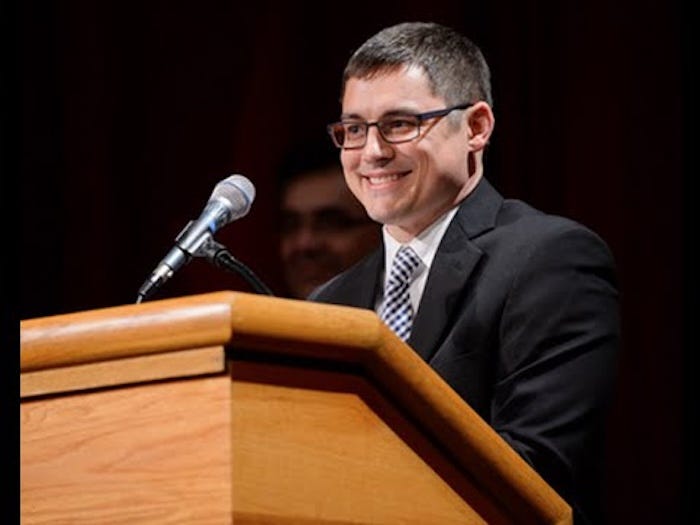
My conversation with the 2015 Nicholl Fellowships in Screenwriting winner.
Sam Regnier wrote the original screenplay “Free Agent” which won a 2015 Nicholl Fellowship in Screenwriting. Sam and I had an excellent phone conversation in which we covered a lot of territory, his background and how he got into writing, a deep analysis of “Free Agent”, and a discussion about the writing craft.
Scott Myers: You grew up in the Midwest?
Sam Regnier: Yeah, I grew up in Kansas originally. Overland Park, Kansas.
Scott: In your acceptance speech for the 2015 Nicholl Award, you thank your father for teaching you about work ethic and your mother for teaching you to love story. I was wondering if you could maybe unpack that in terms of how you learned the lessons from each of them when you were growing up.
Sam: My dad was an entrepreneur. He started a bank out of a trailer — like a house trailer — in Kansas. My mom worked there, and they eventually grew it into a regional bank. My dad has always been dedicated to the idea that if you work hard every day that eventually you’re going to get what it is you want.
My mom is an obsessive reader. If she was in the middle of a book, she’d bring it in the car and try and get a paragraph in while she was driving, which isn’t the safest thing in the world, but… [laughter] …it definitely filtered down to my brother and my sister and I. We would go on these road trips to Colorado or Minnesota, and we would go for two hours, three hours, in the car, and nobody would say a word, because my dad’s driving, and the rest of us are reading. That’s the way we grew up.
Scott: And I’m assuming your reading led you into writing…
Sam: Yeah, I started writing pretty young. When I was still in elementary school, I started doing a little bit of fiction. But really, I focused on poetry. I entered a variety of poetry contests starting in middle school, all the way through high school. I did OK.
I focused on writing poetry through high school — then graduation starts sneaking up and I realized — not only did I have no idea what I want to do with most of my life, I didn’t know where I want to go to college, or why I wanted to go there. There were only three things in my life that I was really passionate about: wrestling, photography, and writing.
I figured wrestling probably wasn’t going anywhere. I thought maybe I’d go try to go to University of Iowa for writing — but my uncle, who was a professor at USC, said “Why don’t you come out here, see the school, take the cinema tour.” I took it, and I immediately knew.
Scott: Let’s step back a bit. Do you have ever some books that were particularly influential for you when you’re young?
Sam: The funny thing is I read a lot for volume. In terms of series, we had every “Hardy Boys,” every “Boxcar Children,” every “Encyclopedia Brown,” every “Babysitter’s Club.”
I had the complete works of Sherlock Holmes. I read every one of all of them. I started reading a lot of science fiction, because my brother was into it.
Then after that, my mom’s favorite author is John Irving. I read a lot of John Irving as well. He was also a wrestler when he was a kid, and so I’ve made that connection with him. He has a literary quality to his writing that is very, very beautiful. Those are probably the main literary influences.
Scott: How about movies and TV, any of them from your youth that inspired you?
Sam: I was also a little bit obsessive about watching movies multiple times. I had a group of friends — we were typical high school guys. We didn’t have active social calendars. Every single Friday night that something wasn’t happening, which was a lot of Friday nights, we would watch The Big Lebowski. I don’t even know why. We loved it. I don’t know why we didn’t watch something else. But we probably watched it somewhere between 40 and 50 times when I was in high school. We loved it so much.
The other one that I would watch a lot was The Princess Bride. I watched that a ton of times, and I read the book. I got really into everything that William Goldman wrote before I went to film school or even thought about being a screenwriter, strangely. Then, once I did, I realized, “This is the most famous screenwriter. This works.” I had read Marathon Man and seen the movie, All the President’s Men, Butch Cassidy.
I also loved a lot of character comedies like City Slickers or Tommy Boy — stuff that I’m trying to write now.
Scott: People ask me all the time, “What are some good screenwriting books?” I say, “Adventures in the Screen Trade” by William Goldman. You should start there.”
Sam: The second one is great, too. If you read that one and then “Which Lie Did I Tell: More Adventures in the Screen Trade,” those two together are all you need to start.
Scott: So the University of Southern California School for Cinematic Arts. That was quite a transition from Kansas. You’re not in Kansas anymore, you’re at USC. What was that experience like?
Sam: It is a big transition. LA doesn’t really seem like a real place when you are from Kansas. I wasn’t from the middle of nowhere or even a small town, but you forget when you grow up in Kansas that people live in a place like Los Angeles.
But I got to LA, and at the beginning it’s the same as any college. The best things about it, by far, that the program I was in had 22 screenwriters. And every semester, you had a class with 10 of those people, and you workshop the entire time. Part of the benefit is getting notes from other people. But the bigger part of it is, every week, you’re giving notes to ten other people.
You learn as much or more from helping people through their writing problems as you do from your own, because you’re looking at it from a real perspective. You can see what’s happening. In your own writing you’re way, way too close to it. The problems seem intractable, whereas with other people’s writing, you take a look at it and you’re like, “Oh, no. Lose that character and you’ll be fine and everything will tighten up.”
Scott: You’ll probably remember this. Billy Ray, when he spoke at your Nicholl ceremony, he said that 95 percent of what screenwriters do is solve problems.
It’s really important to develop those critical analytical skills where you can read material, identify the issues, and then come up with solutions. It sounds like that was part of what was going on there for you.
Sam: Absolutely. You need to be able to look at material from a broader perspective, because that’s how every executive is going to look at your material. You need to know what that’s going to be like for them.
Scott: After graduation, you did some internships, but eventually you landed as an assistant at Paramount Pictures.
Sam: I was an assistant there for a little bit. After I graduated, I had done an internship at Morgan Creek Productions and met an executive, Mona Panchal, and she got a job at Paramount a month after I graduated — which worked out great for me.
I really loved working there. Any job like that has a tendency to take over your life, and that’s what it did for me. That’s why I eventually left, because I knew that I wasn’t writing enough — if I was ever going to get good enough to write professionally.
On the flip side, the lessons you learn from being on that side, the buyer side, are so invaluable. I talk to a lot of writers who get really frustrated with being pigeonholed. What I remember from that time is having all this material and all these writers on one side, and then all of our projects on the other side, and trying to figure out how you make connections between all these creative people and all these projects, which is a really difficult problem that I don’t think writers appreciate how hard that can be.
Sometimes, you need to be able to simplify a writer and what it is they do. People say, “I don’t want to be a name on a list.” But if you’re not a name on a list, you’re not going to get any work. If you trying to hire a writer, on some level you need to be able to say, “These people do comedy. These people do drama.”
You you need to understand the logistics sometimes require people to be able to simplify what it is you do. I tried to remember lessons like that from when I was at Paramount.
Scott: I believe it was Scott Derrickson who said there’s a way of inverting that whole thing about getting on lists, essentially you’re branding yourself as a writer. If you’re a genre writer, in particular, you want to be known as an action writer or a comedy writer or a sci fi writer.
Sam: It can be really useful to brand yourself. I know in the back of my head that I have much broader ambitions or broader interests, and I am still committed to pursuing them, but we work in a business of creativity and ideas and things that are very ephemeral. If you’re going to have a conversation with someone about something that’s real and concrete, you need to ground that. It’s not always the best idea to tell them, “Yeah, I want to comedy, but I also want to do dramedy and I want to do a space opera, also. But also, I want to do a Marvel movie.” It’s not practical to talk about that in conversation. The easier way, when you’re starting out, is to say “These are the things that I’m interested in right now; this is the target that I’m hitting.” And ground that in real things that people understand.
It doesn’t have to be “I’m looking for high concept comedies with a budget of between $10 million and $40 million.” You can say that, but you can also say, “I like stuff with father-daughter relationships.” Or “I like workplace dramas.”
Scott: That’s the value of a spec script. No matter what genre you may be known for, you can always branch out and write something new.
Sam: Exactly.
Scott: You made that shift from being an assistant, and you tutored for several years and then worked for an educational type of an outfit, Green Dot Public Schools, both of them in the field of education. That allowed you more time to write?
Sam: Yeah. When I left Paramount, the number one thing I was interested in was writing as much as possible. I knew I had to get my 10,000 hours in. I was tutoring a lot at night and on weekends, and I had huge chunks during the day to write on my own. I never would have gotten to the place that I needed to be as a writer if I didn’t have that time.
I transitioned to my job at Green Dot, which was more of a traditional nine-to-five job, because I got married, I was starting a family, and I couldn’t be away nights and weekends all the time anymore.
Scott: Let’s jump to “Free Agent,” which is this terrific script that you wrote that won the 2015 Nicholl. Here’s a plot summary:
A female NBA, National Basketball Association executive for the Golden State Warriors, Bridget, pursues the biggest free agent of her career while managing a messy divorce. And a complicated relationship with a younger colleague named Nick and his teenage sister Taylor.
If I’m not mistaken, didn’t the script make the Nicholl top 50 in 2013?
Sam: It did.
Scott: So you’ve been working on this for a while.
Sam: Yeah. I submitted it in 2013, and then I continued to write it over the summer, and was so upset that I hadn’t gotten the draft that I liked in the 2013 Nicholl. I finished it sometime in the fall of 2013. I entered it in a screenwriting competition called Tracking B. That’s how I met my manager, Scott Carr.
Scott: In an interview I read, you said you had three points of inspiration for the story. First and here’s a quote, “I approach all my scripts from the characters’ perspective and start with a character who has a really interesting point of view.”
Could you elaborate on that and how that led you to the protagonist of “Free Agent,” who is very definitely an interesting character, Bridget?
Sam: Bridget was an extremely driven, career focused woman in her early 40s, and she belonged to…what I felt like I saw was a generation of women, people I knew, that had embraced this career focus at the same time. They were all reaching a point where they were making a final decision about whether or not they wanted to have kids are not. Because I wrote the script when I was having kids, that’s part of the main thematic element.
I thought it was an interesting time to be with that character, because it says a lot about feminism and the different requirements that are made of being a woman in America right now. It’s something that I see my wife go through, because she’s career focused and also a mom.
I felt like there was a lot to unpack there, a lot of judgments to be made, or answers that are perhaps more complicated and have more gradations than the way they are sometimes portrayed.
Scott: Whenever I read a script, and I’m looking at the protagonist as they’re set up in the first act, I’m always looking for what I call these Disunity elements. Essentially, these points of conflict going on in their lives, and Bridget’s got a lot of them.
You mentioned this issue of kids or not, and there’s a revelation on that in the story, but she’s a woman working primarily in a man’s world, the sports environment. She’s going through a messy divorce. She provides herself on her professionalism, and she’s carrying on an affair with a much younger associate at work.
Interestingly enough, too, she’s a statistical analysis type of person, one of those Bill James types of sports people. She got a rational nature, but it seems like a lot of her decisions in her personal life were more influenced by emotional impulses. She’s got a lot of Disunity dynamics going on there.
How did you go about developing that character, so that you had those layers of things to work with?
Sam: That’s a really good question. It all started from the same seed, which is this person that has gone through something dramatic, and as a result of that dramatic thing, had tried to sanitize her life as much as possible. Right around when we meet Bridget, she has finally succeeded in fully sanitizing her life, and that attempt to strip any emotion away from her life is what leads to the disunity that you describe.
All of those decisions — her relationship with Nick, her relationship with Taylor, her decisions that she makes at work, which even though they are based in statistics are often emotional in nature — all of those things are reactions to climbing this mountain of removing emotion from her life. And once she got there, she was so empty that she exploded into all these pieces.
The story is her trying to pick those pieces up, to get back to this place of no emotion — but it’s too late, she’s already unleashed all of these different relationships.
Scott: It’s like Joseph Campbell talks about the Hero’s Journey, saying at the beginning, the character is making do, but they need to change.
Sam: Exactly.
Scott: This younger associate with whom Bridget is having a relationship is Nick. Can you reconstruct how he emerged in your story crafting process?
Sam: He was the first element after Bridget. I thought, “What is the number one thing that can make things difficult for her, and really shatter her world?”
Immediately, I knew it had to be something to do with her workplace, and it had to be something emotional. I settled on a workplace relationship very quickly, and it had the added benefit of being something that she was pulling into her own life, as opposed to something that was imposed upon her. That makes the struggle internal; she wonders why she is the one that who is creating these complications by continuing this relationship.
Scott: The second point of inspiration from that interview you said for “Free Agent”, this is another quote. “My wife and I had a daughter, and that influenced me as I wrote the script. There’s a character, Taylor that comes in the middle of the central character, Bridgette, has a conflict that represents my dealing with becoming a parent for the first time.”
You mentioned earlier that you had an emotional connection to the material. Maybe you could delve into that a little bit, this Taylor character, was a surprise to you. That was one of the first instincts that you had.
Sam: I wasn’t even planning to have this character. I was planning on it being a workplace drama focused solely around Bridget having a relationship with a younger man.
I remember the moment the Taylor character came to me. I was looking at the script and I thought there was something missing. I knew the emotional journey she needed to take, and she couldn’t do it with Nick because she would be too guarded in that relationship to really experience some of the closeness that she needs, some of the emotional closeness that’s different than a romantic relationship.
I was walking to work one day, and this character popped into my head. What is Bridget was dealing with a younger version, essentially, of herself? Someone that was as driven, and as difficult as she was. What would that look like? What challenges would that person have?
I didn’t know it at the time, but I was writing about becoming a parent. This was within months of my daughter being born, and her befuddlement and lack of confidence in how handle this new interruption in her life was pretty much a carbon copy of what I was going through.
And on top of that complication aspect, there was feeling — what did I do to deserve this great thing that’s happening to me? It’s a feeling that Bridget also reaches throughout the script.
Scott: What better way to create conflict than to physicalize some internal aspect of stuff that Bridget has yet to resolve in the form of this Taylor. So you’re walking to work, and you have this idea of this young, teenage girl. I’m assuming pretty quickly you said, “Oh, she could be the sister of Nick.”
Sam: Yes. I needed a way, I wanted a good reason for her to be involved in the script, and honestly, the way that she becomes involved with a little bit of a cheat. You get maybe one or two cheats in a script, and I needed a really good way to make sure that they would really be in close contact.
Scott: How would you describe Taylor’s character to someone?
Sam: I would say she’s a precocious 15 year old girl who leads with her chin, leads with her own worst qualities, almost daring someone to reject her. Because her overwhelming desire is to convince you that she does not care what you think about her.
She’s gone through a lot. She’s lost her mom, and she’s on her own in the world. But she’s taken that feeling of being on her own and decided to flip it in her favor — make it as a testament to how strong she is.
That baseline “I don’t care” attitude tends to produce a conflict in almost every situation she walks into.
Scott: Like, a good offense is the best defense?
Sam: Exactly. She’s not going to wait for you to reject her, she’s going to reject you first.
Scott: That’s a primary nexus point for Bridget in terms of her personal transformation, this relationship with Taylor. When you’re walking to work, you came up with this idea for Taylor, I’m assuming you didn’t know, “Oh, this is where this is going to go.”
Did that trajectory and arc of that relationship between the two, how did that evolve over time?
Sam: The next key moment is the introduction of basketball into the script. Even though that is the core plot, it was the last piece to come in.
Initially, I introduced Taylor, and there were scenes where she interjected herself into Bridget’s life, but there wasn’t a really good method or vehicle for them to connect with each other; a way of physicalizing or externalizing the conflict that they were having.
The introduction of this shared love of basketball was a way for these two people that are incredibly guarded to plausibly open up to each other.
Once I found that they had this shared love of basketball, this possibility arose that they could get onto a court with each other and essentially battle each other to emotional exhaustion. To where they can reveal something really about themselves.
There are essentially four basketball scenes between Taylor and Bridget that, in my mind, are the core of the script. You can change a lot of things around them, but those beats are the story, in my mind.
Scott: I definitely want to get into that, because it’s a really interesting aspect of this story. Let’s talk about the NBA part of it. On the surface, someone would say, “Oh, this is a sports story,” but it’s not at all, really. The sports is a backdrop, correct?
Sam: Yes. It’s important, in some ways; that Bridget has this somewhat outsider role, that she’s a woman in a man’s world. Also, this idea that she is stuck between rationality and emotion very much comes from that world. At the same time you never see an NBA game, or an NBA practice. You barely see an NBA player in the script. You see one high school game at the very end.
Essentially, it’s less about the NBA and more about what it means to be part of a team. Bridgette has a history that she played basketball, she loved basketball, she had a history of being on teams. But now she’s rejecting this idea of working with other people, of teamwork. She has to work her way back to trust, learning to be part of a team again.
That’s the whole point of the title. She’s chasing this free agent, and she’s acting like a free agent in life. She’s floating, because she doesn’t want to tie herself down to anything. But she can’t be a free agent forever.
Like you said, is it about the NBA? Tangentially. Is it about sports? Yes, in that it’s about connections. It’s about teamwork. It’s about that feeling that you get when you achieve something with other people.
Scott: It’s really interesting to hear you talk about this, Sam. It speaks to the magic of the creative process. You start off the whole thing with this character, Bridget, and you’re interested in her, and the place of a woman in her early 40s, from that generation, dealing with some of those big issues.
Then you come up with this idea of Nick, and then you have the spark of this character Taylor. You’re starting to think, “How can I intersect them, and what can be the possible point of connection between these two?”
Then you take your obsession with the NBA, because you say, “I don’t want her to have a Wall Street job. I want to give her something interesting.” You said you were watching a game, and you saw a general manager for the Houston Rockets or something and said, “That’s interesting.” Is that right?
Sam: That’s exactly what happened. They were talking about him on TV, and I thought — her story would be so much richer if that was her job.
Magic is the perfect word for it, because watching all these things, all these pieces that you suspended in the air and you’re looking at them, and you’re thinking, “No way these things fit together.” Then something happens, and they all fall together into one piece.
It’s a truly bizarre experience, because there is not a great explanation for how it all fits together, as far as I’m concerned.
Scott: Yeah, you wind through the circuitous journey, end up at the NBA and all of a sudden you’ve got, “Wait a minute, I’ve got basketball. That’s what they could connect with, right?”
Sam: Sometimes the pieces fit so well that you wonder how. You wonder — where did this come from? Is this something that I saw somewhere else? How could I possibly get piece Q before I get piece B, and why do they fit so well with each other?
Scott: That’s what’s so interesting. When you read the script, you know how so many movies have the big story and small stories construction. You’ve got the A plot, but then you’ve got all these subplots.
You’ve got that going on in “Free Agent,” you’ve got the big story, essentially Bridget’s pursuit of that free agent NBA basketball player, but then all these small stories, the subplots. Her relationship with Taylor, her relationship with Nick, her relationship with her ex-husband and so forth. It does seem really seamless.
How much of that was the magic of writing, and how much of that was really hard-ass, getting feedback from people, and having to work, and work, and work those elements so that they felt unified?
Sam: I would say it’s 100 percent magic, and 1,000 percent hard work. Writing is such an iterative process, which is something that took me a long time to realize. You write a draft, realizing what pieces fit and which don’t. You do another draft, do the same thing.
You do it over and over again, and you realize that what they say is true: your first drafts never get any better. The only difference is your last drafts get better. Hopefully, every time you do another script, your last draft is one millimeter better than the last draft of your previous script.
At then, that’s when you can really get in the zone — I like to call it being “in the pocket.” If I’m in the pocket, that means I know what the movie is. I’m not floating anymore. I know I can get there eventually; it’s just a matter of going through the iterative process — refining, refining, refining.
At first, you’re chiseling, and by the end, you’re ironing. You’re looking for wrinkles that don’t make sense, or pieces of dialogue, or pieces of scenes, or pieces of interactions. If you can clean out everything, so that it feels like it’s seamless, then you’re done.
Scott: You mention those four pickup games, and games of Horse, as being the heart and soul of that story. At that point, when you hit on those, you knew you were in the pocket for “Free Agent”.
Sam: Exactly. A couple of those came right away, after I figured out the basketball part, because I had written something similar that wasn’t quite there, the scenes between the two of them. I knew that there’s a midpoint scene between the two of them where Bridget is really hard on Taylor — she’s essentially trying to break her. You can look at dozens of drafts of the script, and that’s right there in the middle of every one. I knew that was the pivot point.
Scott: A transition point.
Sam: Yes. It was something that I could hang onto. I could say, “What builds to this? What follows after it?” That’s the moment where they break each other, where they become close.
Scott: Added benefit, you’ve got, I call them BOBs: “Bit Of Business.” You’ve got this activity, a visual thing, and you can shroud whatever exposition and back story stuff, by having them play basketball or a game of Horse.
Sam: Right. That’s the other huge benefit of anchoring in that world. It’s physical, and it’s real, and it’s a thing that you can do while your characters are doing exposition.
Scott: A bit of business.
Sam: Exactly.
Scott: At the Nicholl ceremony, you were presented by Stephanie Allain, who is a former studio exec, and currently a very successful producer. She said something interesting. She said when she read Free Agent, featuring not one, but two great female leads, she said, “I was so excited to meet this woman writer.”
First of all, I would take that as a big compliment. I’m asking the first thing. Are there any keys you might have discovered in writing female characters compared to male characters, or do you approach them pretty much the same?
Sam: One of many important avenues to becoming a better writer is the ability to listen, to search for motivations in other people, and to really feel empathy. It’s only by really examining people and what makes them tick that you can create stories that are both unpredictable, and feel real and honest.
So the main difference between writing men and women, for me, was that when I see a man’s actions, I filter them through my own feelings. I feel like I’m already halfway there.
When I’m trying to write women, I have to admit that I don’t really have any idea about what it is like to be a woman. So I have to really dedicate myself to observation, examination, and understanding. Through that, hopefully you can write a character that people believe is real.
Scott: That circles back to where you like to start, which is with character. Of course, you go to USC for four years, and you were an assistant for a little over a year. You’re obviously aware of the fact that there is this ridiculous disparity in terms of the numbers of male versus female leads in movies.
Did that ever occur to you when you were writing this thing, or did you say, “I’m not only care about the conventional wisdom there?”
Sam: It did occur to me, and I would love to tell you that it didn’t affect me. It didn’t affect me when I was writing it, because I knew that I loved the story. It did affect me when it was time, unfortunately, to take it out.
As much as I hate to admit it, I knew that it might not be is commercial, or salable of a script. I felt like before I showed it to someone, I wanted to have other material that I could attach it with, as a package.
I would like to work toward a world where that never affected anyone.
Scott: Is that fair to say that that was maybe part of the process in your thinking of setting it aside for a year and a half or so, and trying to write other material?
Sam: Absolutely. That was part of the whole decision making process I was going through.
Scott: But at some point you said, “Screw it, I’m going to submit it to the Nicholl again.”
Sam: By that point, I had come around the gotten closer to, I realized that “Free Agent” was closer to the type of material I wanted to write, and I re-read it, and I realized that it was better than I remembered.
A lot of times, you re-read your material, and you cringe constantly because you can see the strings on the puppets. You think there’s no way people are going to want to read this, because that’s part of being a writer. That was one of the few times I re-read something, and I thought, “Why haven’t I shown this to anyone?”
Scott: Of course the irony here is the script, which features not only one major female lead, but also the second lead. It blows up conventional wisdom when CBS film steps up and buys this thing, even before you were named a Nicholl winner, right?
Sam: Yeah. They became interested the day it was announced as a finalist, and then they bought it the same day that it won.
That’s why you can’t make assumptions. When you’re chasing what people want, you’re never going to catch up.
Scott: I’d like to believe that there’s an object lesson there.
Sam: You want to make the whole industry monolithic. People talk about the industry like it’s one thing, and not 1,000 different companies, all of these different places that have room for different types of material.
Scott: Let’s jump to the Nicholl. What was that process like? You remember where you were when you got the call?
Sam: I do remember. There’s 7,000 scripts. Then you learn that you’re in the top 2,000, the top 1,000, you’re in the top 50. Those are exciting moments, and but the first call you get is when you find out that you’re a finalist.
I was sitting, working on a data request at my job, a spreadsheet full of numbers. My phone rang, and he said “Hey, this is Greg from the Nicholl. Do you have a second?” Immediately, my world went white.
I had tried to be as pessimistic as possible on every stage of it. I thought, “I’d done well, but it’s not going to make top 50. It made top 50, it’s not going to be a finalist. I made finalist, it’s not going to win.”
I was driving home from work when I got the call. The script had sold four hours earlier, so I was in this really crazy, emotional place already, and that was the icing on the cake of an unbelievable nature of a day.
Scott: You’ve got to remember that date, right?
Sam: It was a Friday. September 25th.
Scott: Talk about a Red Letter Day. You sell the script to CBS Films and get the Nicholl award?
Sam: Exactly. My wife knew about the sale, but not about the Nicholl. She came home, and it was a fun moment to spring it on her.
Scott: This brings up, which I’m sure will become the stuff of legend, assuming that your career goes the way that I suspect it will, the bottle of champagne. The seven year saga of this bottle of champagne, or however long it is. You want to share a little bit about that?
Sam: Sure. Soon after I left Paramount, I was excited about my career. I knew I wasn’t there yet, but I felt like I was close. We came across this bottle of champagne, and I thought “This is a symbol — it’s come to me for reason. I’m going to hang on to this bottle, and this is the bottle I’m going to drink when I sell my script.” And then it sat in my fridge for seven years. Four different fridges, actually, one apartment to another.
It was this white elephant of a burden that I was carrying. I couldn’t throw it away, because I was too stubborn.
Scott: Literally every time you open up to get a glass of milk, or a head of lettuce or some cheese or whatnot, there’s this bottle of champagne staring at you.
Sam: Exactly. It’s on it’s side. I can see it in my head, in every fridge I’ve ever had. I pick up the milk, and there it is. “When am I going to get to drink that bottle of champagne?”
My wife and roommates had to live with it, too. Sometimes, the fridge is full and they’re looking at me like, “When are you going to throw the bottle out?” [laughs]
Scott: This begs the question, have you finally drunk it?
Sam: We drank it that night.
Scott: September 25th?
Sam: We drank it that night, September 25th. We got some good food, my wife and I put the two kids to bed and we popped it. I had Googled it, and I had thought, “This is going to be flat and disgusting, because champagne doesn’t really last that long, but we’re going to drink it anyway.” I thought the cork might not even pop off. Then I opened it, and I swear it ricocheted off all four walls.
It was so metaphorical, the amount of pressure that was built up inside that bottle. It was perfect. It was like the day it was bottled. We drank it, and we toasted, and it was a real moment that you remember.
Scott: No matter what bottle of expensive Veuve Clicquot or Dom Perignon down the road for you, probably nothing will taste as good as that.
Sam: A bottle of the cheapest possible champagne that I found on the floor of our apartment after a party. That was its provenance.
[laughter]
Scott: Oh, man. That’s so great. Well, congratulations. That’s wonderful. Let’s jump from that to some craft questions. You mentioned character as a starting point. In this one interview, summing up like an advice to writers, you mentioned patience not only about learning the writing process, but I was really struck by patience about finding that right idea to write, not jumping in on the first thing.
I always like to start off asking people, how do you come up with story ideas? So how do you come up with your story ideas?
Sam: There’s no short answer. Ideas are so slippery, you have to try and find them wherever you can. It can start with a character, and you start with, “What’s a character that I would love to write, that an audience would love to see?”
Then you work backwards by saying, “OK, what are the logistical characteristics that shaped this person?” Then backwards from there to say, “What is the situation that this person would be in that would activate their worst fears or their most difficult journey?”
You can get to it that way, and that’s how “Free Agent” started. You can scour the listserves of news stories, sometimes that works. But I would say listening is probably the best but also the most ethereal, hardest to pin down.
You have to talk to people in your every day life, really listen to them, and wait for anything that makes your ears perk up, something that’s strange or interesting or different. Then you have to think immediately, how do I build a story around that?
Scott: Let’s talk about prep writing, like brainstorming, character development, plotting, research, outlining. Which of the aspects of prep do you tend to devote the most time and focus to?
Sam: I would say brainstorming and character development. Character development is a necessity because you can’t start writing the story unless you know who the characters are. At the same time, I can’t create a character in a vacuum. It needs to be a conversation between character and story, built brick by brick, because each informs the other.
When I’m brainstorming or outlining, I have a very specific and basic process. I open a blank Word document, and I start writing an internal monologue. It’s an extended conversation with myself about everything related to the script.
I write down all the problems I’m having with the story, and I ask myself how to fix them, and then I shoot down my own ideas and come up with new ones, and somewhere in that process hopefully I find some answers. I’ve got these long 20 page Word documents that are just me talking to myself.
It’s not like Scene A, Scene B, Scene C. It’s not like Clark is this character, and Greg is this character. It’s me saying, “Hey, but at the middle of the story, then the story falls apart. Why does the story fall apart?” Then I’ll say, “Maybe I need another character?” Then I’ll say, “Well, I already have three workplace characters, so maybe there’s a personal character.”
Any time I get stuck on a script, then I find the best thing to do is to shut everything down except that one page, and I can almost always find the answers in there.
Scott: How about dialogue? Your script is great in that regard. The characters really pop on the page, and of course, that’s super important when you’re writing a character-oriented piece. Of course, we hear writers all the time say, “Well, you either have that ability or you don’t.”
How do you go about finding your characters’ voices? Do you think it’s possible to develop an ability to write dialogue?
Sam: I think so. It’s difficult to differentiate dialogue, for me, from any other quality of writing because I didn’t do anything different to develop that skill. It wasn’t innate — my dialogue was not very good when I started, and it got better with time.
I am especially prone to giant blocks of dialogue, which can be helpful. I don’t do any editing on my first pass, so my scripts are incredibly long, and every conversation is interminable because each character is saying a soliloquy followed by another soliloquy.
But it’s helpful, because usually in there somewhere, there is one line that is interesting. You have to cut, cut, cut, reword, reword, reword, obsessively until you find an eight word snippet that works. Then you string together enough of those and you’ve got a scene. I’m obsessive about every line being shorter because I’m paranoid about my scripts being overwritten.
You want your characters to be able to express themselves extremely concisely and get their points across, unlike real life. That’s really the only way that I know how to do it: to overwrite everything and then to see if, in those ten lines of dialogue, there’s one kernel that’s really good.
Scott: Zero in on that.
Sam: Yeah, and then slice, slice, slice.
Scott: I’m wondering, because you said you had an early interest in poetry, I oftentimes…specifically scene description. I’ll say, “To me, the best scene description reads more like poetry than prose.” Do you ever circle back to your instincts? In terms of poetry, that concise language and really trying to choose the exact words that are going to convey the most visual and emotional meaning?
Sam: Yeah. That’s something that I have focused on much more recently, because when I was even writing “Free Agent,” I was extremely logistical with the scene description. I really wanted the writing to feel extremely clean and very tight, for the script to have a certain pace.
As I’ve written more, as I continue to try and grow as a writer, I realized that a lot of times the poetry of it is more important than the logistical aspect of it.
Instead of trying to use five lines to describe an entire room, if you describe a single detail on the wall, it’s so much more effective in portraying the feeling that you want with your audience.
You can’t denigrate screenwriting if you want to be a good screenwriter. It’s a very easy thing look at a screenplay and to think, “The audience is never going to see it, and so the artistry of it doesn’t matter.”
That’s a really big mistake because the art of a screenplay is the ability to create a world that the actor and the director and the cinematographer and the art director can all see and they can all reference together, so that when it comes time to construct it everyone involved in the project is on the same page and living in same world that you created.
You can only do that by using poetic language and trying to imbue the script with something that’s more than “Ted walks to the door. Ted opens the door. Ted exits. Ted closes the door.”
While that may cover your bases in terms of physically what happens on-screen, it’s not going to create a world that people are going to want to inhabit with you.
Scott: You mentioned a key word there, for me, too, which is emotion. You want to make the reader feel something.
Sam: Absolutely. When I started, I focused on becoming a very by-the-numbers writer at first, because I wanted to be very workman-like and straightforward. I didn’t want it to seem like I thought I was better than I was.
But what I realized is that when people read a script, they want magic. People are paying for the magic, for something to leap off the page, and you can’t be afraid of that.
Scott: That leads me to a final question here, for you. Back to Stephanie Allain, what she was talking about in the Nickel speech. Before she got to you, she was talking to all five of the winners. She implored you to “keep your distinctive voice.” I’m sure you’ve gone on bottled water tours, and you’ve got a deal in place.
For better or for worse, obviously for better, ultimately, from a career standpoint, you’re inside the bubble now. The 405, 110, the nexus. Have you thought about that? How do you intend to keep your distinctive voice, and how should aspiring writers out there try to nurture their own distinctive voice?
Sam: You just have to remember that it’s not good enough to write something that’s good. And I don’t think it’s possible to write something great, something special, that’s not distinctive to you.
You’re talking about taking ideas from your head, writing them in plain text for someone else to direct and act and build sets and all the rest. The idea has to go through so many hands — like a game of telephone — and the only way it can make it to the end without getting mangled is if it resonates in each person along the way. And the only way to make it resonate in each person is to have it resonate in yourself. And if you do that, and you’re really lucky, maybe it can resonate with each person in the audience.
You can’t fake it. It doesn’t fake, not if you want to be able to do it again and again, to make a career.
If you want to write great stories continually and stuff that other people can’t do, then it has to be personal. You’re fishing in the same communal pool of ideas as everybody else, and the only way to protect yourself from serving up stale or duplicative work is making sure that everything you write is personal in some regard.
If everything I write comes from someplace personal — a place of real emotion — I know that at least I’ve done as much as I can do.
For my interviews with every Nicholl Fellowships in Screenwriting winners since 2012, go here.