Go Into The Story Interview: Renee Pillai
Renee Pillai wrote the original screenplay “Boy With Kite” which won a 2019 Nicholl Fellowship in Screenwriting. I had the opportunity to…
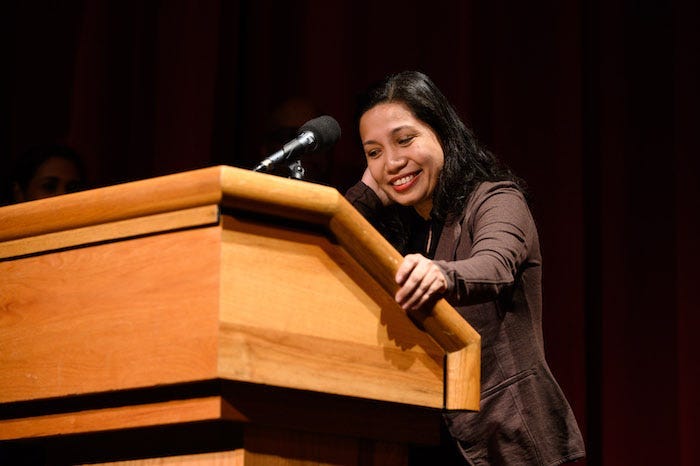
Renee Pillai wrote the original screenplay “Boy With Kite” which won a 2019 Nicholl Fellowship in Screenwriting. I had the opportunity to chat with Renee about her background as a screenwriter, her award-winning script, the craft of screenwriting, and what winning the Nicholl has meant to her.
Scott Myers: You’re from Malaysia. In the Nicholl Ceremony in Beverly Hills, Tyger Williams who was your presenter, talked about the rigors you had to go through to get to the event on time. Can you talk a little bit about what that process was like?
Renee Pillai: When I found out I had become a finalist, I immediately thought, “Oh, no. I have no travel documents.” Then I found out that only Fellows attend Fellowship Week. So I thought, “OK, not a problem because I don’t know that I’ll become a Fellow.”
Then when I found out I’d become a Fellow, that started the whole thing off again, “Oh my God, I have no travel documents!”
I told the Academy I had to get a passport. And that freaked everyone out, because I understand here in the US, it takes a month to get a passport.
Scott: A month or more, yeah.
Renee: So everyone thought, “Oh my goodness, it’s going to be the same for Malaysia.” At that point, the award ceremony was just over a month away.
So I needed — Passport. Visa. Clearance to travel.
Once everything cleared, I applied for a passport and US travel visa. You can only apply online, and it costs quite a lot. By that time, I had used up my savings figuring everything out.
So my friends showed up. Everybody brought their piggy banks, not literal piggy banks but all their small change, whatever they had. We ended up with $160 in a pile of coins. We thought we’d go to the bank to change it to paper money. But we found out you get charged for the conversion and realized, “OK, we’re losing out here.”
So I ended up paying in coins. And bless them, the officers there, they just took that. They closed six counters, and they all counted coins. No complaints.
That wasn’t the problem. The problem started the minute I applied for my US visa. I’d already created the online account on October 4th when I got told we’d become Fellows.
And I managed to get my passport five days later.
When I initially applied, I got the possible interview date of October 16th. That was fine, that gave me more than enough time. But there was a problem with the online payment. And they couldn’t rectify it because it was already the weekend.
By the time it was rectified, the earliest interview date the US embassy gave me was November 8th, which everyone now knows is the day after the awards.
That’s it. I thought, “Game over, man. Game over. It’s not going to happen.”
So I wrote to the Academy, and I said, “This is the situation. I’m not sure what can be done. Yours in distress, Renee.”
They were amazing. They wrote back immediately and they said, “Look, we’re speaking to our legal team. If we have to get lawyers, we’ll get lawyers, because this can’t happen.”
They tried everything. And eventually, they managed to get in touch with the Cultural Affairs Department of the US Embassy in Malaysia.
The Cultural Affairs people said, “We’re not in charge of visas but let’s see what we can do. Let us meet this person first.” I think that was the first time anybody in Malaysia found out that I’d become a Nicholl Fellow.
I met up with them, and we talked. And as it turns out — movies are an international language. They were great movie fans and I think that helped because three days later, I got my visa interview.
Scott: What a wonderful story. Did you ever see when Billy Wilder accepted the Irving Thalberg Award at the Oscars, I believe it was 1988? Billy Wilder told the story about how he had to flee Germany before World War II. He made it all the way to the Mexico‑US border, and they were going to turn him back. He’d go back to Europe and probably be killed. He started talking to one of border guys who just so happened to be a movie fan. They shared their love of movies and eventually, the guy stamps Wilder’s passport, waves him into the United States, and told him, “Write some good ones.” Which I think it’s fair to say, Wilder did!
Renee: Oh my goodness.
Scott: Similar story to yours.
Renee: I actually did not know that. I’m a big fan of Billy Wilder, but I did not know that story. It is amazing. It’s wonderful.
That’s why I said it’s so great that movies became our common ground. And to be specific, it was Alexander Payne’s work that we started discussing, because I think Sideways was the Head of Cultural Affairs’s favorite movie.
Scott: You know that at some point, you’re absolutely going to have to meet Alexander Payne and tell him this story. That’s just fated in the stars, right?
Renee: Yeah, also because my script’s set in Nebraska.
Scott: Yeah, exactly. That’s his home state.
Renee: Yeah, that’s actually how the conversation came about. She was surprised to hear that my story was set there, and that’s how that conversation started.
Scott: Overcoming the challenges to get to the Nicholl is an apt metaphor for the challenges you’ve faced in pursuing your creative dream. In your acceptance speech, you said, “Fact is, I’ve never taken a writing class. I come from 14,000 miles away. I don’t even speak English half the time, and I want to write movies here in Hollywood. What kind of fool thinks that’s possible?”
I’d like to use that as a springboard to go back to the beginning. How does someone in Malaysia become interested in writing screenplays in Hollywood?
Renee: That’s a very good question. That’s the thing, isn’t it? Why it all seems so improbable? But the simple answer is — because I love movies.
That’s what started it all. I remember as a kid, you have to watch the movies your parents like.
My dad loves movies but only one genre. And that is classic Westerns — anything with Audie Murphy, and Randolph Scott, and John Wayne, and Robert Taylor. All those movies.
When you’re a kid, when you’re five, you have to watch whatever your dad wants to watch. But somehow, along the way, it became not that I ‘have’ to watch but more that I ‘want’ to watch. Not that Westerns have become my favorite genre or anything.
But it’s that moment when I realized, “This is really good. I love movies. I want to watch movies.” Also, it was about the same time I started writing a lot.
Not very well because at five, how could it be? But I would write little stories and that love for writing just never went away.
Scott: I was going to ask because you were very specific in your speech, saying you wanted to write in Hollywood. Was that desire based on the movies, the storytelling that you were experiencing out at Hollywood, or is it, just in part, dealing with the reality of the Malaysian film market? I did a bit of research on that. I know they had the big financial scandal about four years ago.
Renee: Oh, yeah.
Scott: They don’t make a lot of movies. I think last year, there were just 84 that they mentioned as being produced annually. I’m curious. What is it? Is part of it just trying to escape the Malaysian film world, or is it more of you’re just attracted to Hollywood filmmaking?
Renee: It’s the push ‘and’ pull factor. I’m glad you brought both points up. I’m going to say something and it’s going to sound so ridiculous because it shows something of the warped view I probably have of the world right now.
I actually found it easier to try and break into Hollywood… not that I’ve exactly broken in yet… but the Nicholl does open up a lot of opportunities, and doors, and everything. So it almost seemed like it was easier for me to do that than to break into the Malaysian film industry.
And it’s not like I haven’t tried — I have. But, first of all, there’s not a lot of demand for English language storytelling. You’ve done your research, so you know. Any film with more than 30 percent, I think, of English or any language that is not Bahasa Malaysia — the national language of the country — is considered a foreign film even if it’s done by Malaysians, starring Malaysians. Do you understand what I’m saying?
Scott: Yeah. Absolutely.
Renee: And even then, the language — it’s not so much a barrier. But the stories that you could tell were very limited for me, personally. Because most movies produced locally tend to lean in very heavily into the cultural aspects of the country.
Scott: That dials in then to what you were saying in your speech where you said, “there are freedoms here, freedoms that so many of us take for granted.” You think that in Hollywood, compared to in Malaysia, you’re going to have a lot more freedom to write stories and express stuff that you want?
Renee: Yes. That’s the absolute truth. It’s very interesting. Look at the list of films that have been banned in Malaysia and the reasons why. There’s a long list.
“Hustlers” has been banned for the obvious reasons. At one point, “Beauty and the Beast,” the live‑action movie was banned, but when Disney took a stand of either you show it in its entirety or you don’t show it at all, then the situation changed. It was eventually shown.
It’s all these movies. Abominable, the animation, is banned for, I believe, political reasons because of the dispute of certain islands, who owns it in the South China Sea, something along those lines. Movies that you generally would not think would be banned are banned for many reasons.
If movies like that cannot even be shown in the country, how can I have the freedom to tell whatever stories I want to tell that are not constrained by certain cultural, or racial, or religious restrictions?
Scott: Tyger Williams said, in discussing your script, the Boy With Kite, that he was quite moved emotionally by the story. He said, “I thought it was really profound.” He said, “I believe the ability to bring real emotion into our work is a skill which is more important than ever.”
You echoed this point. You said, “In everything I write, I try to find and am often spurred by the seed of something deeply personal. When I started writing this script, Boy With Kite, I was hurt, angry, bereft, and unimaginably spiteful, but the more I wrote, the more the characters grew to be worthy of hope. And what started as an idea based on diatribes became a story that demanded my respect in its own right. I can’t say if I wrote it to heal myself, but I do know that it taught me a lot about hope.”
I’d like to ask you, how important is it for you as a writer to have the freedom to tell stories in which you’re, “spurred by the seed of something deeply personal,” that they’re personal stories?
Renee: The freedom to write things that come from a real place is of such importance to me, because that’s where I can find the connection. Because I believe all writing has to be about communication with the reader, with the audience. It has to communicate and to connect.
It’s going to sound so cliché, but if I am brave enough and honest enough to do that, then I am halfway toward winning that battle of being able to connect with the stories I want to tell.
As far as deeply personal goes, this particular story… it’s not a real experience that I had, but it was a real feeling I was going through at a point in my life.
I think most stories that come from something that’s deeply personal have a way of connecting with a lot of people. The humanity of the piece is very, very important.
Let’s say it’s a genre movie like an action piece, because I’ve written action pieces as well, as long as I can have characters and situations that are very human, then I can connect.
Scott: That’s what I tell my students, “If there’s no point of an emotional connection or resonance on the part of the script reader or the movie going to characters, all the action in the world is just noise.”
Renee: Yes. I agree.
Scott: It’s interesting you mentioned these two words: Communicate and Connect. Because, thematically, that’s actually quite a bit of what’s going on in your script, Boy with Kite with the characters.
The plot summary for the project, “A surly loner inherits an odd little boy who must overcome her loathing of him to incur the truth about the one person they both love.” You mentioned the story, and you said this came from a place where you were hurt and angry and bereft of unimaginably spiteful. Would you unpack that? Maybe talk a little bit more specifically how that flowed into the origination of the story concept.
Renee: I had been witness to a family situation that I think I drew inspiration from because these characters — they are characters, they’re not from my real life. I’m from Malaysia, it’s set in Nebraska — it doesn’t get any more different than that.
Having said that, I think the best way to say it is even though I am none of those characters, but I am all of them at the same time.
I think the approach was, from witnessing something and feeling completely helpless and unhappy… over a period of time helped me channel that creatively into the concept of the story.
I also knew I wanted to touch on craft, because and I think you realize this too, everything that is pertinent to something like painting or dancing, the temporal arts, also relates to writing. Knowing all that, I came up with these characters that could embody these different feelings and insights that I was having at that time.
Scott: I want to get to the characters in just a second, but I’m curious, you sound like you’re a real student of film, and of course, thanks to your father for getting you started off on the right foot there.
Was there a movie or maybe movies which provided you a touchstone in terms of tone or feel, something you can reach out and touch as you were developing the story? Or is this kind of its own thing, it had no reference points to another film?
Renee: Yeah, I know what you’re saying, because I actually have used that for some of my other works. In this particular case… I’m trying to think if there was… No, I believe you’re right. This was its own thing.
Since writing it, I’ve had people relate it to some other films with similar mood or tone. But when I created it, when I came up with it, I don’t think I was influenced by anything at that point. It was just a story that came to me and I just explored how I could tell it.
Scott: Let’s talk about these three primary living characters in your Nicholl script, although there’s fourth character, Gabriel who has recently died, but his ghost, if you will, metaphorically, is the symbolic and emotional presence places an undercurrent and even a mystery to the story.
Let’s start with the protagonist, this plucky little boy named Ben. This is how your script introduces him. He’s in a bus terminal.
“In the middle of that empty room, there’s a boy, small, looks about seven, can’t really tell because his hoodie is pulled in so tight you wonder how he’s getting air.
Ben Holland, as we will learn to call him, is a little bird of a boy, skittish and worried looking. He wears the misery of someone six times his age all over his face.”
Was Ben the first character who came to you?
Renee: In truth, I think all three of them emerged at almost the same time, but I think it was a toss-up between Ben and Stella. It was always a story that would focus on their relationship. But looking back at it — Yes, Ben probably was the first character because he was the catalyst.
Scott: The decision to make him the protagonist of the story or, at least, the character through whose eyes we experience the story, would that come pretty early on?
Renee: After I outlined the piece, I decided to go with Ben as the person who will take us into the world.
Scott: His refusal to talk, which I did a little research on that, there’s an actual psychological condition called selective mutism. How did that aspect of his persona emerge? Was that something you knew from the beginning, or did it come through the process of just getting another character?
Renee: Initially, I thought of making Ben older and he could speak but because I wanted to have him be the person that we follow, whose eyes we look out of, and because I knew where I was going with the story, in terms of his relationship with Gabe and everything, I guess it was a conscious decision then to make him mute.
Scott: That came with some challenges too because, obviously, you have a character who can’t use dialogue to express themselves and you’ve got to work your way around that.
Renee: Yeah, it was not without its challenges. Especially because I had to figure out “how do I make this engaging?” If not, the scene becomes just one giant monologue for the other characters.
Scott: Of course, it was a great way of establishing, at least, one of several questions that create a mystery dynamic: Why is he not talking? His mother’s long gone. His father’s died like a month ago, which turns out a sudden violent death. That makes Ben an orphan, so he shipped off to live with his aunt.
This is how you introduce the aunt where Ben makes his way through this farm house. He goes up to this bedroom door and opens it. He sees two very naked people engaged in some robust lovemaking.
“The woman is Stella Holland, well north of 50, interesting as she is difficult. Stella’s a star but so is the sun, get too close and it’s liable to kill you dead.”
What about the story development process, how Stella came to be?
Renee: To be very open, Stella embodied some of what I was feeling at the time. Like I said, this is not a real experience for me, but more like what I felt when I witnessed certain things.
If Ben was the projection of my feeling of helplessness and voicelessness, then Stella was really the projection of a cautionary tale, like this is the bitterness that can creep into people if left unchecked. It was more a reminder of how forgiveness is so important.
She came about as a ghost of Christmas future if people cannot forgive.
Scott: Then there’s her lover, Linny and he’s introduced mid‑coitus with Stella. This is how the script describes him with her:
“He’s Linwood James, 60s, salt of the earth, head in the clouds, heart as big as the sky. He’s a blues man. You’d be proud to call father, brother, and son.”
If Ben is a projection of the feelings of helplessness and voiceless that you were experiencing, and Stella is a cautionary tale about if you’re unable to forgive someone, that this bitterness can be the result, where did Linwood James come from out of your own experiences?
Renee: Well, Linny, he’s like a foil for Stella, that rock‑steady character that you hope to be. Linny is basically all the feelings of unrequited love because there comes a point where she does love him in her own way, but he realizes that she’s never going to love him the way he loves her.
It’s drawing again from different human emotions, not specifically from maybe any one experience, although I think Ben and Stella might have arisen from a similar feeling. Linny’s came from the feeling of loving someone who can’t love you back quite the same way.
Scott: All of these characters, they qualify in that respect of…there’s points of universal human connection to them.
There’s actually another character, setting aside Gabriel, there’s this towering old oak tree that’s been in the farm and it immediately draws Ben’s attention. He often seeks refuge by climbing it.
In fact, there’s a key plot point that happens in relation to the tree when he falls out of it. What do you think that represents to Ben that tree?
Renee: I think it’s safety. It’s security, a haven for him because if you look at it, it’s a place where he can run away to, And I think he identifies that from the very beginning because it seems to call to him in that way.
Once you start learning his history, you understand that he always had to find places to hide or be safe and that oak represents that security that he needs. It’s supposed to come from Stella, or Linny, but it’s interesting that he finds it in that object, that tree.
Scott: You mentioned it earlier which is really a visual motif or theme, which runs throughout the story. There’s a framing device of two characters, Jenkins and Roche, who we hear several times in voice-over, but we don’t actually see them until the very end and so that’s a little bit of a mystery like what’s going on there.
Could you describe what’s that subplot about it? How did that emerge in your process?
Renee: Actually, that might have been in from the beginning because I knew how it was going to end, but my main reason for having these two characters was because I wanted to show the juxtaposition between what is expected in the world of art and in a way how different the people of that world could be from Stella.
It’s almost the same reason why I set Stella being this fine artist, this luminary in the world of art in that place and gave her the characteristics that she had.
Also, I use them to… how do I explain this? It was the creation of mystery because I knew that you’re going to see them in the end and they were going to bring it home. But the reason why I parceled their scenes out was also as a counterpoint to the relationship of those two kids in those scenes. Who we eventually learn are Gabe and Stella.
Because these two, Jenkins and Roche, they sound almost pretentious in the way that they approach art, almost a little too cold‑blooded, until they reach the end and the emotion is undeniable. I just wanted to show the difference in how art can be seen.
Scott: As opposed to like they’re just there to service a mystery. It sounds like laying in some of the backstory elements from within.
Renee: Yes, because if you noticed, as we cut away to these flashbacks of the more innocent time which leads up to the boy flying the kite, it’s almost like a prelude to what follows.
When they talk about Holland and that Holland never went to art school, and then following from that, Stella talks about how she could have gone but she didn’t.
Scott: Another art thing, obviously, you talked about Stella’s work as a painter. She has turned her back on it. There’s a symbolic thing going on there where she’s got this place where she stores these cell phones, which I’m taking is her turning her back on the modern world. Could you make me unpack her character a little bit for us?
Renee: Well, this person, obviously she’s trapped in whatever situation that went on with Gabe years earlier. Because she’s very different from the young girl that we see, that 12‑year‑old at the very beginning.
She has reached this point where she has sacrificed so much, and I think part of her anger with Gabe was that he wasn’t willing to do that. And she does accuse him of selfishness. I think, in a way, Stella has some form of guilt, some form of resentment in her that has caused her to become this hermit, to become this loner.
In addition to that drawer full of cell phones, she doesn’t even want the news on a daily basis. She gets papers delivered once a month and she’s just using that for her art work. There’s also awards that she’s won. Her pieces have been shown all over the world.
It’s all very prestigious, and it’s not that she doesn’t care for it, but what I wanted to show was that it’s come to a point where she perhaps believes she doesn’t deserve it.
Scott: There’s another art angle here, too, and that’s with Ben. The artistic way of looking at the world is in the DNA of the family. You have what you referred to as a sequence in which we see the world through Ben’s eyes several times. Is that out of his DNA?
Renee: Yeah, definitely. You talked about Jenkins and Roche and they have an exchange about this — about those families where everybody’s an artist like the Peales and the Brueghels. And while they might be talking about Gabe, rather than Ben, it does hint at this.
There’s also another scene where Stella talks to Ben about art. I think it’s the first time he ventures into her greenhouse, and she asks him, “Do you like painting?” and he nods. And she goes, “I’d be surprised if you didn’t, but you’re half your ma, so I didn’t wanna assume.” So yes, obviously, this boy has an artistic slant. That’s what is hinted at and that’s why eventually she starts teaching him.
Scott: There’s a screenwriting mantra I love: “Simple plot. Complex characters.” There is a simplicity in your script. The underlying questions are: Stella and Ben, are they going to connect at some point? Is she going to warm up to him? There is that arc that it develops.
Then interestingly enough, in some respects, it’s like the arc, the bond between Linny and Ben is in even more important at the end of the day. Is that fair to say?
Renee: Yes, absolutely, because Linny was always the one who reached out to Ben in as many ways as Stella initially held him at arm’s length. Linny was always the bridge between the both of them.
Gradually and rightly so, Ben and Stella have to come together, but what I wanted to leave behind was the fact that Ben, as our protagonist, was going to be OK. He was going to heal. Because the healing wasn’t just for Stella or Linny, it had to be for Ben and Linny was a very important part of that process.
Scott: Almost as if he’s a surrogate father figure to counterbalance what happened with Gabriel.
Renee: Yes. This is what a father should be like.
Scott: Let’s talk about Gabe because all these mysteries, why is Ben so attached to the tree, why does he not want to take a bath, but insist on a shower, why does Stella have this disaffection for cell phones, why won’t Ben talk, all of them circle back to this metaphorical ghost, Gabriel.
His specter reminded me of the movie, The Big Chill. I don’t know if you remember that movie, but it’s a gathering of a group of people who are there because one of their friends, Alex, has died. He actually committed suicide. He’s there but not there, present in their memories and feelings about him.
I’m curious about, how important is it for you that Gabriel exists as this kind of ethereal emotional presence?
Renee: Gabe’s presence was necessary from almost the outset. Because he’s the reason why Stella has become the way she is. It was the reason, like you said with the cell phones, why she turned away from communication, she didn’t want to talk to Gabe. This was the way she was going to do it.
Her loathing of Ben comes from the fact that she blames Ben for what happened to Gabe. So if Ben was there, Gabe had to be a presence throughout. What I thought was interesting was that she had effectively, completely tried to forget their existence. The fact that Linny has been with her for a good long time and she’d never told him that she had a brother established that. Even before he became a ghost, she’d turned him into one.
Scott: One last question for you on the script, because I don’t want to give away too many of the plot elements. There’s one significant, surprising twist. I don’t want to reveal, but you succeeded in doing something I think would be a challenge for most writers, which is the story could have easily veered in a melodrama, and it doesn’t. I think mostly because the characters are honest and authentic and unique to themselves. Was that a concern for you? Did you have any struggles with that in terms of not wanting to become too maudlin?
Renee: Oh yes. Because when you’re handling a subject matter like this and you’re handling a story like this, that is very much driven by the characters, and the story itself is a drama, it can go down a path you don’t want it to.
I remember telling a friend about this story and bear in mind no one in Malaysia has read my scripts. Because those friends who understood English enough to read it weren’t interested in reading screenplays while those friends who were screenwriters, well… English wasn’t their language of choice. So it was tough finding anyone to talk to about it.
Anyway I remember telling a friend, “Yeah, well this story — it’s kind of like this and that and then this happens. And you know what? I’m going to make it funny. And they go, “No, no, it’s a drama, that’s going to ruin it.” But I’m like, “No, no. It’ll be good.”
Because honestly, as human beings, we’re such a dichotomy of these things — we’re as tragic as we are comic. That’s my approach to it, to make it as honest as possible. One of the things I discovered was, yes, it needed a vein of humor to it and it needed to be as honest as possible.
I remember there was one scene. Like you said, we don’t want to give it away, but when she’s talking to Ben, trying to make him see… and I thought, “Look, I cannot let this get to a melodramatic place because it could very easily go there and that’s not who these people are, that’s not how they would react to this, how they would handle this.”
And this means listening to them, sometimes just letting the characters be. And I’ll be very honest about this… they’re not very attractive all the time. They’re not even likable. But they are very human. My mandate was to make them as real as possible.
Scott: What’s the status of the script right now?
Renee: Well, it’s being read and it’s attracting producers who’d like to attach to the project, and I believe it is being sent out to actors, possibilities for Stella and Linny.
Scott: I assume then that you landed some representation of this.
Renee: I haven’t yet.
Scott: How’s the material getting sent out?
Renee: Well, I haven’t got representation yet because I haven’t signed with anyone yet, but I’ve met several people. It’s making the rounds, shall we say.
Scott: Fingers crossed on that.
Renee: Yes, hopefully.
Scott: I have to ask you, once you got to LA, after your 14,000 miles, the Billy Wilder type trip, how was the Nicholl experience?
Renee: It was amazing because you know how it goes — even with everything you imagine, nothing really prepares you for the reality? Everything was like a fantastic dream.
Except when I arrived on a Sunday and I checked into the hotel. This is going to sound so bad because everything that could go wrong for me went wrong.
I’m not, how do you say… I wouldn’t be considered a person who’s comfortably well‑off. I don’t even live in the city. We have regular power outages and no running water. Which reminds me of another thing that’s apparently peculiar, because when I tell people, they go, “You did not do that.”
I actually wrote the initial draft of Boy With Kite on a typewriter, my grandfather’s manual typewriter. Because you don’t have to worry about saving it or losing power or anything. People find it out there but that’s my reality.
And then I’m in LA — at the Marriott and everything’s paid for, of course, by the Academy. Except for one thing, one very important thing — the security deposit. You need a credit card for that and I don’t have a credit card, so that happened. But I managed to work that out.
So I finally get to my room, completely jet-lagged, after 30 hours of travel, three flights, two layovers and the first thing I do is give an interview before crashing completely.
But then the next day I wake up and I go to the Margaret Herrick Library.
And it’s everything that you ever imagined Hollywood would be, because it’s got all the ephemera and all the photographs, and all the vaults and the posters, and scripts, everything. I do not know how to describe it. It was just mind‑blowing. It was a lot to take in, but it was amazing. It was just wonderful.
Then the next day, we got to meet with Nicholl alumni. We did a boot camp where we’re taken through discussions on how to pitch, what to expect about getting representation. We even met with WGA West’s assistant director and it’s just so much information, so much assistance. So many things — some of it you know, a lot of it you don’t.
Then the day before the awards, we got to meet the Nicholl committee members who selected us as Fellows. That was an incredible experience as well. Then it was a blur leading up to the awards, because I think most of us were actually really nervous about that, because we had to get our speeches done.
Since then, it’s been amazing, the doors that have opened, the people who want to meet you, who want to read your script, and who want to work with you. I don’t know what to say.
The Nicholl experience, I think, would be overwhelming for anyone. In my situation, coming from not exactly, I think… the term is a “developing country,” but in many ways, to be very honest, it is very Third World. So coming from that to this, it’s been a lot to take in.
Scott: You mentioned that in an email, that you did not have any idea there’d be that many people there for the staged reading.
Renee: Yeah. Because I looked up, and I think I went, “Wow,” and that was obviously not in my speech, but just seeing all these people… And after, having people come up to you… and it was people who’d read my work in the earlier rounds, or people who just wanted to tell me how much they enjoyed the reading. It was so many people. It was overwhelming.
Like I said, you have an idea of what it might be, but nothing prepares you for the reality of it. Think about it. I’d never even been to LA before.
Scott: It’s almost like Dorothy going to Oz.
Renee: Yeah. Absolutely. It’s like, “Technicolor, oh my God.”
Scott: Stepping out of the door from the sepia-tone world, and boom! All of a sudden…
[laughter]
Renee: It’s a good thing I went from Malaysia to LA, because LA is sunny. It was sunny when I arrived and quite warm at that time. The weather was familiar, but everything else… it was things I’ve only seen in the movies.
I was standing at Fountain and Vine, which is at the Pickford Center. I went like, “Oh wow.” One of the other Fellows went, “Yeah, we’re on Fountain.” And I went, “No. Office Depot?! I’ve only seen it in movies, and here it is!”
Scott: That’s great. Congratulations on that wonderful experience. I know you’ll continue on as a Fellow with other Fellows and whatnot, and that whole group of people. If you have time for a few craft questions, you mentioned that you worked on an outline. You dropped that in in terms of this project. Is that something standard operational procedure for you that when you break a story, you go to outline?
Renee: Yeah, I do that for almost everything. How it works for me, my process, is I get the idea, I write it down. Because then I’m just flooded with a million disconnected ideas, and I just put all of that down.
I found that that’s what I do. It’s sort of like I pour out all the ideas, and then after that I would outline based on what I have. From there, I would create something I call… because, like I said, I’ve never been to film school. I’ve never been to a writing class, I used to call it a draft zero.
Scott: Zero draft, yeah.
Renee: I’d just write it. No formatting, nothing. Just the whole story, with dialogue, everything, just there. Then I’d write my first draft based on that.
Scott: How about the characters? We danced around that a little bit. Some of these characters in this particular script arose from a pretty conscious kind of place which you were aware of, but other stories that you’ve come up with, how do you go about typically…or is there a specific way you choose to develop your characters?
Renee: Basically, when I look at all my stories, they start from the characters. In fact, when I first started learning to write, I realized I’m that kind of a writer. I start with characters, and there’s a bit of a story attached, and then I have to concentrate on the story.
That’s a good question — the other tools. It would appear that my characters seem to come somewhat fully formed. I would like to be able to figure that out as well, because you can’t always go… Bam! Athena came out of Zeus’s head fully grown.
I’ve read books about how you can use tools to develop your characters. But even though I may refine them through rewrites… because my starting point are the characters, they come pretty much fully formed, they come as real human beings. I know that’s not a good answer.
Scott: No, it’s actually…I tell my students and writer clients…It’s been my experience too. You kind of reverse that whole “Seeing is believing.” No, believing is seeing. If you believe they exist, you’ll see and hear them.
Renee: Absolutely, yes.
Scott: The key is just to engage them directly and immerse yourself in their lives. It’s their story. They exist. Is that a fair…?
Renee: Yes. I’ll give you an example. One of the questions I was asked by the first person who contacted me about the script was, “Who do you see playing the characters? Who are the actors you had in mind?”
My answer was, “Anyone who’s the right age?” That’s what I said. It sounds very lame, but that was my answer, and the reply was, “That’s fantastic, because it means that you wrote real characters,” And it’s true — Linny, Stella, Ben, they’re all real to me.
I did not pen them on, “Oh, this actor…” There’s a type, yeah, sure, but in terms of the creation of them, they’re very real to me. I love what you said. Believing is seeing. That is exactly how these characters come to life. That’s how they become real and they connect with other people, because you have believed them into being.
Scott: I’d like to round everything out here with one last thing. I typically ask people…and the Nicholl people, I say, “Look, this is a question you’re going to be asked a lot moving forward, which is ‘What advice can you offer to aspiring screenwriters about learning the craft,’” but there’s a quote here from you that maybe I would like you to go into a bit.
Because in some ways, you’re the poster child for people who don’t have a chance to go to film school or don’t go to USC, or aren’t the sons and daughters of moguls or haven’t had access to seminars and classes. You’re self‑taught.
You said, “Being self‑taught, I didn’t really have the opportunity to receive this. Having said that, I think the way I learned ‑‑ by reading as many screenplays as I could get my hands on and watching as many movies as I could, and writing as much as I could ‑‑ show me that if you’re going to write, a good place to start is having a story to tell, especially one that’s going to yell in your face until you get it all down.”
Could you maybe expound on that a little bit?
Renee: Yeah. Exactly as you said, I did not have any of these things. Fact is, I didn’t even get feedback for any of my work because of the peculiarity of geography, language, socioeconomic factors, all of that.
I will say this — I did read, in addition to the screenplays, I did have a look at Robert McKee’s “Story,” Syd Field’s “Screenplay” ‑‑ you know, all the things that everyone says you have to read.
I did not finish the books. There was only one book I read cover to cover, and I’ve read it more than a few times. It’s Aristotle’s “Poetics.”
Scott: [laughs] Yeah. Great to hear that!
Renee: That book explained so many things, it contains things that tell you what the essence of storytelling is, of dramatic storytelling. And I also read all the Oscar‑nominated scripts, because every year, it comes out, and you can get a copy.
I read a lot of those, so that’s like, “OK, this is good writing. This is good.” The fact of the matter is you start to be able to tell what’s good, and what’s not good. And read bad scripts as well. Read scripts of movies that make you go, “Oh my God,” because it does educate you.
At certain points, you don’t really have a choice. You go online and you find whatever you can. For me, it’s just being hungry for that knowledge. One thing that was interesting was people go, “You seem to not really follow the rules.”
Here’s the thing I learned. Yes, you can know the rules, but these are tools, they’re guides, and I’m not talking about things like formatting. I’m talking about how you tell the story. I found that you should use it the best way you can to tell your story, to make that connection.
So what I did was, I immersed myself. In fact, I started learning how to write screenplays, about eight years ago. That’s when I went, “This is what I want to do.” For the first couple of years, I didn’t even write. I just read and watched and immersed and studied.
Then I thought, “OK, now, I’m ready to do this. I’m going to write.” And it was horrible, I was really bad. But, I kept at it.
Here’s the thing also. When I first started, I didn’t think I’d be able to write by myself, so I would look for people who might be interested in being writing partners. But no one wanted to keep at it. They don’t actually write or they really didn’t want to, that kind of thing.
That’s why three years ago, I decided, “OK, I’m going to do it myself.”
What I took from the experience is that once you learn something it becomes… Honestly, I don’t know any other better word for this, but it starts to become instinctive.
Like with structure. That’s something that you learn, then after that, you absorb. You start writing and you don’t really even think about it, but you know it’s there at the back of your mind. I don’t know if that makes any sense.
Scott: Oh, yeah. We had this conversation yesterday with Walker McKnight. I said, “It’s great for you to work out an outline scene by scene or however specific I think you want to be. If you do all that work, particularly if you ground it in the characters, that’s where you start. When you sit down to write the scene, or write the script, and each scene, come from a feeling place.”
Renee: Yeah.
Scott: “Dispatch all that left‑brain stuff you’ve done and really be here now with each of the characters. Where are they emotionally and psychologically in this scene? What are their goals? What are they bringing to the scene?” and “Write from a feeling place.” Does that resonate with you?
Renee: Absolutely. That’s basically the basis of how I work. When I told you I tried to break in to the Malaysian film industry, I was told stuff like, “Why are you even writing description? You’re a script writer. Just write the dialogue. All we need is for people to say things.”
These are producers there who tell me these kind of things. I’ve been told that scripts are disposable, that it’s a necessary evil when it is necessary.
Hearing all that, I came to the point where I said, “This can’t be right.”
When I started writing, I realized, exactly as you said, it has to come from a feeling place. It’s not just writing dialogue. It’s not just writing the action lines. It’s everything, the whole story.
I mean, what is connection? Connection between the movie and the audience has to come from feeling. The creation of it should come from feeling as well.
For my interviews with every Nicholl Fellowships in Screenwriting winner since 2012, go here.