Go Into The Story Interview (Part 6): Jack Epps
My talk with the co-writer of Top Gun, Legal Eagles, The Secret of My Success.
My talk with the co-writer of Top Gun, Legal Eagles, The Secret of My Success.
Today in Part 6, Jack answers some questions about the current state of the film and TV business:
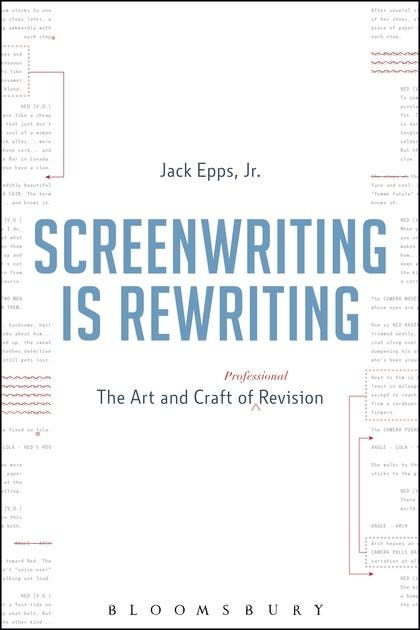
Scott: You divide your book “Screenwriting is Rewriting: The Art and Craft of Professional Revision” into two parts. One’s Foundations and Fundamentals, then Layering and Details. Could you talk a little bit about what you’re going for there?
Jack: My premise for the book is to approach rewrite through a series of focused passes instead of trying to do one huge all-encompassing rewrite. The first half of the book is about the core foundation elements such as character, structure, theme, story and plot. These are the deep, heavy elements of screenwriting that usually requires a lot of deconstruction and reconstruction. One of the reasons rewriting is so hard is become we all become emotionally attached to our scripts. You wrote it. You sweated every line and every page and it’s such a great accomplishment to get to the end. It really is. And now you’ve got to take it apart. You’ve got notes and notes are often confusing and contradictory. It’s usually not clear on where or how to start. “How do I do that?” You’ve got to now take this thing that your proud of and tear it apart. Who wants to do that?
The second part of the book is about layering as if you’re painting something with very thin coats one layer at a time. Each layer adds depth and dimension. Trying to enhance the story by creating more conflict, creating oppositional characters, using reveals and reversals and complication — elements throughout the long second act to raise tension and deepen relationships.
The book is a combination of rewriting passes and fundamental chapters. There are eleven separate passes where the writer can choose which passes fit their specific notes. There is the Foundation Pass, Character Pass, Story and Theme Pass to name a few. I strongly believe that organization and planning are essential to a successful rewrite. The book helps the writer gather notes, organize them and then plan their rewrite by creating a game plan. I also strongly believe it is essential to first find out what is working in your screenplay before everybody piles on what isn’t working. Often a writer only hears what is wrong with their script and ends up believing it’s all bad. They often throw it away and start all over again. There must be something good in your script worth saving. Protect what is working and revise what isn’t working.
Rewriting is really about application of fundamentals. Getting all the story and character elements aligned and working together takes a lot of time and practice. I strongly believe that rewriting makes you a better writer. You learn what you must have before you start writing. I always tell my students, before they start writing, “You will rewrite this. So relax. Just go ahead and try to find out what your movie is about — explore. Don’t worry about being perfect.” There is always a collective sigh of relief. And they tend to write better first drafts. The work is looser, more fluid, and not as precious. I like to call the first draft, the Discovery Draft. Because that’s what you should try to do with a first draft. Discover your character and your story, and then go about in your rewrites layering and deepening the work.
I like to think of rewriting like breaking concrete. It’s hard backbreaking blue collar work. You’ve got to break things and smash things and redo them. And it all comes back to fundamentals. You’ve got to make sure your core elements of character, story, structure, and theme are working together. While I was not necessarily a theme writer originally, I’ve really come to believe that theme is critical. Theme is the glue that holds all those elements together. And it doesn’t matter if the audience understand your theme as long as the writer understands his or her theme.
One area that’s really important in a rewrite is consistency. Are characters consistent? That’s the problem I see a lot in young writers. Their characters change over the course of the script. They have one character in the beginning and then they lose their personality and dialogue voice, and in many cases, the character’s purpose in the script. One of the passes in the book is The Consistency Pass to help make sure the characters, stories and dialogue are consistent throughout the entire screenplay.
Scott: Another part of the book is comprised of interviews you did with Robert Towne, the late great Frank Pierson, and Susannah Grant. Is there some universal truth or wisdom you may have heard from talking to these writers about the rewriting process?
Jack: One of the reason I wanted have interviews with other writers I greatly admire is because there’s no one way to rewrite. Robert, Frank, and Susannah each have their own way, but what they all have in common is the emphasis on character. I look at Robert Towne as the Dean of American Screenwriting, and I asked him, “Robert, does screenwriting ever get easier?” He said, “F no, it never gets easier.” [laughter] If screenwriting is still hard for Robert Towne, even with all his experience and success, it’s OK if it’s really hard for you.
Scott: That reminds me of that Stephen King quote. He was asked once, “What scares you?” He said, “I’m the most scared before I type the first word of a new story.” I tell my students, “Look, if Stephen King gets scared every time he starts a story and he’s written what 70 or 80 things then we have the right to be scared, too.”
Jack: Absolutely. We just had John Wells down to campus recently and John said the same thing. Here is a guy who has like 25 Emmys and I think around 50 Emmys nominations. He just said, “Look, every time I face a new script I’m terrified.” If John Wells is terrified of the blank page, it’s okay for the rest of us to break into a cold sweat every now and then. We all face the terror of the blank page. The thing that you have to do is dive in. Start working, start building out your characters.
Scott: You mentioned the importance of theme, the glue that holds the whole thing together. That seems like one of the more amorphous concepts in terms of screenwriting. How do you define theme?
Jack: Theme is central unifying idea that runs like DNA code throughout the screenplay. In Top Gun, my theme was simple, “No man is an island.” When I’m building scenes and developing characters and relationships, I look for ways to restate and reinforce my theme dramatically. Maverick is selfish and is out for his own personal glory. Meanwhile, the other fighter pilots work together as a team which further underscores the theme.
Theme is the constant — the unifying idea that we should return to again and again so that there continuity and support of the theme through scenes, characters, and dialogue. Without a unifying theme it’s easy for a script to become a series of disjoined scenes that really don’t add up to a cohesive movie. Theme helps bind the screenplay together to create unity and consistency. The theme doesn’t have to be brilliant. It just needs to be simple and clear to the writer. It doesn’t matter if the audience gets the theme — they will feel the theme. The writer must understand the theme so they know what they are writing about.
Scott: It’s interesting that Francis Ford Coppola was asked about this and he said, “I always try to reduce the theme down to one word like The Godfather was succession and The Conversation was privacy.” That’s important for writers and it sounds like you’re the same mindset like Top Gun — no man is an island. That’s a touchstone at every single point along the way.
Jack: Absolutely, and it’s essential. In my first rewrite class, I ask students, “Tell me what your movie is about.” They’ll go into this long explanation of what their movie is about and I stop them. “No, let’s tell me what it’s about in one word.” They struggle and struggle to put it into a single word. Now, they’ve already written an entire screenplay but can’t really put their finger on what it’s about. That’s a problem. If I know it that one word — redemption, regret, betrayal — then I know what I’m writing about and it will keep me from straying.
If I’m writing a story about betrayal, then I’ve got to create a story that shows how someone got betrayed, what are the effects of betrayal, what are the consequences of betrayal, how do you overcome betrayal. My characters, my scenes, my dialogue, my story are linked and focused around a single theme.
Scott: I’ve got a couple more questions for you. First thing, you have the benefit of four-plus decades of working in Hollywood. I’d like to ask you a two-part question about the state of Hollywood, in particular, the state of movie business right now. What about it concerns you and what about it excites you?
Jack: We’re in a real transition period and things are changing. One of the fears is the marketplace is now a global marketplace means which means big visual effects movies are where the studios are heading. 65% of the studio’s box office is foreign and only 35% is domestic. So if I’m a studio executive, which figure am I going to pay the most attention to? What market am I going to make movies for? And if it’s a global market, big effects driven action films seem to be where the box office is internationally.
I’m also concerned that as the movie moves toward these big visual effect movies, the attention to character and story will diminished. We see a lot of sequels and there is a sameness to them. Originality is disappearing from the movies. Originality is finding a home in television which is much bolder, original and more immediate than the movies. It sort of takes away the desire to travel to a theater and pay money to watch familiar uninspiring movies. How many times can Spiderman be remade?
In addition, there is a new generation of people who have been raised on their iPads and iPhones and they want their content now. They are also not used to paying for content. They expect it to be free and immediate. I n the long run, that really has huge repercussions for the motion picture industry.
What I get excited about in movies like Moonlight, La La Land, Manchester by the Sea, Get Out and seeing very powerful movies that are very well written and well-made. They may not be the huge mainstreams, but there is audience for them and there is a future for them. That future might shift to television. The very fact that Manchester By the Sea was produced by Amazon and won an Academy Award® is a huge shift in the way movies are produced and financed as well as how they will be distributed.
Moves are not going to go away, but they are going to change in some way, shape, or form over time. A few years back George Lucas predicted movies will become of a special event which means movies need to offer something that can’t be watched on a cell phone or in a home theater.
You can’t ignore the excitement of television today and how great original content is now found on television. The must-see event is the limited television series. A movie starts to feel short at two hours where you can have eight hours of television and really explore a story in depth and from multiple point of views.
Scott: Finally what advice can you offer to aspiring screenwriters about winning the craft and breaking into Hollywood?
Jack: You’ve got to understand this is going to take time. It’s a marathon, not a sprint. If you’re impatient this probably isn’t the business for you. You have to be in it for the long haul. There is the perspective that it takes seven screenplays before you learn how to write a script. Ten thousand pages is really true. It’s a pile of scripts and how high is your pile? Is your pile six inches? Is your pile a foot? Is your pile a foot‑and‑a‑half? Meaning that you’ve going to dig in, and you’ve got to write a lot of scripts, and keep learning. The learning never ends.
You’ve just got to realize that this is a life commitment. It’s not a commitment like, “Well, I give this a year.” No, you won’t. You have to believe in yourself that you can do this and have to dig in as hard as possible.
As we talked about earlier, you’ve also got to find a network. I talk to all my students about the importance of creating a writers group, because you need to have a community to help you stay in the game. One of the toughest things about writing is that sense of isolation. We do it alone and that’s hard to do. There’s writers wherever you are. I don’t care what city you are in, there are writers who are doing this. You need to find them and get together and basically create a little community so you can help each other moving forward.
Strongly consider film school. But know what you want to get out of it before you apply. And if you go to film school, use the time wisely. You will only get out of film school what you put into it. No one owes you anything — you’re going to have to earn it every step of the way. So, be ready to work. And you better enjoy writing because you will be doing a lot of it.
For Part 1, go here.
Part 2, here.
Part 3, here.
Part 4, here.
Part 5, here.
For more information on Jack’s book “Screenwriting is Rewriting: The Art and Craft of Professional Revision,” go here.