Go Into The Story interview (Part 4): Steven E. de Souza
An in-depth conversation with the legendary Hollywood screenwriter who has had a significant influence on the modern action movie.
An in-depth conversation with the legendary Hollywood screenwriter who has had a significant influence on the modern action movie.
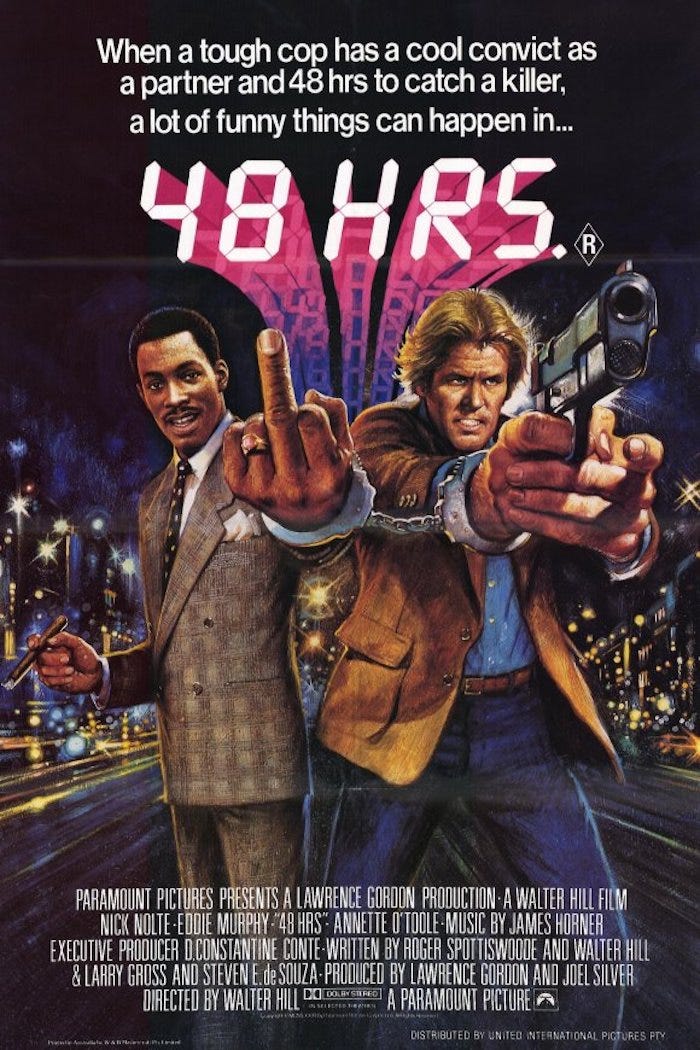
Steven E. de Souza has written movies which have grossed over two billion dollars at the box office. Two of the projects he worked on are considered to be the prototype for their type of story: Die Hard (Action) and 48 Hrs. (Buddy Action Comedy). Other screenwriting credits include The Running Man, Die Hard 2, Hudson Hawk, The Flintstones, Beverly Hills Cop III, Judge Dredd, Ricochet, and Street Fighter, as well as countless uncredited film projects in which he worked as a “script doctor.”
I got to know Steven via Twitter and in 2016, I invited him to be a panelist at the Courier 12 Screenwriting Conference hosted by DePaul University (along with another legendary screenwriter from the 80s and 90s Jack Epps Jr.)
That session was so informative and entertaining, I vowed to do a longer interview with Steven. It took a few years, but we did it: A two-hour conversation covering the entirety of Steven’s screenwriting and filmmaking career.
Steven is a natural born storyteller and the fact he has been involved in so many notable movies means he has had a front row seat when Hollywood discovered the box office power of action and action comedy movies.
Today in Part 4, Steven’s many adventures in Hollywood continue including his backstory on a classic action comedy 48. Hrs.
Steven: I start at Paramount, I get a lovely office with bookcases and a view in the Dietrich building. My first phone call in my new digs is Jim Berkus. “Paramount has a new show that just got picked up, a spinoff of the Chevy Chase Goldie Hawn movie, “Foul Play”. They really want you on the show because it needs somebody who can mix action and comedy like the feature, but the show’s top heavy with producers, so they’re saying all they can offer you is Executive Story Consultant.”
“What happened to come over, you’ll write and produce pilots, do features?” “Relax: That’s what they’re saying. Just take the meeting. I know I can push for the producer credit. They already have eight producers, one more won’t matter, I can use Universal Studios as a club, they already regret they let you slip away during the negotiations.”
I go to the meeting and the room is chockablock with producers. Top-billed in the Goldie Hawn part is Deborah Raffin, a rising star with an overall contract at Paramount. She’d broken out in a Kirk Douglas movie “Once Is Not Enough” and was a hot commodity coming off the mini series “The Last Convertible” and they tell me they’re going for Barry Bostwick from “The Rocky Horror Picture Show” for the Chevy Chase role.
“We already cast a wonderful comedian, Mary Jo Catlett as Deborah’s friend at the library who helps her solve crimes. We’re looking for somebody for the movie’s Burgess Meredith part to be her landlord to help her solve crimes. And we’re trying to get Billy Barty to reprise his movie role, he’ll help her solve crimes, too.”
I’m thinking WTF Billy Barty? Then I remember: In the movie, Goldie overhears a conversation that “the Dwarf” (the codename for a normal sized hit man) is going to whack the Pope when he visits San Francisco — that’s the driver for the movie’s plot. And Barty’s an innocent Bible salesman who knocks on her door and she flips out! He just thinks she’s a tough customer and puts his foot in the door and she ends up beating the crap out of him and puts him in a hospital. I’m thinking, that’s a comedy bit, that’s not a series regular.
I come out of the meeting and Berkus calls, “I already heard, they love you. I can push for the producer credit.” Normally I’m very bad at office politics, but with a gaggle of producers and a committee of crime fighters in what started as a two-hander movie this seemed…chaotic. “Let’s stick with the Executive Story Consultant.” And this turns out to be one of the few times I get office politics right. Because with eight producers and one “shadow” one (stand by, I’ll explain), all jockeying for power, in the end none of them made it through all 11 episodes. (The show got canceled before we got to 13, for reasons I’ll shortly make clear.) I ended up being the only staffer who lasted the whole season, because I was just “the consultant,” and safely outside the circular firing squad.
I meet Deborah, who could not be more gracious: You go to a meeting in her trailer and mere hours after you come out, you get a handwritten note on pink letterhead with her beautiful cursive handwriting in purple ink, “Thank you for the lovely meeting.” One evening, after we all went home, she called me and said, “I know it’s late, but would you mind terribly coming out to the house for some script notes?” I do, and the next day there’s a fruit basket in my office! She’s the most gracious person I ever met in Hollywood… [Long pause.]
Scott: But…
Steven: Yes, there’s a “but”. I keep getting messages, Michael wants to see you, Michael wants to see you, and I go, Michael? Michael? I finally realize he’s this guy in the corner of the conference room all the time who wears oversize voluminous Hawaiian shirts he’s swimming in and has this odd sallow complexion and never says a word.
You know how Vincent D’Onofrio looked in “Men In Black” after the alien skinned him and wore his flesh as a disguise, and when he’d pivot, his skin would shift, like a beat behind? That’s the vibe this guy strangely had. Later, one of our eight producers tells me this horror story: Michael was tremendously obese as a teenager. And the week before he turned 18, his parents tell him, we’re going to Disneyland or something similar, and then they drive him to a clinic where people in white coats yank him out of the car. And because he’s not 18 yet, his parents forced him to have bariatric surgery when that’s in its nascent experimental stage.
It turns out he’s a highly educated guy, Harvard, Master’s from Georgetown. And he’s fabulously rich, having gotten very early into the game with audible books — this is when everybody’s going around with a Sony Walkman. More to the point, he’s Deborah’s manager/slash/husband. And I notice more and more that when I go to meetings with Michael, and he says, “I have some notes,” he keeps consulting a crib sheet on his desk. And I realize it’s the pink paper with the cursive handwriting, these are Deborah’s notes: They have a good cop/bad cop thing going — she’s the one with the big Paramount deal and our eight (counting Michael, nine) producers not withstanding, she has the whip hand on the show.
Nonetheless, I gently press my points — hey, don’t cast the landlord part — if the landlord’s helping her, then she’s trapped in scenes in her apartment and you’re not out solving crimes. You already have the problem that she’s a librarian — that worked in the one-off movie, but in series, it’s kind of ridiculous that the police detective keeps going to the library for research when the police have files at the police department. And forget Billy Barty, the Bible salesman’s not a series regular. At last, Michael calls me up to their house again. “We’ve been thinking you’re right! We’re not going after the Burgess Meredith landlord character from the movie, and we agree the Billy Barty salesman isn’t really a series regular.”
And I go, “That’s great, what changed your mind?” “Deborah saw a late night infomercial with these two identical twin real estate guys in Florida, the Rice brothers, who run how to get rich in real estate seminars. They’re the world’s shortest twins at only two feet ten inches, they’re very charismatic and we’re signing them. They’re going to be the landlords. We get two for the price of one!” Inward, I’m cringing. “And you’re right about the library, it’s not the best place to have her work to really get her involved in these mysteries. So we think instead she should work at a TV station.” “Oh, excellent. An investigative reporter’s a great entree to — ”
“She’ll be the host of a kid’s television show. Deborah loves working with children. So when we see her at work, we can have kids actually be on the show, like the old Howdy Doody peanut gallery, and she can interact with them!” And during all this Deborah is sitting quietly on the sofa literally knitting… she’s like a young, gorgeous Madame Defarge knitting away while the Committee of Public Safety is oiling up the guillotine.
Meanwhile, Barry Bostwick quickly gleans the lay of the land: he’s got to fight for his real estate in the show. I must have mentioned something about having been a medic, because at one point, he comes to me and says, listen, my character is supposed to be this scion of a wealthy family who went into law enforcement. “You were in the army, you must know guns, he’s not going to take the off the rack police pistol. What gun would a rich asshole with money to burn carry?” “Well, it would have to fit the police cartridge…a Smith and Wesson stainless model 60 with adjustable sights and the rare three inch barrel.” He says, “Wow, that was fast!” And I go, “Yeah, I have one, I’m a rich asshole with money to burn!” I ended up taking him to buy one and then took him to the pistol range for practice and showed him how to use a speed loader. Later, after we were cancelled, he rolled into “Megaforce” where he’s mowing down baddies left and right, so I guess my training paid off!
Scott: [Laughs]
Steven: Now we’re ramping up and approaching production, scripts are in the pipeline, and I hear from Michael/Deborah they’ve noticed we’re in a rut: In all the scripts they’re seeing, she’s either on a date with Barry and his beeper goes off, so she tags along, or else she stops by the police station to bring him a sandwich when a call comes in, and then she tags along. “We want her to be more proactive and get involved in the crimes directly.” Of course this problem is the result of the cockamamie idea that she’s the host of a children’s show, but I can’t say that.

In addition, they keep giving me notes that present her as a combination of Mother Teresa and Florence Nightingale like: How about if a kid gets hurt at the TV show and she knows first aid? And whenever there’s a scene on the sidewalk, people have to come up to her and say, “Oh, I love your show, I watch it with my kids.” By now the network is finally noticing that these scripts are getting really bogged down and convoluted to get her in the action. So finally I pitched an idea: She gets kidnapped by a powerful crooked mogul whose underlings mistake her for a similar looking investigative reporter at the TV station. And then they don’t know what to do. And she gets to be smart. She throws down with the villains, outsmarts them! “You keep telling me she’s like Doris Day. Well, like I always say, steal from the best: Doris Day was in Hitchcock’s ‘Man Who Knew Too Much’. She was in “Caprice” and “The Glass Bottom Boat” both rom-com spy movies, this is how we do it!” Mirabile dictu, everybody loves this story, including all six surviving producers. (They’re dropping like flies each episode — it’s one of those who do you have to fuck to get off this picture situations.) The Network loves it. Finally they push the button for me to go to script. Then I get a call: Michael and Deborah have a few notes. So I go to see them and they say, we can’t do this episode.
I go, what do you mean? “It’s too upsetting for the children in the audience.” And I go, “No, no, no, listen. Firstly, we’re on at nine o’clock, there’s more leeway, but even when I was doing the 8:00 pm Bionic shows, he would beat the crap out of people, but we’d do it in a PG way, I can make it not too scary for kids in the audience — ” And they say, “No, not our audience — it’s too scary for the kids in Gloria’s audience.”
Scott: Wait, her character’s audience?
Steven: Yes. The imaginary audience watching her in the in-universe TV show! It’s going to be too upsetting for them that the host of their favorite show is kidnapped! So that script gets canned. And, in short order, the whole series gets canned.
My best experience on this otherwise tortuous series was with the legendary Sam Jaffe, who was a guest star. In his episode, I did a shameless rip off of “The Maltese Falcon,” where my Falcon was this long lost treasure, the “Scepter of the Czar” that had disappeared in the San Francisco earthquake: Jaffe’s one of the last living survivors of the earthquake and the key to finding it. We cast Robert Emhardt, such a lookalike for Sydney Greenstreet, he began his career as Greenstreet’s understudy on Broadway! (I even named his underling “Wilber”.) And the duplicitous Mary Astor role was an old flame of Bostwick’s character. One upping my credo of “steal from the best”, I literally completely appropriated John Hoffman’s masterful earthquake montage from from “One shot Woody’s” 1939 “San Francisco” for the opening, dissolving from it into color and the city today. Better yet, this was one of the handful of episodes we actually shot on location in San Francisco. We staged a charity event with the Golden Gate Bridge in the background, had a a gunfight and murder in Coit Tower, and a scene in the central cable car building where we updated the old hostage tied to the railroad tracks with Barry Bostwick handcuffed to the main cable and about to be pulled into the gears. It was a lot of fun, but the best takeaway for me was… are you familiar with the idea of six degrees of Kevin Bacon?
Scott: Yes, of course. Kevin Bacon can connect you with every movie star ever.
Steven: Right, but not as well as I do, because, thanks to me working with Sam Jaffe and his long distinguished career going back to silents, I connect to everybody that ever made a movie in Hollywood even better than Kevin Bacon. Try me!
Scott: Marilyn Monroe.
Steven: Too easy, “The Asphalt Jungle”: Me > Jaffe > Marilyn. Two degrees of Kevin Bacon or, as we say in my house, two degrees of Steven-ation. Next.
Scott: Cary Grant?
Steven: Oh, come on. “Gunga Din”.
Scott: Anna May Wong!
Steven: Hmm… okay it’s not a two degree, but Sam Jaffe was in “Scarlet Empress” with Marlene Dietrich, and Marlene Dietrich was in “Shanghai Express” with Anna May Wong.
Scott: Damn.
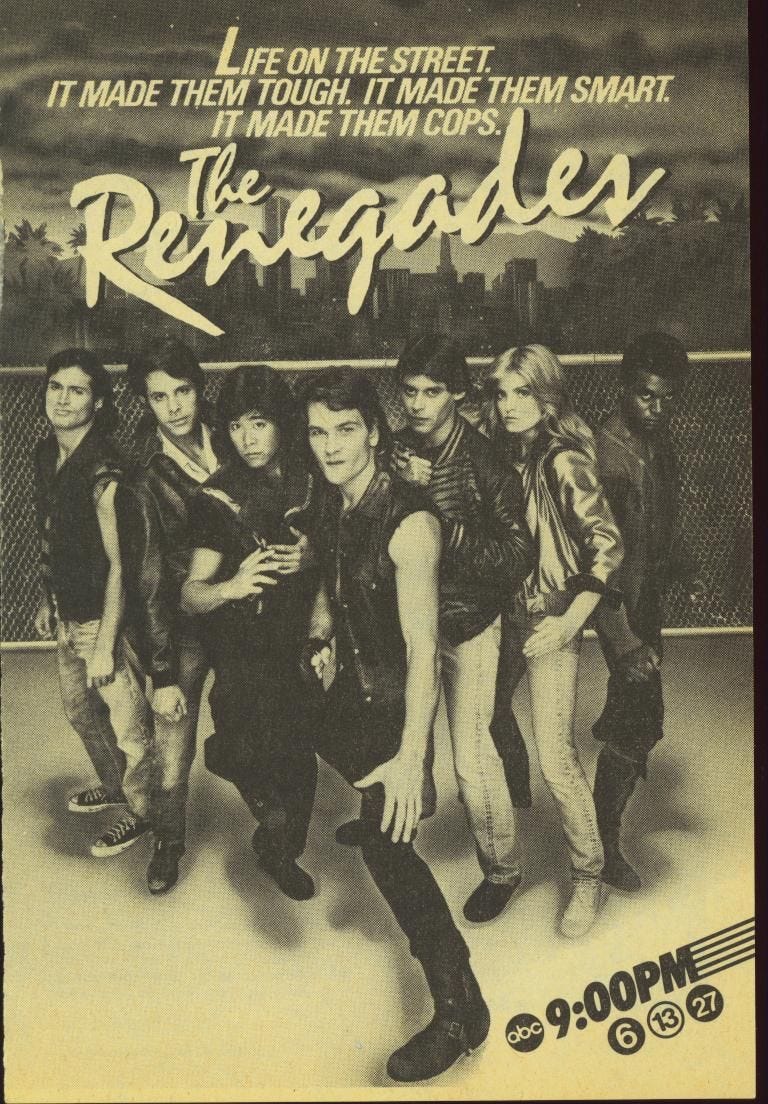
Steven: Anyway, with the show mercifully axed, Paramount’s not paying me to sit there, and Berkus calls me. “You’ve got a meeting with Larry Gordon today on the lot.” Larry’s a huge producer, he’s done movies like “The Driver” and “The Warriors,” and he’s working with Aaron Spelling in television. I go to meet him and his associate producer, the now legendary Joel Silver, and they say, we sold this show to ABC with Aaron Spelling, it’s been ordered directly to series. It’s called “The Renegades,” and it’s like “21 Jump Street” before “21 Jump Street,” only instead of young looking cops pretending to be high school students, they’re actual high school aged delinquents recruited by the police. It’s basically Aaron rebooting “The Mod Squad”.
Scott: This show is now famous for being one of Patrick Swayze’s first starring roles.
Steven: Yes. “We’re supposed to start production next week and we need you to write a scene that we can shoot the first day of filming. Read the pilot script and come up with a scene that’s the last scene of the pilot, where they solve the crime and we lay pipe for next week’s episode.” I say, wait a second, if you have a pilot script, why do you need me to write a scene?
They tell me ABC ordered this thing so quickly, Aaron pulled a writer off of another picture and he was trying to juggle too much at once. It’s a mess. “If we let them read it, we’re afraid they’re going to pull the plug and ask for a whole new pilot, and we’ll end up slipping to midseason.” “There’s not a single scene in here you can film?” “Nope.” I read the script and they’re right. Now this is first thing in the morning, and I knock out the scene in two hours — It’s only three and a half pages. At lunch I bring it back to Larry Gordon and he reads it, Joel Silver reads it, they say, all right, great. “Make a Xerox, take one copy to the print shop, the other to casting.” “Casting?”
“Yeah. We sent one-line descriptions of the characters out yesterday to all the talent agents in town, and there’s actors over in the casting building right now waiting for these pages to audition.” This is how insanely fast this thing is moving! So I take the scene over there where the actors are studiously studying the only thing in hand, their character descriptions culled from the pilot script no one is allowed to read. I meet the director, Roger Spottiswoode, who is going to film my scene the very next day.
Roger finds a spot on the back lot behind between two sound stages that looks like an alley where the teenage crime fighters come together all high five-ing each other and the police captain says, “Not so fast. I’ve got another case for you.” (FREEZE FRAME.) We send this over to ABC and they go, “It’s great! Keep filming the pilot! But you know, why haven’t we seen the entire script?” Paramount says, uh, we’re doing some minor revisions. Larry Gordon says to me, you have to keep writing ahead of the camera. Cannibalize whatever you can from the old script, change whatever you want, but you have to have a plot that involves Chinatown.” “Why Chinatown?” Shades of my lunch at Universal with the Little Rascals veteran, it’s because there’s a standing set on the Paramount lot of a Chinese restaurant! So now I spend the next three weeks writing this two hour pilot, turning in pages one day before they shoot, and sometimes, the morning they shoot. The actors are coming up to me asking me, why am I butting heads with this guy? Why does this girl have this attitude towards me? “Give me two more days, you’ll see!” Somehow it comes together, the series is on air, we’re all heroes.
Steven: Now I finally get my shot to write and produce a pilot from scratch. “The Powers of Matthew Starr,” which could be described in a nutshell as “Smallville before Smallville” — he was the Alien Prince of a planet under attack by an evil Galactic Empire who had escaped to earth as an infant but — not to totally rip off Superman — not alone, but in the hands of the Royal family’s trusted Captain of the Guards, a role that — after a long hiatus — fell to Lou Gossett, Jr. (“Officer and a Gentleman.”). A more interesting casting note though, is, my first choice for the Matthew part: Tom Cruise, whose audition tape gets rejected by Fred Silverman, the head of NBC, who remarks dismissively, “He comes off like a smug smartass — America doesn’t like a smartass.” (!). The role went instead to Peter Barton, whose later long hiatus was due to the fact that, during the pilot, the bad guys had tied him to a chair and set the building on fire by throwing truck flares inside the structure. Some genius on the stunt crew who I can only assume was later taken out and shot actually tied Peter firmly to the chair instead of, you know, faking the knots? Then, when Peter went through the motions of struggling with his bonds, he inadvertently made the chair fall over, and he landed directly on top of one of the flares. By the time he was dragged free, he had third degree burns on his buttocks and thigh and had to be rushed to a special burn clinic where he was under treatment for four months and endured multiple bouts of skin grafts.
With the series now pushed off for an entire year, and me still on the Paramount payroll and idle, Larry Gordon calls me into his office once again.
“I’ve got a picture ready to go and it has the same issues we had on ‘The Renegades’. We have a script, but it needs some twists and turns, and we need some comedy relief: We’re going to hire Eddie Murphy, the kid on SNL.”
Scott: This is 48 HRS .
Steven: Yes. This is 1982, and various drafts of the script had been in development for eight years — so long that the original plan for the older cop was going to be Robert Mitchum and the younger, dangerous prisoner was going to be Clint Eastwood. (I’m not making this up.)
I read it over the weekend, and come back with three pages of notes of how to freshen it up and make it crazier and add humor. Jeffrey Katzenberg and Michael Eisner are running this meeting: Eisner was technically features, Katzenberg was TV, but this is high priority, and they’re joined by Larry and Joel in Katzenberg’s office. “Okay, what have you got?”
I go though my list. In Walter’s draft the MacGuffin was robbery money that disappeared three years ago. The shocking big reveal? It’s been in a safe deposit box at a bank all along! I say, “That’s been done a million times. What about this?” And I tell them about these actual long term car storage facilities. “It’s fresher, and it rolls us right into a car chase.” They love it. I go on. When Nick meets Eddie, it’s in the prison interrogation room with guards all around — Police turf, Nick has the upper hand. “Let’s flip that — instead he goes to Eddie’s cell, and Eddie’s like prison king shit — it’s the best cell, all fixed up, he’s large and in charge, his cellie’s like his lackey, he’s got contraband, he’s grooving to a Walkman.” In another scene, Nick’s character challenges Eddie to get information from a bartender. But it’s a generic “tough bar.” “If Nick’s fucking with him, he should really fuck with him, and send him into a redneck bar!” Larry Gordon — who grew up in Mississippi — cracks up. “Yeah, with a big confederate flag on the wall!”
I go through my whole list and they said, “This is great. You’re going to meet the director. He’s on his way here now.” Walter Hill comes in, and of course I know him by reputation: “The Driver!” “The Warriors!” I’m thrilled beyond belief to be working with a director of this caliber on this, my first Hollywood feature. They say, “This is Steven. He’s a terrific writer for us. He’s here to add some levity and some twists and turns now that we’ve closed on Eddie.”
And I can see right away, Walter is not happy that they want someone else to rewrite him.
He turns to me. “Tell me, what pictures have you done, something I’ve seen?”
Uncomfortable pause. Eisner clears his throat. “Steven is one of our top television writers. He hasn’t had any features made, but we have big plans for him — ” Walter takes a beat, and then very slowly turns from me to Eisner and Katzenberg and says, “You… want… a… television writer to rewrite me?”
Hearing his tone, Larry jumps in. “Walter, he’s working for you. It’s your picture. You’re going to have the final say. He’s here to help you. He just saved our ass in a terrible time crunch on a two hour pilot that went directly to series, you know Roger Spottiswood — Roger directed it, he’ll vouch for Steven — he has a great sense of humor that doesn’t step on suspense.”
Walter says, “This is not a comedy. This is a dark crime picture.” Seeing this is going south, Katzenberg interrupts. “Walter, we understand, that’s what we want, too. But there’s no reason…” Vamping, Katzenberg looks around his office, there’s movie posters everywhere. “There’s no reason this can’t have as much comedy relief as…as — “ He picks the worst possible choice. He points to the Stir Crazy poster, which has Richard Pryor and…
Scott: Gene Wilder.
Steven: Right, Richard Pryor and Gene Wilder in chicken suits. Walter says, “This is the model?” He gets up, he walks out of the room, slamming the door so hard that Stir Crazy poster swivels on its hook and sways wildly.
I go, “I guess, I’m not doing this.” Larry says, “Look, you work for Paramount Pictures. He works for Paramount Pictures. You’re assigned to do this rewrite of the script. We want you to do all those notes you told us about. Now you need anything else to get started?”
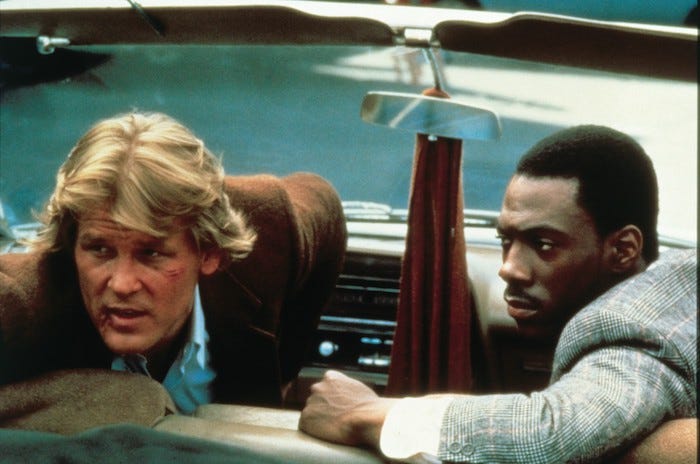
At Universal I had learned from one of my mentors, Don Mankiewicz, (son of “Mank”) that you should always try and meet your actors to get a sense of their speech patterns.” I say, “Yes, I’d like to meet the stars.” So they arrange for Nick Nolte to come in, and he comes into my office in boat shorts, rumpled, unkempt and overweight, looking like the precursor of his infamous mugshot of 20 years later.
He slaps his belly, “Yeah, I gotta lose the gut, get cleaned up here, get a haircut. The studio’s getting me a trainer right now. Nice to meet you, kid.” Then Eddie Murphy — remember, he’s fresh off Saturday Night Live, he’s a week away from his 21st birthday, he has so little idea of the pecking order in Hollywood that he wears a suit and tie to meet the writer.
Scott: [laughs] Like it’s a job interview.
Steven: A job he already has! When Larry and Joel ask me, “How did the meetings go?” I tell them, “Cancel the trainer for Nick. Let him be a schlub, and let Eddie be sharp.” I put in the script that Eddie’s in an Amani suit, and that leads to the running gag in the film that people seeing them handcuffed together think Eddie’s the cop and Nick’s the convict, and he’s even mistaken for a lawyer by two hookers in the holding pen.
The next two days I go into Walter’s office each morning to go over my notes with him. I start with the MacGuffin. ”Isn’t a safety deposit box a cliche?” He darkens. “When I do it, it’s not a cliche, It’s an archetype.” I pitch him the car storage place. “That’s ridiculous.” “No, it’s a real thing…” “Next.” “You’ll like this — the bar Nick sends Eddie into? What if it’s a redneck bar, they’re wearing chaps and cowboy boots — “ “In San Francisco? That’d be a gay leather bar!” And it goes on like this, all day for two days. Whenever I’d try to push my ideas harder, he’d suddenly get an urge to play with his knife collection, sharpening them and rearranging them in their velvet lined case.
It’s increasingly clear he has nothing but scorn for this mere television writer who’s been foisted on him — this, of, course, is decades before things like “Mad Men” and “The Sopranos” erased whatever line of imagined sophistication, depth and class divided the two — no matter what I say, it’s not up to his level. If I persisted more, he had these autographed baseball bats, and he’d pull one off the rack and casually walk around the room swinging it. “We’re getting too silly here, Steven.” Whoosh, over my head, some psychological thing, whatever. So for two days he rejects all the ideas I pitched to the brass. My singular win is my suggestion that in the new scene he wants where Billy breaks Gans out of the chain gang, instead of just opening fire on the guards, he plays innocent until Gans provokes him and they fake a fight, and Walter only signs on to that because he remembers something similar in “The Great Escape”, so it’s not my idea, it’s an “archetype”. Finally he gives me his own notes, all excellent, professional but typical Walter Hill-y notes.
We get to “The End” and I gather my notes to leave, and he calls out to me one last time when I’m in the doorway. “One more thing: When Nick leaves his girlfriend in the morning, she says, it’s cold out and throws him a scarf. When he gets in his car, have him tie it around his rear view mirror. And that’s not one of your “cliches,” Steven — it’s an archetype.” “Oh, that’s perfect! The knight errant fastening his lady’s token to his lance — “
I break off. I can’t tell if the look on his face is astonishment or apoplexy, but for once I’m glad I’m out of range of a Louisville Slugger.
I go directly to Larry’s office where I tell him and Joel, “I just spent two full days with Walter where he pissed on every single thing I pitched to you and Eisner and Katzenberg. What the hell am I supposed to do here?” And Larry says, again, “You have a contract with Paramount pictures that was in place before he got his directing deal. He gave you his notes, right? “ “Yes, brilliant ones, that really elevate the material. The knight errant alone, going into battle with his lady’s — “ Blank looks. “He’s the director. You do all his notes — and do every note you pitched us. And while you’re at it, add every gag you can think of, Eddie’s blowing up, we want to ride that all the way. I gave Walter his first shot at directing. I’ll handle him.”
The next three weeks, I do my page one rewrite, send it to the print shop, and figure, okay what’s next here for me at Paramount, maybe another pilot..? Could I even dare hope for another feature..?
Then my phone rings. It’s Joel Silver. He says, “Get over to Larry’s right away. Don’t tell anyone where you’re going, not even your secretary and most of all not Walter if you run into him.”
I go over there. To my surprise Katzenberg’s in Larry’s office, too. Neatly arranged on the coffee table are three scripts. I immediately recognize the first one: My original pages, complete with sloppy cross‑outs and white-out before they went to the print shop for retyping. The second set is my entire script neatly retyped by the print shop. I’m confused. “What’s this all about?” “Look at the last set.” I do. Curiously, it’s dated today. My name is on it but… “Wait a minute. Everything I did is taken out!” Larry goes, “Uh‑huh, just as we thought.” I’m still confused. “What’s going on?” Joel looks at me. “Walter has a mole in the print shop. He’s throwing out your rewrite as fast as you’re typing it.”
The 48 Hrs. story gets even more intriguing in Part 5 in which for the first time in forty years, Steven shares his take on what transpired with that project.
[Editorial note: The opinions expressed in the interview are those of Steven E. de Souza and do not necessarily reflect those of myself or Go Into The Story.]
For Part 1 of the interview, go here.
Part 2, here.
Part 3, here.
Twitter: @StevenEdeSouza.
For 100s more exclusive Go Into The Story interviews with screenwriters, filmmakers, and industry insiders, go here.