Go Into The Story Interview (Part 4): Jack Epps
My talk with the co-writer of Top Gun, Legal Eagles, The Secret of My Success.
My talk with the co-writer of Top Gun, Legal Eagles, The Secret of My Success.
Scott: The Secret of My Success did huge business. $12 million budget, I think is what I read, and it grossed 110 million worldwide, which is a grand slam in terms of return on investment. Let’s jump to Turner & Hooch.
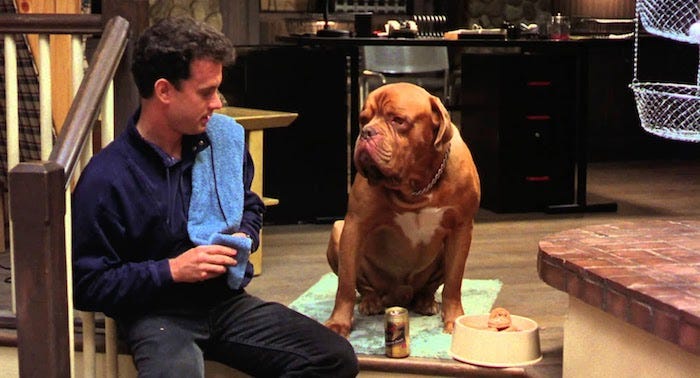
Jack: I’m in Hawaii with my kids, my family, we’re sitting there and Jim calls and says, “I want to do this dog movie.” I’m going, “Jim, no, I don’t want to do a dog movie. Let’s not do that.” He goes, “No, I love this, we can make this character a star.” And again, the passion. His passion was so deep. I said, “OK, you’re really into this. Let’s do it.” The original director in development was Henry Winkler. I met with Henry and Tom Hanks.
What’s great about Tom is that Tom came to all the story meetings. What a great benefit to have Tom Hanks sitting in story meetings throwing out dialog lines and talking about his character. He’s a very funny guy. Really generous. Most actors don’t jump into development — and you don’t want most actors in development, but Tom knows story. His ideas were really good.
When Tom said something about story and character, we paid attention because he’s really very insightful. Not about himself but in terms of the whole movie. One of Tom’s big concerns was the relationship between him and Hooch, which was thin.
We were brought it, as we were brought in on a lot of projects, to fix it and add character. This was, again, another re‑write. The film going into production and Tom had nothing to play as an actor. He really didn’t have any story. It was just him standing saying lines. What he surely doesn’t want to do is be second fiddle to a dog. That’s not going to happen. Our job was to find the role for Tom to play. What was he going to play?
We created the cleanest guy in the world. We said, “No, he’s really clean. He’s OCD almost,” and Tom said, “You mean, like, when he flosses his teeth, he uses a piece for every space between his tooth, a new piece?”
I said, “Yes, that’s exactly it.” That’s in the movie. We wrote that down. It’s simple things but that’s what movies are. You want contrast. We’re not trying to invent the wheel. We’re trying to give a very good relationship the audience can have fun with. You’ve got the neatest, most uptight guy in the world, which isn’t a story and we’ve got the messiest, dirtiest dog, which is a story. What does the most uptight guy need? He needs something to disrupt his life and turn it totally upside down.
What better than the messiest junkyard dog in the world? Our job on that script was really to jump into a work that just lacked story and character, and develop a world for Tom and a relationship for Tom, a love interest, as well as create scenes with him and Hooch so that we can draw his story out. Actually, Jim was right. We had a lot of fun writing it.
Scott: I sold the spec script for K‑9 in ’87. I remember on our bottled water tour, we met with David Hoberman over at Disney and he goes, “So you know, we’re thinking about suing you guys.” I said, “What are you talking about?”
“Well, we’ve got this project we’ve had in development over here,” because I’d never heard of it. Then, as I recall, there was a little bit of a race between the two projects. A strike was happening. We came out first but you won the box office.
Jack: You came about six months before us, but it affected our movie. In K-9, the dog doesn’t die so there was a pressure for us in Hooch to basically not have Hooch survive. Jim and I pushed back on that. We said, “Hey guys, really, you don’t want to do this. Audiences hate this stuff. Plus, you can make more of them.” The executives said, “Yeah, but what about Old Yeller?” I said, “Yeah, but no one went to see Old Yeller twice. You saw it once and never went back.”
But, having Hooch die at the end of the film was an interesting lesson for me. Tom really wanted the dog to die. I didn’t really understand why until I sat in the premier and watched it. If the dog survives, then everybody goes, “Yay, Hooch,” but if he doesn’t, there’s an emotional moment where Tom has loved this nasty, dirty, farting, slobbering animal and has become man’s best friend. At that moment, Tom has something emotional and deep to play. While the audience mourns the loss of Hooch, what we really feel Tom’s pain. That was a lesson to me. It created a much deeper moment the audience we could emotionally relate to.
I often get two questions. People come up to me and ask, “Did you have to kill Goose?” And, “Did you have to kill Hooch?” The answer is yes and yes.
[laughter]
Jack: Because without it, there’s no movie. You learn lessons when you see your films up on the screen. You think you know what you’ve got on the page. You think you know what you’ve written and then you go see it and you go, “Oh, that’s interesting. That works.” Or, “Wow, we really missed that boat. That didn’t work at all.”
Scott: Let’s round off this little retrospective of your movies here with Dick Tracy, which evidently you had started writing way back before it came out. It came out in 1990, starring Warren Beatty and Madonna, directed by Beatty. I imagine that that was quite a trick for you and Jim, that project.
Jack: It was. What was unique about that project was that as writers we stayed on the project and the directors kept falling off. That doesn’t happen. We started with John Landis. I would’ve liked the Landis version a lot. It would have had a lot of energy. But John had that terrible Twilight Zone accident and he exited the project.
Walter Hill came onboard with Joe Silver as producer. Walter taught me a lot. At that time, we had nothing produced and I was taken with all the Dick Tracy characters and it was all about the different faces and all the different people. Walter said, “No, the movie’s about Dick Tracy. He has to be in every scene because when you cast an actor, the actor wants to be in every scene. He does not want to play second fiddle.” That was a good lesson. Then Walter left the project for budgetary reasons. The project moved over to Paramount and Dick Benjamin came on board. We did a draft for Dick Benjamin that was like, “We’re going to do the low budget draft, guys.”
Tracy had a lot of stop and starts, so when Landis and then Hill left the project, we’d be writing other things. Our next project was Top Gun. We’d do some work on Top Gun and then we’d be pulled back to Tracy for a new director, and then jump back to Top Gun. We turned down Beverly Hills Cop because we wanted finish Top Gun. After Benjamin left the project to do City Heat with Clint Eastwood, the whole thing shut down, and it appeared to be dead. Then a few years later, Warren Beatty ended up with the rights and moved it from Paramount to Disney with our script.
We did a little bit of work with Warren but not a great deal. It pretty much came out as we wrote it, only we didn’t write a musical. We wrote it as an action adventure movie, but Steven Sondheim turned it into a musical, which is great but it wasn’t written for that. Had it been written for a musical, I would’ve done a lot of things differently.
Scott: It started off at Universal, went to Paramount and then to Disney. Is that right?
Jack: Yes.
Scott: And all those different directors. That was maybe like the four or five directors. I think. I was counting there.
Jack: Four directors. Warren was the last director.
Tomorrow in Part 5, Jack talks about being a professor at the University of Southern California School of Cinematic Arts and why film school.
For Part 1, go here.
Part 2, here.
Part 3, here.
For Jack’s book “Screenwriting is Rewriting: The Art and Craft of Professional Revision,” go here.