Go Into The Story interview (Part 3): Steven E. de Souza
An in-depth conversation with the legendary Hollywood screenwriter who has had an enormous influence on the modern action movie.
An in-depth conversation with the legendary Hollywood screenwriter who has had an enormous influence on the modern action movie.
Steven E. de Souza has written movies which have grossed over two billion dollars at the box office. Two of the projects he worked on are considered to be the prototype for their type of story: Die Hard (Action) and 48 Hrs. (Buddy Action Comedy). Other screenwriting credits include The Running Man, Die Hard 2, Hudson Hawk, The Flintstones, Beverly Hills Cop III, Judge Dredd, Ricochet, and Street Fighter, as well as countless uncredited film projects in which he worked as a “script doctor.”
I got to know Steven via Twitter and in 2016, I invited him to be a panelist at the Courier 12 Screenwriting Conference hosted by DePaul University (along with another legendary screenwriter from the 80s and 90s Jack Epps Jr.)
That session was so informative and entertaining, I vowed to do a longer interview with Steven. It took a few years, but we did it: A two-hour conversation covering the entirety of Steven’s screenwriting and filmmaking career.
Steven is a natural born storyteller and the fact he has been involved in so many notable movies means he has had a front row seat when Hollywood discovered the box office power of action and action comedy movies.
Today in Part 3, Steven shares the wild saga of how he landed his first Hollywood writing gig. The story picks up with Steven receiving a middle of the night phone call from his would-be agent Jim Berkus.
Steven: I say, “That’s great. I would love to get some advice from a professional writer.” He says, “No. You don’t understand. We represent actors, writers, directors, and he is one of the producers on the Bionic shows. They are having a hard time finding writers who can write at that show, which is a crazy hybrid of science fiction and law enforcement.”
Apparently — and this may confuse some of your younger readers when I mention obscure, now forgotten shows from that ancient era when there were only three networks, but writers who worked on, say, an old time-y sci-fi show called Star Trek, would come in and pitch, saying, “OK, he uses his bionic eye to zoom in through the bad guy’s window and he sees the secret book of payoffs to the crooked D.A. and he runs inside bionically and he arrests him.”
The producers go, “No no,. It’s a secret that he’s bionic. You have to develop a story that involves Steve Austin going undercover as like a bouncer in the bad guy’s nightclub, gathering enough evidence that can be taken to a judge.” And this is terra incognito to the sci-fi writers, it-does-not-compute!
On the other hand, writers who work for another probably also forgotten olden day show, Hawaii 5‑0, they come in and they say, “Okay, he flies up and catches the bad guys escaping in their helicopter,” and the producers say, “No, the Six Million Dollar Man can’t fly.” The Hawaii Five‑0 writers go, “Why can’t he? This is a cockamamie science fiction show. Why can’t he fly?” They don’t understand they can’t just pull anything out of their ass, the hero has a limited bionic toolkit, he’s like a Swiss Army knife. Berkus says to me on the phone, “Between your science‑fiction script and your crime script, you get both halves of the equation, they think you can nail it.”
“You’ve got a meeting in Harve Bennett’s office tomorrow afternoon at three o’clock, but first thing in the morning, you’re getting messengered a script for a new pilot they’re doing. That’s what they want to talk to you about initially.”
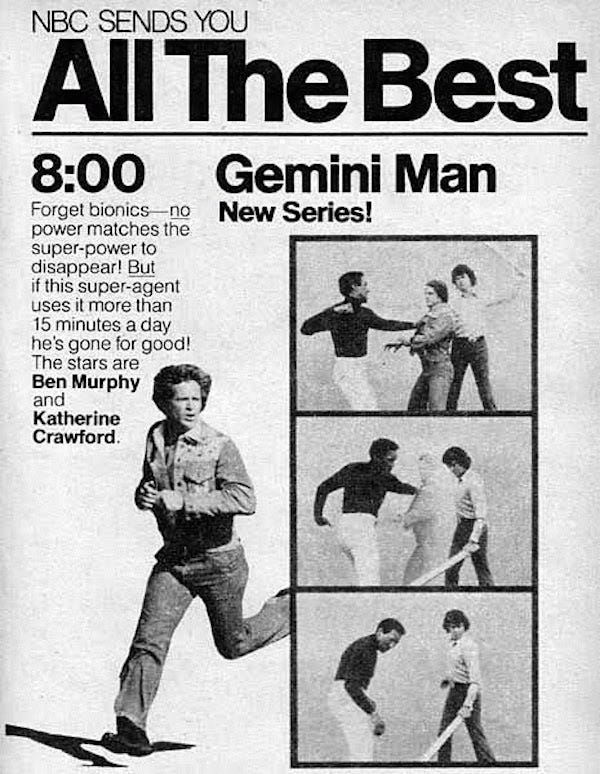
The script they send me is the pilot for something called The Gemini Man (not be to confused with the recent Will Smith movie) which was the second attempt of The Six Million Dollar Man unit to do The Invisible Man: The previous year, they’d done it for another network, with the original H.G. Wells approach where the British chemist character is permanently invisible, but instead of going full mad scientist, he becomes a hero secret agent played by The Man From Uncle’s David McCallum.
Alas, that version got quickly canceled, because they wrote themselves into a corner where a/la the 1930’s Universal movie, to work invisibly he’d have to take off his sunglasses, hat and scarf and strip naked, but then as the story demanded he interact with people visibly, he’d have to either retrieve all that gear, or more often steal clothing from a wash line or a laundromat. It was very clunky.
The new iteration was with Ben Murphy — later well known for Winds of War : Unlike David McCallum’s British scientist, this invisible man was an all-American blue‑collar guy — he wore denim! He rode a motorcycle! A deep sea diver in the pilot, he’s attempting to defuse the X-95B whatever neutron bomb from a sunken sub, but though successful, he gets a fatal dose of “X-95B radiation”. When they haul him up and strip off his wet suit — he’s invisible, the neutron radiation is dissolving his cells! In a desperate move, they invent a widget that will stop his cells from decomposing, and as an added benefit, it also makes him visible again.
They put this handwavium (™) in a watch for him to wear that he can never take off, and say, “OK, this thing both keeps you from disintegrating, and makes you visible. You can turn it off for ten minutes a day and become invisible, but if you leave it off for more than ten minutes, you die.” This was their solution of how to do an Invisible Man without discarding and then stealing clothing, he can switch if on and off, thus “Gemini”: Visible/Invisible.
I go to Universal Studios and I’m in front of a literal panel at a long table like America’s Got Talent. There’s Harve Bennett, later famous for the Star Trek feature films, Leslie Stevens, who’d produced The Outer Limits, Frank Telford, a veteran of police procedural shows for that end of the equation, and Berkus’ client, Allan Balter, bringing in spy and sci-fi experience from Mission Impossible and Voyage to the Bottom of the Sea. “All right. You read the Gemini Man pilot. What have you got?”

Either by dumb luck or because it’s my usual way of reverse engineering, I say “I know almost every other week on your shows, the bad guys are Communists.” (Remember, it’s the 1970s.) “Everyone says steal from the best. We’ve all seen Notorious, the classic Hitchcock espionage movie. So, we rip off Notorious. Our invisible hero infiltrates the house of Commie spies, and just like in that picture where Claude Raine’s putative Nazi spymaster is a mama’s boy — she’s the real boss — we do the same bit. So they’re making their Commie plans, our invisible hero is eavesdropping, and all of a sudden, the mother turns to him and says, ‘Can I get you a beverage?’ because she’s blind, and she sense his presence, and thinks he’s one of the other Commies in the room!”
My America’s Got Talent panel exchange glances, make notes…I see they’re intrigued. “Hmm, what else you got?”
“Okay, another episode, rip off a different Hitchcock, or rather, three of them, one of his train pictures. Different Commies are going to kidnap the daughter of a US scientist… the daughter’s on the train because…because…because she’s a swimmer on the US Olympic team going the nationals! The invisible man in the girls’ locker room scenes write themselves! The team is about to board the train, the hero is undercover as a coach or whatever, the Commies are on to him, they’re fighting by the tracks, one of the bad guys gets behind him with a monkey wrench, knocks him out, he falls down unconscious, and as he falls, his special wrist watch hits the railroad track, the button goes on, he turns invisible, and the conductor says, ‘All aboard,’ and the train starts to move! Commercial.”
At that point, Harve Bennett jumps out of his chair, runs around the table, grabs me, and kisses me on the cheek! “Finally, somebody who gets it, who gets you have to get the hero in a pickle. It’s about what he can’t do, not what he can do. Okay, Steven. Go see Carol about parking.”
I go, “That’s okay. My aunt dropped me off, and I’ll just call her. She’ll pick me up. I don’t need to be validated.”
Harve goes, “No, no, no, for your parking space. You’re starting here under contract at Universal Studios on Monday, and the first thing we want you to do is to take your horror science fiction body horror script with multiple gruesome deaths and water it down, and make it the two‑part premiere episode of next season’s The Six Million Dollar Man.”
He adds, “Oh, by the way, all the gruesome murders and dissections can’t be from a haywire US space probe that thinks it’s collecting alien life samples on another planet, because we can’t do this show without NASA’s help, and they’ll turn on us. It has to be — “
“I know — Commies.” “Right! Also, no murders or dissections, this is an 8:00 o’clock show.”
So that was my first official Hollywood gig, I was that rarity, someone who sold their spec script, and also my first big artistic compromise, rewriting my R-rated script into something kids could watch.
Scott: All these people complain about how hard it is to break into Hollywood, and here you are, five days in town and boom! You got the gig.
Steven: Well, not so fast, technically: We’ve all heard of the 10,000 hour rule, which was popularized by Malcolm Gladwell in his book “Outliers.” As Gladwell tells it, it takes 10,000 hours of practice and experience to achieve a professional level at anything, whether it’s mastering playing the violin or gymnastics, and 10,000 hours works out to about ten years. If you clock it, this was exactly ten years after I graduated high school, where I first got published, and since then I’d written for numerous publications, worked as a a writer and producer in local television, and written, produced and directed an award winning feature film. I had put in my 10,000 hours, by Gladwell’s metrics, I was a master of my trade!
Well, not so masterly: After they give me the keys to my office — where I’m astonished to see it’s equipped with a fully stocked wet bar (although it’s 1976, apparently in Hollywood it was still the Mad Men era — I quickly learned to always take meetings with the brass before they got hammered with two martini lunches), I do my rewrite, and I have my first two (pre-lunch!) official meetings with the Bionic team.
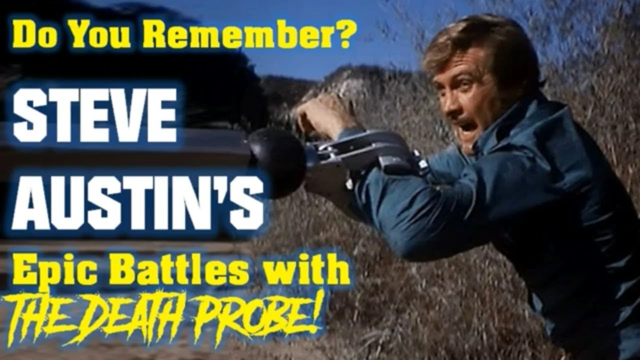
The first one is a high powered meeting with Mattel executives who have brought in the prototype Oscar Goldman doll (“with exploding briefcase!”) and — guess what? — they’re immediately talking getting a toy version of my evil (evil Commie) Death Probe into the Mattel pipeline. I’m thinking, I thought I was in show business, and my first staff meeting is toy business?
I’m itching to get into a show business meeting, where I can dazzle everyone with my 10,000 hours of Mastery of Screenwriting, and we roll right into that. As I confidently stride into Harve’s office, one of the producers, Frank Telford, pulls me aside and whispers, “Listen, you can tell how much Harve liked — or disliked — your script, because he turns the corners down of pages that he has a problem with. If you sneak a peek into his lap you can see how many pages are turned down.”
I go in, and the script in Harve’s lap is as thick as the LA Phone book because almost every page is turned down! As my heart sinks, Harve lowers his reading glasses on their chain (he was always losing them, his secretary had spares stashed all over the office but he wore a pair on his neck like your grandmother as backup to be sure), and he says to me,”Steven, why do you want to bankrupt Universal Studios?”
I go, “Huh — wha — what do you mean?”
He says, “You have ‑‑ “ He turns to Balter. “Allan, what was it ‑‑ thirty?” “Thirty-two.” “You have thirty-two characters speaking, and you’re having us build… Alan, is it twelve?” “Fourteen.” “Fourteen new sets. You’re blowing half a season’s budget right there with that cast and construction!”
I’m dumbfounded. “Don’t you have actors on the payroll and all these sets, like, you know, on the sound stages, the backlot, the studio tour?” Everybody in the room laughs. “Kid, kid, kid, no, no. Every time somebody opens their mouth, we have to pay them SAG scale! Yes, we have sets, but we knock them down as soon as they wrap!” Harve says to one of the guys in the room, “Take the kid to lunch and explain the ropes to him.”
This guy was an old school line producer. How old school? He’d been an assistant on the “Little Rascals”!
I remember that lunch to this day, he said, “OK, if we’re filming a scene in a set, like Oscar Goldman’s office, where every week, Steve Austin, the Six Million Dollar Man gets his mission, after three seasons, every possible camera position for that office has been marked on the floor, and the entire set is pre-lit on the ceiling grid. We walk in there at seven am, throw a switch and we’re instantly filming without any prep, meaning we can film eight to ten pages a day for our 55–60 page script in a standing regular series set. So as much as possible, you want to write to our standing regular sets.”
“Now, if you write a scene in another set that is on the lot that we or another show or movie hasn’t struck yet, it’s most likely not not pre‑lit, not pre‑marked, so we lose time lighting them and marking them and we drop down to six pages a day.”
“If we go to the back lot, as a TV show we are third tier in importance for Universal Studios, after theatrical pictures and the studio tour. If we’re filming on the back lot, we have to stop filming to let the tour bus go through, so we drop down to three or four pages on the back lot.
“Finally, if your script calls for something in the real world, we get barely one page a day, if we’re lucky, two, because there’s always some smartass who sees our cameras and decides to mow the lawn, knowing somebody is going to give him $50 to put the lawnmower away. Never write for the real world.”
I’m furiously taking notes on all this.
“Every week, you will get a list of all the sets that are on the lot that are still standing, left over from other productions. So you may have had it in your mind, a romantic dinner scene in a fancy French restaurant for the Six Million Dollar Man and the girl he’s protecting this week, but we only have a greasy spoon diner set left over from another show — “
“So that’s where he takes her, his favorite greasy spoon where everyone knows him and they make the best burgers?”
“Bingo! You’ve got it!”
This was a great eye opener to me, and I learned in one hour how much of a production schedule and budget is controlled by a pencil…a message I took seriously for my entire career. All of the tricks I learned knocking out a one‑hour show every nine days in network television, I still apply every day. Even on my biggest subsequent features, pictures with budgets well north of $100‑million, I’ll get a studio memo: Hey, while you’re doing the dialogue polish, can you save us some money?” And thanks to my 1976 lunch with a “Little Rascals” veteran, I can do it!
Anyway, I was there at Universal Studios for five years, and I worked my way up the food chain from story editor to Associate Producer to Supervising Producer. And then, when my contract was up, like a ballplayer with a decent batting average, a rival team called Paramount scouted me, dangling not perks like sneaker endorsements and Topps trading cards, but the opportunity to do features.
Tomorrow in Part 4, Steven gives us the backstory on a classic action comedy 48. Hrs.
[Editorial note: The opinions expressed in the interview are those of Steven E. de Souza and do not necessarily reflect those of myself or Go Into The Story.]
For Part 1 of the interview, go here.
Part 2, here.
Twitter: @StevenEdeSouza.
For 100s more exclusive Go Into The Story interviews with screenwriters, filmmakers, and industry insiders, go here.