Go Into The Story Interview (Part 1): Jack Epps
My talk with the co-writer of Top Gun, Legal Eagles, The Secret of My Success.
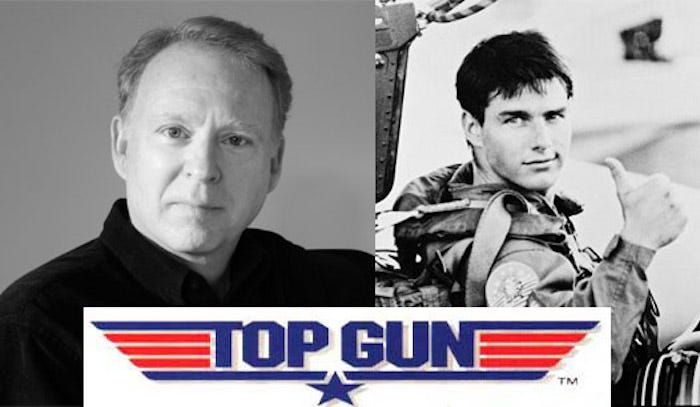
My talk with the co-writer of Top Gun, Legal Eagles, The Secret of My Success.
In 2016 as part of the DePaul University School of Cinematic Arts Visiting Artists Series, I had the pleasure and honor of moderating a Q&A panel with two screenwriting giants: Jack Epps, Jr. and Steven E. de Souza. I followed up with both to do a GITS interview. This week: Jack Epps.
Jack Epps, Jr. is an award winning writer and filmmaker who first became involved in making films while an undergraduate at Michigan State University. Inspired by a student film festival, Epps made his first film the following semester and has been making movies ever since. His student film The Pigs vs the Freaks, was purchased by NBC and made into a Movie of the Week, re-titled Off Sides. Epps produced and worked as second unit director on the film.
Upon arriving in California, Epps wrote an episode of Hawaii Five-O and Kojak. While continuing to pursue his writing, Epps also worked as a cinematographer and an assistant cameraman on various local productions. Epps had the good fortune to work for a period of time as a second unit cameraman and assistant cameraman for Orson Welles on Mr. Welles’ last film, The Other Side of the Wind.
Epps united with his screenwriting professor from Michigan State University, Jim Cash, and began writing screenplays together. After writing seven unproduced screenplays, their first produced screenplay was Top Gun which went on to become the #1 world wide box office hit in 1986. Within eleven months, the writing team of Cash & Epps had three produced screenplays in the theaters: Top Gun, Legal Eagles, and The Secret of My Success. As a screenwriter, Mr. Epps co-authored over 25 screenplays and eight produced motion pictures including Dick Tracy, Turner & Hooch, and Anaconda. Epps also did extensive revisions on Sister Act and Die Hard III.
While Epps is primarily known for co-authoring big actions movies, Epps equally enjoyed writing romantic charm and chase comedies inspired by the films of Hitchcock, Wilder and Sturges. Films like The Secret of My Success, Legal Eagles, Turner & Hooch, Viva Rock Vegas, and Sister Act are examples of the comedy of Cash & Epps. Recently, Epps wrote the video game Top Gun for the Sony PlayStation network. Epps has also written video games for THQ.
Epps had the pleasure to write for some of the most successful actors in the motion picture industry including Robert Redford, Tom Cruise, Tom Hanks, Warren Beatty, Michael J. Fox, Debra Winger, Al Pacino, Anthony Edwards, Bruce Willis, Meg Ryan, and John Voight. He also worked with such motion picture giants as Ivan Reitman, Jerry Breckheimer, Joel Silver, Herb Ross, Tony Scott and Dick Donner.
Epps was recently honored as the recipient of the first Victoria and Jack Oakie Endowed Chair in Comedy at the School of Cinematic Arts. Epps was the fall 2008 commencement speaker at the Michigan State University graduation ceremonies and was awarded an honorary doctorate by Michigan State University. In addition, Epps is recipient of the Michigan State University Spartans in Hollywood Lifetime Achievement Award. In addition, the team of Cash & Epps was recently honored by the American Film Institute as one of the Top 100 Greatest Quotes in American Cinema for their line: “I feel the need… the need for speed.”
Epps is a thirty five year member of the Writer’s Guild of America, and a member of the Academy of Motion Picture Arts and Sciences.
Today in Part 1, Jack and I explore his background as a screenwriter:
Scott Myers: Jack, you’ve had a long and distinguished career in Hollywood as a professional screenwriter. You’ve co-written movies which have been nominated for 11 Academy Awards and won 4 Academy Awards.
You’ve moved on to become Professor and Chair of the John Wells Division of Writing for Screen and Television at the University of Southern California’s School of Cinematic Arts, and just last year, had your first book published by Bloomsbury Books, Screenwriting is Rewriting.
I’d like to hit on all those areas, but first, let’s get a sense of how you found your way into screenwriting as a career. In terms of how you went about learning the craft, I’ve read where you were a student at Michigan State, and Jim Cash was teaching the only screenwriting course there, and the class was full, and you had to talk your way in there, is that right?
Jack Epps: Yes, that is correct. I had made a short film during my junior year at Michigan State. At the time, I was an English major and I didn’t know what I wanted to do. I went to a student film festival, saw the films, came out and said, “Well, I can do better than that.” Took a film class, made a short movie and I found myself creatively. It became instantly clear that I wanted to make movies. If I was going to make movies, I had to learn how to write them.
MSU had one screenwriting class and it was taught by Jim Cash. The class was full and I had to talk my way into the class. A bit of fate on both of our parts. Luckily for both of us, Jim wasn’t a hard ass. We didn’t start working together for about 5 or 6 years after that class, but we stayed in touch.
Scott: We’re talking about Michigan State, the early ’70s at this point?
Jack: Yes, around 1971 or so.
Scott: This is even before Syd Field had put out “Screenplay, The Foundations of Screenwriting.”
Jack: Right, there were no screenwriting books either. They didn’t exist. And there were no screenplays to look at in Michigan. The only things were stage plays, so I was reading a lot of plays and trying to understand how to tell a story. It wasn’t until I came out to California that I was able to get my hands on scripts.
Scott: I remember having to sweet talk my agents’ assistants to get copies of scripts and meeting up with other screenwriters on street corners, slipping each other different scripts, like some sort of clandestine drug dealers.
Jack: Oh yeah. It was a trading game. You had to have something valuable to trade. When you got one you read it cover to cover many times over. I still have cases of them in my garage and I don’t want to throw them away. They were hard to get. When we first came out to California, my wife got a job at Paramount and she brought home scripts. She was working in the finance department, and so they got copies of scripts they didn’t care about and threw them into a closet. She brought home studio copies of The Godfather and Chinatown. I also did internships and read for producers.
Reading bad scripts are almost more informative than good scripts, because when you’re reading a bad script it’s really annoying and you realize, I’m bored to tears. There’s nothing happening here. Why do I want to keep reading? Those are simple craft lessons, but essential to have people get to the end of your screenplay. You have to give them a reason to keep reading.
Scott: How did Jim teach screenwriting?
Jack: He taught basic formatting and some dramatic fundaments. We did scene work. But one word Jim emphasized really stuck with me: “complications.” I ran with the importance of complications in character, relationships and storytelling throughout my career. It’s a great word for screenwriting.
Scott: You made your way after Michigan State out to Hollywood and you said you did some internships. Do you remember what those were?
Jack: I was very lucky. This was a very different time, not a lot of people wanted to get into the movies. It wasn’t like it was today. No one really knew what a screenwriter was at that time. Nobody had much interest in it. Everyone wanted to be a director, so the door to screenwriting was pretty wide open.
I learned that the American Film Institute had an internship program. I went by and said, “I’d like an internship.” They set up an internship at MGM on a movie called Hearts of the West with Tony Bill producing. Tony had just finished The Sting so it was like stepping into a fantasy. I wasn’t enrolled in the AFI, but they helped me and a lot of others.
I got a rare opportunity to spend about six months on the picture. It was a paid internship, half paid by the AFI and the other half by MGM at $100 a week which was enough to cover rent. I was on this picture for three months of pre‑production, three months of production. During production, I assisted the director, Howard Zieff, and then sat on the set for every take and every setup. It was a real epiphany. To watch a movie get made shot-by-shot is really insightful. It became very clear that all the attention was focused on the actors. Everything was about the actors and what they were playing.
It sounds simple, but it’s not, because you realize that as a writer and a storyteller you must give the actors something to play. They’re not just saying lines. These are stories. That was the inspiration that sent me on a path to really work to understand character ‑‑ to really dig deeper into character.
Scott: When you were out in Chicago in October for the DePaul University School of Cinematic Arts Courier 12 conference, we really connected on that point, about the importance and primacy of characters in screenwriting. You had an experience, seen at first hand, in that project where you were on set.
Jack: Absolutely. I had read the script by Rob Thompson, and it was a very well‑written script. Jeff Bridges was the star, and watching Jeff act and seeing the emotion that he was working on and getting there — it was magic.
I happen to like actors. I think they’re really creative people. Just watching how they create a character and a role, you realize, as a writer, you have to give them things to play. They want to dig deep and play some flawed damaged character. It’s not lines. It’s story. It’s emotion. It’s what’s coming from the inside of these actors. They don’t want to just stand in front of a camera and say lines. The really good ones want to get deep into a character, which means that to get a script made you’ve got create something actors want to play.
Scott: How did you segue into writing TV? Some of your early credits are episodes on TV series “Hawaii Five‑0” and “Kojak.” How did that happen?
Jack: I had a friend, Anderson House, who I met at Michigan State. Andy was from Southern California, so, when I came out to Los Angeles, I looked him up. We became fast friends, and we still are to this day. Andy’s father knew Phil Leacock, the executive producer of “Hawaii Five‑0” and said aid, “If we write a treatment, my dad can get it to the show.”
I think they were in the fifth season, which is when shows are hungry for ideas. Andy and I wrote a treatment, and we basically put every “Hawaii Five‑0” cliché we could think of in the treatment. His father got it to Phil Leacock. Leacock got it to the story editor, and within a day, the story editor called us and said, “You really know our show.” They bought the idea and I wrote a spec script just to practice, and they called again and said, “Hey, you don’t happen to have a script?” I said, “Yes, we do!” and got it got produced. Got to join the Writer’s Guild and was officially a writer.
Andy and I had run our course had pitched to a lot of shows, sold a Kojak, but ultimately, Andy went into production as a location scout and through a lot of hard work later became a very successful production executive at Sony Pictures. We pitched endlessly and I really learned how to tell a story.
Tomorrow in Part 2, Jack talks about working on Top Gun and how that movie became such a phenomenon.
For Jack’s book “Screenwriting is Rewriting: The Art and Craft of Professional Revision,” go here.