Go Into The Story Interview: Nikole Beckwith
Nikole Beckwith’s original screenplay “Stockholm, Pennsylvania” won a 2012 Nicholl Fellowship and a spot on the 2012 Black List. Nikole and…
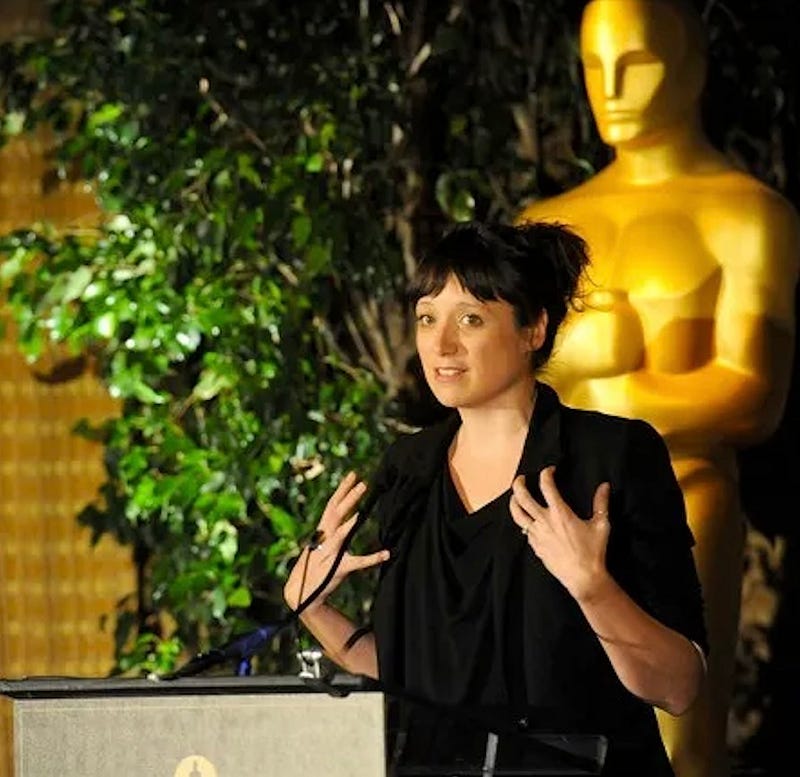
Nikole Beckwith’s original screenplay “Stockholm, Pennsylvania” won a 2012 Nicholl Fellowship and a spot on the 2012 Black List. Nikole and I had a probing conversation about her background, her award-winning screenplay, and her unique insight into the craft of screenwriting given her background as an actor, musician and playwright.
Scott Myers: OK, I have to start with this. Is it true that at the age of 15, basically you were disinvited from high school?
Nikole Beckwith: Yes, actually. I was disinvited from my high school, pretty much. I’d been suspended for a number of things a number of times, the vice principal and I had a lengthy and nuanced nemesis relationship, the stuff movies are made of, one might say, or at least “Saved by the Bell” episodes. He’d keep kicking me out and I’d keep fighting my way back in but we both knew I didn’t want to be there. And eventually he said if I left that he would keep it between us. And that he wanted me to leave. So I left.
Scott: What was the basis of your discontent at school?
Nikole: I think the public school system, unfortunately, doesn’t work for everybody. There’s people that really flourish in that environment, I have a sister who graduated at the top of her class and really, really flourished in a public school environment and learned in that way, but I don’t think everybody learns the same way. The expanding alternative school movement, I think is proof of that. So, I didn’t work in that environment and I was very vocal about it because, I felt that I was…that people are entitled to learn, and I wasn’t learning and I wasn’t being nurtured, nobody cared that I wasn’t succeeding. There wasn’t room for that. No one was thinking, “What’s the way to reach this person to get her to succeed?” Except for me, I was thinking that way. But you can only be so articulate for so long at 14 and 15. Eventually I just started to act out of anger and question people I “shouldn’t have been questioning”, and I’d incite little riots or whatever and “take on the system,” quote/unquote.
I found a school after that, Sudbury Valley School. It’s a school completely dedicated to the fact that everybody learns a different way and that you know yourself best, thusly they put you in charge of your own education. I completely flourished in that environment. All of the energy I had expended negatively in order to be heard, could then be redirected positively into learning and learning how to learn.
Based on my performance in public schools, nobody really though I was going to do anything, some local sob story, but then I found an environment that worked for me, that treated me as an individual and believed I was not only entitled to learn, but to be passionate about what I was learning and the way I was learning it. I attribute so much of who I am and what I’m doing to that mentality and that opportunity.
Scott: Had you been writing before you went there?
Nikole: I would say that I actually didn’t start doing most of my writing until 2008. I created a lot. I made shows with my friends, but never considered myself an “actual writer”, I was an actor and moved to the city as an actor, but my grandiose dreams of rolling into New York City and making a splash were a lot harder than I thought. And so I took the bull by the horns.
I was working for Eric Bogosian at the time as his assistant, and he…now looking back, that’s his narrative. He came to New York as an actor, he wasn’t getting the work he wanted so he wrote parts for himself. He wrote “Talk Radio.” He wrote those solo shows, and that’s what catapulted his career. I was around him a lot and fortunately for me absorbed his creative virtues and wrote my first play, so I could really take control of my creative energy, and like Eric I decided to write the play I most wanted to be in. I wrote this play called “Everything is Ours” but about halfway through I stopped envisioning myself as any one character, and when the play was done, it never really occurred to me to be in it.
That play got the attention of both Ensemble Studio Theatre and The Public Theater, and I ended up in both of their writer’s groups and so began my career as an actual writer.
Scott: You mention that Eric Bogosian was like a mentor figure in a way to you. Could you describe more in detail how that relationship has worked?
Nikole: Yeah, I met Eric roughly a million years ago when he was doing a residency at The Atlantic Center for the Arts in Florida. He was seeking six actors from the country to go down and workshop some plays. I was chosen as one.
I had performed in “Suburbia” a couple years before and was really into his solo stuff so I was thrilled and beside myself to be there. At the time of the residency I was running a theater company in Newburyport with a friend and was hyper organized, so as he tried to wrangle 5 writers, 6 actors and his own writing time I became his accidental assistant, and that worked out really well. He offered me a job in New York when the residency was over, and that’s how I came to move to the city. Then I moved to New York and I worked as his assistant for five years. He’s still someone that, I talk to and turn to about any major happening in my life and my work.
I feel very lucky that I had someone like him that could read my work and talk to me about it and was invested in it, and interested in it, and really encouraged me. He still reads my stuff, which is amazing. And actually his wife, Jo Bonney directed the most recent workshop of “Stockholm Pennsylvania” the play, it was a play before it was a film and a lot of our experience working on it together helped shape the film script. It was incredible. She’s brilliant. It was lovely. I’ve known her since I was 23. It was great to finally get to work together. My relationship with Eric, too, has been really great. He was definitely a mentor to me and a definite father figure when I moved to a city where I didn’t know anybody. Also to feel our relationship shift closer as I moved along in my own career and my own voice, as we become friends and peers. That’s been amazing.
Scott: Here’s a logline for “Stockholm Pennsylvania” from the Black List: “A young woman kidnapped when she was a kid returns home to the family she barely remembers and struggles to feel at home.” What was the genesis of this script?
Nikole: Well, it is a couple of things. One was a very good friend of mine, Greg Moss, he’s an amazing and talented playwright. He had written this play “House of Gold” that I had gone to a reading of years ago. It’s about Jean-Benet Ramsey in the underworld. At its core it’s about a girl being taken from the Earth. That really stuck with me. I wanted to write a response to that, I wanted to write a play about a girl being returned to Earth. I was just meditating on that and trying to figure out “What would that be?” and from there I started thinking about missing children reunited with their families. And how in our culture we are very focused on the unknown, the sensational side of the stories; how they survived, what happened to them. And when and if missing children are reunited with their families, that seems to be the period at the end of their sentence. To me that doesn’t seem like the end of anything. It seems like the beginning. It seems like their life is finally about to start, but as a culture we don’t often focus on that part of it, that transition back into the living. But I am very focused on and intrigued by what that transition is.
Scott: What precipitated you thinking this could be a movie and writing it as a screenplay?
Nikole: I love theater and I loved writing it as a play, but it definitely struck me as a story I wanted to explore in an even more intimate way. Theater is intimate in that you’re all you’re all together in the room and it’s happening there at the moment, and you’re breathing the same air. But film is intimate in a different way, you really feel like you’re inside of it, and you put yourself emotionally in the screen and in the space. It really takes you in. There’s no fourth wall. We dissolve into it. That’s the magic of movies. I wanted to explore the story and this character in that intimacy. When I first started writing the screenplay I…just for the hell of it to see what would happen, I cut and pasted the play and copied it and put it into film format. It was like 499 pages of just talking.
Scott: Wow.
Nikole: Horrifying. So I started for square one in the retelling. I wanted to play with a new structure and find ways to tell the story visually and subtly and to communicate things that you can’t on stage, see things really close up. I was thrilled to be able to invest myself in the story again.
Scott: It sounds like you not only were writing the story when you were writing the screenplay, but also adapting it from a previous source, your play.
Nikole: Absolutely, yeah, which was harder than I thought it was going to be, the adapting. It’s a different part of your brain, and I knew that plays and film are very different, obviously. But you don’t know how different until you really get in there. It is a different animal. I think the most important part of the process for me was allowing it to be its own thing, allowing it to be its own body, independent from the play, because if you don’t do that you end up writing a film that feels like a play.
Scott: Let’s talk about “Stockholm” a little bit more deeply. There are basically four primary characters. Three of them, Leia, a young woman in her early 20s who had been kidnapped when she was five, Marcie, her mother, Glen, her father, those are those three characters. You’ve already explained the inception of them. Why the particular articulation of the parents? How did they evolve?
Nikole: Marcie and Glenn? How do you move forward without moving on, and without giving up? Their lives became a vigil to their daughter, so unified in their loss and their grief. Then I thought what if what they’ve been waiting for this whole time is actually what tears them apart in the end? That’s where their story is, and their relationship. I have deep affection and deep frustration for both of them.
What I really think of “Stockholm” as just the story of people trying to do their best under completely unknowable circumstances. There’s no good or bad nor right or wrong, really, in the film. It might seem that way, but doesn’t it always? Everybody’s working with the best intentions, even the kidnapper. Even he was acting out of the truest and best intentions for himself and for Leia. It’s a confusing story about the gray area, basically, which I think is where we all live.
Scott: That’s really one of the most fascinating aspects of this script, I found. That fourth character, Ben, who is the kidnapper, had a profound influence on Leia. Of course, he was with her for many, many years, and that pivot you do with this idea of Stockholm, which I’m sure is a reference to the Stockholm Syndrome…
Nikole: Yeah.
Scott: …Whereby, on the one hand, Leia is obviously influenced by Ben, obviously for all those years. But then once she comes home, her mother reverses the tables, doesn’t she, and it’s almost like she becomes a quote‑unquote “captor.”
Nikole: Yeah. [laughs] I also have immense affection for Ben. I had to write Ben from a place where I felt very close to him, because if I didn’t have any affection and reverence for him, then I have no business writing him. Then we see it again while Marcie makes her shift where she becomes a captor. We see where she’s coming from and why she’s doing it. It’s not comfortable. Maybe you want to be yelling “No, don’t do that. Stop. What are you doing? But at the same time, how are we to know what our instincts would be in those situations? One thing that Marcie certainly didn’t expect was that it was going to be harder to find her daughter when they were actually sitting in the room together.
Scott: There’s a line that Leia has, I think it’s in a flashback or perhaps in a fantasy moment with Ben, where she says, “If you go away, what am I?” That raises the question of identity. Isn’t that a major theme in this story?
Nikole: Yeah. The film is very much about identity and family, and love, the different kinds of love, nature versus nurture. Who are we? What makes up a person, and then who’s to say if that person is right or wrong? Leia is the sum of her experience, and I think what’s hard for her is that she is who she is. She is 23. Then she walks into this other world where they say, “What you are is wrong.” It’s an extreme situation that raises a lot of familiar questions, I think.
Scott: It seems like, Leia, Marcie, Ben, the father… Each one of them, you basically inhabited them in a way as a protagonist, like you looked at the story universe through each of their eyes, as they would see it, and it really is reflected in the way that you treated the characters.
Nikole: Mm‑hmm, yeah, I think if you’re inviting people into a story, you should invite them into all parts of that story. I tried to inhabit each character as fully as I could. It’d be funny, because I’d be writing some Glen stuff and I’d be really in Glen’s state of mind, and writing some Marcy stuff and be really in Marcy’s state of mind, and then from my point of view, stepping back looking at the whole story, I would get so frustrated with them both sometimes, as much as I inhabited them, they would also frustrate me as though they’re their own people. I have no control over them, in a way.
Scott: How long did it take you to adapt from the play into the screenplay?
Nikole: Three weeks. I was given a deadline to do it, and so I did it in three weeks.
Scott: That must have been a lot of long hours, then.
Nikole: They were very long hours, yeah.
Scott: How did you happen to learn about the Nicholl in the first place?
Nikole: The Internet. The brilliant, brilliant Internet, and I found out about it basically right after I finished the film. It was very serendipitous. The last day to submit to the Nicholl was the day I found out about the Nicholl, which was the day I finished the film. As a writer, you just submit so much. You send so many things to so many places. I will get a rejection letter in the mail and I have to go back into my email to try to figure out what exactly it is I’m being rejected from. It’s just the name of the game, so I sent it into Nicholl and then I honestly didn’t think about it. And then when I got my finalist notification, it was all I could think about.
Scott: What was your time like in Los Angeles when you went out for the Nicholl Awards and met all the other finalists?
Nikole: It was great. The finalists and the fellows are just amazing. I never thought I would be so misty‑eyed leaving a Marriott hotel, but it was a really a wonderful experience. We’re all still in touch. I can’t say enough good things about them. I adore them. They’re brilliant writers, and they’re incredible people. I felt very lucky to get to spend a week with them. Greg and Joan too, who run the Nicholl, were just really generous and amazing. It was an unbelievable introduction to Los Angeles. You go in, and you have a support system in place. We’d go out for meetings, and be doing these things and then come back to the Marriott, and we’d hug it out.
Scott: In your acceptance speech you noted one of the most profound benefits was the affirmation that you’re doing what you’re supposed to be doing with your life, writing. You said, “It’s one of the greatest gifts you can receive, that knowledge.” Could you elaborate on that, why that was so impactful to you, this affirmation with the Nicholl.
Nikole: I think everybody feels this way. I think especially artists of any kind with our sensitive, sensitive souls. It’s an amazing gift to be assured that you’re on the right road, you’re doing the thing that you’re best at. I think, in many ways, that’s all you want to hear. You’re doing the thing that you’re best at. I don’t have to succeed at it. I don’t even have to make a living doing it. I certainly plan to and hope to. But just to know that I am doing what I’m best at is success in itself, because it allows you to commit and move forward and to not worry. And maybe someday I will have health insurance. Maybe someday I will have money to pay my dentist. But even if I don’t, at least I’m doing what I’m supposed to be doing.
Scott: Well, moving into the realm of dental plans and 401Ks, there is the business side of screenwriting and you signed with, as I understand it, ICM and Dan Halsted in management. Is that correct?
Nikole: Yeah, I was with them before “The Fellowship” actually.
Scott: Through your playwriting?
Nikole: Yeah, through my playwriting which is also lovely because The Fellowship was a real whirlwind, and it was crazy. It was lovely to have the support of ICM and Management. They believed in me regardless of the Nicholl. They were thrilled for me when it happened, and they made my time in Los Angeles extremely productive. It was great. I feel very lucky. They were an incredible resource for me while I was out there. Also it is grounding and reassuring to know that I had them in my corner before.
They really know my work, and they really know me. That was great. It was something we all got to celebrate together also. They were really thrilled. I was really thrilled. I was thrilled that they were thrilled. Yeah, that was great.
Scott: Did you do a round of general meetings out there in Los Angeles?
Nikole: Definitely. I did tons of meetings. I drank more bottled water than I thought was humanly possible.
Scott: [laughs]
Nikole: I understand that that’s why the Granola bar was invented. Put a snack in your backpack. [laughs] Your blood sugar is going to drop. Yeah, I was in meetings a lot, and that was great. I had an incredible time. I really connected with the people I was talking to and meeting with. Los Angeles is less of a scary, unknown place. There are a lot of friendly faces for me there.
Scott: I’m curious, was there a common thread in their reactions to “Stockholm, Pennsylvania”?
Nikole: Yeah, I think everybody really responded to the characters and the conflict. What I heard a lot was that people hadn’t read a script like that before, which is great. That’s what I guess I was aiming to do. You want to cultivate a voice or a point of view that is distinct. That’s what I was hearing. That was nice.
Scott: What’s the status on “Stockholm Pennsylvania”?
Nikole: Well, we are going to make it. I’ve signed on as the director, which is really exciting, I’m over the moon about that. We have some financing, which is also exciting and I am headed to LA again this week for my final lap of meetings with potential creative producers. I know it’s a puzzle. It’s a really intricate constellation that you put together in order to make a movie. And right now that assembly is almost as fun as writing the script was.
Scott: I’m sure it doesn’t hurt making the Black List.
Nikole: That was amazing. That was honestly like a fantasy. I was like, “Wouldn’t it be amazing if this happened?” I didn’t actually expect it to happen. It did and that was like an incredible, wonderful affirmation that I should dedicate the next however many years of my life to getting this movie made. It’s nice to have that, “Keep going, this is worth it.” That’s what I’m doing. The Nicholl really affirmed for me that I should be writing films. I should be doing this and so that’s what I’m doing. The Black List really affirmed for me is that “Stockholm, Pennsylvania” is a film that should be made.
Scott: The people who read the blog love to hear from more experienced writers how they approach the process. Particularly given the fact that you have a background as playwright, I think you probably have some really interesting thoughts. So if we could begin some questions related to the craft with this one: How do you come up with story ideas?
Nikole: Oh geeze, I don’t know. I really think that ultimately any story idea I ever come up with comes directly from an emotional experience. It just like manifests itself in different ways. I think that’s true of writers. I try not to worry about thinking of interesting story ideas. I hold onto the things that affect me and churn them over and over and over. At some point they reveal themselves as “Stockholm Pennsylvania” or whatever is next. I have a play about teenagers digging their way out of their hometown, or coworkers trapped in the artic debating on whether they will eat their friend who froze to death…regardless of the actual story it all comes from somewhere inside of you, so your perspective and your story will reveal itself…you have it. Your stories are already in you. You don’t have to press yourself for them to appear. They will appear if you just let them, I think.
Scott: It’s interesting hearing those three things you just rattled off there, when you talk about the importance of emotion, but all three of those ideas, the characters are right up front and center. Would you say that you think more in terms of character versus, say, concept?
Nikole: Yeah, I guess so. The best, most amazing concept doesn’t mean anything if you don’t have characters that people want to spend time with. Circumstances and concepts are only interesting to me based on what the characters are doing within them.
Scott: How much time do you spend at prep writing, brainstorming, character development, and that sort of thing?
Nikole: That’s kind of vague. I’ll take little notes here and there but I’ve never written an outline or anything like that. I envision my mind as the rock tumbler. I throw these little rocks in and these ideas and I tumble them around and every once in awhile, one of them will get shiny enough for me to take out and really look at. When it’s ready to really look at, that’s when I start writing and I write in sequence from beginning to end. I don’t write out of order. If I’m stuck on a scene, I don’t move on to the next scene. I wait until that scene reveals itself. I will stare at the blank computer screen for three whole days and not write a single line. I get very stubborn and I like to write sequentially.
Scott: That’s interesting. I worked one time with a veteran TV writer Roy Huggins. He wrote the pilot episode of “Rockford Files” and “The Fugitive,” and he had the exact same process. He would write it scene‑by‑scene and he wouldn’t go forward until he figured out the next scene.
Nikole: I’m always hesitant to be like, “This is my ultimate process” or “this is how I do things” because I think that might change. It might not, but I’m still learning myself in that way, which I think is great because it gives me room. But currently I have two modes in which I work, One is doing the time. I will sit at my desk and if nothing comes out I still sit in front of that computer screen from nine to five even, if I am staring at a blank screen the entire time. I don’t give up on it. I set up work hours for myself and stick to them. The other mode is thinking time. That’s important time too. It’s important to get out and see people and overhear conversations and go to a museum and read a book and things like that. That’s equally as important. It’s great to read books and go to museums and eat cupcakes all the time, which is wonderful, and sit at dog parks. But it’s also important to temper that with an even more committed share regiment.
Scott: I like that articulation. Share time and thinking time, that’s great. How do you go about developing characters? Are there specific tools or techniques, monologues, biographies, that sort of thing, that you go in developing characters?
Nikole: I’m not sure. For Leia in Stockholm, very, very early, maybe three pages into the play when I was very first learning her, it occurred to me that she’d never seen a dog before. I put on a post‑it note, “She’s never seen a dog before,” and I posted it on my computer. That, to me, informed a lot about the kind of life that she had lived and how removed from the world that I inhabit she was. There was never a scene in the play about a dog at all. It wasn’t about that. It was just something about her that was important to me. Of course, in writing the film I was able to write a scene where she sees a dog for the first time which is great and wonderful to have that opportunity and to get to explore that, especially since I thought about it so much.
I feel like when I’m writing a character it’s not all that different from meeting an actual person, you learn them as you go. If I think I will learn more about a particular character if I get them talking, I’ll head for a monologue, if I think I’d learn more watching them in an empty room, I’ll do that.
Scott: It’s like when dealing with characters, it sounds like you’re of the mindset where they exist in their own story universe and your task is in some ways to immerse yourself in that universe and engage them somehow.
Nikole: Yeah, I like to think of it that way. I think that for me writing is definitely I get to live in a different world. As much as I might be the creator of that world, I definitely often feel like a guest in it, so I like to step in there and see what I see. I think that every human being starts out with a really intense pretend muscle, a really intense imagination muscle, as evidenced by every child ever. Writers are just people that have really hung onto that somehow. For instance, I still have my childhood stuffed animal. I have a lot of respect for him. He’s older and wiser than me. He gave me advice when I was a child. I’m invested in the world where Snowball talked me off a few ledges while I was in the single digits. Imagination-muscle memory.
Scott: We have to talk about your dialog which I just thought was so entertaining and engaging in “Stockholm.” Each character had their own quirks. There was this off kilter dynamic at times, especially between, especially between Leia and her parents, a cross between like they were walking on egg shells and then these sudden shifts in subjects. It’s just really, really entertaining. Obviously it comes across that you enjoy writing dialog. Is that something you were born with? Is that something you feel like writers can develop? What’s your take on dialog?
Nikole: I’m not sure. I think it’s just, like I was just saying, kids grow up inventing dialogue. It’s 90 percent of what kids do. Whether you’re making two dolls talk to each other or two stuffed animals. I used to make a barrette talk to a pencil. We’ve all done it. Maybe for some it’s just a lasting love affair.
But writing also feels like eavesdropping to me, in a way.
Right now, in trying to explain this, I feel like my characters are so much more articulate than I am. I’m just so jealous of them. Right now, I’m just so jealous of them. [laughter]
Scott: What about theme, how does that emerge?
Nikole: I think it definitely evolves over time. I’m sure that there are things that I carry around with me while I’m writing and they emerge on their own, I don’t say, “I’m going to write something that explores identity.” That’s all I do, immerse myself in it. I’m pretty sure I said the word immersed 95 times in talking to you today. [laughs]
Scott: That’s one of my favorite words, seriously. I use it all the time with my students. I say, “You’ve got to immerse yourself in the story universe. You’ve got to immerse yourself in your characters.” That’s so much of what writing is about, isn’t it?
Nikole: Yeah. The proof is in the pudding.
Scott: What’s your actual writing process? You hinted at it, that you’ll keep your ass in the chair from nine to five even if nothing is showing up. Do you write in sporadic bursts? Do you write every day? Do you work in private? Do you go to coffee shops?
Nikole: If’ I’m working on something specific I’ll do it every day. I’ll write every day until I’m done, even if I do go three days without any new pages. I’ll do it every day. Then the time in between projects is mostly my thinking free thoughts. Now I might get to a point in a story where I’m trying to move into Act Two or I’m trying to figure out how to close the story, so I might take a couple days to ruminate but I’m actively thinking about the script. I’m going for walks. I’m eating an ice cream cone, but I’m thinking about this one problem.
I give myself weekends off. Saturday and Sunday I tend to sleep late and go to restaurants and stuff. I have a regular weekend.
Then the in between time, when I’m in between projects or I’m trying to decide what I’m going to commit to for however long it will take me to write it, that’s my thinking time. I walk around and try to figure out what’s going to move me enough to commit to spending X amount of time writing something.
Scott: What’s your writing space?
Nikole: Mostly I was writing at this coffee shop near my house called “Building on Bond.” I would have like two meals a day there. Sometimes when I was really poor I would bring snacks and order coffee. They were incredibly generous to let me get away with that. A year ago I got a dog. Now I write from home. I got a desk and a chair and a whole very “writer‑y” set up that I love.
Scott: Are you thinking about TV at all?
Nikole: Yeah, definitely, because television is really rich right now. It’s very cinematic, and it’s very character‑based, which is great. Currently, I’m the most focused on getting “Stockholm” made and I’m going to write a play at the National Theater. Those are the things that I’m the most focused on right this moment. But I have television ideas, I’ve written a few pilots. There are a lot of shows I love. I didn’t use to have a TV and I didn’t used to watch TV. It used to really be about turning your brain off. Of course, there’s a million reality television shows that are made for that but I think that the scripted television right now is in an incredible spot that asks you to think, which wasn’t the way television was when I was growing up necessarily. I look forward to building a relationship with it.
Scott: That’s another thing that’s changed quite a bit even over the last 20 years. It used to be, you made a decision. You were going to write film or you’re going to write TV, but now there’s complete cross‑pollination where you can…they really…
Nikole: Exactly, yeah, and the shows that were the most character driven like “My So‑Called Life” and “Freaks and Geeks” and stuff like that were cancelled, those shows were way ahead of their time, and now times have caught up. That’s what shows are all about now, character and conflict and I think we are all better for it.
Scott: One last question, an obvious one for the aspiring writers out there, here you’ve been named a Nicholl Fellow. Your script makes the Black List. What advice can you give aspiring playwrights, screenwriters, writers about the craft of writing?
Nikole: Just to keep doing it. You just have to write. [laughs] That’s basically the secret. You have to send your stuff everywhere. For me I sent my script to The Nicholl. This is my first screenplay, and I sent it in, it got The Nicholl competition and that’s amazing. Also, let it be known that I’ve been writing for much longer than that. I’ve been rejected from a million things. That’s really important to know. I’ve always said someday I want my bio to also include the things I didn’t get.
I think that the things you don’t get are just as important as the things you do get because they’re all a part of your journey, to use a really ridiculous word. Try really hard to not get discouraged, which is extremely difficult. But even in your most discouraged moment find a way to keep putting the -you can’t say put the pen to page anymore because nobody uses pens or paper, but to put the metaphorical pens to the metaphorical page.
There’s honestly no such thing as an overnight success. Even the actor that’s on television that you’ve never seen before has been doing plays for 15 years and working their ass off. Nobody has it easy. Just know that you’re in good company when you get that rejection letter, so just keep going. Commitment is so important.
Nikole not only wrote the script, but directed the movie. Here is a clip from Stockholm, Pennsylvania.
Nikole also wrote and directed the 2021 movie Together Together.
For my interviews with every Nicholl Fellowships in Screenwriting winner since 2012, go here.
For my interviews with dozens of Black List screenwriters, go here.