Go Into The Story Interview: Meg Gardiner
My conversation with the Edgar-winning novelist about the craft of writing, how she won ‘Jeopardy’ three times, why she is an “escaped…
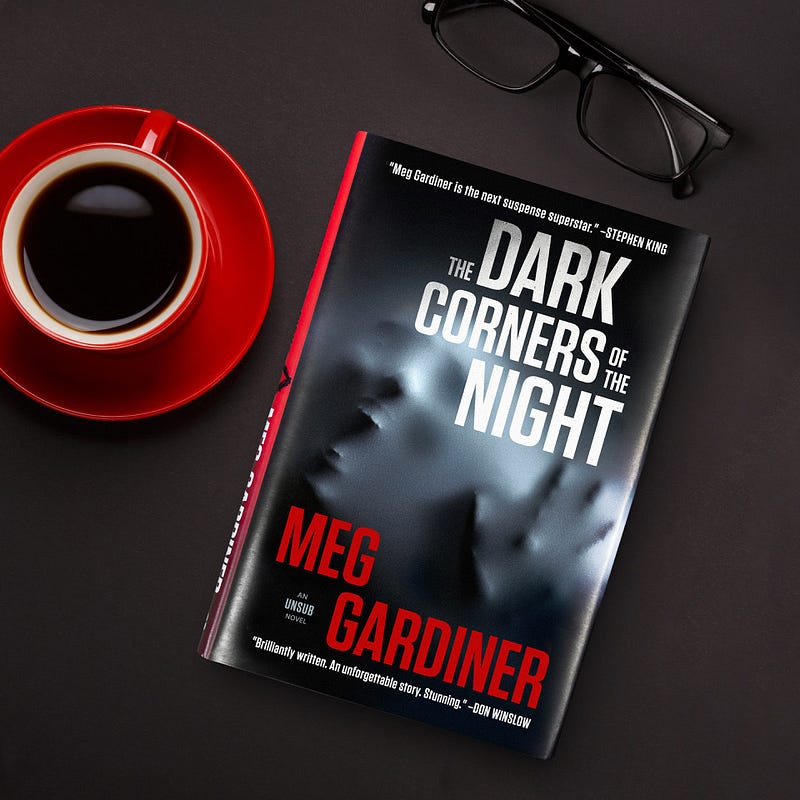
My conversation with the Edgar-winning novelist about the craft of writing, how she won ‘Jeopardy’ three times, why she is an “escaped lawyer,” and her crime thriller The Dark Corners of the Night.
Do you remember the clammy chill up and down your spine when you first read the Thomas Harris thriller novel The Silence of the Lambs? I do. I just experienced a similar thing when reading Meg Gardiner’s newest novel The Dark Corners of the Night. Her 15th book, the Edgar Award-winning writer recently sold the rights to Amazon to develop as a TV series.
In the weird ways of the modern world, I’ve never actually met Meg, but we’ve followed each other on social media over the years, so I feel like we’re at least virtual buddies. Her Twitter feed (@MegGardiner1) is an excellent one for writers as she regularly dispenses writerly wisdom as well as links to bizarre crimes she stumbles upon in her research.
After reading — and getting seriously spooked — by The Dark Corners of the Night, I reached out to Meg to see if she’d be up for an email AMA. She agreed. Here it is, my Q&A with best-selling author Meg Gardiner:
Scott Myers: Let me lead with this because given your background in writing award-winning crime thrillers, I can think of no better person to ask than you. Books, both fiction and nonfiction, TV, movies, documentaries, podcasts, our culture seems to be absolutely steeped in crime stories. What do you think drives this seemingly insatiable thirst for these type of stories?
Meg Gardiner: We thrill at stories of light versus darkness. We like a vicarious trip to the dark side. And we appreciate tales where right prevails and order is restored.
We like stories of transgression. Especially stories where the transgression is big and obvious — and breaking the law isn’t subtle. Crime stories are vivid, high-stakes, often told in a way that’s powerfully emotional. They also embrace the idea that morality exists. They assert that justice is worth pursuing. That wrongs should be righted, or at least reckoned with. People hunger for that.
Scott: You received a B.A. in Economics from Stanford, then a law degree from Stanford as well, and practiced for awhile in Los Angeles. Since you’ve been a writer full-time for well over a decade, what do you think of yourself as: Recovering lawyer? Lapsed lawyer? A ‘my God, what was I thinking about becoming a lawyer’ ex-lawyer?
Meg: I come from a long line of attorneys. When I was in college, they’d look at me with hope in their eyes, and I would shake my head and say, “Sorry — I’m never going to law school.” I wanted to write. My father, an English professor, supported that dream. But he asked how I planned to put a roof over my head while getting started as a writer. I could wait tables. Or I could practice law. I took the hint.
Practicing law proved fascinating, exciting, and exhausting. Writing time was minimal. After a few years of going to court, I was finished arguing for a living. I switched to teaching. I wrote in the evening after putting my kids to bed.
It took years of false starts, awful drafts, and rejection before I wrote a publishable novel. That book sold in the UK. I wrote five more before a US publisher finally took me on. Law (and parenting!) taught me to dig in when the going gets tough, and persevere.
I’m an escaped lawyer. I jumped the fence, with a farewell salute. I ain’t going back.
Scott: You grew up in Santa Barbara and taught writing at UCSB. Honest question: Why in the world did you ever leave? (Confession: It’s my favorite city in California.)
Meg: It’s my favorite city in California, too. It was a wonderful place to grow up, and to start a family. As Santa Barbarans love to say, every day there is “another day in paradise.” But eventually, I needed to live beyond the garden walls. At the beach with the kids one Fourth of July, enjoying the glittering surf and purple mountains and the cozy hometown atmosphere, I turned to my husband and said, “We have to get out of this town.” Soon afterward, he took a job in London. Moving to the UK was the best thing we could ever have done. It opened up our lives, and our kids’ lives, beyond measure.
Now I live in Austin. And Santa Barbara again feels like a promised land, to which we’d love to return.
Scott: You’re a three time ‘Jeopardy’ champ. Do you remember the answer for the Final Jeopardy round in which you won your first match?
Meg: The category was Movie Classics. The clue: “‘I cannot live without my life, I cannot die without my soul,’ are Olivier’s last lines in this 1939 film.”
The other two contestants wrote, “What is Gone with the Wind?”
Does that sound right to you?
I knew that 1939 is considered a standout year in movie history. Gone with the Wind crossed my mind, but Olivier wasn’t in it. And neither was that line…
Which sounded like Emily Brontë to me. Heathcliff mourning Cathy.
I wrote, What is Wuthering Heights?
Emo teen reading habits for the win.

Scott: It’s a cage fight between the Thomas Harris novels Red Dragon and The Silence of the Lambs. Which one comes out standing?
Meg: Silence.
Both novels feature the slithering power of Hannibal Lecter. And Red Dragon is fresh, shocking, gripping, mesmerizing. The battle between Will Graham and Francis Dolarhyde is a grand guignol masterpiece.
But Silence has the crown jewel of crime fiction. The singular, indelible Clarice Starling. Nothing beats her.
Scott: It was recently announced that Amazon has optioned the latest in your UNSUB series, The Dark Corners of the Night, to develop as a television series. You’re a producer on the series. Does this mean you’ll be adding TV writer to your extensive resume?
Meg: I hope so. Larry Trilling is a fantastic showrunner, and the adaptation is in his hands. I’m on board for anything and everything.
Scott When and why did you develop your fascination with UNSUB cases (Unknown Subjects)?
Meg: My fascination started with a police sketch I saw in the paper as a kid: a gunman in a black executioner’s hood that bore a bizarre symbol on the front. It was the Zodiac. Thanks to my vivid imagination, I spent nights wondering if he was lurking outside my window.
More recently, I was stunned to learn that multiple murders had been committed in my childhood neighborhood by the Golden State Killer. That really rocked me. The crime scenes were within easy walking distance of my family’s home. One is literally across the street from my brother’s house. New evidence has reinforced my fears that the killer prowled our street while choosing his targets, and must have fled past our house on foot after one of his killings.
How did he get away with it for so long? Why could I immediately remember the crimes — but struggled to recall the victims’ names? How close had a serial killer come to the quiet home where my parents and little sister and brother were sleeping?
Can anyplace ever truly be safe? Yeah, I wanted to write about that.
Scott: What about the research part of the book-writing process do you enjoy the most?
Meg: Grazing. Wandering through articles, books, documentaries, and conversations, and noting what makes my eyes pop or the hair on my arms stand up. Then thinking, “What if…”
Scott: Character = Plot. Yes? No? “I need a margarita.”
Meg: Yes. Yes. Yes. Plot is what the characters do. They do it to each other, with each other, through each other. Character and plot are one thing. Like spacetime.
I’ll take my margarita frozen, please, with salt. Guac and chips to go.
Scott: A recent quote from screenwriter Steve Zaillian: “I don’t try to make a character sympathetic, or unsympathetic, in anything I write. I just try to understand them.” What are your thoughts, especially when writing characters who are criminals, even serial killers?
Meg: That’s a great quote. I always try to have sympathy for my characters, which is different from trying to make them sympathetic. When writing the first draft of a novel, some characters inevitably feel flat, or clichéd. At that point I back up. I try to view them compassionately — to see some side of their lives that I haven’t considered. Then I try to write my way inside them.
With criminals and killers, I try to have empathy: to view the world of the story from their perspective. Villains have families and pets and problems, just like anyone else. And they think their actions are justified. Their perceptions and motives may be twisted, but they think they’re in the right. I need to know why, so I can convey that convincingly.
Scott: Another writing quote, this one from Janet Fitch: “The writer is both a sadist and a masochist. We create people we love, then we torture them. The more we love them, and the more cleverly we torture them along the lines of their greatest vulnerability and fear, the better the story.” Reactions?
Meg: I’m going to pin that quote to the wall above my desk. The only real way to find out what characters are made of is to pitch them into hell. Then you learn whether they can fight their way back out, rescue people who need help, and rebuild from the chaos. At the climax of a thriller, you have to force the protagonist up against the wall, or the edge of a cliff. Out of time, out of ammo, facing seemingly impossible odds. Then you have to create a way for them to escape and — maybe — triumph, through grit, ingenuity, and courage.
Scott: You have an active presence on social media (@MegGardiner1, @meggardiner.bsky.social). How important do you think an author’s presence on social media is?
Meg: It can be very important. A social media presence can help the public discover an author’s books. Simultaneously, it’s not necessary. If engaging on a particular platform makes you grind your teeth, don’t torture yourself. The key word here is social. Find someplace you can have fun. I enjoy Twitter. I love the banter and the pace. I hope if people are interested in what I’m saying, they’ll check out my work.
Scott: Finally, what’s the very favorite sentence you’ve written in one of your books?
Meg: “Another day defending truth, justice, and militant rodents. God, I love the law.”
Shh, don’t count the periods in that quote. It’s from my first novel, China Lake. I recall how freeing it felt to write it. On the page, through my characters, I could say anything.
Check out these author testimonials for Meg and her newest novel:
“Brilliantly written. An unforgettable story. Stunning.”
— Don Winslow
“Meg Gardiner’s trademark strengths… characters as real as your friends, and a plot as real as your nightmares.”
— Lee Child
“Meg Gardiner is an astonishing writer… I couldn’t turn the pages fast enough.”
— Tess Gerritsen
“Meg Gadiner is the next suspense superstar.”
— Stephen King
That last guy is rumored to know a little something about writing suspense.
Let me zero in on two things I particularly enjoyed when reading The Dark Corners of the Night.
First, the characters. As readers of my blog probably know, a story’s characters are my North Star. It’s a big reason why I’m writing a book about character driven screenwriting. Meg’s characters crackle with individual vitality. We not only get to know each as unique figures, we find an emotional connection to them, even the book’s Nemesis — the Midnight Man. If you like a plot which yanks you along for the ride combined with a cast of compelling characters, The Dark Corners of the Night is a book for you.
The other thing: Psychology as mystery. The book’s Protagonist Caitlin Hendrix, also featured in two previous novels in the UNSUB series, is an FBI behavioral analyst. As she and her compatriots desperately attempt to figure out who the serial killer haunting Los Angeles is, they delve deep into psychological profiling. Their speculative process offers a fascinating journey into the dark recesses of human behavior, the shadow aspect of the murderer’s psyche. As a fan of Carl Jung and a self-professed ‘armchair psychologist,’ it’s abundantly clear to me that Meg Gardiner knows her stuff when it comes to the psychology of criminal behavior.
I rarely read novels nowadays because I have hundreds of script pages to review every week, but I picked up The Dark Corners of the Night at midnight last Sunday and finished it by Monday evening, reading it on the L, between student meetings, and after a three-hour class I taught.
Yes, it’s that good.
Here’s to you, Meg! Keep doing what you’re doing, scaring the bejeezus out of us while entertaining the hell out of readers at the same time.
For 100s of my interviews with screenwriters and writers, go here.