Go Into The Story Interview: Liz Hannah
Sometimes the story behind the story is as compelling as the story itself and that’s the case with Liz Hannah, writer of the 2015 Black…

Sometimes the story behind the story is as compelling as the story itself and that’s the case with Liz Hannah, writer of the 2015 Black List script The Post which went on to be directed by Steven Spielberg, and star Meryl Streep and Tom Hanks.
My hour-long 2017 conversation with ‘The Post’ screenwriter Liz Hannah.
Scott Myers: Liz, I believe you were born in New York City.
Liz Hannah: That is correct.
Scott: Then you went to high school in Connecticut?
Liz: I did. My parents moved to Connecticut when I was four and then my mom ended up staying there. My dad moved back to the city, which, for me, was the best of both worlds because I got to have this small town high school experience, but I got to spend all of my weekends in New York City in Greenwich Village. Then I lived in Brooklyn.
I went to undergrad at Pratt Institute, so I lived in Brooklyn for the last four-and-a-half, five years before I moved to LA.
Scott: Where along the way did you pick up the movie/writing/screenwriting interest?
Liz: I was always a really big reader and I was a really big film watcher. Both of my parents, particularly my mom, is a huge film buff. We would just watch everything without, really, any specific genre or direction. We were constantly consuming. I think my love of storytelling came from them.
I always knew I wanted to make movies. I didn’t really know what that meant, ever. Part of it helps that I wasn’t really good at math, so I had to diverge and figure out what else I could be good at. When I went to undergrad, I was really lucky. Pratt has almost a conservatory like program. There were only like 25 kids in my film class in undergrad.
It was really a great opportunity to do everything. My mom, who’s from LA, had moved back to LA when I went to college. I would come out to LA and intern at production companies in the summer during college, so I kind of got a taste of everything. I found out that I really liked collaborating. That was where the jumping off was. I loved writing, but I really loved collaborating.
Where I saw that happening the most was in producing. I had worked for Rick Rosenthal and he’d gone to AFI (American Film Institute) and he’s a very proud alumnus of that. He had said, “Why don’t you go to AFI? I think you should go into producing.” I was like, “OK.” I applied. I got in.
I went to AFI for producing and really quickly realized I could only be a creative producer because, again, the whole math thing really is a bummer if you’re trying to be a line producer and you’re dealing with budgets. I was like, “OK, that’s what I’m gonna do.” Along the way, I was always writing.
I just thought that creative producing was going to be my way to be creative and to have that outreach into the world. Then I worked at Charlize Theron’s production company (Denver and Delilah Productions). I had interned there while I was at AFI and then I worked there for four-and-a -half years afterwards. That was my last job before I went off to write full time.
A couple of years in, I realized that I wanted to be on the other side of the table. Again, I was constantly writing. I’d written a thesis at AFI that had been greenlit, but I didn’t produce, we didn’t make. Part of it was I thought everybody else was better at it than I was.
I didn’t have a huge education in reading scripts until I worked in development and until I got out grad school. That was really, I think, eye-opening to me of the notes process, a collaboration from a writer’s perspective that I had never experienced before in terms of collaborating with producers, collaborating with directors, and talent, obviously.
That was where I opened my eyes. Like, “Oh, I can still do all this as a writer.” I can, A, tell a story, but, B, also be able to work with all these great people. I think I’d been there for a couple of years when I decided to leave. I love that company. I love the people there. I’m still very close to them, but I was feeling like, “I don’t think this is what I’m going to do.”
I really wanted to try and write, so I wrote a script that was a personal family drama. I sent it to my boss at the time and I sent it to my now manager, who I knew really well at the time. I said, “If this is any good, let me know and I’ll quit my job. If it’s terrible, I’m more than happy to stay here. I’m happy with the tough love and thank you for bursting that bubble for me.”
Both of them were like, “You should quit your job.” That was December 2012. I left and I’ve been writing full time ever since.
Scott: So it figures if someone is not good at math, screenwriting is a viable option because of the simplicity of three-act structure.
[laughter]
Liz: Exactly. I can count to three really easily, so there you go.
Scott: On your IMDb page there are quite a few short films with you having a producer credit. Some in New York, some in LA. That probably was Pratt and AFI?
Liz: Yeah. When I was at Pratt, my senior year I produced a short that had a couple of good legs at the festival circuit. Then, when I was at AFI, my thesis film actually was a finalist for a Student Academy Award, which was really fortunate and wonderful.
What’s funny, when you’re at AFI, you have to crew on all of these thesis projects, so I have all of these random IMDb credits that’s like cameo on this, PA on this, and stuff like that. That all is very much the hands-on experience of being at AFI.
Scott: Has having the experience as a producer and working in creative development impacted you as a writer?
Liz: I think it’s both a negative and a positive. When I first started out writing, I had to learn how to turn my producer brain off because it’s really easy when you’re breaking story or conceptualizing something to think, “Oof, how am I gonna pay for this?” It’s sort of the natural response immediately.
You have to really turn that off for the most part while you’re writing, particularly the first draft, because that’s somebody else’s job. That could be your job, but it’s your job later. You need to get the story out first. You need to get it perfect on the page, and then you can mess with it. Definitely, that is, on one side, it can be a challenge.
On the other side, I feel like I had some immense benefits from coming from development as I still constantly try to read. I think reading scripts: good, bad, mediocre, unfinished, anything is the best education you could get in how to write a script.
It not only teaches you what works, but it also teaches you what you like, ”Oh, I like how this character is shaped. Maybe this is how I want to sort of explore whatever character, or arc,” or whatever you’re working on. That, for me, is a real benefit.
Also, just being able to sit in meetings with any of the 250 people that have to make a movie come together, and feeling not totally out of place, and being able to, as you said, put the producer hat on, and be there, and be present, and put the writer hat almost just to the side for a second and say, “OK, how do we attack this producorially?”
Scott: Let’s jump into talking about the movie The Post which is based on a spec script you wrote. It opens in limited release on December 22nd, I believe.
Liz: Yup, December 22nd New York and LA, and then we go wide January 12th.
Scott: The movie stars these relative unknowns, Meryl Streep and Tom Hanks…
[laughter]
Liz: I think they’ve made two or three movies together between them.
Scott: …And this novice director, Steven Spielberg. When you hear someone mention those names involved in your movie, I imagine it still must feel surreal for you.
Liz: Yeah. It’s funny. It’s strange not just from the, as I’ve been referring to them as the Big Three, that them coming on board was, and still is, surreal. Steven came on and then brought Tom and Meryl very soon after, and then we were in production less than three months later.
As much as there was this very surreal aspect to it, it was also, “We have to go make this movie now. We got to go to work.” There’s constantly been that. I will say that, actually, I don’t know that it’s fully completely hit me until I saw the movie for the first time and I was like, “Oh, my gosh, this happened. It’s real. It’s not as if I just blacked out for the last six months.
“They really did it.” Aside from the big three, the other people involved in this movie are also legends. Ann Roth is our costume designer who I want to be one day. She’s amazing. Amy Pascal who bought the script from me initially is an icon and somebody that I’ve been very fortunate to learn from this year.
Kristie Macosko Krieger, our other producer, who is Steven’s producer. There was an amazing array of women on this film that got it going and got it to where we want it to be. Not to mention that I was paired with Josh Singer a few weeks, I think, after Steven came on.
Again, as a learning experience, as an amazing way to work on my first film in production, being able to have Josh there, it was an extremely collaborative experience. But also I didn’t have to feel embarrassed, or insecure, or whatever if I didn’t have an answer on set because Josh and I could figure it out together.
Scott: It’s mind-boggling, really, that the movie came together so quickly considering all the talent you’re talking about and their schedules. It typically will take anywhere from three to five years or more to get something going. This has turned around in basically 14 months…
Liz: Between sale to release it’ll be about 14 months, yeah. 13 months, actually, I think, which is even crazier.
Scott: I’m reminded of the story of this kid who went to a Carrie Underwood concert. He had a sign that said, “Carrie, be my first kiss”. And she brought him up on stage — he’s like 12 years old — and she did it, she gave him his first kiss. And I’m thinking, “That’s great, but where does this guy go from here?”
Liz: Right. [laughs]
Scott: And her you are, Liz, your first movie with the Big Three as you refer to them. I mean, it can’t possibly be like this for you with every project in your career, right?
Liz: I would imagine not. I would hope so. I think the thing is…Look, the confluence of events and circumstances that put every single person on this movie into it, and we haven’t even mentioned the insane ensemble cast, because we somehow got to shoot this movie when everybody was on hiatus in TV, the TV all-stars are in this film.
Scott: Like Carrie Coon.
Liz: Yeah, we have Carrie Coon. We have Sarah Paulson. We have Bob Odenkirk, David Cross, Bradley Whitford, Tracy Letts. We have all of these amazing people who are typically completely consumed by their actual jobs for 11 months out of the year and we somehow got them in this one little time where they’re…
Although, Sarah was actually flying back and forth from LA to New York to shoot “Horror Story” while she was doing it, so we were very lucky to have her as much as we could. To say that I’ve peaked possibly too soon is probably the understatement of the world.
What I will say that I think is something that I want to take and recreate in my career, that I do think is possible, and it’s something I learned from Steven and Tom and Meryl very specifically is the caliber of material that you’re willing to work for and work on and the level of the players that you want to work with.
I may never be as fortunate to work with Steven, and Tom, and Meryl, and Amy, and all of them again. I hope I am, but if not, it’s still the level of the type of story you’re telling, the type of people you choose to work with. That was really outside of the starstruckness. These are all extremely lovely people who really love their jobs and have fun every day doing their jobs.
That is something I think I want to try and recreate again. It is a little bit of a “Life is too short to be miserable.” Why would you make a movie if you weren’t having fun? That’s something that I think is really hard to replicate, but is something I would like to try and do again.
Scott: Of course, the project began with your spec script. Here’s how the story’s described in the official 20thCentury Fox movie website.
“A thrilling drama about the unlikely partnership between ‘The Washington Post’s’ Katharine Graham, played by Meryl Streep, the first female publisher of a major American newspaper, and editor Ben Bradlee Tom Hanks as they race to catch up with ‘The New York Times’ to expose a massive coverup of government secrets that span three decades and four US presidents. The two must overcome their differences as they risk their careers and their very freedom to help bring longburied truths to light.”
Let’s start with the inspiration for you writing the script. You had read the Katharine Graham memoir….
Liz: Yes, yeah. Her memoir called “Personal History,” yes.
Scott: I read somewhere that at some point your boyfriend I think, he’s now your husband said, “You should write that.”
Liz: Yeah. I read her memoir a few years ago and I was just completely consumed by it. It’s, I don’t know, a 700, 800 page book that I read in like a week. As somebody who had worked in development, I was like, “How is this not a movie? How is her story not what we’re doing? In this world of biopics, how has she not had one?”
Then I realized it’s because it’s really hard to write something about her, because she led 10 different lives and had 10 different movies that could have been made about her. It took me a long time to figure out what the window into her life was. I think unless you’re Forrest Gump or Benjamin Button, the cradle-to-grave biopic is really tricky to pull off.
I wasn’t interested in telling that story, because I didn’t think that was necessarily the thing that would resonate with people. I think, when you’re telling a true story, you have to look through the window and say, “OK, what am I showing people and why is it important? Why is this the most fundamental…the turning point in her life? A coming-of-age story, if you will?”
That, to me, was this moment with the publishing of the “Pentagon Papers.” I didn’t really find that moment until…at this point I think it was like two years ago when I was reading Ben’s memoir, and his conversations about Kay and their relationship.
I realized, “OK, this is…I think it’s a two-hander between them, and it takes place during this time, and it’s really about her finding her voice and standing on her own two feet,” but yeah. I had been talking about it, and I had all this research, and I’d read all these books because it was something I was really passionate about.
I just couldn’t figure out…and I didn’t want to write the bad version of it. I, at this point, had so much respect for Kay that I didn’t want to do poorly by her. Then, this last spring, I had been working on a web series and it was really tough. I was trying to figure out…I’d applied to be in the WB program and I didn’t get in.
I was feeling, I think, a more consistent feeling for writers is, “Should I really keep doing this? Is this going to work?” It was my boyfriend at the time and my now husband said, he was like, “Just write the Katharine Graham story. You’ve been talking about it for so long. You’ve sort of been avoiding it. Why don’t you write it?” and so I did.
Last June 2016, end of May 2016, I finally sat down and wrote it. Now, here we are.
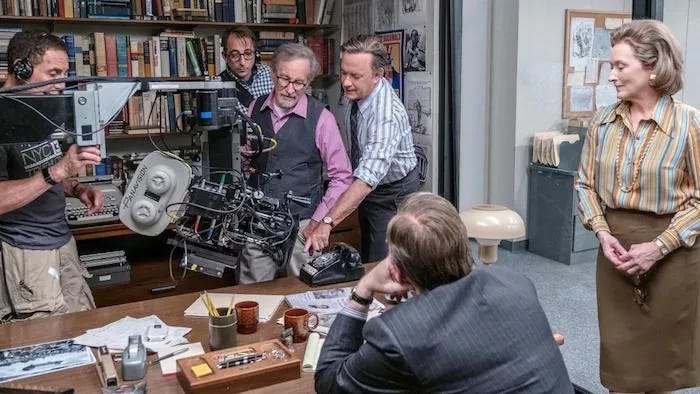
Scott: When you started writing the script in June, you had zeroed in on the Pentagon Papers.
Liz: Yes. I think a lot of writers talk about this. This isn’t striking gold or anything, but I think most of writing is actually done when you’re not sitting in front of a computer. As much as it took me only three months to write the first draft of this script, it took me three years to figure out what the story was, who she was, what I wanted to say about her, and what resonated with me.
It was a lot of reading, and thinking, and doing that but, by the time I finally sat down at my computer last spring or last summer, I knew this was the window in time. I knew the three acts of this film.
Scott: With Katharine Graham, a female in a male-dominated environment journalism was she one of the few or only…
Liz: She was the only female publisher at the time and she was the first female “Fortune 500” CEO.
Scott: She had the shadow of her father and her deceased husband looming over her.
Liz: Correct.
Scott: And a decided underdog. There’s a side of dialogue in the script where a character says, “It says that if you want a good party, you call Kay Graham. Run a paper? There’s a whole list of names that come first.” That underdog component, how important was that to you when you were writing it?
Liz: Extremely. I think I naturally gravitate towards underdogs. I wasn’t the most popular kid in high school. I was always reading. I wasn’t unpopular, but I was just always trying to figure out how to fit in, as I think all of us are. I just naturally have always gravitated towards them. I think, also, being a woman, you also naturally gravitate toward the underdog.
Kay, the thing about her that I always found really fascinating and one of the first things that I really connected to about her was she never victimized herself, but she was extremely vulnerable. She was extremely, in her memoir, willing to mention her mistakes, and go into great detail about what her mistakes were, and analyze them.
Not even mistakes, necessarily, but choices she made and choices she regreted, and very willing, particularly about the chapter in her book that takes place about this time, very willing to talk about how vulnerable she felt and how insecure she was feeling about being in the position she was in.
I think without ever, obviously, calling herself an underdog she would never, ever think of herself that way. That was a very interesting perspective to me.
She just saw herself as maintaining until her son could come and take over the company. I think that was a really just unique self-reflection on her part that I thought was not something that had been explored a lot.
Scott: In contrast to her personality and her perspective, that’s interesting you used the word “vulnerable”, because that’s not the word that comes to mind when you think of Ben Bradlee.
Liz: I don’t think so. [laughs]
Scott: You describe him as the start of the story with a side of dialogue where he says, “Because I used to be good at getting a story, fighting for it.” At the center of the plot, these two characters, that relationship. What drew you to these two personalities?
Liz: I think, for me, there was a big…I was always in love with Kay and her story. Then there’s also this idea that this was the forming of the superhero team. We know from history that these two people came together and were able (with Woodward, Bernstein, and the rest of The Post team) to take down a President a few years after the film takes place.
That forming of that team, we always like in movies when we see the training montage. We always love how the team comes together. There’s something that’s inherently, for me, attractive about those stories. At this point in their relationship, they had known each other for a long time.
She had hired him to work at the company very quickly after her husband had passed away, but they weren’t totally there yet. They weren’t firing on all cylinders. There was something very interesting about telling this male/female relationship that wasn’t about romance and it wasn’t a meet-cute. It was a forming of this superhero team. That was something that was really attractive to me.
I just also think Ben is… I think he’s such a man of a different era and he’s such an icon. Actually, a friend of mine just sent me an article about Ben Bradlee because this film just came out about him on HBO and, obviously, with our movie. He had a swagger about him that was sort of iconic. I didn’t grow up in that era and I still knew what that was. I still knew who he was.
There was something very exciting about being able to write this guy who, not only did he have a swagger, but he also didn’t care that she was a woman. That was always something that was fascinating to me and very different about Ben, is that he didn’t care that his boss was a woman.
He just wanted her to do her job, and that’s not necessarily the typical perspective you get of men in 1971, let alone men in 2017. I think that that was something that was really…Ben was just really fun to write. He’s kind of persnickety, and kind of has a temper, and definitely thinks he is as good as he is. It was just fun. He was a fun character to write.
Scott: Super motivated around the Pentagon Papers, because The New York Times had beaten the Post by three months, they’d had the Papers that long.
Liz: Correct.
Scott: For people who wouldn’t know, could you explain why the Pentagon Papers were so important?
Liz: On a very Wikipedia level, the Pentagon Papers were thousands of pages of documents that were put together via Robert McNamara at the Pentagon. He had assembled this team of academics and former DoD employees and government employees, one of whom was Daniel Ellsberg. This was when LBJ was in office.
He wanted to collect everything in the government that had been discussed about Vietnam, and put it together in one place so that they could figure out what went wrong. He, at this point, had spent many years publicly defending the war and privately trying to negotiate the avenues of getting out through two presidencies. He was there through Kennedy and for LBJ.
The documents themselves are…everything that was ever touched in the government about Vietnam from Truman to LBJ. Four presidents.
The reason they were important is that they showed that four presidents had lied. That four White Houses had knowingly lied to the American people when they were going out into public and saying that the United States is winning in Vietnam, that this is an important war, that we need to defend these people.
That was all a lie that they knew at that time that thousands of American soldiers were going to die, they were continuing the draft knowing that they were sending them into a losing battle, and these documents were, these papers were the culmination of all of that knowledge put in one place.
Scott: I was going to say, then they become this enormous narrative element and the key point of the story really is a choice about whether The Washington Post should publish them or not. Katharine Graham and Bradlee have different perspectives on this.
Liz: Yeah. The New York Times had the papers. They’d gotten them from, now we know, Daniel Ellsberg. They had three months where they’d vetted them and decided what the stories would be, so they really had a leg up.
At this time in history, The Washington Post wasn’t just a local paper. It was the second most popular local paper in Washington. It wasn’t even that it was The New York Times and The Washington Post. The Washington Post was never even in the same sentence as The New York Times.
Ben Bradlee, that irked him, to say the least. They ran in all the same circles as Abe Rosenthal and Scotty Reston, who were with The New York Times. Abe Rosenthal had no problem telling them that The Times was better. There was a lot of competitiveness between them.
On one hand, for Ben, there was a real competitiveness, a real journalistic one-upsmanship once he knew that The New York Times couldn’t publish anymore, that they had to, that that was the only way that they were going to really be in the same conversation.
For Kay, it was very much the company had just gone public. They were not cash-solvent, so they really needed the IPO, and there is a clause that a week after the IPO goes out, it can be cancelled due to a catastrophic event.
One of the catastrophic events is a federal indictment, which The Washington Post could very easily have been federally indicted because of publishing these papers.
There were these two sides of, on one hand, Ben knew that the only way The Post could stay in…It said multiple times in the movie and was said multiple times in history, which was, “The only way to assert the right to publish is to publish.” He very much knew that.
For Kay, she also was grappling with this could take down the company and the legacy of the paper and her family her father, her husband, and the legacy she was trying to leave for her children. There was that.
At the same time, Ben and Kay were both extremely close to two of the fundamental people mentioned three of them, actually mentioned in these papers: Robert McNamara, John F. Kennedy, and Lyndon B. Johnson. Kay’s husband had put LBJ on the ticket with Kennedy.
Ben was there to meet Jackie after Kennedy had been shot, had been assassinated. Robert McNamara had picked every single person on The Washington Post board for Katharine Graham. There was a very, very intimate tie to a number of people involved in these papers.
There was, on a whole other level, this feeling of betrayal, this feeling of did we protect our friends? I think that was something that really happened after the publishing of these papers. Was the real division between the government and the press.
At that time a lot of things were done in the back rooms, and at dinner tables, and that’s where a lot of things were negotiated. Now it was very on the record, off the record.
Scott: I’d like to zero in on the actual writing process, if I could.
Liz: Yeah.
Scott: The script features a lot of dialogue. It’s one scene after another where people are in rooms talking to each other. Yet the story is just compelling as hell in large part because of the characters themselves and their conversations. Not just the historical content, but the actual dialogue.
When you were writing these scenes, did you have any specific kind of mindset? Were you aware, like, “Yeah, I’ve got one dialogue driven scene after another?” Did you bring any special consciousness or awareness to that as a writer?
Liz: Yeah. I definitely think, when you’re dealing with a lot of dialogue which I tend to have a lot of dialogue in what I write you have to just make sure that you’re not making people say things just so that they’re talking.
You have to be very conscious of “Is it better if people are quiet here or not? Am I just trying to have people speak?” I tend to think that sometimes the best dialogue is silence and so it is definitely a challenge to do that or to keep that in your mind. I also think everything is about scene work.
If you’re dealing with something that has a lot of dialogue, then the dialogue is your scene work. You have to make sure that it’s going somewhere, and it’s climaxing at parts, and surprising you at other parts, and that there’s something happening to keep you in the scene because, if there’s nothing else for anyone to pay attention to except the dialogue, then it has to go somewhere.
I also think that the fundamental thing about dialogue is they have to sound different. If it’s just people talking on a page, then you’re not going to care. If it’s characters that you’re interested in who are talking, and they have different voices, and they’re saying different things, and they’re surprising you, then that’s, A, the challenge, and B, the interesting thing about watching it.
When Josh came on, the movie went from being a good script to read to a movie. There was a lot of breathing life into a lot of scenes and giving people breaths.
Scott: You just mentioned the word “silent”. Some of the most impactful moments in the script for example, that scene between Kay and Robert McNamara derived from what’s not said, what the characters are dancing around or avoiding saying. It’s that silent subtext. Is that something you were intentional about?
Liz: Very much so. The two writers that have influenced me the most are Aaron Sorkin and Nora Ephron, and I think they both have an incredible way with dialogue and an incredible way with silence, but the thing that’s the most fundamental about their writing are their characters and their character work.
That was where I was coming at it from and where we all were coming at it, from the film perspective of, this is about the characters. The story is, the plot is secondary to the characters’ journey and, if we can make people care about the characters, they’ll care about what’s going on in the movie.
Any scene work, any dialogue, any lack of dialogue was always and is always, for me, fundamentally based on “What’s this character doing, where are they going, and what’s the best way to tell how they’re getting there?”
Scott: One last thing about dialogue…your use of interruptions, characters talking over each other. It’s a different pace, not as frenetic, but it reminded me of another movie set in the world of journalism, His Girl Friday.
Liz: Yeah.
Scott: Which I think was the first movie in which the characters were directed to step on each other’s lines to reflect the real world of working in a newsroom. Did you use interruptions to reflect that or…
Liz: That’s sort of just how I talk.
Scott: You interrupt people. [laughter]
Liz: I interrupt people. I also think that’s naturally how conversations go. They ebb and flow and people speak over other people. Nobody ever speaks…Unless you’re doing an interview, nobody’s ever, “I’m going to say this,” and then you wait a beat and then somebody answers. It’s very much a conversation, a free flowing conversation.
That’s just something that I naturally, I think, feel. I have to read this a kajillion more times than anybody else and so it has to feel natural in a way. That’s the real thing about dialogue, because it is heightened to an extent because you are making a movie. You are having exposition in your dialogue. You are having all these things happen that don’t necessarily naturally happen in real life.
The goal is to have it be as natural as possible and you don’t realize, “Oh, I just learned that.” You know? [laughs]
Scott: I would think especially for a movie like this, which is grounded in history, that that was even doubly important.
Liz: Yes, very much so.
Scott: You were able to wear the producer’s hat in the past because you were working on that side of the table. I’d like for you, just for a moment, to put your producer’s hat on and consider some of the key narrative elements of your script of The Post. First off, it’s a period piece.
Next, it’s that midproduction budget, that whole thing that the major studios have just run away from for the last five, ten years. The target audience is adults, which strays away from Hollywood’s obsession with young people. The story’s very specific to the United States and so with 70 percent of the box office being international market, that would be a concern.
Instead of CGI and pyrotechnics, you just got a lot of characters who are great.
Liz: Right. [laughs]
Scott: You put your producer’s hat on there, one producer might say, “I don’t see what’s here.” Did you every think any of that stuff at all, or did you say, “No, screw it. I love this story and I’m just going to write it.”
Liz: Well, I constantly thought that, but I did also say, “Screw this. I’m going to write this story.” My goal with this script was to get an agent. It wasn’t necessarily for it to get made because I was thinking, “Who’s going to see this movie?”
I love it. I love the idea of it. I love the concept of it and I love the finished film, but I was very much like [laughs], ‘There are no sex scenes in this film’. The reaction that the script had… One reaction that the script had was stunning, and I think part of it was because this is not a movie that gets made that much anymore.
I think people are thirsting for that. I think the industry was thirsting for it, in a way, and I hope audiences are thirsting for it in a way: smart stories about things maybe you didn’t know.
On the other hand, this is the brilliance of Amy Pascal, and what she saw in the film, and what she was able to bring to it to get it made, and the team that she was able to rally around it. It was, in putting your producer hat on with Amy, her seeing that this was a makeable movie and a relatable movie to audiences that wasn’t…
I’m not a 55-year-old woman in 1971 if that’s how people would want to go see a film, but I’m also not a superhero. I’m also not an alien. I think that there are many ways that people can relate to films. I think, as a writer, if you can find something you care about and a story you care about then, generally, other people care about it, too.
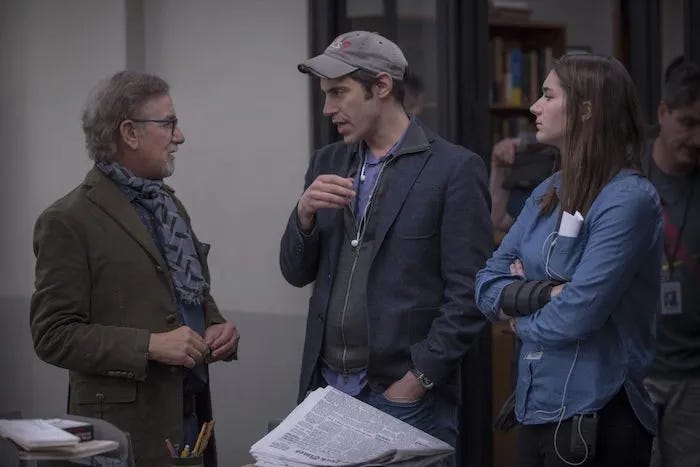
Scott: There’s a timeliness to it [The Post], too. The movie’s getting rave reviews. It’s already receiving various critics’ awards and nominations. In fact, I just saw a Tweet today from David Chen. I don’t know if you saw this, but he said, “Watching The Post was a disorienting experience. Can’t believe we ever lived in a time when newspapers struggled financially, the media was considered abdicating its civic responsibilities, and the president was openly, violently, antagonistic to the press.”
Liz: Oh, yeah. [laughs]
Scott: You sell this thing, I believe, in October and then November 7th comes around.
Liz: Yeah.
Scott: The current occupant of the White House wins the Electoral College vote and ascends to the presidency. There does seem to be a really remarkable sense of relevance to The Post and events unfolding today.
Liz: Yeah. I sold this literally, I think, nine days before the election. The conversation Amy and I had the day she bought it was very much about a reality we thought we were going to be living in that we do not live in and that the parallels that we thought existed at that time in 2016 to 1971 were very different parallels than what ended up happening.
The thing that I always thought was relevant and the thing that is always relevant to me regardless, is the story of a woman finding her voice and the story of a woman being in a room filled with men and not knowing how to speak, or when to speak, or if she should speak.
That’s not something that’s necessarily specific to, at the time, 2016. It’s something that we definitely talk about more now, luckily and happily. It’s definitely something I think that needs to be conversed about and questioned.
Did I ever think that the assaults on the fourth estate would be something that was a connection between 2017 and 1971? Absolutely not. The stunning thing that happened over the last 10 months was seeing more and more things that happened in 1971 start to happen in 2017 and the similarities between the people who were in the White House at the time.
Scott: Well, frankly a clarion call to the journalists. You were quoted in a Vanity Fair article saying, “It doesn’t matter that in 1971 reporters didn’t have a cell phone. You’re still dealing with betrayal, your own ethics, your own idea of what yourself is.” We could arguably need legitimate journalism now more than ever.
Liz: That’s really been fun to see, in an exciting way, the work that the Post and the Times have been doing this year. I saw something on Twitter that would take way too long for me to find it, but it was the Twitter of the Times and the Twitter of the Post were backing each other up against something that had…some sort of attack that they’d been under.
For me having worked on this film, obviously, but also has the Times and Post battling, to see that coming together was really exciting and fun. I think there is a call to arms right now. The Fourth Estate exists for a reason.
I’ve been quoting this line from Lin-Manuel Miranda because I don’t think there’s anything better that’s been said about it, but they genuinely get to be “in the room where it happens” that we are not allowed to be in.
They exist for a very, very distinct reason, which is to hold the mirror up and show us what is out there, show us what we are doing, show us how our government is behaving or not behaving. That is something that, in 1971, they had to do as well. The interesting thing about the Pentagon Papers is that Nixon isn’t in them.
They were completed before Nixon became President and, yet, he had such an issue with publishing them because he knew it was a crack in the facade of the White House. He knew it was a crack in the facade of the indelibility of that role and that, now, people would learn that the president lies.
That’s something we all now know. Not just from this past year, but from decades and decades that started with the Pentagon Papers. It was the first time that the American public realized, “Oh, my God. The President lied to me,” and that’s an important reality to confront.
Scott: Again, congratulations on your success with The Post. I can’t wait to see the movie.
Liz: Thank you.
Scott: I want to jump to some of the projects that you’ve got going on and one in particular. You’re teaming up again with Amy Pascal, I just read recently, on “Mercury 13”, the untold story of thirteen American women and their dream of space flight, as a miniseries.
Liz: Yeah, so that was a book that Bradley Whitford optioned years ago. I worked with him on The Post. He, and Tim, and Trevor White who are executive producers and Amy and I all read this book and all felt, “This is the type of story we want to tell.”
The women, they went through the same program that NASA had designed for the men. It had to be conducted via a private foundation because NASA wouldn’t sponsor it. They passed it all and they were still not allowed to go up into space. It’s, I think, the story of these very, very, very strong women who the only reason they weren’t allowed to do what they were best at is because they were women.
Also, obviously, I’m a humongous Bradley Whitford fan, and his passion to make this story come to light was something that was very inspiring to me. So, yeah, we all decided, “Let’s try this one more time. It worked well the first time, so we might as well do it again.”
Scott: This project will be a long movie, essentially.
Liz: We haven’t decided on the episode count yet, but were doing it with Amazon, which is wonderful and they’ve been amazing. We’re going to tell it very much like a long film. I think limited series, the renewal of them in the last five or six years is absolutely incredible. Not every story is two hours long, not every story is 10 hours long, and not every story is 200 hours long.
Sometimes there are ones that fit in one of those and not all. It’s very exciting, as a content creator, to be able to figure out, “What’s the best version of this story? Where does this story exist the most and where is the audience for this story?”
Scott: I’d like to jump into some craft questions if I could.
Liz: Yeah. Go for it.
Scott: How do you come up with story ideas? Is it mostly just through material that you read or do you ever actually generate things conceptually? How do you come up with story ideas?
Liz: I think reading is huge. I’ve been very fortunate to be given a lot of opportunity to write in the non-fiction world in the past year. In terms of generating story, that…Honestly, it’s not necessarily generating story that is where I get inspired. It’s in characters.
The thing about “Mercury 13”, and the thing about The Post, and I just finished a feature called “Only Plane In The Sky,” which were all three true stories, was they’re all about the characters and about their stories, and their journeys, and their arcs and how I found that relatable or, if not relatable, some way that I could empathize with those people.
I think that’s the challenge in all of this, putting yourself in positions that are maybe a little scary or telling stories that are maybe a little different and challenging yourself to do that. In those true stories it’s really for me about the characters and less about the scope of it.
In the fictional world, I’ve been lucky to work with some really great talent. It’s between sitting there with a couple of people…I don’t really like to sit there by myself and come up with ideas because it’s…I think, again, collaboration is where it works best. I like to sit down with potential collaborators, or friends, or whatever and just toss ideas around until one thing hits.
Scott: Let’s talk about story prep — brainstorming, character develop, plotting, research, outlining. Do you have a process or does it vary from project to project?
Liz: I have different processes for different types of things. If it’s a nonfiction, if it’s based on something real, then there’s a really heavy research process that goes in. I have an amazing research assistant who can find anything and locate articles, and interviews, and things like that that I never knew that existed.
There’s that and then there’s also talking to real people. With “Only Plane in The Sky”, which follows George W. Bush on 9/11, I was able to speak to a number of the people who were really on Air Force One that day and they’ve given me amazing access.
While I was writing, if I came upon a scene that was like, “I don’t really know what happened here,” I could email them and they would tell me exactly what was happening. The process of writing a nonfiction, for me, is very research based to begin with, and as much research as I can do. Any questions I have or things like that, I try and answer them.
Then I have to go away and not think about it for a couple months and sit all the research aside because it does have to be a movie and you do have to let all of the stories percolate and then die down so that you can see what the arc is. I don’t like to do treatments because I end up writing a lot of dialogue.
Treatments, for me, tend to be hard because I just end up wanting to write the dialog and not paragraphs of what somebody is going to say. I write just a very straightforward outline, including act breaks, and turns, and all of the save the cat and all that just so I have a sense of where I’m going and if there are any points of issue.
With “Only Plane”, which was based on an article that was an amazing resource to have, it had the procedural arc of what happened that day so, so cleanly laid out. Then, with Mercury 13, obviously there’s the book but, since we’re expanding it, it’s also about…The research on that is a very wide net of trying to get all of these different stories and finding out who we can talk to and stuff.
That is all with the perspective of whose point of view you’re telling the story from, and what character you want your audience to empathize with, and what character you want to…At AFI we were taught this a lot and I feel this way, is that if you water down your POV too much, then the audience really loses sight of giving a shit, for lack of a better phrase.
I think you can really get your audience in on a couple characters. Don’t get me wrong. The ensemble movies that can do it, I’m very jealous of, but, for me, there’s just a few…I can only juggle a couple POVs at one time. The whole process of before I sit down to write interior or whatever, exterior or whatever, has to be “Whose POV am I telling? What perspective is each scene?”
Then it’s really writing the absolute worst first draft that’s ever existed and just trying to get through it. Once that’s done, I’m immediately rewriting it from basically page one.

Scott: I’ve written some nonfiction-based stories as well and it strikes me that character development, it’s a different beast than if you’re generating characters from whole cloth because you’ve got a wealth of content. It’s like these are real people with full, complete lives. What to focus on, what things to omit. Is that a particular challenge for you when you’re dealing with nonfictional characters?
Liz: I think, if it is a challenge, then I shouldn’t be writing that script. For me, if it’s a challenge to find the perspective of the character, then that’s why it shouldn’t be a movie or it shouldn’t be whatever because, for me, the perspective of the character is the thing that I should be the most attracted to, because then that’s the reason I tell the story.
If you’re just telling…I think Sorkin said this actually. If you’re telling a story about a place, then that’s a TV show. If you’re telling a story about a character or a time, then maybe that’s a movie. If you’re telling a story about…
I told a story about, for instance, The Post. It is two people in 1971 that takes place over the course of about a week, that’s not a TV show. With Only Plane, it’s one day and it’s really three or four characters that you’re very, very much committed to and in their shoes.
I think, for me, if I have a problem getting into the character’s shoes, then I have made a very grave mistake of tackling that project. I actually think, with fictional characters, that is the problem for me because I do work in nonfiction so much.
I think it’s sometimes very nice to find people in history that you never knew about and find a shared experience that you’ve had. It is a way for an audience to be nonjudgmental about the character, because it’s a person who lived in history. They can take it as that.
Whereas, a fictional character, sometimes you know it was generated from somebody’s brain, and you know it wasn’t a real person. Sometimes you can poke holes in them that way. I sometimes find the generating from an original character standpoint much more challenging.
Scott: What about theme? How important is that to you in your writing to know it? Do you know it upfront? Do you learn it along the way? Are they multiple themes? How about your attitude and theory about that?
Liz: I think it’s multiple. For The Post, the theme was always, I think, very clear. One of the themes was very clear, which was about a woman finding her voice. That, for me, was always very clear.
Once Josh, and Steven, and Tom, and Meryl, and everybody joined on, the theme of the power of the Fourth Estate and the importance of the truth being exposed, that became very important and something that we focused a lot of time on.
With “Only Plane,” I knew going into it that I wanted to have a conversation about leadership and the role of leadership. That was something the article, I thought, did really well and was something I’m often interested in exploring, is our own expectations of leadership.
That theme was really clear for me from the beginning and something that I really very much focused on heavily while I was doing my draft. For other things, it’s sometimes a challenge because sometimes you fall in love with a character, but it’s like, “Well, where’s the movie? What is happening with that?”
Generally, for me, it has to come with something I’m interested in talking about, and that’s fairly consistent. I’m very interested in talking about the role of leadership. I’m very interested in talking about our national integrity. I’m very interested in talking about the role of women and the role of our expectations of women.
Those are things that I naturally gravitate to and they tend to pop up in things that I’m writing.
Scott: So, when you’re writing a scene, do you have some specific goals in mind?
Liz: When I’m doing the first draft, my specific goal is to get out of it as quickly as possible.
[laughter]
Liz: In the first draft, generally the scene is What are the two beats I have to hit in this scene to get out of it and get it on the page? My first drafts are usually pretty bad because there’s not a whole lot of scene work in them. It’s almost very procedural in terms of I need to hit A, B, and C, and get through there.
Then, when I do my rewrites…Which, again, are my personal rewrites. They’re not the studio rewrites. These are all the rewrites I do by myself before anybody ever gets to read a single page of it. Then it is very much about the scene work.
I think, every scene, you have to take from every single character and say, “What’s their goal?” and, “What are they doing?” Particularly, your main players in scene. Every scene should have a beginning, a middle, and an end and every scene should exist for a reason. If it doesn’t, if you’re bumping up against it being there, then it’s got to go.
If it’s taking me out of where I am, it’s got to go. I’m a big believer in messing with structure in terms of if I write a movie, and I look at it, and I’m like, “These three scenes need to be swapped,” I have no problem swapping them and figuring out a way to make that work with the story because, at the end of the day, it is also a movie and you want people to be entertained.
You want people to sit there for two hours and not regret it. If you are making people check their watch or check their email, then, obviously, you’ve made a misstep.
Scott: I’d like to get even more granular in terms of the craft. One thing I noticed in your scene description in The Post is you have these moments where you editorialize, commenting on the moment. Of course, there are these script literalists out there who call that “unfilmables” and you’re not supposed to do that. What’s your thinking on that?
Liz: I think it has to go back to character, and it has to go with dialogue and exposition. If I could write more on-the-nose dialogue better, then probably my scene descriptions would not be so editorialized.
I generally think, if I can write two lines in a scene description and then I don’t have to write seven lines of dialogue, I would much rather do that. If I can write in somebody giving someone a look, and that tells just as much as six lines of dialogue, then I have no problem writing the look in.
I think you have to be very judicious with it and not make it feel like you’re hammering somebody over the head or, also in the same time, not make them feel like they’re reading a book, because we are writing films, we are writing a visual medium, which I think, at the same time, is…I don’t necessarily agree with the unfilmables.
I think if you have the right director, you have the right cinematographer, you have the right cast, then I think everything is filmable. It’s just a matter of finding out who’s doing it and whose job it is. If it’s not filmable, then that’s a problem.
I learned a lot of this from Steven. We had a lot of stuff in the movie where we’re like, “Can we just do this with a look?” He was like, “Yeah, I think we can just do this with a look,” and so, instead of having a line of dialogue that felt like we’re really on the nose, obviously we had an amazing group of actors who can do that with a look, but we would rather do that, and visualizing things.
Steven is an extremely visual filmmaker, so there was a lot of visualizing moments, and scenes, and things like that that weren’t necessarily in the script that made the script a movie. That’s something that Josh and I both very much were working on is articulating it in that way.
Scott: You were on set for most of the shoot…
Liz: I think I was on set for six of the nine weeks.
Scott: That must have been quite an education.
Liz: It was amazing. It was a pretty insane experience to be standing a couple of feet behind Steven Spielberg while he’s making a movie, and to be able to ask him about making a movie and ask him why he’s doing things.
I think this thing that people don’t necessarily know about Steven or at least I didn’t know is that he is really a teacher. He’s very much an educator in a way that he’s had so much experience that he wants to share it. He is very open to sharing it.
For Josh and I, we were on either shoulder of his for the entirety of filming. For me, aside from a couple weeks. And we were really getting down to, as you said before, brass tacks and finding where the movie was. That was really amazing.
Scott: So you done the producer thing, then writer. Do you see ‘director’ in your future?
Liz: Hopefully, yeah. I definitely think that that’s something that I’m going to try to do, I hope I get the opportunity to do.
Scott: Final question. What advice would you offer aspiring screenwriters about learning the craft and breaking into Hollywood?
Liz: First, read everything you can. Read every script you can bad, good. Read Paddy Chayefsky’s collected works. That’s probably the best place to start, and then read everything else from there. Try and read bad scripts. Some of the best learning I’ve ever done is reading bad scripts. Try and sit there and analyze why it’s bad and why it doesn’t work.
It’s really easy to just say, “Oh, I don’t like this…” This was something that I’m really lucky to have learned in art school. When we were doing the critique in art school, you were never allowed to say like, “I don’t like it.” You have to say, “Why don’t you like it?”
When you’re reading things, contextualize why it’s not working for you, why you didn’t like it. It’s the same thing with going to see films. Try and articulate why it’s not for you, because that will help you find your voice. Then, once you figure out what you want to write, just keep writing. Constantly write.
Things will only get good once you’ve gone through the bad. Nothing just comes out perfect. You have to rewrite and rewrite and rethink often. The last thing is write about something you care about. Again, if you care, chances are somebody else does. I cared about Kay and I cared about her story, and I just wanted people to know it.
That was something that I think people related to. It doesn’t matter what genre. It doesn’t matter what character. Just write about what you care about and I think, generally, things turn out pretty well.
Since my interview with Liz in 2017, she has written movies (The Long Shot, All the Bright Places, Lee) and written and produced TV series (Mindhunter, The Dropout, The Girl from Plainville). According to IMDb.pro, Liz currently has 6 projects in development. And it all began with a spec script.
Takeaway: Write. Your. Spec.
For more Go Into The Story interviews with screenwriters and filmmakers, go here.