Go Into The Story Interview: Lisa Joy
My 2014 in-depth conversation with the creator and co-executive producer of the HBO series Westworld, the Amazon series Fallout, and…

My 2014 in-depth conversation with the creator and co-executive producer of the HBO series Westworld, the Amazon series Fallout, and writer-director of the movie Reminiscence.
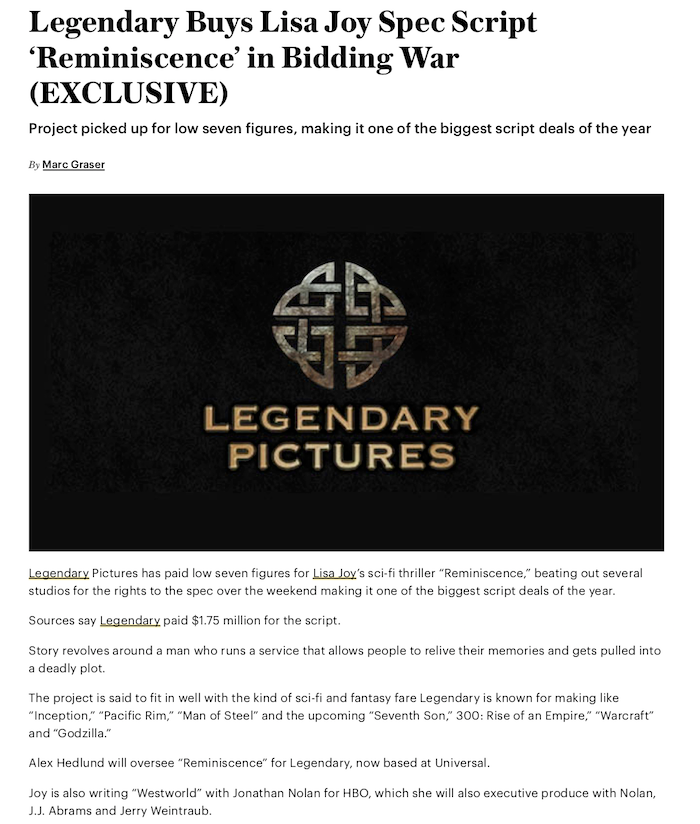
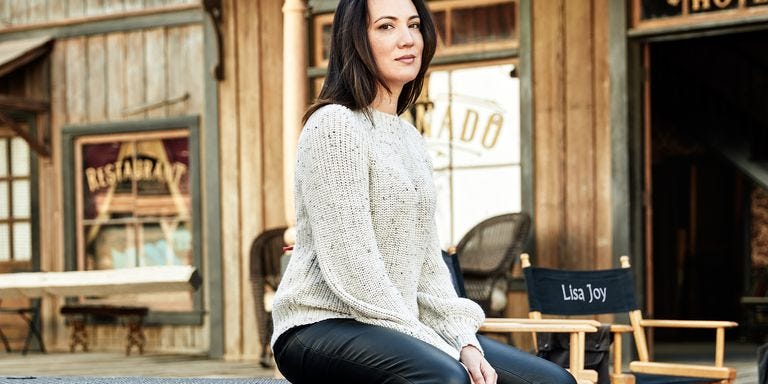
Lisa Joy got her start as a Hollywood writer working for the ABC television series “Pushing Daisies,” then as writer-producer on the USA series “Burn Notice.” She wrote the spec script “Reminiscence” which made the 2013 Black List and sold to Legendary Pictures for a reported $1.25M. In addition, she (along with her husband Jonathan Nolan) is creator and co-executive producer of the HBO series “Westworld”.
I first met Lisa when she took two of my online screenwriting classes. At the time, she had recently graduated from Stanford and was working in the legal affairs department at Universal (I think my memory is right about that). Eventually, she went to Harvard Law School, but we stayed in touch throughout her time there. Lisa wanted to be a writer. Movies. TV. She was passionate about learning the craft and it was clear to me she had the talent to make it. I kept telling her, “Just keep writing what you can, when you can.” She sent me feature scripts she’d written while taking a full load of classes in law school. Then one day… well, read the interview to find out how Lisa went from practicing law to creating stories.
Scott Myers: How important were movies and TV to you when you were growing up?
Lisa Joy: I feel like I have an unorthodox answer for this, for somebody who works in entertainment now. That book that came out about the Tiger Mom and everything [laughs], I guess I kind of had a tiger mom.
We weren’t really allowed to watch TV and movies in the house very much, at all. Then I hit those broke college years and didn’t have a TV, so I didn’t really have access to watching that sort of stuff there.
Until I graduated from college and invested in a TV of my own, I would say I did not have that much experience of so much TV at all, frankly.
It’s been interesting because people make fun of me sometimes as I’m learning some of the basics and classics at a relatively old age. But it’s great for me because it’s all fresh. Watching those films, I get that sense of wonderment that other people get in their childhood, but I experience now an over 30 year-old woman.
But the magic of a really great movie or a really great TV series is they never lose their luster, and they still have the ability to leave you awestruck with wonder and make you think — no matter how old you are when you watch them
Scott: You were at Stanford and you were eying law school. What was your major there?
Lisa: I was English and Chinese.
Scott: Was the English, was that literature or were there writing classes involved?
Lisa: I studied literature. I didn’t take a lot of creative writing because I was a bit shy and the classes seemed scary. You all sat in a circle and everybody seemed kind of ferociously intellectual. I was a little intimidated to share my stuff in that environment. I felt like I needed more anonymity.
I mostly stuck with analyzing literature. I focused a lot on the modernists. But literary theory is its own kind of curse because if you dissect literature too much, you start to become a critic more than a creator.
I didn’t want to pursue it too far into a PhD program or anything because I knew if I had that constant critic and that constant metafilter on all the time, it would make it even harder for me to write.
Scott: I remember we met right around the time you’d been out of Stanford and before you went to law school. Where was it that you said, “Writing is something I must explore”?
Lisa: Well, it was this crazy thing because before going back to law school, I spent a lot of time doing business. I was a consultant for a couple years, just traveling all over the place. Then after that, I worked in Universal Studios in their corporate strategy group.
It was that kind of thing where college is expensive and I didn’t have a lot of money, and I needed to get a job to pay back student loans and to figure out what I was doing with my life. Being a writer did not seem a viable career option because there’s so much risk involved and so much uncertainty.
I went into business and got health insurance, which made my parents happy, and a stable job and a 401(k). I got to see a lot of the world traveling for work. I got to learn about a lot of people and different industries. As Nora Ephron would say, it’s all copy.
But the whole time that I was doing this, I think if you love writing, it never quite leaves you. You’re always reading. You’re always writing. At the time, my focus was very much on poetry. I’ve loved poetry truly for as long I can remember, since I was a little kid actually. I wanted to pursue that even if it was just as an avocation. I figured I would write little poems in the evening and make Excel spreadsheets with financial models during the day, and that would be my life. I was content enough with that life.
Even though I lived in L.A., I didn’t really know anybody who was in the industry or anything. It never really occurred to me to try transitioning screenplays until my boyfriend at the time, now my husband, for Christmas he said, “You know, you work really, really hard at your job. Then you stay up late writing all the time. You never have enough time to do all the writing you want. Maybe there’s a way that you can combine your day job with your passion. But it’s probably not poetry. Because you probably won’t be able to pay back your loans from poetry alone.”
He scraped up his funds, he was a starving artist at the time, and bought me my first copy of Final Draft, and said, “Here’s the tools, now see if you can make something with it.”
After getting the software, I tinkered around with it a bit, and it seemed fun. I’d never read a screenplay or anything, I started reading a couple screenplays just to see what it looked like. It kind of struck me that there were some similarities between poetry, which I’d always loved and screenwriting. You don’t have that much space. You have to convey things very compactly.
You don’t want a script that’s 400 pages long, but you still want to create an evocative world. You only have a couple lines to do that, to set something up after you say like, “Interior hallway.”
What does that hallway look like? What does the man walking down it look like? You have a couple lines to say it, and to me it was the kind of challenge that I love in poetry, to find a word. It could be a very simple word. It doesn’t have to be a $10 word, but find it and try to make it count within the scene description. The same goes for dialogue.
So the format of scriptwriting itself was appealing to me, but I still had no idea what I was doing whatsoever, and I also had no community to talk about it with. I felt very embarrassed because in LA everybody will say, “They are an aspiring screenwriter.”
I was scared to say that myself. [laughs] It always sounded like once you’re an aspiring screenwriter, you’re never a screenwriter screenwriter. You told too many people, “I’m the aspiring screenwriter,” and it somehow let’s the air out of bag, and you’ve got nothing left.
I didn’t tell anyone because I was embarrassed. That’s why I took your UCLA class. I read about it, and it sounded like a good program, and it was an online thing. I could do online classes and still do my day job which had pretty long hours.
The anonymity of it, really, really appealed to me. You get a little scared about your thoughts. [laughs] It was my way to put my toe in the water and find a community without feeling too terrified. It makes me sound like a coward, but it was great. You were my teacher there, and up to this day I have never had somebody who’s spent so much time and thought reading and responding to what I wrote.
I don’t know how you did it with all those students, but you were pouring over things, going over them in detail, providing emotional support to all these fledgling writers. It’s not just about the business, but about how are the characters appearing, and story structure, and all those things.
To have that kind of legitimizing voice to bandy ideas around with, and to have people who were supportive was extremely nice and extremely comforting even if I didn’t think what I was writing was any good yet, it kind of gave me a little bit of hope to keep going… “They haven’t laughed me out of the online chat yet.”
You also provided some structure with the classes and that pressure was very helpful for me. Once a week, you can submit something, and you also hear feedback about it during the week. I was always so excited to check my email, and to see if anybody had thoughts or to read other people’s things. It was a nice little break in my day.
It was like this secret life that I had between making financial models and PowerPoint presentations. I’d kind of slip away, and my personal inbox would be this little oasis where people were talking about writing — giving and getting feedback. It was truly a delight. It kept me kind of happy and fulfilled in those years, before I dared submit anything to anyone in terms of a real writing job or anything. But during those years when I was basically just writing for myself and trying to learn, that’s the kind of thing that kept me going.
Scott: Do you remember that script that you were working on in that first class? It was this eccentric family, an offbeat comedy. Obviously you had talent, I could tell that right off the bat.
Lisa: Oh, thank you. It was a very quirky script. I think it was called “Spritzy and Blue.”
Scott: Yes, exactly.
Lisa: It was extremely quirky. I still feel like I never quite cracked it. I worked on it for about three years trying to crack it. It’s funny because I feel like it’s very similar to the first show I ever worked on, which was “Pushing Daisies.” I think there was some kind of sensibility there that translated, and that I was able to exercise when I was working on “Daisies.”
Scott: I never realized you had been so private about your writing back then. I guess that class was when you took your first step‑out of the little private sphere of writing, yes?
Lisa: That was it. I’m still private. My husband and I are both writers. We’re co‑writing “Westworld,” but I never showed him “Reminiscence” until I sent it out to my agent.
Scott: Seriously.
Lisa: I don’t know. [laughs] It’s terrifying for me, frankly. I thought about writing under a pseudonym, but then I figured no one really knows who I am anyway, it doesn’t matter.
Scott: So you dip your toe into writing, but then you go to Harvard Law School, right?
Lisa: Yeah. I’m basically the most risk averse person that has ever lived in the universe.
Scott: While you’re there, I get this email from you with this script you’d written. I’m thinking, “Lisa’s at Harvard Law School, yet she’s finding time to write this screenplay?”
Lisa: Right.
Scott: How in the world did you find the time to do that?
Lisa: It was the same thing as when I was working in Universal and working in consulting, I had to have a little thing to myself because it was just how I had fun. Other people jog or do yoga or hang out in their free time. I wrote. It didn’t feel like work. Although writer’s block is truly always horrible, no matter what.
As for the script itself, I co-wrote it with a friend, Suzanne Wrubel. It was lampooning some of the more ridiculous aspects of getting an education at Harvard. In some ways, it was a way of surviving law school. I think I wrote two scripts there. I also wrote a legal procedural TV pilot for a class I took with Scott Turow.
Scott: The Scott Turow?
Lisa: Yes. Now let me be clear. This was hilarious. I took a class with Scott Turow. It was a tutorial, which basically means that it’s one on one and you write a paper and they give you a grade.
I never once spoke to you or heard from Scott Turow. There are basically two emails documenting our relationship. The first was me asking him if I could write a script for him as a tutorial kind of thing.
He said, “Well, I suppose so.” Then I sent him the script. Then eventually, I got a grade for the class, but that was the entire tutorial. It was like three points of contact and all of them somewhat unilateral.
Scott: If I’m a hands-on teacher, he’s a hands-off teacher.
Lisa: Yes, he’s a hands-off teacher. I think he was like, “What is this person doing? She should be studying for torts or something much more important than this.” But he did humor me, and I believe I did get class credit for it.
Scott: We were having conversations during this time, too, because eventually, you get a job in a corporate law environment.
Lisa: Yeah.
Scott: Yet you’re writing these scripts. So you’ve got this fork-in-the-road here. How did you end up making the choice, “I’ve got to go for the writing?”
Lisa: To me, I really never thought that it was possible I would become a working writer. It’s truly, if you told me I was going to become an astronaut who colonized Mars, that would be about the equivalent feasibility for me.
Maybe it’s because I’m first generation American. Neither of my parents are from this country. It’s not the career path that a lot of immigrant families believe their child will have. The focus was on something more stable like medicine or law, or at least in my family it was. I don’t know. Other immigrant families may be different.
But in my family, it was like they struggled very hard to have their tiny piece of the American dream. All they wanted for me was to be secure. Literally, to have health insurance and a job that paid enough to get a house one day.
Anything else, like artistic ambitions just seemed very out there. That was somebody else’s game, you know? That was something that was out of the realm of how we were thinking and I was taught to think.
Even when I was writing screenplays, I always just figured it would be for myself. I actually had all these plans to record my own scripts and, I don’t know, play them at family gatherings or something.
As for my first break, I have one of these crazy stories where I owe a lot to my friends for having this happen, but by the time I finally felt ready to show a script to anyone in terms of asking for a job…What happened was the consulting company I used to work for had paid for me to attend Harvard. That was the only way in which I could have afforded to go.
In return for them sending me to Harvard, it’s like indentured servitude. I was supposed to come back and work two years for them so that my loan would be forgiven. That was my plan after graduating from law school.
But first I want to pass the bar and all that stuff. While I’m studying for the bar, I kind of freaked out and thought, “Well, this is the rest of my life. I can see it happening. It’s unfolding in front of me.” I passed the bar exam and then I go back to this consulting firm. I buy a lot of suits, and I go to work every day, and I travel quite a bit. If I’m lucky, I have time to write evenings and weekends.
And something about that vision of my future just terrified me because I didn’t think that it would necessarily fulfill me. So I started to write a spec script with the full force of all of my existential fear behind, compelling me forward to write. I’m studying for the bar during the day and then at night I’m writing a spec script.
I’m thinking, “I can’t be a coward on this. I have to send this one out. I’m going to send it to some friends I have who work in the entertainment business, and see if I can get any job whatsoever.”
I ended up writing a “Veronica Mars” episode and I showed it to my friend Michael Green, who’s a screenwriter. I said, “Do you think maybe I could get a job as an assistant on the show?” Or, something like that. He said, “Maybe. Let me read the script and see.”
He passed it along to Bryan Fuller. Literally, within a week… I had actually just started a project in San Francisco, consulting for a high tech company, and I was working with a client… I get this phone call and it is, basically, I’m hearing from, “Pushing Daisies,” and they’re saying, “You got the job.”
It was the only script I’d ever really written, and finished, and sent out and I got the job. It was completely insane. I remember thinking, “OK, that sounds great. I’m going to wrap up this study. It should take a few weeks and then I’ll quit my consulting company.” They said, “No, no, no, no. You start tomorrow.”
It was this surreal thing where I had to walk out of this board meeting and say, “I have to take a flight back to LA, and furthermore I have to quit this job.” It was at once the most irresponsible thing I’ve ever done, but it was the pursuit of a dream that was so dear to me that it truly was a no‑brainer to me.
It was crazy because I had to pay back all my student loans in one fell swoop which involved some begging and borrowing. But it was one of those things where I just knew that I loved writing, if I got the chance to do it, I just didn’t really question it.
It was such a rare chance to work on something I loved, to work with Bryan Fuller, who I was a huge fan of, and to get a taste of the dream. I knew that even if nothing came of it, I would never regret giving it a shot. I was willing to work as an assistant, so to get a job directly working on staff as a writer, was beyond anything I could have hoped for. I took a leap of faith.
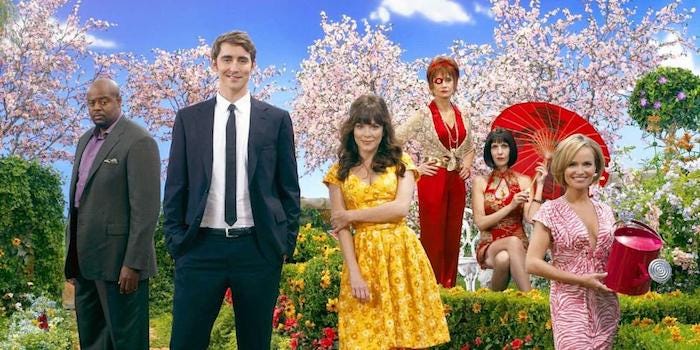
Scott: I want to talk to you about, “Pushing Daisies,” a bit. But I’m sitting here listening to this, Lisa, and it’s utterly astonishing. You had an interest in poetry. You had very little exposure to TV or movies because of your upbringing. You took a couple of classes with me, and I think that’s probably the extent of your formal education in screenwriting.
The rest of it is just your passion, your talent and you were obviously working hard because you were writing these things while doing everything else including law school. I don’t know how you can’t look at that and say, “That’s just destiny at work.”
Lisa: It certainly didn’t have to happen in any way. I think that having success in terms of being able to make a living as a writer, I would love to say that it’s all just talent, but I think it’s a lot of other things besides that. First and foremost, it’s extremely hard work and the ability to take rejection, and to take adversity and to just keep writing.
For me that was really easy because the thing that I always did when I felt rejected, or put down, or sad, or confused is — I always retreated to writing anyway. It was my safe place to go. So in some ways it fueled itself.
The odds of making it as a screenwriter always seem daunting… If you took every single person that said, “I want to be a writer,” in Hollywood, everybody who ever said that, then the percentage of people who actually make it in terms of actually being a working writer would be extraordinarily small.
But then, if you took the percentage of people who said, “I want to be a writer,” and wrote something, then the percentage gets a little higher of people who are successful. Then if you take the percentage of people who say, “I want to be a writer,” and wrote several things, and kept on refining them and kept on working at them, then the percentage gets higher yet.
By the time you get to, and this is the last step and the step that took me the longest, the time you find a person who said, “I want to be a writer,” and then writes several things and then actually submits those things to people, and bothers their friends and such, and sends them out to agents — then the odds don’t look so bad.
I was willing to work as an assistant. I was willing to proofread anything any friend ever gave me just because I love reading, and some of those friends happened to be screenwriters themselves, and some of them happened not to be screenwriters at the time, but they ended up becoming them anyway by the same kind of sheer willpower and passion.
I would say it wasn’t destined, but it is something that I love and it’s something that I try to work at, and I’m lucky that I’m able to do something I feel so passionately about.
When I first sold the script, my future script, “Reminiscence,” I remember that day just being incredibly grateful for all the people who had given me a chance at making it in such a difficult industry. I called them all up, or I wrote them all, including you, to thank them because it wouldn’t have been possible without them.
I remember I told Michael Green, who was the first person to pass along my resume to Bryan Fuller who gave me my first job and I told him, “Without you I never would have been a writer.”
He pointed out, “That’s not true. You were always going to be a writer. You couldn’t stop writing. No one was reading what you were writing, but you were always writing, and now you have something to show for it.”
But I did feel even before any of that happened, I did feel that for me writing was its own reward. It’s something I would have done for my own private joy regardless of the reception. I think I would have continued to do it that way. Is that destiny or is it just obsession?
Scott: You’ve worked on two TV series. “Pushing Daisies,” which was on ABC and “Burn Notice” on USA Network. I know it’s hard to generalize, but what were some of the key things you learned in terms of writing from working on TV series?
Lisa: Everything was new to me when I started. I worked with Bryan [Fuller] not only on “Pushing Daisies,” but in the end we also collaborated on a pilot for USA that alas, did not go, but I did have a lot of fun working with Bryan on it and we’re both very proud of it.
I’d say that the thing I learned from him the most is to be bold and to try to stick to your vision as much as possible because no one else is going to do it and you can have death by a thousand cuts with an idea. Bryan was always very steadfast. When he knew something was good, he wasn’t going to let it go.
There’s something to that, to having the courage of your convictions. That’s not to say you should be completely impossible with people. But I often think that if an idea is really good, when you share it with people, they tend to come around because fundamentally everybody wants whatever they’re working on to succeed. It’s a matter of not fighting people, but getting them to see where you’re coming from.
Bryan has a contagious vision, and I think that was extremely helpful. He’s also virulently allergic to cliché, and that is something that is extremely handy to keep in mind, to have your inner‑Bryan in your head saying, “That’s so fucking cliché,” and to try to eradicate cliché as much as possible. That was extremely helpful.
I would say that from “Burn Notice” the thing that was most helpful to me was I really got to learn what it was like to be on set and to produce episodes from the ground up. We were sent there for pre‑production, through production and post, and oversaw every aspect of the episodes we were covering.
That’s the kind of opportunity that not a lot of people, not a lot of writers especially, get in this town. It was a wonderful education on how to interact with a crew, on dealing with effects and stunts, and figuring out what’s going on with transpo.
I truly don’t think that you can learn production unless you just survive it, unless they just dump you in on the deep end, and you have no choice but to sink or swim.
I think the ways in which people swim in production are all very different and dependent on their personality. It’s all about finding your individual style for leading and collaborating — and by being thrust into it on that show, I really got to figure mine out.
Scott: You had two big writing projects go forward in 2013. Let’s talk about, “Westworld.” It’s described in the trades as, “One of the biggest TV commitments by HBO.” A TV series with some heavy‑hitter names attached to it — Warner Brothers TV, Jerry Weintraub, J.J. Abrams and Bad Robot.
As I understand it, it’s a pilot you co‑wrote with your husband [Jonathan Nolan], an adaptation of the movie written by Michael Crichton. How did that happen?
Lisa: I have long been a huge fan of J.J. Abrams. A couple years before, I’d met with J.J. and his team, Kathy [Lingg], Athena [Wickham] and Bryan [Burk] over a pilot that ultimately went to a different studio.
As I said, everybody has their own style. But for me, writing is such a joy and getting to work in this industry is so fun that when I find people who come at it from the same perspective, who just want to create something really fun, and are extremely collaborative and extremely talented, when I find those people, I tend to never let go.
Having narrowly missed out on an opportunity to work with Bad Robot, we wanted to find another opportunity, so we were keeping in mind projects. Meanwhile, Jonah was working with them on “Person of Interest” and he loved working with J.J.
Bad Robot got the rights [to “Westworld”] from Jerry Weintraub, who had been trying to sell it as a feature for a long time. J.J., I think rightly, figured out that this would be a hell of a series because you could take the characters and the themes of the movie and really explore them in a very deep, and new and subversive way.
Currently, TV is having this renaissance, I think where you are able to do so much, and to explore so much, and to go so dark, and to go so deep with characters and the world. He figured that it would be a natural fit with somebody like HBO, and someone like us.
He brought it up, and we clicked to the idea immediately. For me, the idea, as soon as somebody said the words, “Westworld,” and, “TV show,” I was like, “Oh, I get this. This is going to be fantastic.”
It also dovetailed with a feature that I’ve been trying to write for like seven years, and I’ve never quite done it the way I wanted to. I realized I could take so many of the ideas and things that I wanted to explore in that story and put it into an idea like “Westworld.”
I think Jonah felt the same way. We’re so interested right now in explorations of the soul and of human id and the ways in which emerging technologies are changing the world and our place within it.
To be able to explore what robots and artificial technology would look like in this world, and to explore the entire Western trope through this new lens was just so enticing, it was impossible to resist. Especially when you added in the possibility of working with J.J. and his team, and Jerry, and HBO, who are just so open to big, bold ideas. We just jumped for it.
Scott: That’s moving forward this year?
Lisa: We’re writing the pilot now, and it will shoot in June, and Jonah is going to direct.

Scott: Let’s jump to another sci‑fi project, another big project from last year, your script “Reminiscence” which you wrote on spec. Terrific script, Lisa. You made your teacher very proud.
Lisa: Oh, thank you.
Scott: Here’s a description of the plot: “An ‘archaeologist’ whose technology allows you to relive your past, abuses his own science to find the love of his life.”
This is set in the near‑future. It’s a fascinating science fiction, crime‑thriller script with a very strong emotional core to it. What was the inspiration for this idea?
Lisa: I think it was floating around in my mind. It’s hard to say where inspiration comes from. I remember I was in New York, and I just woke up one morning and I was like, “Oh, I think I have an idea.” It had been something that I was kicking around as an idea for a TV show for awhile.
But at the time, I’d actually found out that I was pregnant, and it was hard for me to staff and everything. The Writers Guild does not have maternity leave, and I was scared that I’d worked so hard to get into this career and what if it was all over.
Suddenly, when I’m thinking of this idea, I was like, “I have absolutely nothing to lose. I might as well write this exactly the way that I want to write it, with no thoughts about ‘sellability’ and no thoughts about appealing to certain people. I’m just going to write something that amuses myself, because there’s really nothing else for me to do for the next nine months.”
It’s a mix of some of the things I love. I love the movies To Have and Have Not, Blade Runner, Eternal Sunshine, and the novel “Slaughterhouse Five.” If you took all of those things, and some of my favorite poems, and put them in a blender, I think you’d see a lot of those influences and the kinds of themes and world that I wanted to explore.
Once I had the idea and I thought, “I’m not going to do this as a TV pilot,” which when you do something for TV, on network especially, there are certain places you don’t go, certain things you can’t do. You have to self-censor.
When I took away the idea it was going to be a TV pilot, I said, “Write a feature. Write it exactly as you want it.” Shortly after I let myself off the hook that way, the structure for it fell into place easily.
It’s a complicated structure, the piece, but it has a symmetry to it that was poetic in the way that it fell upon itself. As soon as I found those kind of buoys bobbing in the water I knew I had to hit and that made the whole piece float, I just swam for those buoys and wrote the thing. That became the script.
It’s funny because there are scripts I’ve worked on, this one that I’m now using for the idea for “Westworld,” I worked on it for over seven years I would say, and never got it to quite the place I wanted to.
For “Reminiscence,” most of the time I spent on it in pregnancy trimesters. It was the first trimester I thought of it. My second trimester I finished the script. I just wrote in this delirious burst, and edited it for a while. We took it out and within two days it had sold.
Scott: The central idea of “Reminiscence”, that there’s this technology which exists in the near‑future where people can experience a startlingly real re-experience of events in the past, was that the very first thing you had for the story?
Lisa: Yeah, that was the core of the idea, the high‑concept hook. It came from a place where I’ve always been fascinated by memory. I think some poet said this, maybe, Billy Collins, I’m not sure, but he said that his biggest sins are cynicism and sentimentalism.
I believe the same thing could probably be said for me in that I honestly sometimes wake up at night so full of nostalgia for random things and moments in my life. Nostalgia’s its own kind of drug. There’s something beautiful about thinking back on a moment, and yet so tantalizingly frustrating about it, too…
It’s like when you look back at memory, you’re seeing things only in peripheral vision. Everything’s a little bit hazy, and you remember how special that moment was, but you can’t quite grasp it again with the same solidity you once experienced it. I thought, “What if you could?” I remember back in high school reading about the brain, and psychology has always been something that’s fascinated me.
I remember somebody told me when people have their brains operated on, sometimes when you touch certain parts of it with an electrical charge, it triggers memories. I don’t know how real that is. But for me it was an evocative enough thought.
What if every moment you ever experienced is still there locked inside you? Not just the thought of that moment, not just the memory of it, but the actual sensation of being in that moment. What if your own brain could be a time machine and take you back to a moment and immerse you fully in it?
What would you do with that power? How would you use it? How would you abuse it? What would the world look like? How would the world change? Out of those questions grew the script.
Scott: What’s fascinating about it is we always look for high concepts, strong concepts, and this one for a science‑fiction story is a terrific one. But also, it has an innate emotional and psychological element to it.
The idea that people would choose to pay money to have these reminiscing experiences, some of them even preferring to live in the past, suggests they are fundamentally connected to regret, or grief, or lust, or nostalgia, whatever. So what starts off as a technological idea really is a very human one.
Lisa: Yeah. For me, I’m always so interested in the emotional core and the character work of anything I write. I’ve written in a lot of different genres, I would say. But the thing that is first and foremost to me is, “Do I love the character? Do I empathize with them?” I even think you have to love and empathize with the villains you write, especially them, in a way. Otherwise it just becomes caricature.
For me it would be hard to write something where there wasn’t an emotional core to it. Memory has so much of that built into it. It’s a very ubiquitous human trait — to wonder about the past… the people you left behind… the things that could have been.
In physics they talk about time as being just another dimension. We think of it as very linear because that’s how we experience it. But what if you didn’t have to experience it in a linear fashion?
If you could go back as an old man to relive holding your child for the first time, or your wedding night, or talking to your parents again. If you could just relive that moment in all its fullness, would it be any less real or any less valuable than say sitting at the kitchen table eating some Cheerios in the present day? That’s one of the things that I wanted to explore.
Scott: One of the interesting themes of the story is time. You have the protagonist, a man called Bannister, and that’s the way in which he’s an archaeologist, he’s skilled in guiding clients into their memories and digging back through these layers of time back into their past. In fact, at one point he says, “I’m just a keeper of lost moments.” How would you describe Bannister as a character? What are his core issues?
Lisa: Bannister is a character who is a kind man, but it’s hard to see that kindness because he’s so buttoned up. Because of his job, because he’s so good at what he does…there’s an art to being an archaeologist, you have to give people the right prompt to lead people back into their memories.
But because he’s so good at that, and he’s seen so many people and the reasons that they go back in time to experience things, it’s given him a cynicism. It’s kept him at arm’s length from the rest of the world.
When he sees young lovers walk down the street, he knows that probably in five years they’ll be in the tank one of them thinking about the other. It’s made him a little bit jaded because he knows how ephemeral joy can be, how ephemeral love can be, and because of that he keeps life at a distance.
You get the feeling there’s something broken in him, something a little disconnected with the rest of the world, and something achingly lonely. He’s looking for a memory that’s worth keeping.
Scott: That dovetails right into the Mae character who becomes the object of Bannister’s rather obsessive pursuit. How would you describe her character?
Lisa: I was heavily influenced by classic noirs for the script and Mae’s character is no exception. Many noirs create very strong nuanced roles for women; but some noirs still have a bit of that femme fatale / damsel or sinner / saint dichotomy.
I wanted to work within the noir style, but subvert it a bit and flesh out the nuances in the female character to portray a complex and modern portrait of a woman.
I wrote this movie from Bannister’s perspective, a male perspective. This is a unique opportunity to write as a man observing a woman, to literally study the kind of masculine gaze it’s from. Bannister is an archaeologist and “archaeology” I think is the right word for how we find Mae’s character. It’s a dig. You have to search for who she really is.
I remember thinking about that in Vertigo, Alfred Hitchcock had explored some of those themes. This is my meditation on that. You see her through Bannister’s eyes, and you see her as one thing. But what I wanted to do was to give her, her full depth as a character too. To peel back layer after layer and to go on this discovery with him, and as we learn more and more about Mae, we also learn more about Bannister — and the somewhat unreliable lens through which he views the world and Mae.
As a female screenwriter a lot of people say, “It’s harder for a female protagonist to open movies,” or “women can’t write men” or whatever. In my mind, that’s just all nonsense. You should ignore all that. What you should do is just write a character. Write a full, beautiful character that you fall in love with, man or woman. That’s how you get something true. Something that resonates.
Scott: In any science fiction story set in a different time or a different planet, there’s a certain amount of world‑building the writer needs to do. You’ve got that going on in “Reminiscence” with driverless cars, designer drugs, memory‑tank technology and whatnot.
But there’s a whole culture you develop around all of those technologies which is really interesting. Businesses like that Memorabilia Inc., a kind of chain store where people can go and get their memories fix. You’ve got these odd sort of New Orleans style funeral practices. Advertising in the sky, all this stuff. It feels very real and it’s quite entertaining. How did you go about creating that world?
Lisa: I had the luxury of time, in a way, where I sat down and I was writing the script spec, I was writing it to my own taste. Honestly, before I went into any theme, I would just close my eyes and sit there for quite awhile and think, “What is it like to move through this world?”
If it was boring me, I would say, “That’s not good enough.” I think the world that was created has bits of things that I love and find fascinating.
I’ve just taken little bits of culture that I witnessed when I traveled to Asia, or when I look at different parts of the United States, or when I’m in Europe, or anywhere, and I just take tons of things that seem strange to me at the time and just follow them through, strange but beautiful. That’s what I did.
I read this thing recently about how New York is built on the rubble of blasted European cities from World War II, and that if you were to dig down beneath say, FDR Drive, you’d find the landfill was composed of fragments of cathedrals, buildings and homes destroyed in the Blitz.
That’s how the archaeology of scripts sometimes works is that you have all these little pieces of the cities you’ve been to and the people you’ve seen. That part of creating the world of screenplays is to piece them back together, these broken Lego bits and create something all your own.
Scott: From a nuts and bolts perspective, much of the story is about creating a thread of clues Bannister has got to follow which in effect constructs the plot. I’m wondering how much of that came intuitively and how much do you think derived from your time working on TV with a series like “Burn Notice,” going from clue to clue, commercial break to commercial break.
Lisa: The most important one of the things about TV is it goes at such a pace that sometimes it can become predictable in some ways because you even know when the ad break is coming and what’s going to happen. You can just feel those rhythms. A part of it is it become intuitive.
But you also want to subvert that a little bit and make sure you throw in some surprises in TV and in film, keep things experimental a little bit and moving forward. I would say that from TV I learned the rigors of keep the story moving. Make sure something new is happening. Make sure you’re discovering new things at each turn. But not exactly in the same six act structure that TV would have necessarily.
To me, I wanted it to be more organic so there would be room for surprises that would surprise me. That I’d, if I stumbled across something and it seemed like a little bit of a digression, in TV I would normally cut that out, because frankly, you just don’t have time for network TV specifically. You have 52 pages.
Unless it’s really important, you just don’t have time for it on network TV. In the feature, you have a little more time to explore things and take small digressions, which you might not immediately understand the importance of those digressions, but later on I think they add to the fullness of the universe and help take a script to new level.
I tend to think that part of structure is learned. After writing and reading a lot of scripts, you start to get a feeling for: “Oh, God, the hero needs to be driving something forward at this point. He’s meandering around too much.” I guess its craft, and you just keep practicing until it becomes intuitive.
But I also think that part of it is like music. Not everybody’s a musician, but when you first hear a song, there’s a kind of “a priori” sense for the rhythm and flow of it. How things crescendo into a peak. Decrescendo into conclusion. When the chorus will come back and give you something to hang onto. When it’s going to really get going and have you swaying or clapping along.
Screenplays and music have that in common. Sometimes I don’t know why it doesn’t work, but I just know it doesn’t sound right. It’s not singing right, if that makes sense.
Scott: You mentioned the word “complicated” earlier in terms of your structure. You’ve got these reminiscing events and you have flashbacks, yet they’re distinct. I think in the script you say they have a distinctly different look.
Lisa: Right.
Scott: There are several of them. How challenging was that for you? How many to use? When to use them? How to use them? Did you do a lot of rewriting on that or did that lay out pretty easily for you?
Lisa: I did a lot of thinking on it beforehand, it wasn’t as much rewriting as it was a long and heavy meditation period beforehand.
I wanted to talk about memory’s fallibility and subjectivity. The thing about the archaeologist’s reminiscence machine is that when you go back in those memories, they are accurate. You are just pushing a button in your brain, and the exact replica of that memory is coming up. You don’t get the kind of subjective bias that you do in an organic memory.
Organic memories are fuzzy. They’re hazy, and you can get confused about did that really happen or was that something somebody told me? Did I embellish it over the years? Did I turn it to suit my purposes? Did I tell this memory as a funny anecdote so many times that the little embellishments I’ve added have now become fused in my mind to the actual memory? You do lie to yourself about your own past, and I think you do invariably lie to yourself about your own past. They can be white lies, or they can be more malicious lies. But the way in which we think about the past is not honest.
It cannot be honest because our brain just does not conjure it back up with that level of detail, we fill in the blanks. We fill them out to suit our purposes.
I wanted to be able to juxtapose from the way Bannister remembered things for himself, or the way things actually went to illustrate that point and understand the Bannister character in terms of the lies that he told himself about the past.
Scott: One final question about the script. The conventional last two words of a script: The End. Not in “Reminiscence.” In your script, you end with the words: “The Middle.”
Lisa: Right. The thing that influenced me structurally in writing “Reminiscence” was a format of a Rondel poem. In that poem, the first two lines of the first stanza are refrains, and they repeat at the last two lines of the second stanza and the third stanza. Basically, you have a poem progression where certain lines are echoed and tweaked in their repetition.
In a way, the structural underpinnings for “Reminiscence” are borrowed from that sort of poem. Because for me that kind of poem works like a memory, where certain memories tug you back again and again. I wanted to mimic that in the structure of the screenplay.
The last two lines, the words, of the screenplay wanted to point out that that was the structure that was happening, and to point out that an ending is not always an ending.
Scott: So you sell this thing to Legendary Pictures for a boatload of money. Then the script makes the Black List. Where are you with all the amazing buzz around this project?
Lisa: I don’t know. I’m so grateful for the interest that people took in it. Honestly, for me the most thrilling part of it was some of the directors and some of the producers who responded to it, and wanted to work on it were fantastic, and the fact that there were those options out there.
These were my idols, and to be able to just have them read something that I wrote, frankly, was so gratifying to me that it was probably the most meaningful part of the process. Not even the sale itself, but just hearing from people I admire, that they liked it and responded to it was truly, for me, fantastic.
The collaboration with Legendary is so fun. They’re a company that invests in big, bold worlds. They have this huge appetite to tell stories, and tell them provocatively. They’re not afraid to take chances and take on big things. To be in collaboration with somebody who’s as keen and driven to create a world that people believe, and love playing in it has been really gratifying.
It’s been really great because you have this baby, and it’s a script, and you just want to make sure you raise it with the right people. To have such great collaborators has been so gratifying, on so very many levels.
In terms of the actual feeling of selling a script — it was pretty unreal. But nothing really has changed in my life, [laughs] I have to say. Except I have some really great meetings with people, and there are more opportunities to work on really cool projects.
But I have this philosophy where, it’s going to sound pretentious…I’m even hesitant to bring up another poem. There’s a line in it, “When you meet with triumph and disaster, and treat those two impostors just the same.”
Scott: Rudyard Kipling?
Lisa: Yeah, Kipling’s “If”. My grandmother used to love that poem and had it hung on her kitchen wall. It was a lesson to his son on how to be a “man”. But man or woman, the same lessons apply.
“When you meet with triumph and disaster, and treat these two impostors just the same”, you really have to have that mentality when you’re a screenwriter. Disaster comes, triumph comes, and they never last, either of them. The most you can hope for is that you love what you’re doing, when you’re doing it. I celebrated selling “Reminiscence” by getting back to work.
Scott: You called your script your baby. Of course, you actually have a baby now. That’s the trifecta of good news — setting up an HBO series, selling a spec script, and having a baby. How’s it balancing, being a mom and a writer?
Lisa: It’s been really great. This is something I’ve thought about a lot because I was actually very worried. There are fewer female writers in Hollywood, and we’re still trying to find a place on an equal standing in this industry. You get scared.
You get scared that if I take my foot off the pedal for even a minute by having this baby, will I be sacrificing the stuff that I’ve worked so hard to achieve? I was really scared of that thought.
In fact, people will tell you that that is going to happen. I heard a lot of, “It’s impossible. You’re going to have to choose. You can’t do both. You can’t be a good mom, and also be a full‑time writer.”
It was about the same time that this debate about “Can a woman have it all?” was reaching a fever pitch. I was feeling somewhat hysterical about it all and then one day I just thought — ENOUGH. “This is fucking bullocks. This is nonsense.” The question should not be, “Can a woman have it all?” That is a ridiculous question, because it is doomed to failure. No one can have it all. You can’t eat all the cake and also have the figure of a super‑model. You just can’t do it. It’s impossible.
The fact that “can you have it all” was the question posed to women specifically — was complete bullshit. It makes everything a binary all or nothing choice. And if “all” is impossible — then we must settle for “nothing.” The paradigm itself is messed up.
What I realized after I was done freaking out was that I don’t want it all. Here’s what I do want. I want a family that I love, and that I’m an active part of. I want to be the best writer that I can be. My job and my family. Those are two things. They’re not “it all.” It is a perfectly reasonable ambition and I shouldn’t spend time feeling ridiculous or doomed for wanting it — I should instead invest my energies in attaining it.
I had to overcome a lot of fear, and a lot of conventional wisdom about that stuff. For me, it’s important to talk about because first of all, I do also recognize that I’m in a privileged position, where my husband also works, I’d saved up money, and I could take time to do this.
If, like me, you find yourself in a very fortunate position like that, I felt it was my obligation to not be afraid, and to chase down the dreams that I had, both personal and professional. To not let the status quo and conventional wisdom about what the limitations would be on someone in my position hamper me too much.
The end goal for me is, I believe — I have an obligation, when you make some headway in an industry like this, to help affect change. There are many writers rooms with no women or only one woman on the team. I don’t think that’s right. I don’t think it’s a reflection of talent in the marketplace. I feel like there’s an obligation for me to do better on my own shows.
There are other people doing that. I just talked to Marti Noxon, who’s a friend of mine who just had two shows greenlit. She was saying, “Why don’t you come on my show?” She said, “If you have time, you can bring the kid. We’ll have a room set up, and you can get a nanny to help you out.” Timing wise, my TV focus is Westworld right now so I can’t work with her this go-round although it would be wonderful. She’s an amazing writer and doing such a great service to future voices by unlocking the potential of so many writers, who would otherwise not get their full chance of expression.
I was so scared of how having a child would influence my career. It’s true, there are some sleepless night. I’m tired sometimes, but I used to be an insomniac anyway. Now instead of waking up and staring into the darkness full of spiraling thoughts, I get to cuddle my sweet baby. [laughs] It’s just a pleasure. Having a child is just another experience in life, another wonderful experience in life. It unlocks so many feelings and so many thoughts that I’m sure that will at some point filter in however, indirectly into my work.

Scott: It’s insane, isn’t it, the numbers? If you look at it all across the board in Hollywood, the paucity of female directors, female writers getting hired, it’s just crazy.
Lisa: It is crazy. Part of the reason why, when I find somebody I love to work with, I never let them go. When you are fighting for equal ground, when you are not of a group that is equally represented, the people who believe in you are the people who keep you going when stuff gets tough.
My friendships with writers like Marti Noxon, Laeta Kalogridis, Bryan Fuller, Michael Green and my husband and so many others… they all inspire me and keep me writing even when I want to give up. Friendships and those allies mean so much to me. It also enriches the work and gives you an obligation to be that kind of friend to other people. It’s something that I try to do, and will continue to try to do.
Scott: How about some craft questions.
Lisa: Sure.
Scott: How do you come up with story ideas?
Lisa: Wiling oneself to come up with a story idea, for me, is like trying to will oneself to fall asleep when suffering from insomnia. The very exertion itself seems to chase away the thing you’re seeking. I do find, however, that travel; reading good books… poetry and prose, fiction and non-fiction… scrounging about on the internet for odd bits of knowledge; and people watching all tend to trickle into story ideas eventually.
Scott: How important do you think the story concept is to the overall strength and commercial viability of a screenplay, specifically a spec script?
Lisa: I think it’s important to have a story concept that you as the writer are interested and tickled by and that gives you a fun playground to romp in intellectually and emotionally. Aside from that, I try not to think too much about commercial viability because there is really no formula. And if you chase formula too closely — the writing can become formulaic. And no one wants that!
Scott: How much time do you spend in prep-writing and which of the aspects of prep do you tend to devote the most time and focus to?
Lisa: This all depends on a project to project basis. When writing genre, I think it’s important to really think about the rules of the universe and make sure you stay true to them. For character, it sometimes takes me a bit of writing a character before I find their voice.
Scott: How do you go about developing your characters? Any specific tips or tools you find yourself using regularly?
Lisa: Creating a character is almost like getting to know a person. You start with the generic pleasantries, the how-are-yous and observations about the weather. But then you spend a bit more time; you dig a bit deeper; and you get to really know that person — their history, their dreams, their secrets, their fears, their tiny tics and idiosyncrasies… that’s when a character comes alive. After creating a character I also like to step back and ask myself — is this a complete person, do they have surprises and depths within them, have I “stereotyped” them — assigned them normalizing attributes based on their gender/race/socio-economic status/sexual orientation. Stereotypes in life are clichés on the page. Bad in both places. I try to avoid them.
Scott: What about dialogue? How do you go about finding your characters’ voices? How can a writer develop their ability writing dialogue?
Lisa: I think once you really understand a character and what makes them unique — you start to hear their voice in your head. If they don’t have a distinctive voice, it’s probably because you don’t have your character and his or her motivations fully fleshed out yet.
Scott: How would you define theme? How important is it? Do you start with themes or do they arise in the context of developing and writing the story?
Lisa: For me, theme is the soul of a script. It’s the sense or feeling stitched in fine thread throughout the pages. It’s the part of a script that a reader can take away and relate to or apply to their own lives long after they’ve forgotten the snippets of dialogue or plot points of the script itself. I don’t necessarily start with theme, but by the time I’m done — I always have one. And often, writing a script shows me what my theme is and allows me to deepen my own thinking on that theme. Writing becomes, in its own way, a philosophical investigation into theme. Sometimes I go back, once I understand the theme more fully and use it in the rewrite to enrich the scenes.
Scott: What do you think about when writing a scene? What are your goals?
Lisa: For me, it’s just like playing pretend when I was a kid. I go into a scene hoping to lose myself in the thing I’m writing. To be transported into that universe. On the rare occasion I manage to do that, there’s almost always something salvageable.
Scott: What keys do you have to write entertaining scene description?
Lisa: Use words sparingly. Try to make it pop — so that the scene description isn’t the boring, skimmable part of the script. But an enjoyable, humorous, insightful read in its own right. Easier said than done, I know.
Scott: When you finish a first draft, you are faced with the inevitable rewriting process. Are there some keys you have to rewriting your scripts and if so what are they?
Lisa: Coffee. Lots of coffee. And the knowledge that the second draft is the fun part. You’ve done the heavy lifting. Now you’re just burnishing stuff to make it shine.
Scott: What is your actual writing process?
Lisa: If I’m away from writing for too long I start to get depressed so I try to write every day. I tend to hyper-focus when I write or read or watch film or TV to the point where sometimes my husband will say something to me and I literally won’t hear him because I’m too immersed in the work. I think it’s something I learned to do because so much of the writing I did earlier in life occurred in the stolen moments between meetings or classes or day jobs. I had to learn to not be precious about where I was or what time it was, and to just get down to it. One exception to that is I have a hard time writing with music playing or the TV on. Other writers love writing with music. But it just takes me out of it.
Scott: What is your single best excuse not to write?
Lisa: As a producer on most of the projects I write on, one of the biggest distractions from writing is handling all the phone calls, logistics, and meetings that go along with trying to get your script shot and aired. But being involved in production is its own reward — as I get to see my words transformed into something far greater than what I had on the page. And I get to work with terrific collaborators and partners who bring their own expertise to the table. It’s humbling and thrilling but it keeps me very busy so sometimes I have to carve out time to unplug my phone and hold my meetings so I can focus on the writing itself. Also, cuddling my baby is a pretty great excuse not to write.
Scott: What do you love most about writing?
Lisa: I first fell in love with reading because I was a shy awkward kid, and as silly as it sounds, reading book, poems, letters etc. showed me that there were other people out there who thought about the same things I did and felt the same way I felt. Reading made me feel like someone out there understood me. And writing does the same thing. It’s a message in a bottle — a way of communicating with people you may never meet, living in places you may never visit, perhaps even in times you’ll never live to see — but sharing nonetheless, some tiny connection.
Scott: One last question: What advice would you offer to screenwriters about learning the craft and breaking into Hollywood?
Lisa: I guess for me I’m a risk‑averse person. But it’s harder to write if you can’t eat. Or if you can’t afford a roof over your head. So if being a writer means taking a day job, don’t be scared because I’ve done some pretty intense day jobs — if you love writing, you always find a way to carve out time.
Also, I’d also say you’re so lucky if you want to write, because all you need is paper and a pen. If you’re lucky, you can get some screenwriting software, which is about 100 bucks. That makes it a lot easier.
We have very little overhead, and you can write whenever. You can think about the ideas you’re going to write as you sit through board meetings, feed your child, shower, rotate your tires. That is incredibly liberating, the fact that you can just think about it. I would be in board meetings talking about theme park expansion, and in the back of my mind I’d be thinking about the love scene between a quirky agoraphobic neurotic and his nurse.
I’d say the other thing is, for aspiring screenwriters especially, you’re so lucky. You’re so lucky because no one expects anything from you. There are no expectations. There are no obligations.
You get to write about whatever you want. You get no notes. You get nothing. You get to write whatever you’re truly passionate about. You are not on the procedural that you have to take at some point to pay the bills. You are just unfettered you.
You are finding your voice, a voice that will hopefully take you through many years of being a writer. To really, really engage and love that process, really work at it, enjoy it, try to do something fresh. Watch movies and read scripts if you want to, or read anything. Read poems. Travel.
All of this stuff is all going into the great process of writing, the incubation process of it. Then at the end of the day just sit down in front of that blank page. It’s terrifying, the tyranny of the blank page and all the expectations you put upon yourself. But then you turn off the naysaying voices in your head. And you write. Just write.
Lisa is repped by UTA.
Twitter: @lisajoynolan
For more Go Into The Story interviews with screenwriters, filmmakers, TV producers, and industry insiders, go here.