Go Into The Story Interview: Leigh Cesiro and Erica Matlin
My interview with 2021 Black List writers for their script Cruel Summer.
My interview with 2021 Black List writers for their script Cruel Summer.

Leigh Cesiro and Erica Matlin wrote the original screenplay “Cruel Summer” which landed on the 2021 Black List. In 2022, I had the opportunity to chat with Erica and Leigh about their creative background, their script, the craft of screenwriting, and what making the annual Black List has meant to them.
Scott Myers: Congratulations on making the 2021 Black List. Let’s dig into each of your creative background. Let’s just start with Leigh because you’ve been a bold and intrepid adventurer, evidently the first person to move from New York City to LA…
[Laughter]
So I think we need to start there. Where did this adventuresome spirit emerge in your life, and how did you become interested in writing?
Leigh Cesiro: I really am a trailblazer in that way. [laughs] I started out in advertising, as a writer. That’s kind of soulless writing but then through that, met a lot of people that did UCB, Upright Citizens Brigade in New York, and started taking improv classes and performing.
Then I was on a bunch of sketch teams. It became less of a hobby and more of a passion and something I really wanted to do. And from there wasIwriting pilots and sketches. That’s my background.
Scott: You write for Vulture?
Leigh: Yeah. They do a weekly podcast round-up. Way before podcasts really became what they are now, I was obsessively listening to them. Splitsider was a comedy website that was really one of the only places writing about comedy podcasts.
Then, Splitsider became part of Vulture. Then, I’ve gotten to write about some other cool things through that .
Scott: Erica, how did you all meet?
Erica Matlin: Leigh and I met at sleepaway camp, where Leigh was my counselor, and then years later we became friends. So when Leigh was doing UCB and discovering sketch and improv in NYC , I was in college at Wisconsin in Madison. Part of my education, to Leigh’s credit, has been following whatever she does [laughs] not to embarrass us both completely.
I started writing in college and it was at that time where I learned there is a real actual Hollywood that you could actually work in. After school I worked in production, had a very brief stint at WME and have been working with Anthony Bregman and Stefanie Azpiazu at Likely Story as a producer and development exec while also doing improv at UCB, writing for music blogs. I guess I found my way into screenwriting by working in the business and, of course, following Leigh.
Scott: You studied acting, as well.
Erica: Yeah! at HB Studio and Terry Knickerbocker Studio.
Scott: How did you both grasp the basics of screenwriting?
Leigh: I had taken a pilot writing class and then from there, just learning how to break it down. It really was just reading every script, not just good ones, but reading bad ones really helped. Every pilot that ever came out, I read the script for, whether I thought the show was good or not, because it had gotten made so someone must have thought it was good.
I took a few workshops and stuff, but nothing formal. It really was just reading them and listening to podcasts about writing, reading a script and breaking it down,, watching the movie, and figuring out how things came together.
Scott: Erica, how about you?
Erica: I took a seminar in college on screenwriting and by the nature of my job, read scripts daily and surrounded by producers and filmmakers constantly breaking down story. Also I have to mention, I have a folder in my Gmail that’s called “Go into the Story.”
Scott: Seriously?
Erica: I’ve been receiving your emails and screenshotting different tweets of yours or articles from the blog since 2014 or 2015. There were various points where I considered film school. I worked on a movie with Nicole Holofcener who said, “If you have someone to pay for film school, go. If you don’t, figure it out on your own.” So I’ve been trying to figure it out on my own.
Scott: Well, apparently it took, with your script “Cruel Summer” making the Black List. It’s such an enjoyable read. Here’s a plot summary:
“During the summer of 1998, five camp counselors accidentally kill a stranger in the woods.”
You’ve already tipped this off that you both were counselors at a summer camp. So the script is based on some life experiences that you all had, although I’m hoping not the “kill a stranger in the woods” part. What’s the name of the camp you went to?
Erica: Westmont. Shout out.
Scott: Westmont, where is it?
Erica: Poyntelle, Pennsylvania.
Scott: There been a lot of summer camp movies, Wet Hot American Summer, Heavyweights, Meatballs. What made you think, “Hey, this would make a good fodder for something to do right now. Time for another summer camp movie?”
Leigh: Wet Hot American Summer is the gold standard of a camp movie, but that is its own thing. It’s untouchable. You can’t make anything like it. To say that we wrote a movie about camp, that’s always the reference that comes up. It’s like, “Oh, is it Wet Hot American Summer?” Which is yes, only in that it’s about camp.
But there’s no movie that we can point to that’s our experience because yes, there are movies about camp, but our specific kind of camp and that world seemed fresh.
Erica: I didn’t cross our minds to write a camp story until we visited camp together. Once we there we were like, “Oh, of course. Why are we not writing about this place where we met and is something that comes up in our lives an embarrassing number of times?” [laughs]
That whole “write what you know” thing We were like, “This is what we know. Let’s set a friendship story in camp.” From there it just took off.
Scott: As I was reading it, of course, I was just enjoying it as a writer. I have a lot of writing questions for you. I also put on my producer’s hat. As you know, they operate out in Hollywood with this working ethos of “similar, but different.”
As I was reading your script, I was going, “OK, so you got summer camp.” Meatballs, that’s my point of reference because I’m old. Then you got young people finding a dead body, so now I’m thinking, “Oh, that’s Stand by Me.” They had to schlep this body around and now I’m going back to another ’80s movie, Weekend at Bernie’s.
I’m thinking, producer’s hat on, “We’re awash right now in nostalgia.” It’s a big deal in Hollywood and this is a great time for this kind of project. I thought, “Somebody should step up and make this movie.” Does that seem like a good plan to you all?
Leigh: Yeah, you totally cracked our code with those are [laughs] good reference points.
Erica: Yes.
Scott: Were you thinking, “This is a cool story” or were you thinking, “I could see where producers, or a production company, or somebody would step up and make this thing?”
Erica: I wish we thought that way, but no. We were excited to write something set in camp. We definitely had Stand By Me, Now & Then and Weekend at Bernie’s in the back of our minds while writing it. Maybe we’ll take you on pitches with us, Scott.
[laughter]
Scott: I’ll be there to close the deal by saying, “Buy it.”
[laughter]
Erica: This is going to sound cheesy but since we both get can get caught up in what’s out there and what’s popular, we really tried to have the mindset of “what makes us laugh and what makes us happy”.
And with that in mind, we had read a few other scripts where, instead of looking at them as successful projects, we were like “Oh! It feels like these writers were making each other laugh or had fun while writing and making this movie” So that’s definitely something we started to strive for.
Scott: What about tropes? Were you thinking about that at all because there is that lineage of summer camp movies, like “the underdog camp versus the overlord camp?”
Leigh: Yeah, in looking at the camp tropes, a lot of them do stem from real things and real people that we knew. Even in our camp, we would play sports against other camps and you’d get a taste of a very fancy camp or a more rough-and-tumble camp.
Definitely, we were aware of the tropes in the movies, but more so they’re tropes for a reason. They came from somewhere and we had firsthand experience with them.

Scott: I have to ask you, of course, there’s a ghost story. That’s pretty typical of camps. Dead Fred Wormer, now is that a subtle homage to Animal House because isn’t it Dean Wormer was the dean of the school?
Leigh: No.
Scott: No? Oh, come on.
Leigh: [laughs]
Scott: When this debuts at Sundance and somebody’s going to ask you, the French critic, they’ll say, “The Dean Wormer, this is an homage?” You go, “Yes, absolutely, that’s exactly what we were thinking.”
Leigh: [laughs] It’s a coincidence.
Erica: No, but that’s a great coincidence. One of the owners of our camp was named Fred. The camp in the script is named Camp Brower because the last name of the boy who dies in Stand by Me is Brower.
Scott: There you go.
Erica: There’s some of that. [laughs]
Scott: It’s subtle, getting the nuance in there. I assume that amidst your experience together at summer camps, that didn’t necessarily involve finding a dead body?
Leigh: No.
Erica: No.
Scott: How did that emerge because that’s a central element of the story? You got the summer camp, then boom, dead body, and that becomes the plotline. Where did that come from?
Leigh: I don’t even remember exactly how we came up with the dead body, but it mostly came out of the idea that when you’re at camp, you’re so isolated from the rest of the world, so things that happen in camp are not how they would happen in the real world.
Once we did land on, “OK, so what if they find a dead body?” we would ask our camp friends, “Hey, for no reason, what would you do if you found a dead body at camp?” They’d give their answer and a lot of times they would give us an answer and we’d be like, “Oh, we didn’t even think of that,” and it would go into the script. We had a resource at our fingertips I don’t know how we first came up with, that they have to hide a dead body. Do you?
Erica: I don’t, but I do remember talking about what would happen if we did find a dead body at camp. It became funny to us like, “What if you threw a bit of real world stakes into this camp world?” Not that we’ve seen dead bodies in our real world. Us personally, but well, you know what I mean.. [laughs]
Scott: I’ll throw out an adjective here with reference to that, that you may not think of associating with this type of material. It’s rather “elegant” to see because it’s a very simple but effective way of establishing stakes. It gives you this clothesline that you can just keep dropping these things in, these moments, and these bits of business. It works quite well.
Let’s talk about these five counselors, who discovered this body, learn a little bit more about them. I’m curious how you came up with this “family” of characters, and maybe it is just people that you knew or based on them. They’re led by Sam, who you describe is 19, funny, and self-assured. How did Sam come into this crew of counselors?
Leigh: I think it’s really just that we needed the leader, the responsible one. In every friend group, there is the responsible one.
Erica: We needed the straight man to bounce off of, and then make everyone else slightly more heightened.
Scott: That’s Sam. Then there’s Jayne. 19, effortlessly cool with a mischievous streak. How would you describe her, and how did she come into being?
Erica: Jayne is probably the one mostly, loosely based off people from camp. I think we were intrigued, again, going back to this idea of bringing the real world into camp world. How would someone like Jayne, who is nonchalant and at this crossroad of wanting to stay a kid and wanting to be an adult, how would she handle something like this? What kind of friend would that make her in this situation?
Scott: They do have a friend. I mean, you mentioned that earlier that this is a story, in terms of the small story, the emotional story. It’s about the friendship between these two characters Sam and Jayne. How about Alexis, 19, sassy, daddy’s girl?
Leigh: She was the most fun to write. I guess, she’s also based on real people in the same way that there’s a responsible one in every friend group. There’s always the ridiculous one who like you roll your eyes at them in the most loving way at anything they say, but then sometimes say brilliant ideas, not even knowing it.
Erica: Yeah.
Scott: I’m worried about the state of her hair at the end of the movie.
[laughter]
Scott: She goes through quite an ordeal.
Scott: Another character: Benji, sweet, rule follower.
Leigh: He’s the most sincere one. When you’re at camp you take very small things very seriously, but you never wanted to let on how seriously you were taking these things.
Through a character like him, he could just say, “You mean so much to me as a friend,” when you would never say that really out loud, but it’s maybe what you’re thinking.
He just became a way to be sincere and sweet. He wants to sing all the time, and maybe it’s not cool to be singing all the time, but he just does it anyway.
Erica: In terms of somebody having to keep the secret of hiding a dead body, we figured that would be the hardest for Benji, who can’t because he’s so sincere. He doesn’t put on a mask. It would be hard for him to keep that a secret.
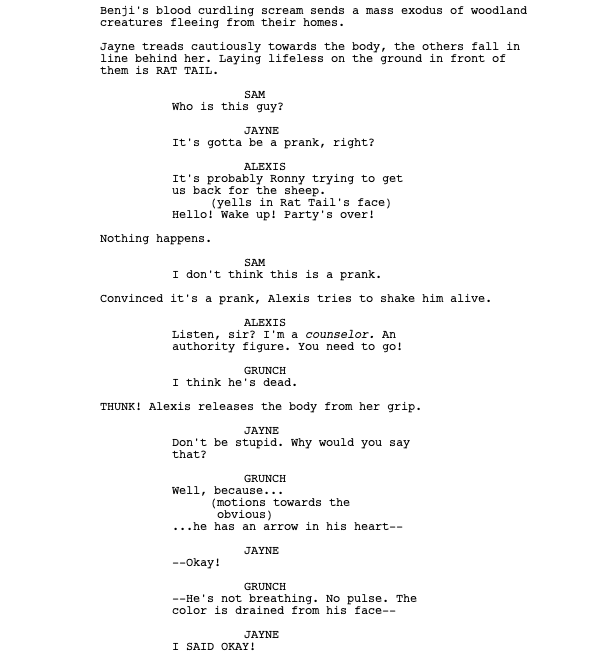
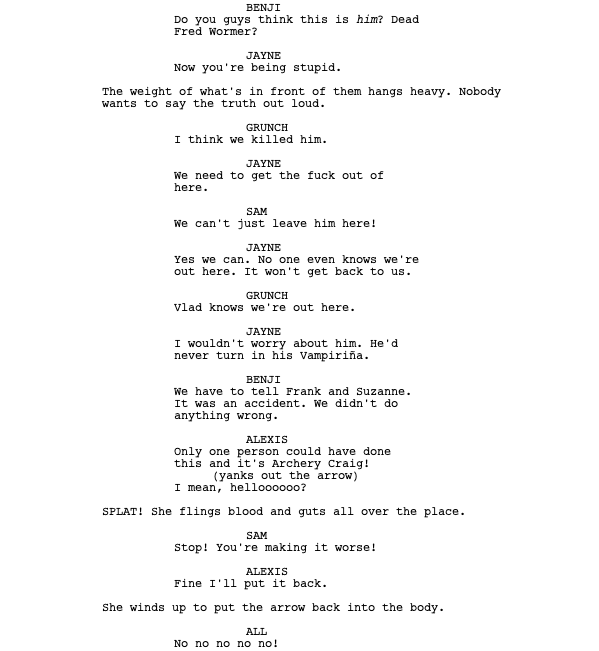
Scott: I’d say that brings back that word elegant again. As soon as you have this dead body, they decide, they’re not going to talk to anybody about this. Then it becomes this ticking bomb-like, “Oh, oh.” You’re right, Benji would be the one you’d think would be the one to break on that group.
The fifth member of the crew you describe as, “Grunch, 20, drinks non-dairy milk years before anyone thought to milk an oat), sitting cross-legged under a tree, reading. This would be hot at a liberal arts school but this is camp.
Was there a Grunch in your past, or is this just a wish-fulfillment for a character? How did this character come about?
Leigh: I think he’s the only one that 100 percent is based on one single person.
Erica: He was also a fun character to write because with this idea of being inside the camp bubble, similar to a high school cafeteria, you brand people in your head, you grow up with these people. Then it’s so funny to look at them in a different way.
It’s like, “Oh, my goodness, this is the most good-looking person I’ve ever seen,” or the opposite like a fact of having, “Oh, my God, Why do I think that person is so attractive?” [laughs]
Scott: Yeah, he’s got his own little subplot because at first Jayne and Sam are like, “I don’t see what they see in this guy.” Then, all of a sudden, they shift the perspective and there’s this hot pumping pony party music. He’s brushing his hair back and even Benji falls under the sway of that same plot, which is a really nice little twist.
You’ve got this relationship between Sam and Jayne, where was that in the process here? It’s a fun summer camp movie, but there is some emotional resonance between these two characters. How did that emerge?
Leigh: I think that was definitely the hardest part of the whole thing. The comedy parts came pretty easy. You find the body and it’s funny and they do these crazy things, but to give it any emotional depth, there had to be a friendship at the center of it.. Everything is so heightened when you’re 16 and then to compress it even more in camp, everything is such a big deal. You can’t step outside of yourself to be like, “Why don’t we take a second and look at what we’re doing.”
Everything is life or death, whether it is a dead body or not when you’re that age. The camp part takes things to an emotional extreme, because you’re living together with these people for two months and your time with them will run out. I don’t know if I’m explaining it well. You want to…?
Erica: Yeah, obviously it makes sense to me. [laughs] I will say, when we were originally writing the script, it was much more of a four-hander between Sam, Janye, Benji, and Alexis. Then, we pivoted to focusing on Sam and Jayne’s friendship, and how discovering the body serves as a catalyst for them recognizing perhaps how fragile their friendship really is.
This is very specific, but when you have someone in your life who is your person, and you look at them when something happens but they don’t look back at you, how does that cut you? How do you move forward from that? Which is a very not-funny thing and a challenge, as Leigh said, to put into a comedy.
We were interested in these insular friendships and what happens when you bring outside drama into them.
Scott: I’m curious because you’ve got so much sketch writing in your background. I know that Leigh has done a bunch of pilot scripts and you’ve done writing too, Erica. Maybe it wasn’t that much of a challenge for this particular script, but that is a challenge, I’ve discovered, with students who have sketch writing.
How do you go from that type of mentality to writing a feature-length script, 100 pages or so? Was that a challenge for you and, if so, what were some of those challenges?
Leigh: It is hard because a sketch doesn’t have a beginning, middle, and an end like a story does really. It goes up. It heightens to the most extreme…It starts at one place and then it gets heightened. You don’t really care what happens plot-wise in a sketch. It actually ruins a sketch if you’re getting too caught up in the plotty details.
But with this we had to have a full story arc, and the pacing was something we had to figure out. The only way to figure it out was to do it and fail a bunch of times, course correct and go back.
Scott: It’s interesting you mentioned pace because almost every scene’s a page or less. The script really moves and then you’ve got your crosscutting back and forth between various subplots and whatnot. There’s always something funny going on, so you can see the sketch instinct at work in that. Were you conscious of that? Were you saying, “We want this thing to move at that pace,” or was this just a result of your comedic instincts and that’s how you write?
Erica: I think it’s a combination. As someone who does not have sketch-writing experience, that’s something innate to Leigh’s sensibility. We really wanted this to be tight and move and were mindful of the real estate our story was taking up.
Leigh: In a lot of comedies you can tell where the people making the movie are having a good time but sometimes it’s working against them because things are going on for too long. They’re saying lots of alt jokes in the same scene that feels like they were probably cracking up making this or writing this.
It feels very self-indulgent and more of a challenge to have a scene, get in and get out, and know what the funniest way in and out is, and move on.
Scott: It works for you in your script because it’s almost like you’re saying, “We have so much content, we’re just going to zoom through this thing.” It’s not like we found a bit and we’re going to milk it for five pages.
In fact, it speaks to the tone. When you’re writing comedies, it’s critical to figure the tone. You got to figure that out. In your script, there is this carefree, tongue-in-cheek tone. You even see it in scene description. I’ve jotted some things down. You have a lot of these contemporary references.
“Benji is mere moments from going full JK Simmons in Whiplash on her,” or, “Slowly, the ground underneath them starts to shake. It’s like that scene in Jurassic Park where the glass of water jiggles.”
“Together, they drop it in the lake like old Rose and the heart of the ocean.” Then, of course, the “hot-pumping porny music.” Even the minor character names, Warhead Kid, Brandon Bonesaw, Archery Crick, there’s this like, “We’re just going to have fun. We’re going to do whatever we want to tell this story in an entertaining way.”
Going back to that point that you were making earlier, how conscious were you of that? “We just want to make ourselves laugh. We want to have a good time doing this.” How did you approach that? Were you conscious of it or was this more of your instinct?
Leigh: For me, that is a habit that I’ve picked up from sketch stuff. Either people like it or hate it, trying to be funny in the scene descriptions. With sketch writing, the first stage is that all the writers are reading it and they’re not going to perform the role the way an actor would, so you want to make them laugh. They’re going to laugh at the little jokes that are just for them.
The way that I approached writing in the beginning was, at this stage I’m not making a movie, I’m making a script for someone to read and to give them an enjoyable experience reading. Then on top of that is for me and Erica making each other laugh in those places and the names and stuff.

Scott: So what was your writing process like? Did you outline the story before typing Fade In?
Erica: Oh, man.. My memory might be really off with this, but we did a lot of outlining before we we even got into the script. Then when we were in the script we would re-outline and get back into writing. We work together in WriterDuet so we can be in the script at the same time.
If we were struggling finding our way within a scene, we would step out of it and re-outline little chunks of the script, so that we were maintaining where we were and the perspective of where we were in the script at that moment. We did try to whiteboard at some point and failed. [laughs]
Scott: WriterDuet. You were actually writing it together? You’re bicoastal. Are you live and then reworking stuff, or is it, Leigh’s going to write a scene and Erica is going to rewrite it. How does that work?
Leigh: I wish we had an easy answer for that because we do switch it up. Sometimes we’ll take different sections and come together and then make them line up. Then sometimes we’ll be in there together at the same time dictating a scene and writing it together on the fly. It depends on the scene. The funnier ones are more fun to write together.
Scott: Let’s talk about that, the morning of December 13th, 2021. Were you all paying attention to this at all or on Twitter and YouTube as the annual Black List rolls out?
Leigh: I was not paying attention to it. Actually, that morning, Erica had called me a few times, and I didn’t answer because I was sleeping. The night before, I had cut my finger really bad on a mandoline and had to go to urgent care so had been up all night getting my finger mended.
I got home really late, went to sleep, and then was ignoring my phone. [laughs]
Scott: I think that’s the most dramatic response to the Black List revelation thing I’ve ever heard, though I’m curious. I play guitar. How do you hurt your finger on a mandolin?
Leigh: No, the slicer mandoline, not the instrument.
Scott: How about you, Erica? You were paying attention to it?
Erica: I was paying attention. I was very excited. I celebrated alone for a few minutes… until Leigh finally answered the phone. Then literally, the next day, I tested positive for COVID. It was a very exciting eight hours, then immediately COVID, and move on. That’s life.
[laughter]
Scott: I hope you have a recording of that conversation where you just tested positive for COVID, and Leigh’s got this finger wrapped up and you’re both like, “We made the Black List.” It’s the juxtaposition of all that. What did it mean to you? Has making the Black List been helpful for you?
Leigh: Yeah, it is a crazy thing to think about. It’s something you’re aware of as a writer, but it feels unreachable. It’s just like this elusive thing that’s out there that you hear about. It does feel a little surreal to be grouped in with some of those people, and some of those scripts.
Erica: It’s really exciting. It is very surreal. Everything in this world we’re living in today feels surreal, especially something like this, where it’s something I follow for the last five, six years. As I said, I have your Go Into The Story in my email account. It’s just been thrilling to work on something, just us, and then talk about it with people.
Hopefully, have it be something where either the script gets made or leads to other writing opportunities, would be hugely exciting.
Leigh: We have another script that we’re working on now. It seems like things that we learned the first time around not trying to write what we think people want to see, but just the stuff that makes us laugh will be the best material.
Scott: You have any thoughts on that, Erica? Burgeoning writing team here?
Erica: Who doesn’t want to hang out with their camp friend all the time?
Scott: I got a few craft questions for you. How do you all come up with story ideas? Story concepts? Do you keep a file or you’re proactive about it? Is it just like you’re drifting along and something pops in your head?
Leigh: Especially with the project that we’re working on now, it was a combination of being in the pandemic and re-watching the stupidest, in the best way, comedies from the ’90s and stuff from the early 2000s, like Austin Powers, and being thirsty for more of those. I guess just noticing what kinds of things were making us laugh and finding a story in that.
Erica: I think that’s right. I think we are very different people, we both have our own processes, but we spend a lot of time talking together. It’s like, what are the things that stick, and what’s the thing that’s going to carry from one day to the next, and in the midst of keeping track of all the days in a pandemic? [laughs]
Scott: You mentioned that you’ve learned a lot writing this first script together. What are your strengths, respectively? Do you have an understanding of what each of you brings to the writing process?
Leigh: My instinct is to do more comedy all the time and only that. Erica is more, what are the feelings, other than that it’s funny, that go with it?
Erica: I was going to say the exact same thing.
[laughter]
Scott: There you go.
Erica: Leigh is very diligent about putting in the hours, putting in the time, and making sure we are working. It helps keep me in check. Working with a partner is very rewarding in that because you’re not just in a bubble.
As we said, I’m more feelings-based and those feelings can go off the deep end and some of the jokes can go off the deep end. It’s finding a way for them to come together is our sweet spot, at least with us working together.
Scott: You serve as you’ve got these bumpers that keep you, one of you is like, “OK, we need to have more feelings,” and “OK, we need to have more jokes and whatnot.”
The dialogue in the script is great. It’s so much fun and the characters do have distinct personalities. Do you think dialogue is something that is you either have it or you don’t or do you think it’s something you could develop? How do you find the voices of your characters in writing?
Leigh: The good thing about working with a partner is that you can read it back and forth to each other and hear it, instead of keeping it in your head. If you write something, you can bounce it off someone immediately and hear it out loud.
Erica: In addition to that, reminding each other this is who this character is and that’s how they’re going to speak. This is how that character is and that’s what their feeling is or their perspective is in this scene. Checking each other and your characters in each moment throughout.
Scott: You mentioned scene, I was going to ask you, do you have an approach or a conscious awareness of, “OK, we’ve got a scene. This is what we’ve got to accomplish?” Do you have any goals in mind when you sit down to read a scene or you just feel your way into it?
Leigh: Always going in with what the goal of the scene is, so that you can get in and get out without getting lost but still having room to find new things. t does help a little bit to explore when you’re in the scene and find new things.
Then if that happens, you adjust the goal of the scene, but we do go in with, this is the scene where X happens, and then to know that that’s what we’re working towards so that we can move on.
Erica: Then when we’re further along into a project, then we’re able to call them chunks. This needs to happen in this chunk and then it’s less overwhelming to have something happen in a specific scene.
Scott: Chunks, yeah. I guess, that’s a different way of saying sequence…
Erica: Yes. That’s more elegant.
[laughter]
Scott: Elegant. There’s that word again. But I like chunk. I’m going to use that for now. It’s much better. I know that Leigh has written some TV pilots. Is that an area of interest for you? Writer’s room, eventually running a TV show?
Leigh: Yeah. That was my goal, in the beginning, was TV and then this was a very happy detour that has proven fruitful. TV was my original focus and still have that going, with pilots I think you’re expected to churn them out quicker than a feature. There’s the pressure of that. But yeah, TV is still a goal.
Scott: Erica, same thing or no?
Erica: Writing features feels where I’m most comfortable. The level of collaboration that Leigh and I have together has made me way more interested in TV, even if that was not my original goal or intention.
Scott: A final question: Based upon your experience of what you’ve done so far, what advice would you offer to someone who’s an aspiring writer trying to break into the business?
Erica: I would tell someone to keep writing, to just write and rewrite. Don’t be afraid to share your script with people so that you can get a better sense of where you’re going and find the ways to motivate yourself and find the right people to help motivate you. It is scary, it’s very vulnerable, but it also can be rewarding when you go for it.
Leigh: I would add, it’s fruitless to try and write something that you think seems like Black List fodder or bait in that way. I guess there are trends, but it’s not worth the energy of trying to guess what will get on there.
Instead, the energy is better used writing what you have a good time writing and doesn’t feel like a chore.
Also being OK with being bad for a while, and working through that and getting better. There’s that Ira Glass Ira Glass quote. Do you know that?
Scott: Yeah.
Leigh: I feel like it’s imprinted in my head, that you have to accept that you will be bad in the beginning and keep working through it. Eventually, things will click and the story that you see in your head, you can get it out on the page.
Scott: That’s some great advice. The stuff that you have a good time writing, it’s like, you’re going to get paid, hopefully at some point. Oftentimes, you’ll get paid to write stuff that’s not terribly motivating. If you’re doing it for free, for sure.
Leigh: Especially when you’re not getting paid, you should enjoy it.
For my interviews with dozens of other Black List writers, go here.