Go Into The Story Interview: Jonathan Levine
My interview with the 2022 Nicholl Fellowships in Screenwriting winner.
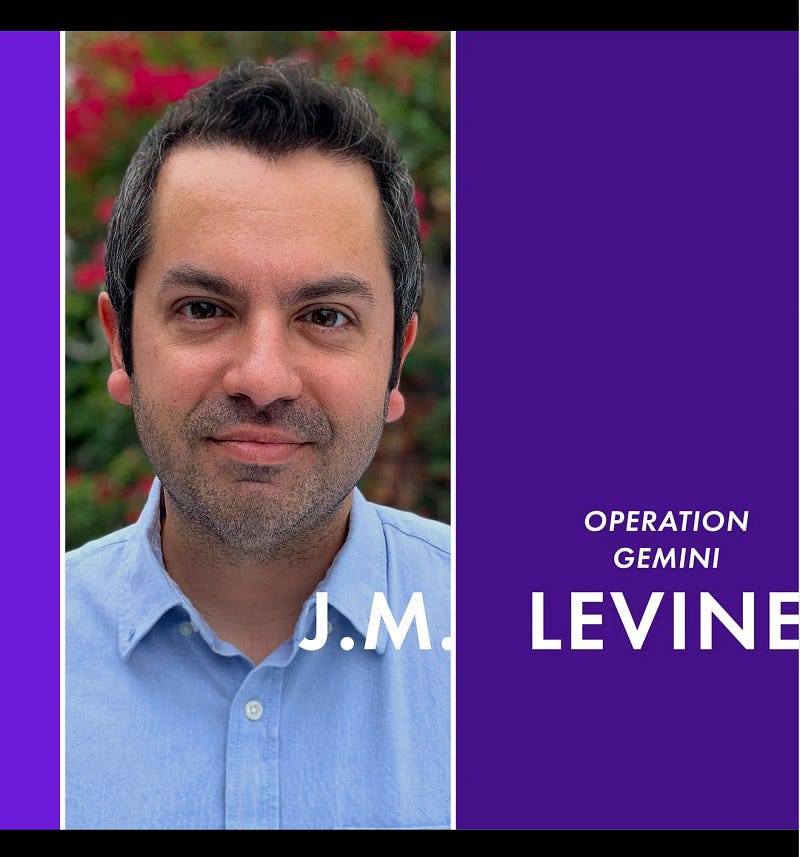
My interview with the 2022 Nicholl Fellowships in Screenwriting winner.
Jonathan Levine wrote the original screenplay “Operation Gemini” which won a 2022 Nicholl Fellowship in Screenwriting. I had the opportunity to chat with Jonathan about his creative background, his award-winning script, the craft of screenwriting, and what winning the Nicholl Award has meant to him.
Scott Myers: Jonathan, congratulations on winning the 2022 Nicholl Fellowship. A nice way to round out the year for you.
Jonathan Levine: It’s a very crazy, exciting time. I wrote the script very quickly and so it’s very surreal to have it so well received. It’s quite an honor.
Scott: Let’s talk about your background because you’ve got a different one than the more conventional Nicholl Fellowship recipients in that you’ve already carved out a career in film and TV. In fact, you’ve even got your own production company Infinitive Films, but I want to work our way up to that. I think originally you’re from Florida. Is that right?
Jonathan: Yeah. Born and raised in Jacksonville, Florida, in a nice little beach community out there. When I turned eighteen, I moved out to Los Angeles to go to a USC’s screenwriting program.
Scott: How did you become interested in film and TV, so that by the time you were eighteen, you were ready to leave Florida and go to LA?
Jonathan: The arts have always been a part of my family. My mom is a graphic designer and an artist, and my dad is a musician and a composer. My earliest memory is wanting to be an animator when I was three watching Disney movies.
I was around ten when me and a friend were bored on New Year’s Eve. We rented a video camera from a video store and started making our own little movies. And so the story goes.
I actually made two features in high school and wrote a musical in high school. I’ve always been editing and writing and producing projects so it was a natural progression to start looking into film schools.
When I was accepted into USC’s screenwriting program all the way out in Los Angeles, I just figured: “Well, if I’m going to try to go for this, I might as well go for it and move to where the industry is. So instead of going to a film school at Florida State or University of Central Florida, which have great film schools, I might as well take out the loans and try to get out there to Los Angeles and see what happens.
Scott: You’re writing two feature films in high school. How did you figure out what you were doing screenwriting wise back in high school?
Jonathan: I’ve always been an avid reader. I tried to write short novels as a kid, wrote comic books as a kid. When you discovered that there were screenwriters and what a screenplay was, you start reading the screenplays to your favorite movies, and then you start writing them.
You start writing like, what would my ideal “Batman” movie be when I’m eleven years old. I think I made five short films in elementary school and middle school, and then made a one feature my freshman year in high school and then a second one my senior year.
I grew up in a beach community, a soccer community. I was in a band and all that, but I was the unique movie kid. Everybody was always like, “Oh, what’s Jonathan doing? Let’s help Jonathan out with his new movie.” I’d recruit my friends and their friends and the whole community to come out and make it happen. It was a great way to spend a summer: shooting a movie with your friends.
Scott: Sounds like your own version of The Fablemans, getting in touch with your inner Spielberg.
Jonathan: The one thing that was really compelling about the movie, that I hadn’t seen before in the “young kid makes a movie” story was the reaction and impact when you make something for your school. I made the band video every year and screened it at the big band event. I did the “Senior Year video.” I’d never seen that in a movie before: how different people react to seeing themselves and then how that reaction impacts, for better or worse, the kid who made the movie. That was very recognizable to me. Sometimes it would mean a lot to people, and I think that positive reaction gave me the confidence to keep going, to keep making things.
Scott: That probably shortened your process whereby you graduate from SC and then you got this production company. Talk a bit about the type of work you’ve done after graduating from college.
Jonathan: When I graduated from USC, I got some good interest off of my thesis script that I wrote there. I worked with a management company and sent it out. This was 2008. The writers’ strike was going on. The recession was happening at the time. I keep making the joke that I’m like a reboot of myself now from then. It’s 2022 and James Cameron is releasing another “Avatar” movie, the economy is in trouble, there might be another writer’s strike coming up. [laughs]
Anyway, coming out of SC, I had a good writing sample and I got a lot of good meetings off of it, but nobody was interested in hiring young writers for anything.
I ended up leaning back into my production background and creating a production company. I would produce commercials and documentaries, even film opera recitals and audition videos for college submissions. Aside from my company’s work, I also did video work for a law firm and helped teach a writing course for the theater school at USC.
Since nobody was making my scripts, I decided to write and direct a feature myself.
Scott: “The Daughter,” right?
Jonathan: Yeah. It’s a hostage thriller about a bunch of rich kids being taken hostage on the eve of an election. My girlfriend at the time, she’s now my wife, was the producer and star of the movie. We raised money. I leaned into all my production friends who couldn’t get a job being a gaffer, DP, or an editor because of the writer’s strike and economy. I said, “Come on: work on my movie for free and you can get those credits.”
I wrote it, directed it, produced it, and even ended up doing some of the post sound and color work on it. It was exhausting, but we got distribution around the world for it. It was released in Japan, Spain, and a couple international territories.
It was my Swiss-Army-knife ability for that project that led me to work for Larry King.
Scott: How long did you do [Larry King Now]?
Jonathan: I was there for about five years. He had just left CNN and brought all his lead producers with them. It was a startup but they were used to CNN resources. I was brought in with a couple other friends of mine. Friends from SC actually, people I knew there, because we could make something look expensive for a small budget.
I built the control room, I ran post for about three years and then ended up directing the last two years I was with the show.
It was his 80th birthday at the time, and so I got to produce and edit the documentary about his 80 years in broadcasting. The event was at Dodger Stadium and I got to work with the tech team there to make the giant graphics that wrap around the stadium. It was great.
Scott: During all this, doing all these different things, you’re still screenwriting?
Jonathan: Yeah, still writing. When I first graduated, my plan was: “I’m going to try to do one script a quarter, one feature a quarter, and try to work on it.” That dwindled down to about two a year. As I was writing these, I’d be leaning on old connections that I’d made when I first graduated from SC and gone out with that original thesis script. And of course, submitting scripts to the Nicholl every year — probably five scripts total before the one that won.
Before work or on my lunch break, I go and write. I have a nice catalog of scripts. Some that I was going to try to make myself but couldn’t get the money for, others I’d work on with producers or development executives who I had met in my travels.
Scott: That’s a nice segue into talking about your Nicholl-winning script, “Operation Gemini.” Here’s a plot summary:
“After being separated from her newborn twins during the invasion of Kyiv, a mother recruits two civilians to drive her back into war-torn Ukraine to rescue her children before medical supplies run out and the Russian army takes over.” Inspired by a true story. What real-life elements figured into your script?
Jonathan: I’ll give you context for how I ended up writing it. Following my time working for Larry King. I left there and I went to work for this kids production company called pocket.watch. I’m still there today, as their SVP of Production and Studio Operations.
pocket.watch partners with big influencers in the kid’s space on YouTube and grows their I.P. and brand into TV shows, movies, books, games, and toys. Aside from overseeing all the shows we produce, the job allowed me to write and develop material for kids. About a year in, I also had my first daughter — which was great because now I’m producing shows that she can watch and enjoy.
As it goes, life and work started taking over the time that would normally be reserved for my own writing; which was okay because honestly I was tired of the spec game and chasing that and trying to find motivation to make that happen.
So when the beginning of 2022 came around, I thought, “OK, the Nicholl deadline is coming, am I going to try to submit something? Am I going to rewrite something that I’ve already done?” I decided: no, I really don’t have time.
Then in March, about two weeks after Russia invaded Ukraine, I was driving to pick up my daughter from preschool and I heard on the radio this story about a woman who had given birth to twins in Kyiv right as the Russian army had come in. She was a surrogate for a family in Chicago. The family in Chicago reached out to a group called Project Dynamo, a group made up of ex-military personnel who go into war-torn countries or very bad situations like hurricanes or natural disasters, and get people out. Really great organization.
They were contacted, they went into Ukraine. They picked up the mom and her two children, the twins, and loaded them into a caravan of three emergency vehicles and drove them to the border of Poland and through snow and through checkpoints.
There was a war happening around them. It was a dangerous situation, but they reunited these twin babies with the family from Chicago. When I heard this I thought, “That sounds like a cool idea for a movie.” A rescue mission. Rescuing babies in war. It felt very compelling, it felt very readable.
I still didn’t think I had time to do it. The Nicholl deadline at that point was seven weeks away or something, but the idea kept popping into my head. I told my wife about it: “I heard the story about these two twins who’ve been born and they go into rescue…” and she stops me in the middle of my little story, saying: “No, no, no, no. I can’t handle babies in a war zone. It’s too much.” It was a very interesting reaction. A very emotional reaction from just a sentence.
And I thought: Huh. There must be something here.
Then I started reading about all these civilians who were going out to help. People from all around the world selflessly traveling there to help because they felt like they needed to be a part of it. They need to do something. They wanted to make a difference. It felt very unique to our time, especially in the context of COVID because I feel like COVID forced a lot of people to look inward and re-evaluate their lives, and a nice by-product of that was this wonderful outpouring of humanity to help others.
I was very moved by that selflessness. I thought that could be my way into the story: This American who wants to help. He’s a fish out of water, trying to make a difference.
So I hunkered down and wrote for an hour or two hours a night for six weeks. I feel like in some ways the ticking clock of me trying to push through it helped the writing because that’s the nature of the story.
I finished it — I want to say — four days before the final deadline for the Nicholl was due. My wife was the only person who read it. She read it in a day and gave me notes.
It was funny. When she read it, she said, “Well, you realize that you are your main character, Sam. Sam is trying to re-evaluate his life. He’s trying to find himself. That’s what you’re doing in the script.” I realized she was right. Me writing this script was me reconciling old Jonathan writer with new production executive Jonathan. Now I’m a dad. There’s COVID. There’s social unrest. This script was my way of processing and finding my new self or the rebooted version of myself. Sam’s journey to find that he can keep going is my journey to find that I still have stories to tell. That there’s still features to write. I can still find the time. It’ll be worth something. Somebody will read them. It ended up being a very cathartic, emotional writing experience.
Scott: I’ve read tons of interviews where writers say the stories they write are really the ones that they are intuitively drawn toward.
Jonathan: Ironically, I discovered months after submitting “Operation Gemini” that I have a great-grandfather who was born in Ukraine, so maybe on some level my lineage was driving me to write this story.
Scott: It’s almost like The Hero’s Journey. The journey they take is the journey they need to take. It’s like the writers. The writers, the stories that they write are the stories they need to write. Your wife made an interesting observation.
Jonathan: She did. I’m trying to apply that looking ahead to the next things that I’m working on, because I still have a day job, still busy. I’m keeping myself open to having an emotional response to material. That’s the difference in my approach, post-Nicholl, and pre-Nicholl. Pre-Nicholl was very intellectual. Post-Nicholl is more emotional.
Scott: It’s a thrilling story, but it’s more of an Action Drama. That was an interesting departure, I suppose for you. Let’s talk about these three characters. You’ve already mentioned Sam, who’s the Protagonist of the story, but it’s all about this woman, the mother.
Jonathan: Kalyna.
Scott: The war breaks out. Kalyna’s with her husband. Now she’s going to have these twins. Talk about her character, the evolution of that character in your story-crafting process from hearing a real-life story on the radio to becoming the Kalyna character in your script.
Jonathan: For me, there’s a lot of my experience as a parent, my wife’s experience as a parent. That inherent fear about being a parent, but then instinctual drive to protect your children at all costs. There’s this theme in this script where everybody’s telling her what she should and shouldn’t be doing as a parent.
You encounter that all over the place as a parent. Do you have kids?
Scott: Yeah, two.
Jonathan: What ages are your kids?
Scott: They’re grown. 31 and 21.
Jonathan: There you go. It’s like everybody when you first have kids, everybody’s telling you, “We do it this way, or do it that way.” Especially the COVID-ness of the world and the question about COVID and kids and protecting your kids from the world. It was all funneled into Kalyna and the way I wrote her.
She serves as the Bill Paxton character of the movie, which I always think the Bill Paxton character is the guy who is the audience, the guy who is constantly asking questions, “What are you doing? Are you crazy? This is what’s going to happen if you do this cray thing!” She serves as that voice and you get to talk about Ukrainian people and what the city was before and after.
Giving her the background in mathematics as this professor, it was a way to play into the theme about the idea that the world can go crazy, but if everybody cares about each other, there is this undefinable factor: People looking after one another, nobody can underestimate the power of that.
She represents that both literally as a statistics professor, but also in the way that finding two needles in a haystack when the haystack’s on fire is [laughs] impossible. Her determination makes it possible and her gut as a parent to know the connection with her children that can help her find her way. If you care about your children, that’s enough. [laughs] If that drives what you’re doing, then that’s enough.
Scott: I’m a huge fan of Pixar and I’ve done a lot of research on them. They never green-light anything unless they have a very specific understanding of what’s the emotional connection the audience is going to make. You can’t get much more emotional than a mother who’s trying to save her children. It’s primal.
She may be intellectual, she may be very well-schooled, but once she gets separated from her children which is what happens, there’s an attack where the children are born. She wakes up and all of a sudden she’s in Poland and as it turns out, her husband was killed in the attack. The twins aren’t there.
She’s got to find her way in, way back. Now, that brings us to Sam. He’s an American. He shows up in the Ukraine. What were you going for with this character?
Jonathan: Sam is an amalgamation of all these different stories that I heard about civilians who traveled to Ukraine. Some of them did have some military background, but a lot of them felt a calling. I talk about this in the script. Sam does have his family he can’t be with them now because they’re so freaked out by COVID.
He’s not married, he doesn’t have any kids. His business has gone under because of the pandemic because nobody wants to let an electrician into their house, especially when they can just go online and look up how to do things. He’s searching for meaning. He’s this broken character and he goes there hoping that his life will matter. That he can make his life matter.
Even though he has no idea what he’s doing when [laughs] it comes to being in a war zone. There’s some fun humor that comes out of that.
I also found it very compelling in the context of a war movie to have a character who goes into the war zone, who has no business being in the war zone. No connection to it at all.
What kind of people go head first into the war? That’s very interesting to me. What part of your life has led you to feeling that you would take that risk and take that chance?
At the same time, I didn’t want to make it seem like this is like, an American is going to come in and save the Ukrainian people. I tried to poke fun at that by having the Ukrainian military make fun of him by spouting off all the famous action movie lines from “Die Hard”.
Plus, it wasn’t just Americans coming. It was people from all over Europe and all over the world coming over to help.
Scott: Of the primary characters, I guess it’s almost like a partner. This Alvaro.
Jonathan: Alvaro. Yeah.
Scott: Alvaro does have a military background. In fact, at one point, he poses that question to Sam, which is the question that you played as a mystery because Sam doesn’t answer this until late in the story. Alvaro says:
“I have the training. What the hell are you doing here, Sam? Are you a crazy war enthusiast? Did you murder someone and now you’re running from the police? Or do you just want to get high on those pills you’ve got? Drive people around, watch things explode. Do you even know?”
Alvaro, at least has his military background. Of course, he’s got even though it was a very foreshortened one, and he had this injury in which he’s got a replacement leg.
Talk a bit about Alvaro and how those two guys are essentially partnered together.
Jonathan: Alvaro, like Sam, is broken and lost. He missed his chance to be a hero. His whole family is ex-military and this accident happened and now he thinks he’s worthless.
He’s coming out to find his own purpose and do something that matters and to show the world that he may be handicapped, but he’s not. Don’t count him out.
It seemed like an interesting couple, an interesting dynamic with these two guys who didn’t know each other except for six days ago and they met in the airport, waiting in line to rent a van. Now they’re trying to be these heroes.
They may be ill prepared but hopefully the audience roots for them because they’re coming out from such a pure and hopeful and selfless place.
Scott: There is that truism that nothing defines life more than death. There are people who have served in the military. My father did. My grandfather did. You talk to them, and it really is the intensity of that. The proximity of your own demise at any given moment, there is not anything that can quite replicate that.
You’ve got these two guys who in effect are trying to redefine themselves in a way amidst this harrowing circumstance. That’s a really interesting psychological thing to explore.
Jonathan: The thing that in my questioning and unpacking of, “Why would you go out and do this? What are you trying to fulfill or how are you lost, that going out into this war zone would be something that you would be so gung-ho and determined to do?”
To me, I find it very compelling where it is revealed that Sam basically has a death wish. He has made the choice that he’s living to die. That’s what he wants to do.
Ironically, that was the one part of the script that I was nervous about because it felt very…I don’t know. It felt like if it wasn’t done right, it could seem silly and tonally wrong, or it could make it dark and too weird.
Sam’s journey is from nihilist to optimist, he finds a reason to live. I was nervous about that. I wasn’t sure if it was going to work, but I needed something. It felt unique. It gave him someplace to go, and it also allowed us to make his journey a little bit different. I hadn’t quite seen that arc done.
Plus I think it’s the anti-war movie arc. I didn’t want them all to die at the end. I feel like in a lot of these stories, by the end of it, the main characters die. They sacrificed themselves for this great cause and they die. To me, I wanted people to read this and walk away with the idea that you can look out for people, you can be selfless, you can go and try to make the world better, and you don’t have to die. [laughs] You can still walk away from it. You can make a difference in the world. You don’t have to die to make that difference.
Talking with a lot of people who’ve read it, executives and producers, a lot of people respond positively to that. They are excited by the fact that he lives, that he shows up at the end and they’re surprised by it.
Scott: There’s a theory that all stories pose this question to the Protagonist: “Who am I?” That’s, I think, what Sam is going through, asking the question of self-identity. He says to someone, “I want to do something. I’m going to make a difference.” Later he says:
“A funny thing happened on the plane ride. I got scared, really scared, that I made a decision I was going to die here. It just took the pressure off the whole thing. It became my mantra. I’m going to die. I’m going to die. I’m going to die. It’s very freeing now. I just need to find some awesome way to go. I have nothing to live for except death.”
That is actually quite interesting. It makes me want to know more about his background. How does a guy get to a place like that? It does go right into the face of something that we as human beings, somehow as children moving forward, we accommodate ourselves with the idea that, you know what? We are all born with an expiration date, and yet we get up every day, we go through our lives. But with Sam, it’s like, “OK, look, we are going to die,” and he embraces that. I found that quite interesting. It added a whole level of dimensionality to him that may not have been there. I want to do something selfless.
Jonathan: That’s great. I’m glad to hear that because that was added in the last 72 hours before I had to submit the script. [laughs]
I was nervous people might think that it’s funny and be tonally incorrect. It was an interesting place to take him and an interesting place to land that made it feel a little bit different than a typical war movie.
Scott: Let’s talk about the structure of this story because by the midpoint of act one, Sam and Alvaro have intersected with Kalyna, and they’re in Poland. Her kids are in Ukraine. That’s a very compelling conscious goal. “We’ve got to get these kids.” Now they’re traveling in the opposite direction where everybody else is going.
It’s a great visual way to set up the underdog nature of this story. You talked about finding two needles in a burning haystack, which is a great metaphor. It’s like everybody’s going this way, they’re going that way. The Russians are coming in. It’s just a really tense act two with one complication roadblock or reversal after another.
It reminded me of a quote. It’s one of my favorite quotes. I always tell this to my students. From Janet Fitch, she’s an author. She said, “The writer is both a sadist and a masochist. We create people we love and we torture them. The more we love them, the more cleverly we torture them along the lines of their greatest vulnerability and fear, the better the story.”
I felt like that’s probably the spirit that you had here because you put these guys through hell and back. Was that an enjoyable experience? All the plot twists and turns were gut-wrenching.
Jonathan: Thank you. That’s a great quote. I knew I wanted her to find her kids in the middle, which feels more like an ending. I wanted her to find the kids in the middle but then realized that it’s not just about finding them. It’s about getting back out.
How do you escape when literally these humanitarian quarters are collapsing? Also, structurally, the big plot points, the big moments in the story from the beginning to the midpoint, are all actual things that happened in the war. The tank battle in Brovary was actually a thing, so I knew I was heading toward that.
Tracking toward actual moments in the war kept me honest when it came to plotting the movie. I wouldn’t lean into anything too conventionally thriller-y, to make anything too over the top or too crazy. I almost felt like I was writing a documentary more than I was writing a feature or a narrative.
Going back to the comment you brought up earlier, a mother searching for her child in the worst possible situations when she just had a C-section when she herself can barely move? That’s all great stuff. [laughs] It’s terrible, terrible, great stuff.
I’ve read a lot of scripts, written a lot of scripts. This script I was like, “I want to make this thing as propulsive as it can be.” I was trying to keep things moving. I had the ticking clock of what actually happened in Ukraine that the characters are driving through. Then as they were exiting the same thing about all the stories I had read about things that the Russians had done or this bridge had collapsed, or this had happened here, or this city had been wiped out. It’s all terrible fodder for something compelling.
Scott: I want to get into the weeds of screenwriting a bit. You have a lot of action scenes. The way you approach them aligns quite appropriately, maybe not the right word, but breaking up paragraphs suggesting individual camera shots: “That paragraph is a shot. This paragraph is a shot.”
Had you read a bunch of scripts and figured that out? Because this does read like an action script.
Jonathan: Well, since this is the appropriate setting to nerd out on screenwriting stuff, let’s talk about that. I am a huge Tony Gilroy fan. I think everybody is a huge Tony Gilroy fan. His Michael Clayton script had a tremendous impact on me.
There’s something about the way that he writes. There’s an energy to everything. He says that you want the reader to feel that the writer knows the world of the movie that they’re writing. You want to sell the tone of the piece in the tone of the writing, and you want to make the reader feel confident they’re in good hands. I’m a big fan of that approach, of that style of writing. Writing in a very aggressive, propulsive, not too cheeky, but maybe cheeky if it’s appropriate way. Double dashes, short sections of action.
At the end of the writing process, all I have is a document, a PDF, that I’m going to give to some random person, and I’ve got to hope that they’ll at least get past page one and maybe keep going.
I don’t like reading huge blocks of text. Why should I expect some poor reader to do that? I’m not going to have huge blocks of text, I’m going to have short lines, I’m going to make it very easy on the reader to keep going and pull people’s eyes down the page.
I print off my first drafts. I like to hold the pages and write on the pages and mark on the pages because I definitely feel there’s something special about holding your script in your hand, having a physical copy of it, helps your brain streamline it. When it’s all digital, you can’t interact with it. It feels very elusive. When it’s in your hands, I make all the corrections by hand on the page and then go in and retype.
You say it’s an action script. Others say it’s a drama. I consider it a thriller, but I think all good scripts are thrillers. In the end, you want to have a mystery be solved and have a little bit of excitement along the way. No matter the genre.
Scott: I do the Austin Film Festival pretty much every year. I moderated a panel last year where we were talking about scene description. A whole seventy-five minutes on scene description as action writing. It was really great to see these screenwriters just really getting in the weeds on that stuff.
Jonathan: There’s also a little weird game you can play: “You described this in six words, but could you do it in three?” Then you start cutting things down. How short can you make it? Maybe that’s the analytical mathematical part of my brain that enjoys that part.
Scott: Ah, that mantra: “Screenplay: Minimum words. Maximum impact.
Jonathan: That’s great.
Scott: One of the things I thought was quite interesting and maybe this just came up in your research, but several of the authority figures in the Ukrainian military are women.
Is that grounded in reality, or was it like you’re trying to…
Jonathan: All based on real people. The Ukrainian officer Lt. Strainer who helps the main characters when they arrive in Kyiv is based on a real woman and everything she does in the story, the whole operation — her loading the missile into the trunk of the car and keeping the car small and driving into the city — is all based on actual things they were doing. She is an amalgam of a couple of different women who are serving the military.
Over the past year, more and more stories have come out about how more and more Ukrainian women have joined the military to serve and how it’s changing the gender dynamic of the country, which is great.
I tried to honor all of these true stories of heroism I’ve been reading about. Kalyna was not the woman who gave birth to the twins for the couple in Chicago. Because our three main people are not actual people, I tried to make everybody around them based on an actual person. At least it felt like it kept it grounded and true.
Scott: Well, congratulations. It’s a really good read. I hope that in addition to winning the Nicholl, it moves forward. And speaking of the Nicholl, let’s talk about that experience. How was that for you?
Jonathan: I thought maybe the timeliness will work for me and become interesting, compelling, and make it so the script would stand out.
Like I said, it’s very surreal to hunker down and bang out the script that does so well. All the other scripts I’ve written and rewritten, and they’ve gotten better. I believe in all that.
The thing that’s been most shocking to me honestly about the Nicholl Fellowship is how… Yes, you get a plaque. Yes, you get to speak at the Academy Museum, but it’s the camaraderie with your other fellows that is really striking. Not just the ones that you meet this year but also the past years. I immediately have been welcomed in this alliance of writers who have won the Nicholl. Everybody wants to check in and see how everybody else is doing. That emotional nurturing has been very surprising to me. The head of the Nicholl committee, Eric Heisserer, has done a really great job connecting this year’s fellows with last year’s fellows and also with other industry people. It’s very nice to know that, if nothing else comes from the Nicholl experience, you’ve got a good group of friends who you can lean on.
Scott: Did you get to meet managers and potential reps and stuff during this process?
Jonathan: Yeah. I got about 30 or 40 requests to read from managers and agents to producers. I don’t have a representation. I’m still meeting with people trying to figure out what’s best for me, what’s best for where I am in my career.
Like I said, I went through this 13 years ago so I’m just taking this one day at a time. I’ve got my family, my job, and my dog. All these things keep me grounded and keep me focused. I don’t really have time to think about it too much. Just taking it one step at a time.
Scott: Well, congratulations. You provided me with a perfect segue to some craft questions. The first one is how do you come up with story ideas, and here you are. You’re trying to come up with the story concept that you want to work on for this Nicholl script, the next one you’re going to write. How do you come up with these ideas?
Jonathan: I have a theory that if I have an idea. I write it down then put it off to the side. Then I may have another movie idea, and I’ll write it down, stick it to the side. It’s like all the ideas will fight each other in your head. Then if you’re still thinking about that same idea a month later, then that one probably is the one that’s worth digging into further.
I’m trying to write something that speaks to me a little more emotionally because, because of all my other responsibilities, that’s the thing ultimately that is going to keep me: The emotional drive to tell this story or communicate this theme. I’m trying to connect with what that is. What’s the heart of the movie is more important than ever before right now.
Scott: I tell my students there’s two paths, people in Hollywood or screenwriters. One is, you’re writing what you think they buy. I know that a lot of writers say, “Don’t do that. Write whatever you’re most passionate about,” which is legitimate, of course.
I know a lot of writers, myself included, who made a living coming up with material that you feel like can fit into what you think Hollywood needs. The other path: Sell them your dream.
Jonathan: The emotionality of it is important, but also the idea that somebody will read it. That’s important too.
Scott: How about your prep writing process? Maybe it was a little different with this because you had such a short amount of time. How do you go about breaking a story?
Jonathan: I was a big fan of the notecard method: “Have an idea, write it on a notecard, put it into stack.” Over a few weeks, the notecard stack gets taller and taller. Then you lay out all the notecards and see if you can form a coherent story with everything you scribbled down.
A did a variation of this method for “Operation Gemini”. Because I had to work quickly, I gave myself two weeks to figure out the outline of the movie. I did it in a Google Drive document because it opened on my phone. [laughs] Anytime I would read a news article, find a cool scene or something, I would drop it into the Google Doc. As I was dropping them in, I’d organize it. By having to assign it a place in the story, I knew more quickly if it was working or not.
Then when the time came to actually write the thing, it was all ready for me. I still cut scenes, combined scenes, moved things around as I was writing pages, but it was a great roadmap.
Scott: When you were at SC, were they teaching the eight-sequence theory there for screenwriting or no?
Jonathan: I don’t remember. I know it and I definitely use it when abstractly thinking about laying out all the different sequencing. I don’t remember if they taught us that. I know they did those basic structure things like act one, act one midpoint and act two, all those basic things. I don’t remember if they did the eight-sequence technique. I don’t remember that.
Scott: How about developing the characters? You had these amalgam or these variations of them. Do you have specific techniques or tactics or exercises you do to dig into the characters? Or is it more of an intuitive organic process?
Jonathan: I guess, it’s probably more intuitive. I think the thing that I learned while writing this was the idea that character can come out of conflict very clearly. You don’t have to have the character stop and tell their backstory. You’re putting them through this ringer and the way they’re reacting will tell you a great deal about them. That can give the audience or the reader enough.
I didn’t want to have any flashbacks or have any prologues or anything like that. I wanted the story to move, always driving forward. People seem to respond well because got who the characters were, which is great.
Scott: What about when you’re sitting down to write a scene, do you have specific goals in mind?
Jonathan: This might sound super analytical, but I know that I don’t want the scene to be long. Obviously, the scene has a purpose that I’m trying to go for, but the only thing I’m conscious of, or the only thing that will cause me to go back and cut a scene down or delete a scene is it’s just feeling too long and throws off the pace.
Either let’s split this over a couple of scenes, or let’s have it be very simple. Maybe that scene becomes about something new or I realize it’s taking me too long to get to the point of the scene and I need to cut out the beginning and cut out the end, which is that old trick that everybody says. Keep it simple and keep it moving.
Scott: How about theme? Is that something that you are concerned with? If so, is it something that’s upfront in the process, or is it something that evolves as you were writing the story?
Jonathan: I always try to think about that from the beginning. I normally like to say, “What am I trying to say?” What is the point of the movie? Every scene, every character should be influenced by that theme. Everybody exists to unify around, to make that theme clear. If I don’t know what the theme is, I’m lost. I don’t know what to do.
For “Operation Gemini”, when I first started I wrote down some questions at the top of my outline, right at the beginning:”What does saving these twins mean to these characters?” How does it heal them? How does it allow them to rediscover who they are? Sometimes themes will change and it will shift especially as you focus in and find maybe what your movie is. Listening to your story, listening to your characters, is important.
I don’t necessarily need to know how it ends on a plot level but I absolutely need to know how it ends emotionally and psychologically.
Scott: Your script ends with that title, the super. “Over 20,000 civilians from 52 countries joined the Ukrainians to fight during the Russian invasion, making one of the largest voluntary foreign enlistments in modern history.” That theme runs through there, specifically. One last question for you. Let’s say you’re meeting writers who are trying to emulate what you’ve done and are doing. They ask you, “How do you go about learning the craft? How do I go about becoming what you’re doing?” What advice do you have for folks?
Jonathan: [laughs] As somebody who was on the other side of this conversation a few months ago, it’s a funny question to be asked. Again, there’s the practical aspect of it which I mentioned earlier: you want to be easy on your reader. You want to write something that will keep people reading because the first step is to get people to finish your script. You can write a drama that’s propulsive. That word can apply to any genre..
Then there’s the emotional aspect of it. I had to tell this story for some reason. It spoke to me emotionally. I would say that, if you are responding to it emotionally and if you feel that there is something that moves you in this story, whatever that story is, it’s worth writing because the people who will read your script and react emotionally, in the same way, will be your brothers and your sisters in the writing or producing world. They’ll connect with the script the same way you did, and then you’ll have allies.
That was the main thing about this script. It was that emotional connection that led to this creative burst of inspiration. Sometimes we’ve got to write when we’re not in the mood, of course we do, so having an emotional connection to it will get you up in the morning to write, or motivate you to stay up late and write after a long work day. If you don’t have that emotional motivation, then that’s a good sign that you should think of another idea.
For my interviews with every Nicholl Fellowships in Screenwriting winner since 2012, go here.