Go Into The Story interview: Jessica Bendinger
An in-depth conversation with the screenwriter of the beloved 2000 comedy Bring It On.
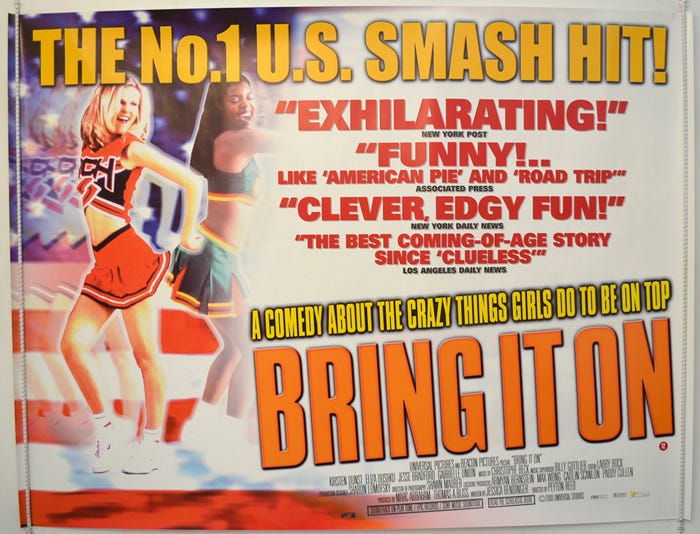
An in-depth conversation with the screenwriter of the fan favorite 2000 comedy Bring It On.
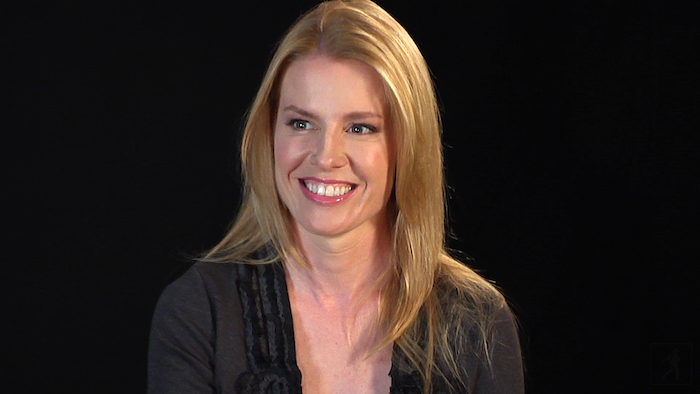
I’ve gotten to know Jessica Bendinger over the years through our involvement with the Black List Feature Writers Labs and a couple of our conversations were about her involvement as screenwriter with the 2000 movie Bring It On. I loved the film and enjoyed hearing some of Jessica’s stories.
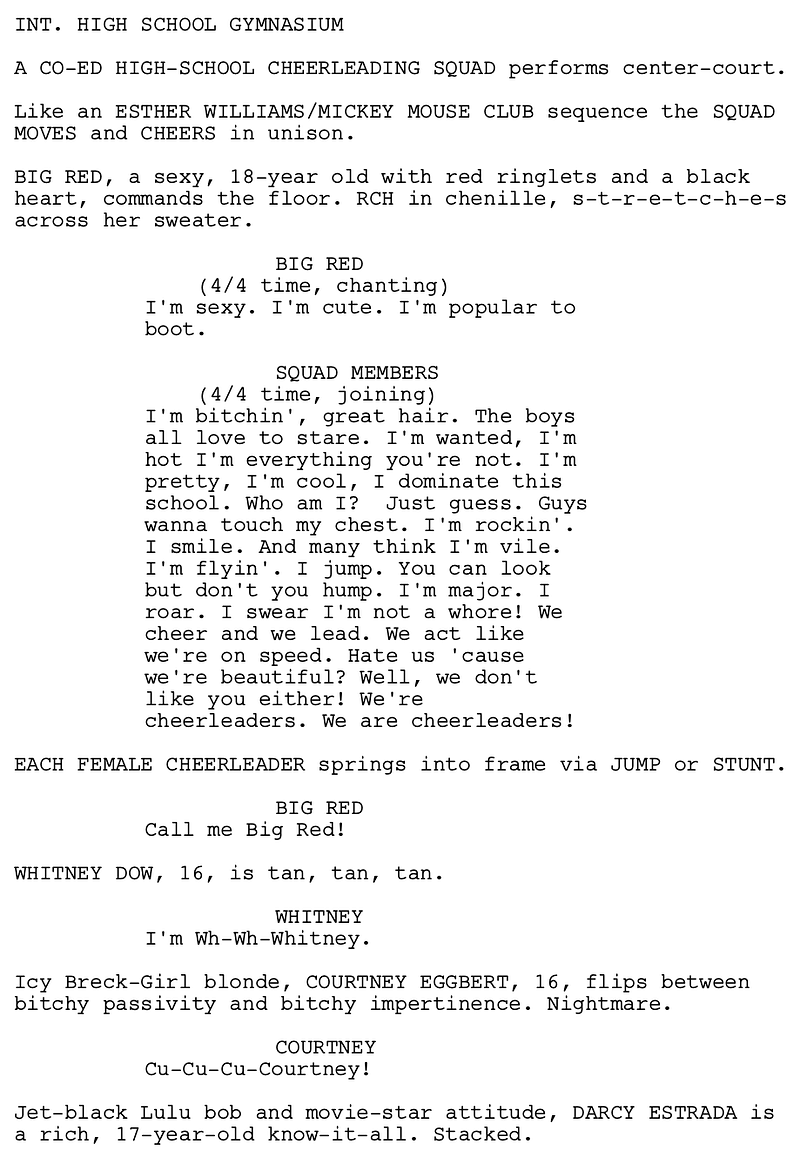
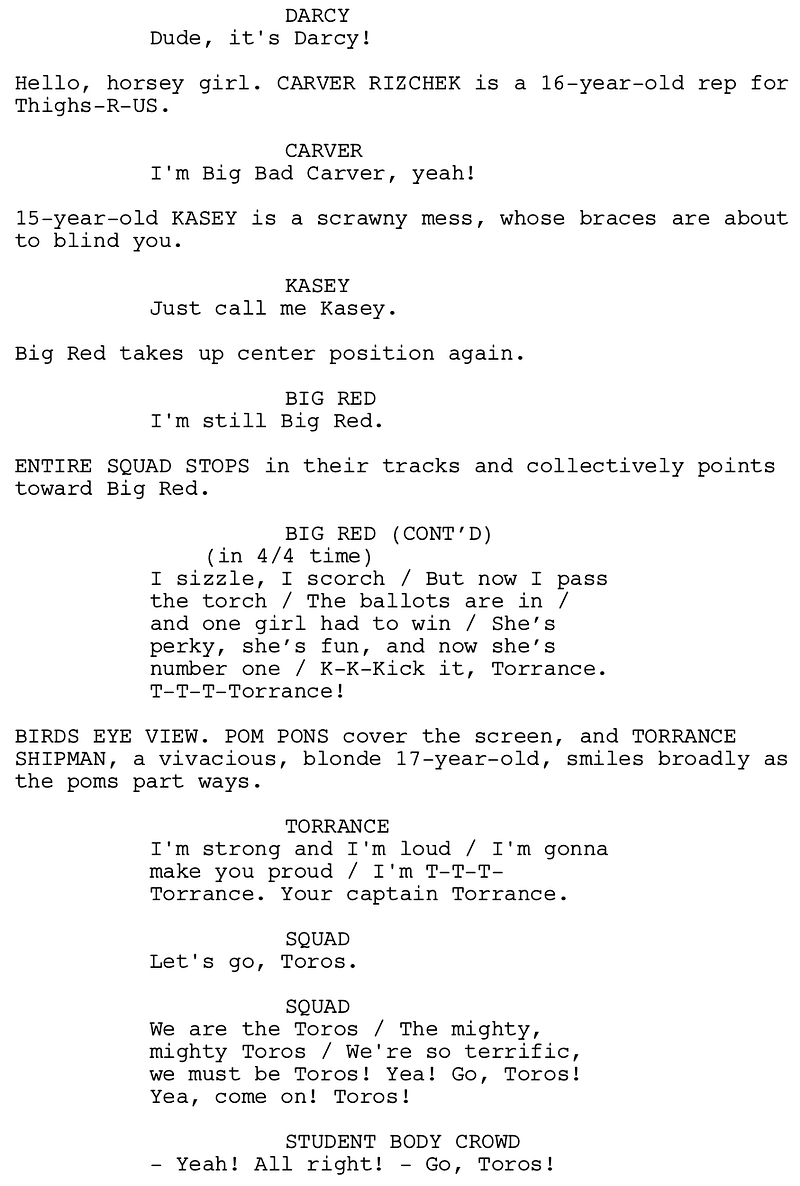
To commemorate the 20th anniversary of the film’s release, Jessica wrote “The Bring It On Book.” It’s an interesting hybrid book in that it not only provides an inside look at the movie’s evolution into and through production, Jessica also shares her approach to screenwriting, so there’s a practical application related to the craft.
I rarely promote screenwriting books, but I thought what Jessica has accomplished with “The Bring It On Book” would make for an interesting interview. Here it is in its entirety.
Scott Myers: Jess, you wrote the script for the 2000 movie Bring It On. Now, you’ve written “The Bring It On” book, but before we get into all that, what was life before “Bring It On” for you? I mean, how did you wind your way into writing, directing, and getting into Hollywood?
Jessica: I was lucky in that. I had my 10,000 hours, as Malcolm Gladwell says, in by proxy. My dad was in advertising, and he was a copywriter who worked his way up, the kind of advertising hierarchy and into making commercials and being a senior creative director and then VP at places like bookcon with Leo Burnett and J. Walter Thompson.
My mom was a professional jazz musician who was very much a part of the gig economy in the wild ’70s and early ’80s, so I saw weirdly two sides of Hollywood ‑‑ the live entertainment side of music and performing.
Her band was the opening act in the final years of Ed Sullivan Show in New York. She toured with Eddie Arnold, Jack Jones, Loretta Lynn, and then the famously Bill Cosby. [laughs] Now, you say, just slightly differently.
Another female horn player was the tuba player in Woody Allen’s band at Michael’s Pub. I saw a little bit from the very fringes about the entertainment business and the hard work, and then it was a working class business.
I had a clue about the difference between what was on stage and what happened. That helped me and that served me in ways I couldn’t have predicted. Then, my dad making commercials. I remember going to a…I want to say it was a Michelob jingle recording session with a full orchestra in the ’70s like being a little kid and as if you were seeing a film score.
It was a full orchestra in a soundstage in Chicago recording a jingle. I got the benefit of seeing how the Sausage has made the steps. You’re seeing the steps of how things go from nothing to something in a weird way. You’re seeing the rehearsals. You’re seeing the tech rehearsal.
I got a passive sense of process through my parents who…My mom was a musician and my dad is in advertising, which I was lucky. I think I underestimated that for a long time and looking back, that served me well.
Then when I was at Columbia as an undergrad, I started interning at “SPIN Magazine”. They were very understaffed because Bob Guccione Jr. had left his dad’s parent company, Penthouse, and I was in the right place at the right time.
My editor there, John Leland, had gone to Columbia, so he suspected I could write, and he gave me an interview with Public Enemy. As you can read in the book, I interviewed Public Enemy and Salt‑N‑Pepa while I was still an undergrad at Columbia.
If you can imagine, hip hop was in its infancy, and I was fortunate to be a huge fan of hip hop and working at a magazine. All the luckiest breaks you can get, I got.
I was writing, covering other people creating as I like to say now when I was an undergrad and then worked at MTV News after I graduated, and while I was at MTV News writing news items for Kurt Loder and John Norris, who were the on‑air talent back then.
This giant…We used to have these electronic press kits that were on three‑quarter inch tape and a three‑quarter inch EPK as they were called for a movie called “Say Anything,” came across my desk.
I wrote the news item for it, and I was watching the EPK, and it said Cameron Crowe, the writer/director, had been a writer for “Rolling Stone,” [laughs] as we know now from “Almost Famous.” Back then, I didn’t realize that was a thing. I didn’t see how my path of writing about other people creating could lead to me creating. That felt like such a big leap to make.
I saw that interview with him on the three quarter inch, and I was like, “Oh, my God. Maybe, I can do it.” Shortly thereafter, I saw something with Joe Osterhaus about…He had written articles and went from kind of magazine. And so I saw the leap. I think seeing that those leaps that they’ve made I thought, “Oh, maybe, I can do this. Maybe, I should actually think about this.” I started teaching myself taken a screenwriting class at UCLA summer class, but Columbia wouldn’t accept the credit. I’d gone to summer school at UCLA.
I go back to Columbia, and their Ivy League snobby where we’re like, “Yeah, no. That’s a graduate school discipline. We won’t even accept that credit.” I was like, “OK,” and I didn’t love it, so I was like, “OK, I’m not going to go to film school.”
I was kicking around and then I saw those things, and I was like, “OK, let me try this.” I just started trying to write in Earnest. By the time I got to Hollywood, I had been a 10‑year overnight success story. I had worked in magazines. Then I worked for MTV News. Then I worked on a TV show in France.
Miraculously, I got a job writing scripts on this new show. I saw I was a member of the French Writers Guild before the WGA. I would take any experience I could get. I was good about saying yes. Knowing that experience would take me to the next thing, and the next thing, and the next thing.
I was very lucky and a hustler in that way of like, “OK, a pharmaceutical script for selling pharmaceutical stuff to reps, great.” I was always saying yes and taking those little money jobs. They ended up making this cool quilt in my life historically. I was fearless. More through stupidity than anything else, would say yes, and then, “OK, I’ll figure it out.”
Scott: The point where you were coming up with the idea for Bring It On, I think it was 1996 when you registered a treatment.
Jessica: Yeah.
Scott: Where were you at that point in your career?
Jessica: I was nowheresville, really. I’d worked at “Spin.” I’d worked at MTV in New York. I had worked on this TV show called “Sous le Soleil” in France. I brought back the scripts and nobody cared. Everybody looked at me like, “That’s a poopy diaper. Why are you showing us this French TV show? We don’t care about that.”
I wrote a spec script that everybody liked but nobody bought called “Hit Girl.” On the strength of that spec, I was able to get meetings. My agents at the time said, “You should really pitch something.” That’s the best way to get your next job, is to pitch it. I pitched “Bring It On” 28 times, and had 27 nos.
Scott: One yes.
Jessica: One yes. The last meeting I took was the yes, with Beacon. Funnily enough, I think I was relaxed in that meeting. A, because everybody had passed, and I honestly didn’t think it would sell. I also knew Jon Shestack, who was the producer at Beacon, from my music video days.
He had been in development at Limelight, which was a production company that I worked with when I was directing music videos. We knew each other. I think I relaxed quite a bit because of that. I knew him. I didn’t have to perform for him as much.
Scott: Also, too, you probably had the benefit of pitching the thing 27 times.
[laughter]
Jessica: That didn’t hurt.
Scott: The 28th time, you knew it backwards and forwards.
Jessica: For sure.
Scott: The premise of the movie, this is from IMDb: “The champion high school cheerleading squad discovers its previous captain stole all their best routines from an inner city school, in the scramble to compete at this year’s championship.” What was the inspiration for the movie? Where did you come up with that story conceit?
Jessica: It’s funny to hear that, because that’s so literal. How I pitched it was it’s Clueless meets Strictly Ballroom set at the National High School Cheerleading Championships. I’m a big believer in your closet fixations hold a lot of juice. I was obsessed with those cheerleading competitions on ESPN.
I had learned to pay attention to the culture, because of my dad being in advertising, and my mom performing. I was very much a student of culture, and paying attention to where there are maybe surprising intersections of activity.
Having covered hip hop at Spin. Again, I’m the white writer covering black artists at a predominantly white magazine. My dad had always said to me, “Hey, always try to put things together that don’t go together, but that work together.”
Having seen white kids emulating hip hop moves at those competitions, I thought, “Well, what if.” I started asking what if questions, as I talk about in the book, until I got to, what if the best team in the country had been stealing their routines? What if that squad they’d been stealing from finally came to show up and compete for their crown? What if, what if.
It was my love of hip hop and my love of cheerleading, and this idea that those two things would work nicely together because they were so foreign to each other. I was speculating. My guesses were right on the money.
Then also, because my mom worked in trad jazz, New Orleans jazz, which is historically Black music, I was very aware of this idea of cultural appropriation on some level. My mom worked in traditional jazz. My dad, one of his biggest accounts was Popeyes fried chicken.
I was acutely aware of the power of Black culture in America. I don’t think I would have articulated it, but I was a benefactor from that as a kid, and I saw it. I was aware enough to be to be a little self‑conscious. Not in a bad way. Just like, “Wow, Black culture is definitely centered in my family.”
It’s important and it’s revered. That was a part of my upbringing. Yeah, I was ahead of the curve in weird ways that I can’t totally claim responsibility for but was influenced by.
Scott: Absolutely ahead of the curve. The movie was hugely profitable with five sequels.
Jessica: Straight to DVD sequels.
Scott: What is it about this story in the original movie which created a kind of cultural phenomenon?
Jessica: I think the original has a lot of medicinal truth. I think we recognize what’s true. I think the coolest things in American culture have always been born out of Black culture, historically. It’s just what’s true. To take a homogenized world, like cheerleading, and mix it up like that was an irresistible combination for people, but it also echoed what is true.
Which is whether it’s rock and roll being appropriated from the blues. Just case after case of the thing that’s cool being homogenized and sanitized by the White version. That was going on for decades and decades and decades.
I just think it was a unique way to say it and put it in the mouths of teenage girls in high schools was…It just worked. It worked because it was truthful.
Scott: Like body shaming.
Jessica: I think I talk about that in the annotations. There’s a lot of internalized misogyny that women grow up with that we’re unaware of until we’re aware of it. Certainly, having come of age in the ’70s and ’80s when it was super stick thin models that went on to become the de facto standard for beauty, when in fact, it’s really unhealthy, [laughs] and not great for you.
I remember when Kate Moss was really thin and looking emaciated, and everybody was talking about how complicated that was. I don’t think we had a real awareness of how complicated it was to revere these unhealthy images.
Anyway, that was just de rigueur of the time, body shaming and talking about…There were more lines that didn’t make it in about ghosting next to an eating disorder. It was a very irreverent way that you probably couldn’t do now that we were trying to talk about that stuff.
Scott: That instructor who comes that they hire…
Jessica: Yeah, Sparky.
Scott: That line where he’s going down the line critiquing everyone, especially the women…
Jessica: I just talked to Ian. That was real. The diet culture in the dance world is real. I talked to Ian about that. We just talked a couple days ago. He was like, “Yeah.” It’s so ironic. The body shaming part, it’s funny. I guess I was just leaning into the archetype of cheerleader, but we’re having a lot more…
I’m enjoying the way the conversation is moving, and I’m enjoying the more inclusive way we’re talking about this stuff. I don’t know if you’re familiar with this book, “The Body Is Not an Apology,” by Sonya Renee Taylor. She was just on BrenÈ Brown’s podcast.
She was talking about this hierarchical ladder that we all buy into of things being better than other things that puts us out of self‑love. She’s like, “Radical self‑love asks that we divest from that hierarchy,” because we have that inherent value.
If we all stop climbing this ladder that insists on hierarchy, when we stop trying to climb it, we don’t have any use for it anymore. I love that idea. We’ve been sold a bill of goods [laughs] to tell us we need to climb this ladder and be better, thinner, whatever. It’s all bullshit, really. If you love yourself, you don’t need to buy into that.
Scott: In your book, you talk about being the mother…
Jessica: Mother of “Bring it On.”
Scott: Mother of Bring It On, yes. You talk about how much you loved the project. How much of this was about entertainment and how much personal connection to the material?
Jessica: The project was my first time at that. Professionally getting hired to write something that I conceived of. I’m very attached to that truth and I include the outline in the book so you can see what I pitched.
You can see we put in bold, I believe, all the things from the pitch that are in the movie. You can see how close to the movie the pitch is. It’s pretty remarkable. The DNA of what that movie is is in the pitch. It got better and improved, for sure, and we pulled back and some things went away, but the purity of my intention…
I was really a unicorn. I didn’t come up through the Hollywood channels. I was self‑made. I had this other exposure, but I dropped in. I had no connections, I didn’t know anybody. There was no nepotism. Other than being born white and being born on that base because I’m white, I didn’t have those connections. I had exposure, but no connections.
So yeah, I’m very attached to how hard I worked to get it made. The fact that it wasn’t developed. Just selling a pitch now is almost impossible. You can’t do it anymore. That I sold that as a pitch is also crazy. Nobody sells stuff as a pitch anymore.
We were lucky enough to get Peyton who got the vision of the movie and had the right comedy chops from his work with UCB. A lot of great things lined up, but I do feel like there was a unicorn quality to me, and to the project, and to the way it happened.
That wasn’t developed by studio. That was pitched to a small outlier who had a licensing deal, a distribution deal, with Universal and it just so happened they made it.
It didn’t have a lot of interference. I look at the first draft into the final shooting script, there’s some changes in line changes and edits, but it’s very close. Yeah, I’m a proud mom.
Scott: Had it gone through the mainstream Hollywood development process, would the movie have emerged the way it did?
Jessica: I don’t think so. Had the budget been bigger and there been more attention…This is the thing, that category of movies is historically and continues to be minimized and marginalized. It’s very much, people say, “Oh, it’s a teen movie.” There’s a dismissive tone even in your question upfront, which is fair enough, what do you think of “Porky’s”?
I think in a way that people underestimate the genre did us a favor. That’s part of what I’m playing with. It’s like, “You think it’s this, but it’s really this.” I’m preying upon your low expectations. That’s really helping. That’s that universal emotional real estate that writers love, where I’m preying on your expectation and using that to my advantage as a storyteller.
Scott: I’d like to talk about your book, which is both instructive and a lot of fun to read.
Jessica: Thank you.
Scott: It offers a window into the creative and development process of how the movie came to be, but there’s a lot of craft talk in it. You have taught at UCLA. In putting together your pedagogy, how you were going to convey your understanding of the craft to students, how much did you learn about the craft in that process?
Jessica: That’s a great question. Look, you’re a teacher. You’ve been teaching and you are in a much different way than I am in it or I have been in it, and I mean that fully respectfully. Yes, I did have to.
For me, it was experiencing the same things over and over again, whether it was mentoring at the Black List labs, the numerous Black List labs, or for NYWIFT, or for Sundance, or for AFI. Over the years, as you know, from teaching, you’re encountering the same kinds of mistakes over and over again.
I thought, “If I can articulate what I believe, what works for me just as something for people to consider, if I can actually do that, what would that look like? Then, can I do it in an entertaining way that’s not dogmatic?”
I dislike the dogma of a lot of screenwriting books. It really bugs me because as anybody who knows who works in the business, it’s such a nimble living, breathing thing when you’re actually working on a movie. The idea that there are these hard and fast rules is ridiculous to me.
I wanted to open it up as much as I could and just share some of the ways I open it up for myself and some of the frames I put around things to contain them and try to shape them, but hopefully, in a non‑dogmatic, non‑condescending way. I’m trying to share these as springboards for people.
Also, things to push against if you feel lost. If you need a container for yourself, here’s some ways you can contain yourself to get the idea out. Because I think that blank page, and I had a section that I wrote about why people have so much anxiety ‑‑ and if I do a second book, [laughs] I’ll talk about that. If I’m stupid enough to try and do this again, I’ll talk about it.
What it is is people know that good work comes from a place of revealing something about yourself. You have to reveal what you care about and what you think and what you feel in order for the writing to work.
I don’t think people are scared of the blank page. I think they’re scared of that vulnerability and that disclosure. That’s where the fear comes in. What am I revealing about myself that I may not intend to? [laughs] That is scary. That is scary for people. That didn’t answer your question. Sorry, I’m drifting off the question.
Scott: The book has got this kind of a kind folksy charm. It’s like you’re having a couple of beers with people. You’re inviting an imaginary version of Tom Cruise and Katy Perry into these conversations. A lot of the book is written in screenplay form, which is great, because you’re not only just having that kind of convivial conversation with people, but also demonstrating script format and style. In a way, it feels like you’re saying, “This is me. This is my personality.” And if I’m reading this right, the subtext is for writers to be courageous enough to convey their own self in their writing.
Jessica: Yes, interestingly enough. I also think there is a fantasy life that I’m talking about liberating for people. Yes, I want you to feel like I’m showing you this fantasy. There’s a lot of fantasy, as you said, the imaginary conversations.
For me, if anybody wants to go deeper and go like, “Why is she doing that?” For me, I became a good writer because I became good at dissociating as a kid. I was an only child of divorced parents, a huge amount of trauma, a lot of trauma survived in my childhood, which I don’t need to trigger anybody and talk about that right now, but I think a lot of writers are good disassociators.
What I mean by that is, at some point in your child, you learn to go inside. You learn to imagine another world. You learn to imagine an alternative, whether your present circumstances were unpleasant, or whether it was something dramatic, or even you’re just bored in school. I think writers are naturally daydreamers and they can dissociate from present time.
I’m bringing you into a little daydream world, or fever dream, or anxiety dream, as the case may be, at moments, and showing you how you can use that. I’m using myself as that example without saying everything I just said to you, but that is the subtext for me.
Scott: I’d like to spotlight this comment in your book: “I have discipline and focus when I need it, but I allow myself to be very messy, and unfocused, and all over the place.” Could you unpack that?
Jessica: I think a lot about tyranny. I think about different forms of tyranny. There’s generally, for your protagonist, there’s emotional tyranny going on in your character’s life. Generally, there are tyrannies in our lives.
What is the place where you get really frustrated? What is the place in your life where something goes wrong and you lose your shit? Is it with customer service? Is it at the DMV? Is it alone in your car? We all have those tipping points. We’re human.
Some people have fewer of them, some people are more patient and don’t have those kinds of ups and downs. I’m not one of those people. To think about internalized tyranny, which if you’re not letting yourself be messy, if you’re not letting yourself being in the unknown, if you’re not letting yourself be in the bad draft, that’s a form of tyranny.
You’re stopping yourself before. You nailed it. I don’t think of it as right brain, left brain. I think of it as permission versus a forbidding or a rule. I’m a rule breaker. Anytime I see a rule, I want to push against it or break it or figure out the workaround.
I’m more of a rebel. For me, creativity becomes an act of rebellion. You have to know your internal tyrannies. You have to know yourself. Writing for me is therapy and I think what I’ve experienced with any writer I’ve worked with at a lab or, or at UCLA as a grad student.
My grad students at UCLA said, A, was their favorite class they ever took. I demanded of them that they treated their work seriously because work is like therapy. If it’s going to be good, you have to be working something out. What we’re working out is there’s those things inside us, those tyrannies.
Scott: Yet, for all that, you believe in outlining and you’ve got a pretty rigorous approach. There’s an aritcle you wrote John August’s blog, talking about Beginning, Middle, and End.
Jessica: Barry Jenkins and a lot of writers have thanked me. Aisha Muharrar from “Parks and Rec” and “The Good Place,” and a lot of young writers. That technique has helped them demystify the process for themselves.
Again, getting back to the blank page and how intimidating that can be, if you can just hang your hat somewhere, that the outline is a great place to do that.
I’ve gotten great feedback about that piece for a long time. It seems very straightforward and almost like, “What that seems so easy.” But you’d be surprised. People get really anxious. You work with students all the time. The agita.
To me, if you could think of them as these sequences, these bite‑sized sequences, that seemed to help me and that seemed to help other people. I just started it as beginning, middle, and end, and then the beginning, middle, and end, and then the beginning, then breaking those down into subsections as you go.
That just became an invaluable, straightforward tool to help me organize a messy process. If you leave sections blank, you leave them blank. It just gave me a place to start. Starting is such a scary act for some people and such an act of wishful thinking.
Like, “We’re hoping this will happen.” It’s nice to have some little structure to hang your dream on in the beginning. I find them the more humble and the more modest, the easier that can be to build something bigger.
I like the outline process, also, because it was hard for me to learn to do. I wanted to go, “Run and write the scene.” Just like, “Run, be free.” Like, “What’s the crazy thing?” That’s great, but it gets you in a lot of trouble if you’re trying to work and communicate your stuff to other people or sharing your vision.
The outline it, I’m a reluctant outliner, so that makes me a good teacher of it. I had to learn it. I was equal parts mortified and delighted that my grad students ‑‑ and I call them mine because you get very attached to your students ‑‑ that they hadn’t done any outlines. That they’d been sent straight to script every time.
I was like, “This is not how it works. If you get a job, you’re going to have to turn in an outline first.” To me, that’s a valuable piece of the process. I revised it a little bit from that first time I wrote that in John’s. I revised it and added to it a little bit, but I highly recommend it. It’s a valuable part of the process.
Scott: So, Beginning, Middle, End. That’s Aristotle, right? And that number three, so prominent in storytelling. In your book, you’ve got three threes: the three Cs, the three Ts, and the three Ps. I’m like, “That’s a teacher right there.”
Jessica: Not everybody’s going to like all the threes. You might like some of the threes, but I love that I wanted to take the rule of threes to an extreme. I thought that was really funny because anytime you’re working in a writer’s room, there’s a rule of threes.
To me, A, it’s appropriate, and as you just said, yes, it is a magical number. Three is the magic number. I also thought it would be funny to take it to an extreme and so I did.
I tried to think of all the different areas I tried to teach, or try to impart, or share for your consideration, and then put that into a format. Once I got in on a roll, I was unstoppable. Then it just became like a funny runner.
Grab whichever works for you. They may not all work for you, some might work for you. Particularly, one of my favorites is, we don’t talk about when you’re writing always good, fast, cheap, pick two, which is this project management triangle. Certainly, there are more developed economic models of that you can look up and play with.
Why aren’t we talking about…? You should be telling writers, they should be learning how to write to a budget. You should be thinking about this stuff. What is the context of what you’re making? To me, content is king, as I say in the book, but context is God. The culture is the context of what you’re making.
You have to be able to zoom in and out between your work and the culture at times. Yes, sometimes it’s good to forget. I guess I’m trying to teach awareness and orientation as you’re writing, because those are skills we don’t talk about in writing books. You’re just talking about the craft or that project itself.
You’re writing this for human beings. You’re writing this for markets. Let’s zoom out and zoom in. Let’s not be babies who are infantilized and can’t think about context. No, think about context.
We’re in a world where TikTok is the biggest thing right now. 60 seconds. That is the context today. It’s not movie theaters and traditional desk distribution or windowing like when Bring It On came out. It’s a very, very different world.
My hope is these tools will help people as context shifts, as it will continue to do for the foreseeable future. This will give you ways to think about that. I didn’t want to be in the echo chamber of a screenwriting how‑to. I wanted to the creative universe. You’re a creator in the universe. What is that?
Scott: I like that about your book. The fact that you’re not dogmatic, you’re not saying, “This is the way.” You’re saying, “If this helps you, great. These are tools, not rules.” I appreciate that. I also do appreciate the way you ended the book. I want to quote you in that last part because with my students, I begin every class and end every class talking about Joseph Campbell of “Follow Your Bliss.”
When I read this at the end, you say, “Be a hero for what you care about. Believe you are the person you can look up to. Do this and your authentic voice will shine through. That’s point of view. That’s being a hero for what you care about. Be your own superhero. The world needs you.”
We can teach them structure, character development, plot, subtext, subplots, and all the rest, which is great and necessary. Ultimately, though, isn’t our task to try and help them get in touch with their authentic nature, their creative spirit?
Jessica: Thank you for reading all the way to the end. [laughs] That’s my favorite part of the book and that’s what it’s all about. There was a moment where I was going to put that at the beginning and I changed my mind because I wanted that to be what you’re left with.
Because you’re left with you. That’s why the last section is the all‑you part of the book, because it’s, what are you going to do? What are you going to make? What are you going to do with this? Thank you for quoting that back to me. I’m really proud of that part of the book. It is how I feel.
I do it to try and uplift the lost parts of myself and I teach to try and uplift the lost parts of other artists to help them find themselves in the world. It’s that simple.
Scott: I tell my students, I say, “It’s already inside you.” It’s like when Glinda, the Good Witch, says to Dorothy, “You’ve always had the power to go home.” Like when Carl Jung says, “The privilege of a lifetime is to become who you are.” Our state is already there. That creativity is already there. They just need to believe in it and embrace it.
Jessica: Amen.
Scott: You’ve got a couple other things going on I want to touch on. The HBO deal…
Jessica: I created this docuseries about a woman named Anna Genovese for Stitcher last year. It was a podcast docuseries that it’s 12 episodes. You can hear it at mobqueens.com, but basically, I pitched this as a TV series, this woman’s life, and I wasn’t able to sell it with my partner, Michael Seligman, at the woman who basically started gay nightlife in New York City.
We told her story over 12 episodes, we partnered with Stitcher. It was an 11‑month production process. We debuted at number 11 on Apple, which is very hard to do as a new show.
Lady Gaga was originally interested in playing Anna Genovese. Because of Lady Gaga’s interest and the success of the podcast, we quickly had multiple offers to buy the rights for television, which was our intention and what we were hoping to do, but it’s a guess.
HBO bought it and Ruth Wilson is going to star as Anna Genovese. It will be a limited series. We were supposed to be in production next year. Now with COVID, things will hopefully happen a little later than originally planned.
The point is you have to be very wily and innovative right now because of how saturated the market is. We’re in an insanely saturated entertainment marketplace that is controlled by the consumers. Ever since smartphones in 2007, 2008, the power completely inverted and was disrupted.
The traditional distribution channels were disrupted by phones and now the control is in the power of the consumer. I was experiencing this glacial kind of response by traditional entertainment companies, or legacy media as it’s referred to, in responding to that fact.
Since 2008, very reluctant to embrace the fact that they were no longer in control, and the consumer’s tastes and discretion was king. Content was king, but context was God. The new context was phones. I was trying to figure out how to deal with that reality.
While I was consulting in tech, in the intervening years to try and crack this new matrix we’re living in. I was consulting for Verizon in 2016 and 2017 on a $650 million allocation into streaming. I could see there was a very clear behavioral pattern with podcasts. I thought, “Why don’t I try my own theory.”
My theory is that a podcast is potentially a great template for a pitch for show, especially if it’s in a nonfiction arena. It gave me a chance to try a new genre that I’m not known for and do it in a supported way and make something great over time, and nuanced, and tell a story over a longer period of time.
Yeah, I made the show. It was very time‑consuming, very expensive, and very wonderful. Then we sold it to HBO. We had six incoming offers without any meetings. I did not have to pitch the show. The podcast became the pitch in and of itself, which was by design, and it was awesome. Who knows? This is how the scripted show will be.
My experience in that part of it was great. We were nominated for a Webby. We got a Webby nomination for best miniseries alongside amazing shows. I was super thrilled.
Scott: That’s great. That also speaks to Hollywood’s obsession with preexisting content and IP.
Jessica: Yeah, and in this case, I own the IP. I was able to control the IP versus sell it. Like when you sell a movie, the company owns it…
Scott: They are the author.
Jessica: Yeah, which is ridiculous, as we know. This was a great way to put my money where my mouth was. We own it, which is remarkable.

Scott: Finally, I’m sure you get asked this question a million times, but it’s a legit question. You’re looking at this ever‑shifting landscape of the entertainment industry right now. What’s your advice? What do you tell people in terms of when someone comes up to you and says, “How do I break into the business?”
Jessica: I think that’s the wrong question. I don’t think people should be asking how to break into the business right now. The business is broken. I would absolutely not be telling anybody to try and break into a broken business. That’s not good advice.
What I would be telling people to do is storytelling is a superpower. If you work on your ability to tell a story, storytelling can do lots of magical things and fix lots of problems. Because you can make lots of good trouble with your storytelling.
I would say, “Take the creativity of storytelling and what you learn in learning how to be a screenwriter and a storyteller and apply that to worthy endeavors.” The ladder of Hollywood and the hierarchy of Hollywood, as much as that’s a lovely nostalgic relic, the landscape has changed. The economics of it are shattering. There’s some much more interesting problems to solve.
What I encourage people to do is, don’t break into Hollywood. It’s broken. Work on solving really cool problems with storytelling in an interesting way. Whether that’s telling a story on YouTube, the tools have been democratized. It’s never been cheaper to make stuff. Make stuff for now. Don’t make stuff for yesterday.
Make stuff for now and for tomorrow. That means getting out there, making mistakes, trying things, being brave. You can practice for cheaper…It’s so inexpensive to do now. Man, it was really hard to shoot great films, transfer it to three‑quarter‑inch, or beta, and cutting…
The whole process has been so optimized now. Don’t break into Hollywood. It’s broken. [laughs] Figure out your own way and figure out your own path and figure out ways to distribute and make your own stuff for the future. That’s what I’d say.
Scott: That brings me back to Joseph Campbell who said, “If you find a path, it’s probably not yours. You need to create your own path.”
Jessica: Think ahead of the curve. Think about tomorrow. Don’t think about yesterday and the selfie fixation and this fixation with fame. I put that quote from Sia Furler in the book as well because fame is not what you think. In Hollywood, is not what you think it is.
I think Hollywood has let us down in lots of ways, but mainly, it is an industry that spends Q4 of every year seeking nominations, and Q1 of every year, the following year, rewarding itself. If you just think about it, it’s deeply revealing and deeply troubling. I don’t think slapping ourselves on the back…I think those are empty victories, right now.
They’re fun, and everybody likes to win a prize. I get it. We’re a competitive culture and everybody likes to win. There are much bigger problems in the world right now and it’s going to take the innovation of storytellers and creative minds to solve those problems. Let’s do that. That’s my call to action.
Here is the original trailer for Bring It On:
To check out “The Bring It On Book,” go here.
Twitter: @JBendinger.
For 100s more Go Into The Story interviews, go here.