Go Into The Story Interview: Jennifer Archer
My interview with the 2022 Nicholl Fellowships in Screenwriting winner.
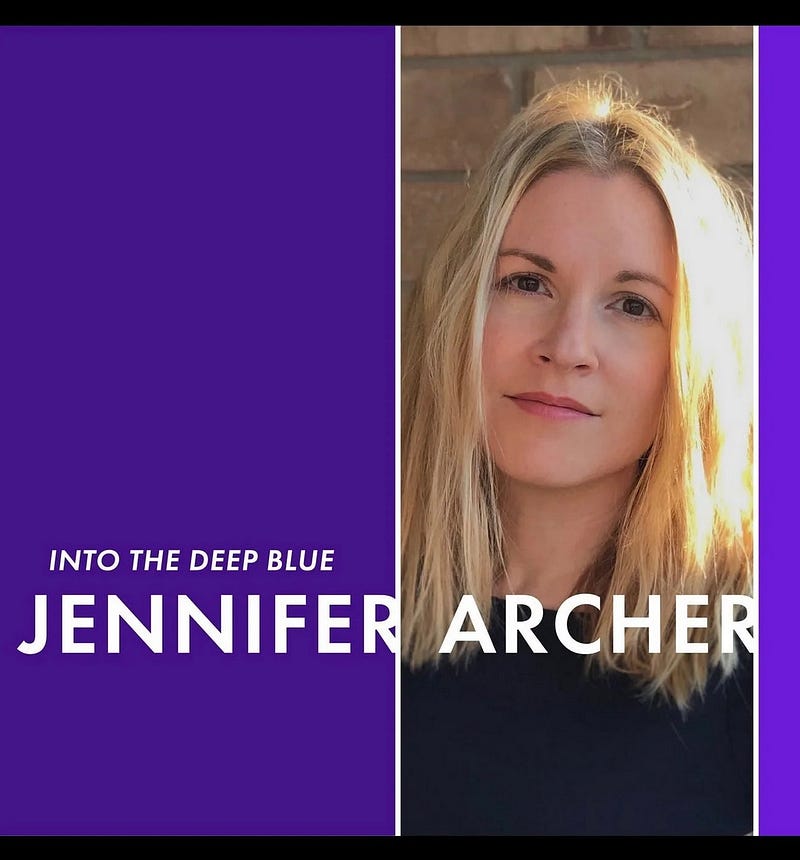
My interview with the 2022 Nicholl Fellowships in Screenwriting winner.
Jennifer Archer wrote the original screenplay “Into the Deep Blue” which won a 2022 Nicholl Fellowship in Screenwriting. Recently, I had the opportunity to chat with Jennifer about her creative background, her award-winning script, the craft of screenwriting, and what winning the Nicholl Award has meant to her.
Here is my interview with Jennifer.
Scott Myers: Congratulations on winning The Nicholl.
Jennifer Archer: Thank you.
Scott: Let’s learn a little bit more about your background. I believe you currently live in Toronto. Is that right?
Jennifer: Outside of Toronto, just north of the city.
Scott: Is that where you grew up, in Canada?
Jennifer: Yeah. In the remote north. In northern Ontario.
Scott: What was that like, growing up in the remote north of Ontario?
Jennifer: It was great. Our town was so small. It was a railroad community. There were no movie theaters, no chain restaurants. It was quiet. [laughs]
Scott: What did you do to entertain yourself there?
Jennifer: My parents put me in figure skating. That took up most of my free time. It was a two hour drive to where I would train. We would wake up at 5:00 in the morning and do that before school, then go straight to school. On the weekends, it was just playing in the woods and using our imagination.
Scott: When did you become interested in writing?
Jennifer: I’ve always loved writing. I’ve been writing since I was little, just stories for fun. Didn’t really think that it could turn into anything. Never thought of writing as a viable career. Still not sure about that.
Scott: Was there any formal education, college, creative writing?
Jennifer: I went to the University of Toronto. I took English and art history, but spent most of my time in class writing in my notebook and not paying attention to lectures. I still, at that point, hadn’t really thought of writing seriously.
Scott: You have an interest in YA novels?
Jennifer: Yeah, that’s right.
Scott: When did you move into that direction and actually start writing them?
Jennifer: It wasn’t until after the birth of my son. He was around one or two. I was staying at home with him. I started reading a lot more in the downtime. I really wanted to write. I found some online communities and met other writers and thought, “I can do this. I’m going to take this seriously and try my hand at it.”
Scott: Were you reading a lot of YA novels, too?
Jennifer: I was, yes.
Scott: Yet the thing we’re talking about is a screenplay Into the Deep Blue. How did that happen? You decided to write this as a screenplay as opposed to like a novel.
Jennifer: I did write it as a novel as well. They went hand in hand. I wrote it as novel first, except it was a messy, fragmented novel. It wasn’t like airlocked. Halfway through, I thought, I need to put this in screenplay format and see how it reads. That process activates different areas of your brain, so I sat down and adapted it over a weekend.
Scott: You saw it as a movie. Is that what inspired you to write it as a screenplay then?
Jennifer: Everything comes to me as a movie first. It’s always visual. I can see certain scenes play out.
Scott: You didn’t get an MFA or any formal education about screenwriting. How did you learn the craft?
Jennifer: Screenwriting actually came before the novel writing. I used to work in film as an assistant director. I would read a lot of screenplays and I’ve always loved the industry, so I started writing screenplays first. I read a ton of books on craft, blogs, and scripts of course.
Scott: Do you find any difference between the experience as a writer writing novels versus screenplay or anything distinguishable for you in that regard?
Jennifer: Huge differences. With novels, you get to indulge in so much more language and the inner thoughts of your characters. It’s like writing a journal. Whereas with screenplays, you really have to pare it back and look at the framework of the story and think more visually.
Scott: On your website, there’s this description, “Jennifer loves a good love story and writes them whenever she can. She writes stories rooted in reality with just a hint of magic, because what’s life without a little magic. Jennifer’s stories are always full of adventure, heartache, hope, and happy endings.”
That’s a perfect segue into talking about your script Into The Deep Blue, which did win the Nicholl Award in 2022. Here’s a plot summary for your script.
“Nick Bennett is rebuilding his life after the death of his mom, a DUI and mandatory grief counseling. Together with Fiona. Fiona, his fiery best friend from therapy, they navigate the waters of grief and their growing feelings.”
Let’s start at the beginning of the story crafting process. You wrote it as a novel. You wrote it as a screenplay. What was the inspiration for Into The Deep Blue?
Jennifer: There was a tragic world event that really affected me. That’s what triggered the story — reading some articles in the news about young people who lost their parents. I couldn’t get that out of my head. How do you cope with that?
Scott: Let’s talk about some of the key characters. Was Nick the first character to come to mind out of this? Once you had this idea of wanted to deal with teenagers and them dealing with grief. Was Nick the first one or…
Jennifer: It was both of them. It was just both of them together. I think the very first scene that I had in my head was him riding his bike through the rain to go to her house for some kind of confrontation. That was the very first seed. I kept replaying that moment and then everything else was built outwards from that.
Scott: How would you describe Nick’s situation at the beginning? He’s lost his mother in a tragic plane crash, he’s in therapy. How would you describe where he was emotionally at the beginning of the story?
Jennifer: Angry, very frustrated. Just trying to figure it all out, make sense of his loss, his place in the world and why these things happen, I think.
Scott: Then there’s Fiona, who is a member of the therapy group and also his friend, I guess you could say, best friend, it’s fair to say, right?
Jennifer: You could say.
Scott: Because she also has suffered a loss, her mother has died. How would you describe her situation at the beginning psychologically and emotionally?
Jennifer: She puts up a stronger front, and you almost get impression that she is OK just from the way that she interacts with people. I think she’s bottling a lot up inside which she doesn’t reveal until the layers get peeled back and their journey unfolds.
Scott: You make some interesting narrative choices which run counter in some respects to these conventional wisdom in Hollywood, which is often more about convention and less about wisdom. They worked well, I thought. I’m always happy to see that because there’s so many people who talk about these screenwriting rules.
To see that when stories work that don’t necessarily align with that stuff is always heartening to me because it’s like, “Yeah, go write the story you feel like you need to write.” For example, you’re reading the script. It starts off voiceover, Nick in these images. For the first 20 pages or so, it’s very clear. Nick is our guy.
Then you pivot for about the next fifteen pages or so, it shifts over to Fiona. We follow her, we meet her father, we see her at work, she has a friend that we meet.
Even the scenes with Nick feel like a little bit more from her perspective. The first question I would have for you about that was, the conventional thing is like, who’s the protagonist? Let’s be really clear about that. Would you consider them both protagonists? Did you give that any thought at all, or you just go by instinct?
Jennifer: I just went by instinct, and I would consider them both protagonists. I’ve read all of the books, and all of the rules — all of it. I’ve done the cue card thing, and plotted everything out in the past, but this one was really just intuitive. I went with who I felt the story was leaning towards at the time. Yeah, I was worried about if it would work, for sure. Yeah, yeah. It was instinct.
Scott: You start with a scene. You see Nick riding this bike in the rain to see Fiona. How did you then go about writing the story, you just threw yourself into it? Did you do any sort of outlining or anything?
Jennifer: I wrote it really out of order for this one. I started with that, and then I would go backwards. Then I think I started with the voiceover, with Nick’s voiceover. I kind of knew what the story was going to be. I just went chapter by chapter. I would alternate between the POV for the chapters, and it unfolded pretty naturally.
Scott: That’s also probably against the conventional wisdom…
Jennifer: It is, for sure.
Scott: …which is when you’ve got to have scene by scene outline with the three by five cards, even. There does seem to be a psychological structure to it, that naturally flows. You mentioned that Nick, if we talk about the five stages of grief, Nick’s in that anger stage.
But Fiona’s in a different place. I’d say, it’s a couple of times where she talks about this railing thing, I got a little worried about that. Like, “Oh, I see.” She’s at least subconsciously dabbling in that depression stage. Does that seem like a fair assessment of her character?
Jennifer: Yes, absolutely. Absolutely. There’s a bit of a ’what is she going to do’ element.
Scott: Here’s another thing where you did something that was interesting. There’s this language. I’m sure you’ve seen, that’s been floating around forever in the screenwriting universe. “What does the character want? What does the character need?” This idea of an active protagonist having a specific, conscious goal and that’s defining their want.
What strikes me, what’s interesting about these two characters, it’s more about what they don’t want. It’s like they don’t want to move forward. They don’t want to say goodbye, or towards acceptance, I guess, the end stage. Does that resonate with you? Is that something that you’ve felt going on with these two characters?
Jennifer: Yeah, I think that they’re both really stuck. They don’t know how to get through that place that they’re in, and they’re not really getting any kind of support from people around them. Well, they’ve got some support but not a lot.
Scott: But that need, it’s very clear. This really feels like one of those stories where it’s not like there is this conscious goal. It’s more about this need that’s driving them, and that’s the journey they don’t want. It feels that this is the journey they need to go on. Does that feel like an accurate…?
Jennifer: The need to let go and move on, and the resistance to that, yeah.
Scott: That leads me to another interesting choice you made. You drop us in right into the middle of their relationship, and it’s already very complex. That was probably instinctual to you. You’ve already got the first image is riding a bike towards his house, so they presumably know each other. That was an instinctual decision on your part?
Jennifer: It was. I wanted their relationship to be well on the way…Like they’re in the thick of it already and take it from there, instead of starting from the beginning and slowly getting there. We’re going through it with them and they have this history of friendship.
Scott: Yeah, I think the advantage you have in the script is really the dynamics between these two characters is very strong, really gripping emotionally. You’ve got these two storylines going on. One is the grieving storyline. One is this feeling/romance storyline that’s going on between them, their interpersonal relationship.
I thought that was quite interesting, because at times, those coalign. At times, you explore them…
Jennifer: Separately.
Scott: …more separately, correct. Let’s talk about some of the other characters in this family of characters that exists in your storyline. Some of them literally are family members. The fathers are interesting to me. Could you talk about Nick’s father, just describe who this character is, and what his personality is?
Jennifer: He just lives under the umbrella where he wants to ignore everything. He’s already moved on. He loves his family, but he doesn’t really express it in a very loving way. Love to him is rooted in the financial — I helped get you out of a jam, I gave you a job, there’s a roof over your head. He doesn’t really understand what Nick is going through, like the depth of it.
Scott: He’s had a series of girlfriends, is that right?
Jennifer: Yeah.
Scott: Including one who we meet who is quite younger that he is.
Jennifer: Right. I think he moved on a long time ago. You almost want to categorize him as the villain, but to me all of these characters are doing the best they can with the tools they have. There are no perfect parents, siblings, or friends. It’s really about not being defined by other people’s actions and choosing your own path, and I think that’s the journey Nick and Fiona are on.
Scott: He has that one exchange, I think, their last exchange that he has with Nick where he says that. He says, “She didn’t even want me to be…” It’s interesting though, the character’s name is Mr. Bennett…
Jennifer: [laughs]
Scott: …as opposed to Fiona’s dad, who’s Bob. It’s like OK, Mr. Bennett is a little bit more officious and standoffish. It’s a little bit more of a patriarchal dynamic with the son, whereas Bob, it’s like, “Bob.”
Jennifer: [laughs] Right.
Scott: Could you talk about Fiona’s dad, because he’s in a different mode. I mean, similar issues in terms of having lost a loved one, but a different place. Can you maybe give us a little sense of who Bob is?
Jennifer: I think he considers himself a superior parent to Nick’s dad, but he’s not by much. He’s avoiding the situation at home and avoiding Fiona essentially. He loves Fiona, he’s still so lost in his own grief, he’s a little oblivious.
Scott: I warmed up to him. I liked Bob. He has a couple of mentor moments there. At one time, Nick is drunk. They take him in. Sincerely speaking, he’s more supportive of Nick than his own father is. Then there’s a conversation they have about a car. I was very happy to see that he’s ready to move on by the end. It’s funny how those little secondary characters could sometimes connect on an emotional level with you too.
There’s a couple of females that I want to talk to you about who influence both Nick and Fiona. There’s Nick’s older sister, Alex. Could you maybe describe what you were going for there and who Alex is in relation to Nick’s life?
Jennifer: Alex was the rebel of the family. She was a teen parent. She moved out of the house early on. There’s a lot of conflict between them because he blames her for creating the rift between their parents. There’s that dynamic.
Scott: She’s moved on quite further in the grieving than Nick. In fact, there’s this startling revelation at some point, maybe the middle of the story, where she’s pushing Nick to write a victim statement, I think it is, for an insurance settlement. There was an airplane crash, and the airplane company is going to do an insurance payment to the family. As it turns, it’s for $2.5 million, I believe it is.
Jennifer: Yeah, she’s very pragmatic, and she’s been independent from the family for so long. She really wants that financial security for her child.
Scott: $2.5 million, a lot of money. Nick, to show again what he doesn’t want, is like, “No, I don’t want to do the statement. I don’t want the money.” He has an interesting comment. He says, “If I take the money, every time I buy a hamburger, I’d be reminded of this.”
Eventually, he does. Her primary function with that settlement, it’s like a ticking clock. It’s forcing him. If it weren’t for the insurance thing, he could just go on forever in the state of not moving forward. Isn’t that one of the main benefits that you derive as a writer is that it was propelling him to deal with this?
Jennifer: She definitely added that layer of pressure and forces him to deal with his feelings. He felt obligated to do it for his nephew more than anything, but it turns out to be quite cathartic for him.
Scott: Alex does serve a really important narrative function there in that she’s forcing him to move forward with this insurance claim. Similarly with Fiona. She’s got this friend, May, who meets Nick finally. They’re invited to a party. Then she finds him attractive. She has a moment with Fiona where she’s saying, “I thought there was a little spark there. If you don’t mind, would you have anything going on with him romantically?”
Fiona says, “No. It’s fine.” We then discover Fiona does have feelings. Is it fair to say that May exists as a way to force Fiona?
Jennifer: She makes her come to terms with her feelings, for sure.
Scott: It’s interesting how this all is organic, but if you step outside and look at it from a structural standpoint in terms of why the characters exist, you can start to see those dynamics there. Because you came at it from an organic way, the characters are lively, vibrant, and unique. Nick is an aspiring writer.
Jennifer: Mmhmm.
Scott: You get a personal point of connection there. You get this wonderful runner in the story. I’m just curious where this came from. Fiona asks Nick from time to time, “Happy ending this for me.” Where did that come from? Just that idea. It’s repeated like three times.
Jennifer: It is repeated. I don’t know where that came from. It started in the book. It’s something that came out once through stream of conscious writing. Sometimes you have an idea that comes out once and you’re like, “I’m going to latch onto this and it’s going to repeat.” It really becomes a coping mechanism for both of them.
Scott: That’s one of those, the magic of writing. Wrangling magic. It’s a lovely thing. It works very wonderfully in the story. There’s a theme that because of the happy ending thing, it probably ties into that, strikes me that happiness is a theme in this story. It’s an existential question.
Nick actually says to Grace, the therapist, “I don’t know, Grace. I think happiness is an illusion. It’s a product manufactured in books and movies, and everyone buys into this idea that it’s an attainable life goal but it’s all really pain management.” That’s him starting off pretty early in the process.
Were you conscious that there is this theme of happiness? Is it possible? If so, how conscious were you of that in the writing of the script?
Jennifer: Very conscious of it. Life throws us so many curveballs. I think everyone goes through phases of questioning this idea of happiness.
Scott: It feels to me like there’s these layers going on there. There’s probably some survivor’s guilt that’s underneath the anger and the looming depression. Out of that perhaps, do we deserve to be happy? Not like it even is it possible, but do we even deserve it? That’s a complicating factor in terms of their budding romance, isn’t it?
Jennifer: They each have so many issues. In the beginning, there’s not a lot of room for them to even recognize their feelings for each other because they’re dealing with so much independently.
Scott: I don’t want to give away the specifics of it, but the arc of it, these flawed, frail people living with trauma and tragedy, can they find happiness? Can they recognize what they have inside, which is these feelings for each other? Are they going to finally get through this balancing between the grieving storyline and the romance storyline?
One thing that was interesting is you got a set of objects along the way. I call them talismans, physical objects with a symbolic meaning. They’re symbolic of their moms and the attachments, almost like negative attachments because they can’t move forward.
For example, there’s Nick’s mother bucket list, which she got halfway through and didn’t finish. There’s a fancy bottle of Fiona’s mother’s skin cream, which she keeps. There’s Fiona’s mother’s camera with some photos.
There’s a dramatic scene that speaks to this thing about objects in the story where at one point, Fiona deconstructed. I think this is after when she’s really frustrated that May’s seeing Nick, and Nick hasn’t responded. In the script, it says, “Fiona sits at her desk. A gymnastics photo holding a trophy next to her proud mom beside her. She can’t breathe. She tugs at her shirt.
“She puts the photo on the floor. The entire room closes in on her. The trophies, ribbons, all of it. She eviscerates the room. She pulls everything down, tosses it all in a bag. She even rolls up the rug and removes her blue duvet cover. She empties her desk, pushes it into the hall, carries the empty drawers outside to the curb and drops them.”
It’s like a symbol of trying to disassociate yourself or disconnect from those attachments. Is that something you were conscious of, or again is that an organic thing?
Jennifer: I was conscious of that. She reaches a point where she’s feeling the weight of all of these memories and these reminders of what her life was, and she wants a clean slate. She’s trying to figure out who she is now.
Scott: Another one of those objects that I thought was an effective one is the baton.
Jennifer: I love the baton. [laughs]
Scott: I do too, because at one point, he’s so frustrated. Nick does write a series of these little victims statements, but he keeps erasing them and ends with a great line on which I won’t mention.
One of these more honest ones he says is, “To the airline industry, you guys fucked me. You fucked her happy ending because if she was alive, there was a solid chance she would have left to him, her husband.
“You know what that bucket list was, a countdown, and every time she crossed off another number, she was that much stronger, that much closer to making, and I wanted her to make it. You stole her happy ending. Where does that leave me? Now I have to pick up the baton because I still have a shot.
“Maybe I can be the one who makes it. Maybe I can have the happy ending. How can I do that South American Airlines? When the baton lies and ruins somewhere in the middle of the Amazon, what am I supposed to run with?”
You have this thing which is going to races. Later on, he’s in a hotel and this kid’s playing in the pool. It’s a baton.
I thought it was such a great symbol. It’s like, “Are you going to carry your mother’s story or are you going to be free?” You were talking about Fiona. Do your own story. That’s what’s going on with that, isn’t it?
Jennifer: Absolutely. The baton idea came out through free writing when I wrote his monologue. Then later on, when the pool scene came up, I was like, “OK, so there’s this kid in the pool, and what is he doing?”
I thought, “Oh, man, that’s perfect. That’s so good.” That whole scene is symbolic to Nick on so many levels and it worked beautifully.
Scott: I don’t want to give away the ending other than to say it is a happy one. In fact, when you type the final words, we always say fade out the end. You typed “THE ^VERY HAPPY^ END.” What were you feeling when you typed that? I was imagining what feelings might have been going through when you managed to type a very happy end.
Jennifer: Joy, relief. You know that, ‘Somewhere Over the Rainbow’ song, the ukulele version? I heard that in my head. It felt good. It felt joyous.
Scott: In Hollywood, you have to earn it. In order for these characters to do this, they have to earn one. You do feel like they have earned it. These two do deserve to be together.
Jennifer: They really do.
Scott: Job well done.
Jennifer: Thank you.
Scott: More congratulations for you. Let’s talk about the Nicholl experience. Maybe walk us through the whole, “Oh, you made the quarter final, semifinal, final, then the Nicholl week.” What is all that like?
Jennifer: It was so crazy. I didn’t think anything would come of entering. Even this experience is so crazy because I would always read your interviews with the past winners. Last year, I was reading your interviews, and I remember being so depressed and thinking, “That’s never going to be me.” And here we are. This whole experience is so surreal.
I would keep getting the advancement notifications, and I didn’t think anything of them. I’d think, “OK, well, that’ll be the last one.” I didn’t even tell anyone until the quarter finals, then I told my parents, and I said, “But I won’t make it past this, so don’t get excited.” Then it kept progressing, and I’m still so shocked.
Scott: Did you do the whole LA thing?
Jennifer: I didn’t, because I was pretty sick at the time. I was unwell throughout the final calls. I remember before the final call, you have to spend a few hours on Zoom in a waiting room.
I was like, “Mom, I don’t think I can do this.” She said, [laughs] “Yeah, you can,” and I said, ”I’m going to fall off the chair. I’m going to pass out.” So, I was feeling horrible, but it was awesome. [laughs]
Scott: That’s a metaphor for writing there. It can be a joyful experience, but also…I’m glad you’re feeling better and you’ve got even more to feel better. I’m reading the trades a couple of weeks ago and they’re going to make your movie.
Jennifer: Yes! So excited.
Scott: Sabrina Carpenter, terrific young actress. I remember seeing her in Emergency at Sundance last year. She’s going to star as Fiona. You’ve got a director. They’re going to film it in the UK. Is that right?
Jennifer: Yes.
Scott: What was that like?
Jennifer: Really exciting. Sabrina is such a powerhouse of a performer. She’s amazing. I see so much of Fiona in her and she’s going to crush it. So excited!
Scott: This is what I tell my students. I say, “Unless you’re writing Marvel movies or Star Wars or whatnot where the spectacle is the star, you’re writing scripts that you hope actors will respond to those parts.” I joke with them I say, “This is why characters are so important. Care. Actors. You want the actors to care about your characters.”
This is a good example where she read the script and responded to Fiona. Now you got a movie in the making, so good luck to you on that. I look forward to seeing that happen for you. Let’s jump to a few craft questions if you don’t mind. I’d be curious to see how you track some of these things. How do you come up with story ideas? Is there any set process? I imagine it’s more intuitive for you.
Jennifer: It is. It’s completely intuitive for me. Usually when I’m working out, or driving, things will pop into my head and I write them down.
Scott: What about prep writing? If you’re going to be moving into screenwriting, certainly if you’re moving into TV writing, you’d have to adjust your pattern a little bit more in terms of breaking story. What do you do in the way of character development? You had a scene where Nick’s riding his bike over in the rain over to Fiona’s. How did you get in touch with those characters and how did the story evolve for you?
Jennifer: It’s almost like journaling, being in their headspace. I love a voice-y first-person narrative in books. Writing really does feel like an extension of journaling — writing from their POV. I feel I really need to embody a character to develop them. Sometimes when you just assign traits to character it can ring a little hollow.
Scott: That’s what I do with my students. You sit down. Literally what I say, get into their headspace. Almost a meditative type of experience.
Jennifer: Yeah. It’s like you have another person living in your head. You can’t stop hearing their voice. They’re talking to you all the time. [laughs]
Scott: You’re journaling. Exactly. That’s great. The dialogue in your script, it just feels authentic. Obviously, I’m not a young, but it’s also really smart. The dialogue is what? Just them talking and you’re shaping it into a form that works on the page?
Jennifer: I just imagine them talking, and actually hear the conversation play out. Sometimes I have the conversation with myself out loud. I write it from that.
Scott: I’m reminded of that August Wilson, the great playwright was asked once, “How do you write such great dialogue?” He said, “I don’t, they do.”
Jennifer: That’s so good. So true.
Scott: How about themes? Do you think about them at all? Or if you do, is it something it’s up front of the process? Or did you discover it stuff like that along the way?
Jennifer: Usually themes come into focus during revision, I think. I feel like first I get the framework onto the page, and then as I’m revising, I’ll start to pick up on the different threads of themes. Then you dive back in and you reinforce those threads.
Once you notice themes that start appearing, then you can find places in the story to build them up a little bit more.
Scott: That sounds like you have a framework again, like what I tell my students. I say, “Sometimes you’re inside that story universe, and you’re trying to receive from them, but then there are times you step outside particularly when you’re revising,” some executive thinking where you’re noticing things like themes. Is that a fair assessment of how you approach the process?
Jennifer: It is. Absolutely, yeah. You have to do that. I don’t love revising. [laughs] I don’t like the stepping out part. I love being in the immersive drafting free writing phase.
But it can be the most rewarding part because that’s where you start to see these connections and threads that you can pull on and where the story really grows.
Scott: Well, hopefully, you’ll write such great material that people on the other side putting the money up to make movies will say, “Let’s shoot it as it is as opposed to getting script notes.” If that’s the part that you don’t like then you may have to develop a bit of an embrace of that process.
Jennifer: For sure.
Scott: Let’s talk about your writing process. Do you have a specific thing like your work regimen, or do you have a more organic load of the writing process? Do you have a schedule? Where do you write, at home? Do you go someplace? Do you listen to music? You don’t listen to music?
Jennifer: I do listen to music usually when drafting not so much when revising. I write at home, I could never write in a cafe or public space. I love to write in my bedroom, on my bed [laughs] in my little cocoon. It’s like a cozy safe space. I don’t really have a set schedule. I used to prefer writing at night, but I’m slowly embracing mornings.
Scott: What do you love most about writing?
Jennifer: The euphoric feeling when a story comes together. It’s fleeting, but there’s nothing quite like it. Mental healthwise, it does so much for my headspace, being able to create, and the problem solving. It’s so gratifying. I find that when I don’t write, I feel a void, and I really miss it.
Scott: Are you going to continue to write both novels and screenplays?
Jennifer: I would like to. Yeah.
Scott: Have you thought about 10 years from now, perfect world, what would Jennifer be doing?
Jennifer: Oh, gosh. I would love to be producing as well. There’s a lot of young adult material out there from other writers that I know would be great in the film space. I’d love to bring some of their work to light too. That would be interesting.
Scott: Now, here you are. You won the Nicholl. If you ever show up around Toronto or you’re in LA or whatnot, you’ll probably be with friends, people you meet will ask, “What advice do you have? I’m interested in writing. What advice do you have for me?”
There you go. That’s the big question for you to wind this thing up. What advice do you have for someone who wants to develop a craft as a screenwriter and a writer?
Jennifer: Everybody says, keep reading and writing. Those are big ones, but don’t just read — read critically. Spend ten minutes writing down what you like or dislike about a project after reading, for your eyes only. What did you love/hate about the characters and story? It helps!
And find some trusted critique partners. Finding good ones can be like finding a needle in a haystack, but they are invaluable. Mine have motivated me, pushed me to my limits, and have become my dearest friends. Writing, while rewarding, can be a lonely, difficult journey. Find that support, it makes a world of difference.
To learn more about the Nicholl screenwriting competition, go here.
For my interviews with every Nicholl Fellowships in Screenwriting winner since 2012, go here.