Go Into The Story Interview: James Ponsoldt
An exclusive conversation with the co-writer and director of the drama film Summering.
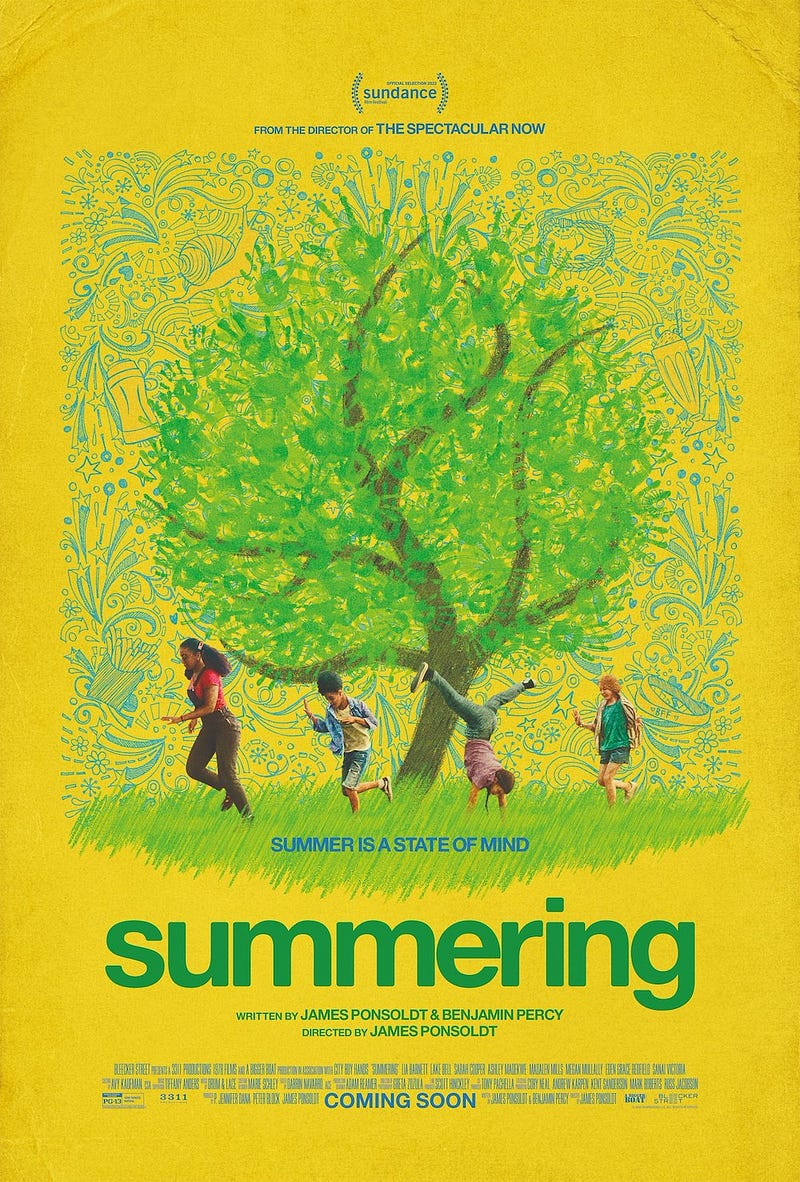
An exclusive conversation with the co-writer and director of the drama film Summering.
One of my “Best Of” movies from the 2022 Sundance Film Festival is Summering. Co-written (with Benjamin Percy) and directed by James Ponsoldt (The Spectacular Now), it is an engaging drama from the perspective young adolescent girls.
IMDb plot summary: During their last days of summer and childhood — the weekend before middle school begins — four girls struggle with the harsh truths of growing up and embark on a mysterious adventure.
I had met James at a Black List event in Las Vegas in 2013, so when I screened Summering, I reached out to him for an interview. Here is a transcript of that conversation.
Scott Myers: I want to start with some comments you made when Summering debuted at the Sundance Film Festival, which is where I saw it.
You said, “It’s a film about female friendship that seeks to dignify the emotional inner lives of the protagonists. It was born out of a desire to see better films to present people like my daughter, my sister, my wife, and my mother. This is a film for every generation, for parents and for children.”
How did you go from that desire to make that kind of film, to the actual storyline that’s at the heart of Summering?
James Ponsoldt: The inciting incident, as it were, not for the story, but for the idea of the story, was that there was an older man found dead, not so far from where we live, and he could not be identified.
Still, to this date, I don’t believe has been identified, which in a city like Los Angeles is not such an anomaly. Every year or two at Evergreen Cemetery, they do a mass burial for the unclaimed, unnamed dead, and it’s over 1,000 people; men, women, and children.
In this case, it felt to me like to not even receive the dignity of being named when you die was a signifier of a larger, deeply troubling breakdown in our social contract with each other.
I began to talk with friends and family, and with my children, about it, and about issues related to equity and justice and issues related to structural violence that can lead to someone being unhoused, to divorce, to addiction, to toxic masculinity. All of these things that can run around that and be a part of that.
I really tried to listen to my children and hear their thoughts and feelings on it. The way that they approach the world is obviously quite different than I do. I realize that there’s a hyper‑rational approach that has happened in middle age, that wasn’t always there. I was reminded that children process trauma through imagination. That’s one of the tools they use, in a way that might not always be as obvious, and they might make decisions that we definitely would not make.
I think a lot of the artists that I love, part of what they’re doing is just tapping into that imagination of childhood, and to not judge the characters, and to lean into and embrace the subjectivity of the experience of those characters; their age, their gender, their race, their situation in any number of ways. That’s part of their desire as storytellers.
It was pointed out to me recently that aspects of the story have been creeping up in things I’ve been making for a long time. My thesis film in graduate film school was about a single mother and her daughter. Jeanine Garofalo played the mother. I guess in many ways, she could have been a character from this film.
Benjamin Percy, my co‑writer on this, we met over 15 years ago at the Sewanee Writers Conference, and then he wrote a short story called “Refresh Refresh.” That was in The Paris Review and Best American Short Stories.
That was about toxic masculinity. It was about young men and violence in the high desert of Oregon; teenage boys whose dads are Marine reservists that are activated and deployed, and about these fight clubs that the boys create and videotape and send to their dads to green zones in Iraq and Afghanistan, to show them that everything’s okay.
I adapted the story and went to the Sundance Screenwriters Lab, where I developed it with people like Ron Nyswaner and Atom Egoyan.
I did not get to make it, but while I was in the process of trying to make it, a graphic novelist named Danica Novgorodoff read my script and said she wanted to turn it into a graphic novel, which I found to be such a fascinating idea, and she did.
She made a remarkable adaptation of an adaptation that created a whole new lens on which to look at the subjectivity of the experience of these people. Her graphic novel was ultimately selected for Best American Comics selected by Alison Bechdel.
Ben and I, at that point, began talking about violence in young people and structural violence in young people.
Our lives had paralleled each other to some degree. We both have very close relationships with our mothers and sisters, and both have children. We both have daughters. He was someone that I talked to, early on as this story was stewing around, and we began to develop it together.
Scott: There are these four girls in the movie: Dina, Lola, Daisy, and Mari. They’re just about to cross a threshold. Literally, in the next few days, they’ll be entering middle school. Do you remember the thought process behind that, the significance of that threshold?
James: Yeah, absolutely. It was very intentional. That age, just before middle school, this is the very end of summer, last nine days of summer.
Kids develop on a spectrum. Boys and girls develop in different ways as well, but if you take four kids at that age, they won’t all be the same in their emotional inner life and their development.
You will have kids in some ways that will externally present as maybe still innocent, still childlike, still use their imagination, still live in the Terabithia of their imagination, as it were. You might have another kid that is already, because of life experience, trauma that’s happened to them, might present as a world weary or cynical, might feel more like a teenager.
Then if you catch them a year later, by the time they’re in seventh grade, it’s like they’re all essentially doing teenage cosplay.
I wanted to look at that moment in time, when kids are not quite adults, and they approach trauma and a fear of change, and the anxiety related to that, the anxiety related to losing their friends, where that fear of losing your friend might be more front of mind and real than the fear of death, which might still be abstract, until it’s not.

Scott: The very opening sequence, they’re doing this little walk through the woods. One of them says, “What if every step you take goes backwards in time?”
I took that kind of a double meaning, because there is a liminal quality to the story. It’s set in this interesting timeless rural environment. The woods feel very mythical. There’s ghosts and magic.
There’s that, but then it’s also, like you were saying, going backwards in time because there’s an emotional subtext about fear of going forward. Does that track pretty much what you’re going for?
James: Yeah. As you said, when they’re in the woods, there’s a pastoral gothic quality that’s much of their own creation, in their minds. It was important to me that these are kids, they’re not growing up in the middle of nowhere, so to speak, nor are they growing up in the heart of Los Angeles or New York.
Their adventures, much of them take place within 10 minutes of the suburban homes where they live. Those are the exact same places that, for them, might be their Terabithia, and when they’re teenagers that might be where they go to make out or smoke pot or whatever the teenagers are doing. Those are sometimes the same places.
It was important for me that it feel…it’s a story that takes place now, but I didn’t want the specifics of place to make it about that place.
It is the end of summer. It was important that the world feel at times beautiful, but not too beautiful, to not be sentimental. Maybe there are the bright warmth of summer, but with dark shadows around the edges.
If they’re going to town, maybe the businesses are all shuttered up. Things are changing, and the sprint to adulthood, maybe it doesn’t need to be a sprint.
Scott: I’m a big Pixar fan, and I’ve talked to a lot of their filmmakers about how they traffic in human sentiment, like emotion, but they don’t get sentimental and veer over to melodrama.
Your movie, same thing. It’s got this kind of innocence of the era of Nancy Drew/Hardy Boys mysteries, but there’s also divorce, parents dealing with alcohol dependency, the place of religion in one’s life, and other very contemporary, realistic issues.
How conscious were you of trying to find that balance between not veering over into melodrama, and yet trying to make it as grounded as possible?
James: Very conscious. Obviously it’s a tightrope walk that you’re navigating, especially if you’re leaning into the subjectivity of the characters, for whom middle school could feel like a horror film that they’re about to walk into, and embracing that.
And, in many ways, embracing the tropes of a detective story, in a world where maybe it’s not the Maltese Falcon that’s playing on their TV, but maybe it’s just a basic cable procedural like a Law and Order that’s playing on in the background, where there’s the 10,000th dead female who is never named, that serves only to be a catalyst for a journey of a male detective, to not be given real agency and real centrality to a story.
That is the world that these characters are living in. Those are the things I wanted to explore.
Yet these are characters that also can be incredibly earnest, and earnest in a way that I think can be very uncomfortable for people when they’re older, sometimes, to hear, and men to hear, because the way that a lot of people, and especially men, articulate themselves and talk about their friendships and their fears isn’t always as central to their lives.
The flip side of that is the fear of losing friends if they’re that important to you. The fear of losing friends can be devastating, and it doesn’t go away.
I’m thinking of my wife and her friends, and the idea of juggling a career and parenting while maintaining friendships is a lot, and the idea of making new friends, friends that meant what your friend group meant when you were younger, it seems impossible, or can feel impossible.
Here is a trailer for Summering:
Summering is equal parts drama, mystery, and thriller, and because of the female leads, an ideal movie for families with girls between 8–14.
Twitter: @jamesponsoldt.
For 100s more interviews with screenwriters and filmmakers, go here.