Go Into The Story Interview: James DiLapo
James DiLapo’s original screenplay “Devils at Play” not only won the young screenwriter a 2012 Nicholl fellowship, it also landed on the…
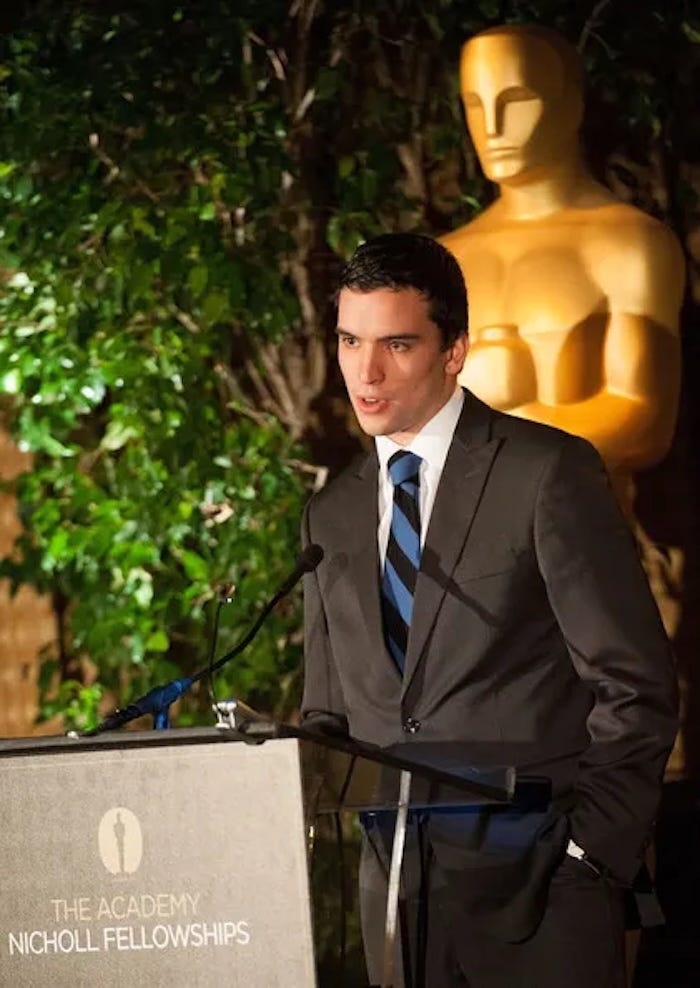
James DiLapo’s original screenplay “Devils at Play” not only won the young screenwriter a 2012 Nicholl fellowship, it also landed on the 2012 Black List.
As part of ongoing Nicholl series, here is my 2013 interview with Michael in its entirety.
Scott: How and when did you become interested in movies?
James: It’s something that’s been a part of my life since I was a little kid. Some of my earliest memories are watching films with my family. When I was growing up, my dad really gave me a film school education. He was a big fan of the old Al Pacino Robert De Niro films. He loves movies from the late ’60s and ’70s. So I remember from a young age watching Dog Day Afternoon with him. Serpico, Apocalypse Now, Bonnie and Clyde. I think that’s where the joy of this came into my life.
Scott: When did you become aware of the fact that people actually wrote movies? What about that aspect of the craft that interested you enough to pursue it?
James: I don’t know necessarily when I figured out there’s people who actually write them, but I was sort of just doing that in my own head as a little kid. I would come up with the ideas for movies, and work them over and over in my imagination. I would live with them, and I still do with some of those stories.
Scott: I understand you moved like dozen times before you went to college.
James: I moved around a lot. The longest was in Portland, Oregon. Then after that, I went to Columbus, Ohio and then New York City for college, then Minneapolis. So the longest part of my growing up was Portland.
Scott: You went NYU and studied screenwriting and history. Is that correct?
James: Yes. I had a major in screenwriting and a minor in history.
Scott: Why that combination? What was the interest in history?
James: They both have always just been huge passions for me. I didn’t take history classes for stories, I think it’s just important to try to branch out and find as many different things that fascinate you as possible.
Scott: You were a recipient of the Michael Collyer Memorial Fellowship in screenwriting, from the Writer’s Guild of America East. As part of that fellowship, you were mentored by some professional screenwriters while working on your script, “Devils At Play”. Who were those writers and what was that experience like?
James: My mentor on the project was Richard LaGravenese. He was great. He taught me some really important lessons. The one that sticks with me the most is that when it comes to story telling you have to strive for a sense of emotional authenticity at all costs. Emotional authenticity, even with a period piece, is more important than historical authenticity. If you can get the audience to feel as if they are there with the characters in that setting, experiencing the world that they are in- that’s the closest we can come to being there. We can’t recreate a world, but we can recreate the emotions of it.
Scott: How did the chain of events play out, with regards to “Devils At Play” and the Nicholl Fellowship?
James: I got the idea for “Devils At Play” during college, and I was fortunate enough to receive a fellowship from the Writer’s Guild East after I graduated to write it. So there was about a year after graduation when I was just reading very big red books on the Soviet Union, working crappy part time jobs in New York City, and writing “Devils At Play.” When I finished it I wasn’t entirely sure what the next step would be. I submitted it to Nicholl and waited. When I won it completely changed my life.
Scott: What happened then to you professionally?
James: The Nicholl Fellowship has crated opportunities for me that I would have never had before. I think that’s the real gift of the fellowship. It gives you the chance to reach out to this industry and find people who want to work with you. I was an outsider before this happened, and it’s completely changed everything. I’m very, very grateful for that.
Scott: You’re represented by Verve and Kaplan/Perrone. How did that come about?
James: I first met my manager first, Alex Lerner from Kaplan/Perrone, while I was in Los Angeles for the Nicholl ceremony. We clicked really well. Your manager is kind of like your partner-in-crime. You got to pick someone you trust, someone who will have your back. Alex is that guy.
Getting my agents at Verve is kind of a funny story. I went back to Minneapolis in December to visit my folks, and the guys at Verve called me up out of the blue one day and said they wanted to work with me. I told them I appreciated that, but wasn’t going to make a decision on picking an agent until I moved to Los Angeles in a few months.
“Okay,” they said. “We respect that.” They hung up.
A few days later they called me up again and told me that, respectfully, I didn’t have time to wait on picking an agent because the Mayan Apocalypse was coming. They told me that the world was about to end in a fiery explosion, so we had to act fast and sell a script before we all died. I told them that I appreciated that, but again I was going to wait.
“Okay,” they said. “We respect that.” They hung up.
A few days later they called again. This time they assured me that I had to sign with them because they were very handsome, far more handsome than any other agents I was going to meet. They just kept going at it. To be honest, I was really impressed with how much they were willing to hustle. They got a great sense of humor, but they’re also true professionals. It’s been amazing working with them and Alex. It feels like I’ve found the right people.
Scott: You’ve moved to LA now, right?
James: Yes sir, I moved here about a month ago.
Scott: And how has it been so far?
James: Moving from New York City to Los Angeles is kind of a surreal shift. And spending all your time in cars is especially is a unique experience for me, but you get to drive around blaring hip hop, so it’s got its perks. I miss New York pizza, but the writing’s going well here so far, and that’s the most important part.
Scott: I’ve heard a ton of acceptance speeches, but not one like yours where you spoke at the Nicholl ceremony, where you jokingly offered to offer up one of your body organs for the opportunity to write a specific movie. Can you explain what that was about?
James: Yeah, so the offer still stands. I said at the award ceremony that if anyone from Disney wants to bring me in to discuss working on a Star Wars film I will give them one of my kidneys. My manager wants me to negotiate on that, maybe start with a spleen and work my way up, but I disagree. Let’s show them I’m committed, I say.
Scott: So above and beyond the Al Pacino movies in the ’60s and ’70s, you were a big Star Wars fan, I take it?
James: Oh, yeah, absolutely. The Star Wars films broke open my imagination as a kid. If you want to become a story-teller, I think one of the best things you can have is an creative world like that to engage with. As a kid I use to make up my own Star Wars adventures and characters. It was a perfect entry point to telling my own stories.
Scott: Let’s talk about your Nicholl winning script “Devils At Play.” Here’s a logline I found for it:
“In the Soviet Union, 1937, a worker of the People’s Commissariat for internal affairs finds a list of traitors, which he thinks is going to be his way out.”
What was the inspiration for this story?
James: I was cramming for a mid‑term for a Soviet history course at NYU. I was reading a book by Robert Conquest called “The Great Terror”. There is a chapter in there where Conquest breaks down what the arrest process was like. When you’re arrested, how many people could you expect to share your prison cell? What were the strip searches like? When you were interrogated, what were the sort of methods they would use?
Reading that, reading the details, I started to see flashes of the story. It was inspiring, but it was a script that I knew would take a very long time to research. I didn’t have the time to devote to this project until I graduated and received the WGAE Fellowship.
Scott: Putting on a conventional wisdom hat, right? You’ve got a period piece set in the Soviet Union in the 30’s. You got a deeply flawed protagonist. There’s a lot of violence, and torture. There’s no real love interest per say. You used flashbacks, which some people in Hollywood aren’t fond of. The conclusion, which is beautifully realized, is definitely not your typical Hollywood happy ending. Were you aware that this script was cutting against conventional wisdom on so many fronts?
James: To be honest, I didn’t think about that. I just tried to tell a story to the best of my ability. I think it becomes problematic for us as screenwriters to create only what we think is going to sell, or only what we think is going to attract attention. It’s better just to write as well as you can, and hope that it creates opportunities for you afterwards. At the end of the day, you just have to tell the stories you want to see on film. That will be your best writing.
Scott: What about the story made you think this can be a movie?
James: I think we have a tendency when we discuss this time period, whether it’s Nazi Germany, or the Soviet Union, to see it from the view-point of the victims. What it was like to be oppressed by these nations, for example. I think it’s more uncomfortable for us to tell a story from the other side of that perspective. What was it like to be the secret police? That involves us imagining that there are perhaps darker sides of our humanity. That was something I wanted to address with this story.
Scott: You talk about this idea that Richard LaGravenese talks about emotional authenticity. For a historical piece, too, you also, one of the thresholds you have to accomplish is create a sense of plausibility about the world, a sense of realism there, too. You did that incredibly well. I mean, all these little tiny details, suicide nets and things like that. How much research did you do and what type of research was it to create that sense of verisimilitude?
James: When it comes to the details of the world, I mostly read textbooks and historical non‑fiction. I tried to find as many specifics as I could, while also giving myself the creative freedom to build the narrative that I thought would best serve our story.
Scott: Are you familiar with the idea that JJ Abrams talks about promoting the mystery box?
James: No.
Scott: He has a TED talk. Basically there’s this thing called the mystery box, literally a box that evokes mystery. JJ uses it to remind him to create mysteries in his stories, big and small. You do that really well with “Devils At Play,” especially at the beginning.
The script starts with this little snippet of a dream or a memory of this wintry field with a fence and barbed wire fence, and so immediately, we’re like OK, what’s that. Then your Protagonist is winding his way through the prison headquarters where he passes by some guys carrying a body bag, and there’s movement inside the body bag, but we don’t know what that is. And then quite literally a character gives him a box, the contents of which the script doesn’t reveal for pages, and again, it’s like what’s that? So I guess since you don’t know about the mystery box, that was kind of an intuitive thing on your part, where you’re planting these little mysteries, and pulling the reader into the story. Was that a conscious effort on your part, or was that an organic thing?
James: It wasn’t something I did consciously, but what I wanted to do was get the audience to actively engage with the setting. I didn’t want to have a cue card of the opening that explains the backstory. I didn’t want to preface this with exposition. I wanted to just put us there with the characters and turn the audience into detectives during the first 15 minutes of the film, piecing together what is going in. You’re rewarded for it, I believe, because it makes you understand the setting and it’s politics, and that energizes your brain for the process of being in a detective story afterwards with a mystery at its core. Now you’re searching for the clues. Now you’re putting the puzzle together along with the protagonist.
Scott: Yes. And it works very well. The story has a lot of twists and turns in the plot, and yet as I read it, it feels like a story of three acts. Act One, you set up a story world. Act Two, the commencement of a competition between two key characters. And Act Three, where all the threads play out to a final struggle and resolution. Did you consciously work with that as part of your approach, three act structure, or was that, again, an organic expression of your process?
James: I’m a very big advocate of three-act structure. It doesn’t have to be terribly overt in your story, but I think it usually needs to be there, and the more you practice it the more it intuitively and naturally enters into your writing process.
Scott: But speaking of this idea of the competition, it’s a rather twisted thing. It’s a race between Stepan and a character named Volkov, basically his rival, to be the first to land 100 traitors, or supposed traitors, in order to get the transfer of their choice. Stepan definitely wants to get out of this environment. Was that something you hit on early on in the story crafting process? Because it’s an important choice, it provides a spine to the plot, dramatic tension, and a ticking clock.
James: It was on one of the earliest things I thought of. There are a lot of stories in the Soviet Union about workers being pushed into very crazy competitions, not so much in the police departments- but if you were in a factory worker, how much could you do in a day? If you were mining, how much could you mine per day, pushing people almost to an absurd level of exhaustion and mental trauma. I thought it could be very compelling to put that sort of strain into the mindset of the secret police. How it would warp them, how would it play off the sadism in their minds. It is a game they get to play now with human lives.
Scott: Would you consider the story’s protagonist, Stepan, to be an antihero?
James: It’s a redemption story, so I see him as a hero. He has a very dark road to go on, but it’s a quest to eventually absolve his soul.
Scott: We hear talk a lot in Hollywood about giving a protagonist a flaw, but with Stepan, you go much deeper in that he’s a radically conflicted person. We see enough of him to learn that he’s capable of both humanity and monstrosity. What are you trying to get at in exploring his journey?
James: I wanted to put the audience in his mindset. To show them that there is the possibility within the human spirit for both for great cruelty, but also for great redemption and acts of heroism. It became this high wire act. Can we root for him while he’s doing things that get more and more morally ambiguous? I didn’t want us to turn against him as a character. I wanted us to be capable on some level of sympathizing with him, even when he’s down the darkest path possible.
Scott: That makes this story so much richer. You do such a great job of hitting that point of exploring the dark side of the character, Stepan getting in touch with his shadow self, but also dropping in these moments of humanity. You see human side of him, and we’re rooting for him to get out of this prison environment. It becomes a really interesting psychological experience for a reader to keep himself going on this journey with him.
James: Yes, sir. You said it better than I did.
Scott: There’s a side of dialogue from Stepan, it’s almost exactly mid‑way through the script. It strikes me as a classic moment of transition, of what is going on with him, and this prisoner Dmitri, who Stepan desperately needs to break to get information critical to his goal of winning a competition. I’d like to go to that side, and break it up into three parts, and get your reaction to each. Stepan starts, he says, “I hate torture.” “I hate that torture has become the tool we use.” “Getting a suspect to confess with it is like cheating.” “I know that every suspect I tortured into a confession probably was innocent.”
Is this speaking on some level to the post 9/11 consciousness, and about the current conversation we’re having about torture?
James: As far as current events go, I wrote this without the intention of it being a parallel to any specific point in human history. I think you can draw from this connections to other moments, but there is a singularity, and a singular shame, to this period of Soviet history that makes it deserve to stand apart. I wouldn’t like this script to simply be an indictment of the war on terrorism. I think it hopefully speaks to a broader point about society than that.
Scott: Then the second part of this side is the process that, “but now for the first time, I know I have a guilty man sitting before me, a conspirator, a liar. His confession is the only way I will ever get out of here. “That seems to me to sum up very nicely his conscious goal, I guess you could call it, his warrant, to win the competition in order to get transferred out of this hellhole existence. That’s pretty accurate, right?
James: Yes, sir.
Scott: Then the third part, so he says, “So what am I going to do, Dmitri? Am I going to go down that path again? I’m not an animal, but this place, it wants to make me into one. I’m struggling, I’m struggling to stay a man.” That middle part really sums up his conscious goal. Isn’t this more of a summation of his need, in a way, to rediscover his humanity?
James: That line of dialogue is the exact midpoint of the film. Hopefully it speaks to the emotional stress he’s going through, but also that his goal is worth pursuing even beyond logic. He wants to convince himself there is only one version of reality in front of him. “This is an enemy of the state, this is an evil man. I have to do what I have to in order to break him.” That line is someone trying to trick himself into believing in his own cause.
Scott: It really concretizes very nicely a question that the reader carries with him for the script, which is, will he somehow find his humanity, or will he lose it? It is like literally in the middle of the script, right at exactly the midpoint, so it just struck me as being a terrific transitional moment.
James: Thank you. I think act structure is extremely important. The midpoint is very crucial. It doesn’t have to be as overt as it is in the middle of this script, but there needs to be that transition on an emotional level for the character, from reactive to active.
Scott: You mentioned that this is a story of redemption, and I absolutely picked up on that. In fact, would you say that at one level, this is a story ‑ at least metaphorically speaking, not theologically, necessarily ‑ it’s about sin and redemption, what Stepan has done and does some terrible things, but in the end, by saving the lives of a woman and her daughter, he is in effect saving himself?
James: Yes, absolutely. This was a period in Soviet history where there was a lot of militant state-sponsored atheism. I thought that was a very fascinating setting in which to tell with what is really a religious story of redemption without ever mentioning God. Theirs is a very interesting quote by Alexander Solzhenitsyn. He tries to sum up what he thinks went wrong in the Soviet Union, and all he can really bring himself to say is that they forgot God.
I think that, regardless of whether or not as an audience member you have religious views or belief, I still think that there is a sense of redemption, a sense of spirituality, which permeates any society. How it plays into Stepan’s transformation was important to me.
Scott: A transformation. He literally has…the denouement at the end is almost like a transfiguration moment, this kind of hyper‑reality, almost transmigrating to heaven kind of a thing. It’s spiritual, that way, isn’t it?
James: Yeah. I wanted to show the audience that he’s at peace. Heaven doesn’t factor into this, or damnation. His soul is just at peace now.
Scott: That works really well. One thing I always look for when I read scripts is, I want a lighter use of subplot to break up the action, but also to explore from a variety of angles story themes. You did that really well in “Devils At Play.” There’s one subplot in particular that I thought worked so elegantly, I guess you could say. I’m talking about the rabbit. The mystery box that I talked about earlier, that box, there was a rabbit inside, and it had been injured and it had been given to him to tend to because Stepan had grown up on a farm. The script keeps coming back to this rabbit, and I’m wondering, “How is this subplot going to pay off?” It does beautifully, with the daughter, whose life Stepan saves. Can you talk about the inspiration and the evolution of just that particular subplot?
James: I have a hard time unpacking the idea of a subplot. I think that subplots ultimately are just an expression of any story that is large enough to have multiple pieces within it. The rabbit is one of those pieces. I had to have a way to show Stepan passing the baton, so to speak, from one generation to the next, but I also wanted something that spoke to his humanity. To be honest, I didn’t even realize it was a subplot until now. It was just a piece of the story to me.
Scott: Despite that litany of story aspects I mentioned earlier that go against the supposed conventional wisdom of commercial film‑making, Hollywood did respond to “Devils at Play,” and it made the 2012 Black List. How did you discover you made the list?
James: I was actually sitting at my laptop working on the next script, “The Odyssey,” and I got a text from a friend saying I was on the Black List. I had been so focused on work that I hadn’t really been keeping up with what day it was going to be announced. So it took me by complete surprise. It was a huge honor. It is so gratifying to know that people have responded to the script. You work for so long writing something. You don’t really know what other people’s reaction to it is going to be. And the fact that there are people who enjoy the story, that means the world to me.
Scott: Let’s talk about “The Odyssey,” a high profile deal for you with Warner Bros., the classic Greek myth as a futuristic tale set in space. Can you talk about how that whole process unfolded?
James: It’s been an absolute pleasure working with the studio and the producers. They had a tone and direction they knew they wanted to take the story in, but they were also very open to me coming in with ideas. It’s been a great team to work with. They’ve let me throw my imagination into that world. I’d give my kidney to write Star Wars. I’ve been fortunate to get Homer. He’s the best writing partner you can possibly have.
Scott: So I guess you’re a fan then, of “The Iliad” and “The Odyssey”?
James: I’m huge a fan of Greek antiquity. It’s the history fan inside me.
Scott: How closely are you planning on hewing to the source material? Can we plan on seeing the outer space versions of sirens, Cyclops and the like?
James: I don’t want to give away too much. I will say that I have strived to find creative ways of incorporating elements of the mythology. So there will be sirens and a cyclops in the story, but they won’t be what you expect.
Scott: Years ago in 1981, there was a science fiction movie called Outland starring Sean Connery, which was, in effect High Noon in space. So there’s a precedent for this type of thing. I understand Warner Bros. sees this as a potential franchise.
James: It’s a very exciting possibility, but my focus right now is just on doing this story to the best of my ability. I will say that if you look at the source material, there are other great epics which could be told in that setting. But right now, I just want “The Odyssey” to stand on its own as the narrative of a man trying to get home.
Scott: That brings us to Joseph Campbell, who referred to “The Odyssey” as one of the great examples of the cosmogonic cycle — departure, initiation, return. Are you are a fan of Campbell?
James: Yeah, absolutely Joseph Campbell gives you the template for mapping the emotional growth of a character, irrespective of what the genre it is. I think his lessons fit anywhere you want to apply them to. He is definitely in the back of my mind now, along with Robert McKee and Homer. They’re all sort of co‑pilots guiding me along this thing.
Scott: Is it fair to say that none of what transpired in your life ‑‑ the WGAE Fellowship, the Nicholl, the Black List, the Warner Bros. deal ‑‑ would have happened had you not followed your passion to write “Devils At Play,” and is there a lesson there for aspiring screenwriters?
James: My advice to anyone who wants to do this is don’t worry about networking, don’t worry about writing what the industry wants. Write what you want to see and write it as best as you can. If you do that with authenticity, in my experience that helps open opportunities that you would never have seen otherwise. Good luck with that. We’re all working with an industry that is a struggle to get into. My heart goes out to everyone else out there chasing the dream.
Scott: I’ve got some craft questions here. How do you come up with story ideas?
James: It hits me. I don’t go looking for them, they come looking for me. I find that the entry point for me typically, is the setting, and the world. Getting a chance to live in that place, and flesh out the characters and story within it, is where I get the most rush.
Scott: How much time do you spend in prep writing? You know, brainstorming, character development, plotting, research outlining?
James: I spend a lot of time on that. I actually have a tendency to write my stories as novellas first. I wrote “Devils At Play” that way before I wrote the script it. I recently finished one for “The Odyssey.” After I write it out that way, I go back and structure it more clearly in an outline.
The amazing challenge of our profession is that you have from page 1 to 120 to tell a story. A little bit more, or less, depending on the genre. You have to be so economical when you get down to what you’re showing the audience, and what you can afford not to show them. Outlines are crucial for that.
Scott: How do you go about developing your characters? Are there some specific tools that you find yourself using to do that?
James: One of the things I find extremely helpful comes Robert McKee’s Story. He says that you have to try to inhabit the head of yours characters and live with him for a while, almost like how an actor would. Whenever I struggled with lines in “Devils At Play” I would stop and would run the whole story in my head from the characters perspective, trying to feel what they are feeling and thinking how they would.
It’s not always easy. I think that’s probably the hardest element of screenwriting. You have to find a way to stretch beyond your own understanding and become, for a moment, someone who is so foreign to the way you live your life. In my experience, however, the more you do it, the better you get at it.
Scott: So then that’s probably, you would say, is the key to writing and good dialogue, is by immersing yourself in the characters, right?
James: That, but you have to also be cognizant of the dictates of the narrative. You have four pages to do this scene, for example, so it’s a balancing act. You understand the people. You understand what they want and how they will go about it. But you also have to understand realistically how quickly you have to do the scene and where you move from there.
Scott: How do you work with the idea of theme and how important is that to you in the writing?
James: I think theme is immensely important, but for me, it’s not always readily apparent when I begin the process. With “Devils At Play” we were talking about the idea of redemption, that there can be angels and devils inside our own personalities and societies. That, for me, is the theme of the story, but I didn’t know it when I began. Eventually the story itself will tell you what the theme is.
Scott: How about when you write a scene? Are there specific goals you have in mind or questions that you want to make sure that you answer when you approach writing a scene?
James: Well, typically because I’ve done the outline first, I have an understanding of where the scene begins and where it ends. But I think it’s also helpful to break the scenes down into their own mini stories. Scenes can have a midpoint inside them. We were talking about the interrogation scene. That almost is a miniature story in itself with its own beginning, middle, and end.
When you approach scenes from that perspective I believe it reward the audiences. If you can give them a sequence in the story with it’s own obstacles, conflict, and satisfying conclusion, then it helps move the pages.
Scott: How is scene description ‑‑ your script does such a great job of doing just enough to get us there and make us feel like we’re in that moment, and yet ‑‑ so it’s entertaining in that respect, and yet not so much that it creates this kind of cumbersome feel. What are some keys that you have to writing entertaining and good scene description?
James: Poetry. Good poets are masters at breaking complex thoughts and themes down into the simplest forms possible. I think writing and reading poetry can really help you craft the prose of a script.
Scott: Yeah, I’ve always said that too. I’ve said scene description really is more like poetry than prose, because you’re using these really strong verbs and vivid descriptors and economical use of words. And trying also to get people to be present in the moment, which poets sometimes do very well.
James: Yeah, I agree entirely.
Scott: When you finish a first draft and you’re faced with the inevitable rewriting process, right? What are some of the keys you have to rewriting this script?
James: Stephen King has some great advice, which is that each draft is the last draft minus 10% or 15%. I also think the key is to get some distance from the story. I don’t begin the second draft immediately. I take some time away to just watch movies and read and play video games. It gets my mind flowing with creativity from other sources and disconnects me from what my mindset was when I was writing.
Then, when I approach the story again, I try to approach it solely from the perspective of the audience. I try to build movie in my head, actually watching it while I read. It lets me see how it flows. It shows me places where I can push story faster, where I can clear up plot points that aren’t put together as coherently as they could be. I think it’s a good process to have.
Scott: What’s your actual writing process like?
James: I love noise. I listen to a lot of music. I like to be in public places. In New York City I wrote a lot of “Devils At Play” in taco shops in Spanish Harlem and in pizza places in the Village. For me, being around people, especially at night, helps a lot. It’s a lonely profession at times. Especially when you spend the whole day working in your room. So I try to get out and be some place else. Also, it gets you disciplined to it. You’re getting out of the house and going to a job like everyone else. I think traveling to and from work helps you stay in that mindset.
Scott: What’s your single best excuse not to write?
James: That’s a good question. Nowadays, it’s emails. Emails creep up on you, especially when you’re working in the industry. It’s a great problem to have, but it’s definitely a problem. They collect every day. So I’ll take time off from writing, and listen to some gangster rap, and just chew through emails for a few hours.
Scott: Finally, what do you love most about writing?
James: The biggest pleasure for me comes from when other people get to experience my stories and enjoy them. That makes it worth all of the effort I put into it. I haven’t been fortunate enough to see whether or not “Devils At Play” is going to me made into a film, but the fact that there were people read it and enjoyed it, that means the world to me. It keeps me going onto the next one.
For my interviews with dozens of other Black List writers, go here.
For my interviews with every Nicholl winner since 2012, go here.