Go Into The Story Interview: Filipe Coutinho and Ben Mehlman
My interview with 2021 Black List writers for their script Whittier.
My interview with 2021 Black List writers for their script Whittier.

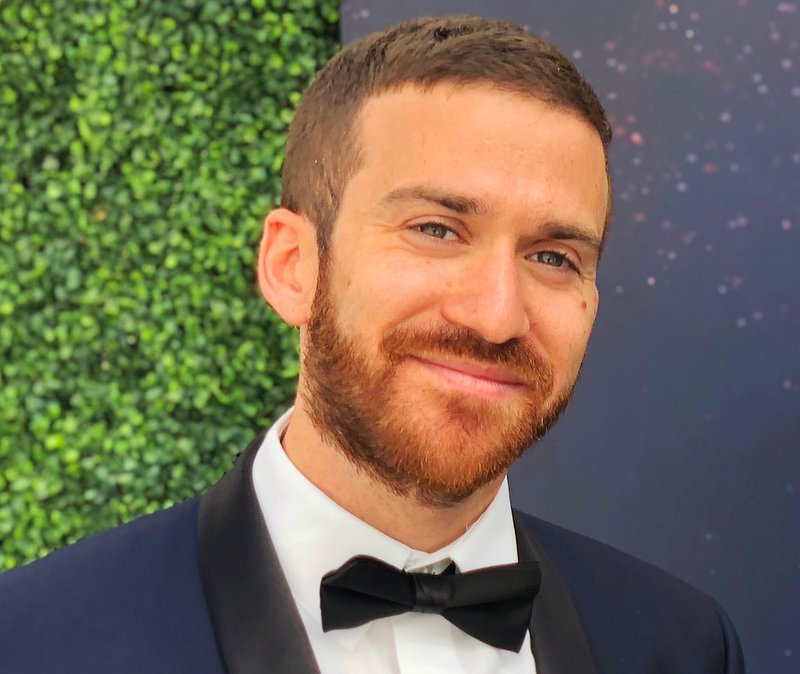
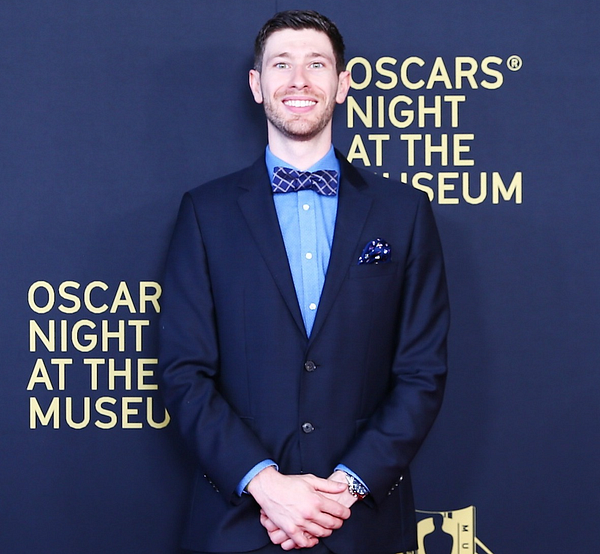
Filipe Coutinho and Ben Mehlman wrote the original screenplay “Whittier” which landed on the 2021 Black List. Recently, I had the opportunity to chat with Filipe and Ben about their creative background, their script, the craft of screenwriting, and what making the annual Black List has meant to them.
Scott Myers: Congratulations for making the 2021 Black List with your script “Whittier.” I’d like to just jump in here and get started with your background how you got involved in the business? Ben, let’s start with you. How did you find your interest in writing?
Ben Mehlman: It’s been a long way into writing. I was someone that grew up always loving movies and then when I got to college, I realized that it was something you could actually do.
So I first started writing as a way to have something to be able to direct. Slowly but surely though, I realized how much I enjoyed the freedom of writing and also there’s the very practical fact that you don’t have to pay anything to write. You don’t have to ask for any permission for that type of self-expression. Which was a very freeing realization.
Scott: It is the least expensive part of the process, because it’s literally pen and paper, or computer and fingers and keyboard. That’s it. Did you take screenwriting classes in college?
Ben: Yeah. I was a film production and studies major. Funny enough, while the writing classes were helpful, it was actually the theory classes that were the most helpful. That was what really opened my mind, my 101 studies class was foundational. Watching “Run Lola Run” and understanding how the intentionality of editing plays into visual storytelling changed everything.
That then led to a class on the Coen Brothers where the teacher dug into themes throughout works and deconstructed why a movie might emotionally connect with a viewer. I then took what I learned in my studies classes into my screenwriting classes, my production classes and the film club I was a part of. I was also a part of an SNL knockoff called TNL where we would have to be making a new sketch show every week.
Scott: I’m a fan of learning theory. People tend to want it simple — “This needs to happen on 25” — as opposed to really looking at the thematic and narrative underpinnings of stories.
Ben: I think the thing Filipe and I might talk about most are movies we have watched or are planning to watch.
Scott: That’s a nice segue to Filipe. How did you find your way into screenwriting?
Filipe Coutinho: My story with filmmaking– and screenwriting in particular– began in Portugal because that’s where I grew up. But the person responsible for my writing career is actually Cate Blanchett. She doesn’t know this, but, well, I hope she’s reading…
It happened when I was feeling a little lost in college, unsure of what I wanted to do with my life. I knew I loved movies, but that was it. I didn’t think I could even do anything with that love. That all changed when I went to the local theater to watch “Elizabeth: The Golden Age” with my mom and grandma. I didn’t even want to see it, but I figured it’d beat trying to crack microeconomics. Little did I know that my life was going to change forever. It sounds like a bad cliché, but it’s the absolute truth. I was so taken with Blanchett’s performance, so full of feelings and emotions, that I had to do something with them. So I went home and did what a lot of people did at the time– I created a blog and wrote about it. That was my first official ‘review’, if we can call it that.
Then I started writing about all the movies I watched, and shortly after I started getting published. As nice as that was, it didn’t feel like that was going to be my path. I didn’t want to write about movies, I wanted to actually write them.
With the help of my very supportive and understanding parents, I moved to L.A. and enrolled at the New York Film Academy, which was the perfect school for someone like me, who knew nothing about filmmaking. NYFA, as we call it, has this thing where every week you’re writing, shooting, directing, editing, and producing scenes and little movies. It was the crash course I needed, which helped me figure out what I was good at. I gravitated towards directing and writing and, well… here we are.
Ben: It’s very funny that Filipe and I ended up getting connected because for him, it was “Elizabeth,” where for me, it was “Grindhouse,” which was such an important movie because I was such a horror kid. For him, it was high art and for me it was intentional exploitation “low art.”
Scott: Now my goal in life is going to be directed toward getting Cate Blanchett in one of your movies. In fact, I can see her as your script’s Protagonist (Jackie).
Ben: She’s our prototypical Jackie.
Filipe: She was the actor who was in both our minds. Ben’s also a big fan.
Ben: She’s incredible in “Nightmare Alley.”
Filipe: Which we saw twice, because there was a second version in black and white. We just had to see what Cate Blanchet looked like in a black and white noir. Spoiler alert, she’s everything you want her to be.
Ben: Bradley Cooper and Rooney Mara also were quite good in black and white.
Scott: Blanchett is great in “Nightmare Alley,” well, she’s basically great in everything, so agreed. Moving on, how did you all meet?
Filipe: I’ll do the quick version. The composer of my thesis film was an incredibly talented guy named Ian Rees. I loved working with him. Coincidentally, a couple of years later, when Ben went out on his own, he also hired Ian for a short film and they became good friends.
After that, Ben told Ian he wanted to meet other writers and filmmakers, and Ian set us up on what I can best describe as a “creatives date”. We hit it off right away, bonding over Mad Men, futurism, and a lot of other nerdy stuff.
Ben: As a sidebar, I want to make sure this is included in the interview, Ian Rees is an unbelievably talented composer. He just composed the music for the HBOMax doc “Gaming Wall Street” but he’s still super underutilized. Anyone who’s reading this, Ian Rees is an incredible composer and you should hire him immediately. I adore Ian, I was on the phone with him yesterday.
I directed a short that got some good response. Some people were like, “Have you ever thought about doing a feature version of it?” The irony being I went into that project wanting to through and through make a short and people were then asking about a feature version.
After Filipe and I became pretty good friends for like six or seconds months, I asked him about potentially writing this feature with me. That was five or six years ago. The funny thing is that’s probably the worst script we’ve ever written.
I can say that it was all about the multiverse, so we were a few years ahead of Marvel. We’ve made no money off of it but between that and “Everything Everywhere All At Once,” we were clearly onto something.
Filipe: That script was absolutely essential for us to learn each other’s rhythms and ways of working. Even though the script doesn’t totally work, it’s probably the most important story we’ve written together because it allowed us to write “Whittier”.
Scott: I want to talk about “Whittier”. I’d like to see more of these kinds of movies, reminiscent of all those great gritty dramas from the ‘70s.
Plot summary, “While looking into a client’s murder, a Los Angeles social worker stumbles upon a political conspiracy in the wake of the 1987 Whittier earthquake.”
What was the inspiration for the story?
Ben: We were working on a project with an actress that was based in the world of sex trafficking, which is a really, really, really dark subject matter.
After we’d wrapped that up, we were like, “We gotta do something a little more lighthearted. Let’s just try to find something fun based in the ’80s that we can do.” At this point I’ll say, Filipe and I have the philosophy of “Listen to what stories are speaking to you.”
As we are researching, we discovered the 1987 Whittier earthquake and saw that two weeks later was Black Monday. There just seemed to be something going on in 1987. We quickly realized “This is an LA neo-noir.”
It felt like a “Chinatown” meets “LA Confidential” style movie that we, as fans of the genre, really wanted to see. Also what was going on politically and socioeconomically in the late ’80s felt, unfortunately, very prescient.
Sadly, as the pandemic continues and homelessness grows even worse in LA. It has become even more prescient, so it’s also a story to talk about something bigger through local politics and bureaucracy.
Filipe: Also, there aren’t a ton of noirs set in the ’80s. That was a very interesting proposition, because when we think about that decade, we think about a time of expansion, excess, kitsch, colors, neon, all that stuff. Those aren’t elements you’d normally associate to film noir. You could argue Michael Mann did a lot of that with movies like “Thief,” or even “Manhunter”, but I think those movies fall more under the ‘crime’ banner.
Ben: Taking into account that our lead is a social worker as well, which is an extremely dangerous job. Also, as we were saying with the ’80s, there’s a whole sub genre called neon-noir.
What is so interesting about this sub genre is a lot of them have ’80s influence, “Drive” is probably one of the most popular, but there has yet to be one that has used the ’80s as a time period. So it embraces the style but hasn’t necessarily gone back to the era it’s channeling.
Scott: It’s a fascinating era because it was at the end of the whole Reagan 80s “greed is good” era. The Whittier earthquake and Black Monday tore apart that illusion. It’s like the earthquake is for you, contributes to the plot, but it’s also very heavy in terms of the thematic elements in the story.
Ben: Absolutely. An earthquake brings a lot of stuff to the surface. If you think about it in metaphorical terms, it is the inciting incident in terms of what kicks the story into gear, and what leads to the ultimate discoveries that Jackie and Tracy will make.
Filipe: It sounds so obvious, but we’re talking about trickle-down economics. We really wanted to focus on who’s actually being affected by that policy and show how it affects them.
Scott: Set in 1987, so it’s a period piece. I always tell my students, you’ve got to find a point of relevance: why tell the story today? It seems to me with “Whittier,” you’ve got two things. One, the homelessness issue, which is very significant right now in Los Angeles.
There’s also the whole true-crime podcast phenomenon. Putting on my producer’s hat, I would say, “You could probably draft off that.”
Were you thinking that this is relevant because of the socioeconomic situation right now and the popularity of true-crime podcasts?
Filipe: This is a good time to say that, at the time, we had a side gig working for a brand consultancy company doing cultural forecasting. That essentially entails looking at society, putting all the pieces together, make connections, and try to figure out where things are going.
We ended up bringing that muscle into the writing. That’s why we included the homelessness as a backdrop and an integral part of JD’s storyline. We live in Los Angeles, and every day we see it. It’s impossible not to. It’s a real issue that’s been going on for far too long, and it doesn’t seem like anyone has a viable plan to improve it. After we started writing, the “L.A. Times” published a series of pieces on the subject, and then the pandemic exacerbated everything.
This is to say that, speaking for myself, I never thought about the podcast space for this story. We did think that if we’re going to write a period piece, it should say something about the times we’re living in. So we looked at where the politics were going and infused some of that into our writing. We started in late 2016, I think…
Ben: Probably ’17, because it was around Trump’s first year.
Filipe: Yeah. We thought, “Well, this is a good opportunity to talk about a lot of issues.”
Ben: Unfortunately, corruption is evergreen. For us, it’s also studying certain films we like and seeing what our version of talking about something like the California water wars from “Chinatown” is.
We don’t reference him as much as we should but the way David Simon handles a lot of what he does was also a big influence on us. In “Whittier’s” genesis, “Show Me A Hero” was a big influence on how to use small town politics to talk about big world problems. The day to day impact of racist policy, a “not in my backyard” mentality, or even interpersonal soft racism.
The way that is unfortunately becoming more and more pressing is a huge bummer. The idea of what happens with someone’s life or how their perceived worth is dependent on their skin color, ethnicity or socio-economic status is, frankly, a disgusting rot that’s at the core of our country and it’s something that’s currently getting worse and worse. Too many people are focused on trying to not be called racist then actually focusing on ridding themselves of internalized racist actions.
When we first started sending “Whittier” out, some people were a little unsure about how much someone in government could get away with. Then as we got deeper and deeper into the last administration, and especially during covid where people were taking advantage of PPP loans, people stopped questioning the reality of the corruption we depicted.
In our research, unfortunately, people stealing millions of dollars from local governments is super easy. People only got caught because they were dumb and cocky.
Scott: Let’s talk about your protagonist, Jackie Cross. She’s a piece of work. You have this idea, ’80s, you think “Whittier.” How do you come up with Jackie Cross, how did she emerge?
Filipe: We looked at who was a social worker in the ’80s. The truth is most were women. We were like, “All right, we have the gender for our protagonist and there’s a reason for it.” The rest evolved from there. We studied what that job entailed. Social working was– and still is– very dangerous, alienating, and exhausting. And it involves a lot of “detective” work.
Ben: More of a detective than our detective.
Filipe: Exactly. Ben, you want to talk a bit more about some of her traits and her outspokenness?
Ben: Of course. For us, and also to go deeper for the people interested in craft, we were tired of the cop trope. We were thinking about a fresh way of tackling our “detective” and ended up loving the idea of a social worker.
Then once we decided on a female lead, it really opened things up. It let us tell a somewhat different story with familiar tropes that can be viewed through a deconstructionist lens. How having a woman live out tropes we love pushes people differently.
Like the idea of Jackie maybe drinking a little too much, or God forbid, be a woman pushing 50 who is confident in her sexuality. Not having her be defined by having a child or through her partner would make certain people uncomfortable in a way that made Filipe and I want to push against it more. This is a different kind of rot in our society, a sexist rot.
Female characters, and plenty of women in the world for that matter, are under a microscope to always be “perfect and likable” in a way that can become a prison. We want to create characters who are relatable in their flaws and have the room to make mistakes and learn from those mistakes. Characters who have the space to figure out where they’re going, what they’re dealing with and have an ability for reflection and growth.
Filipe: Jackie’s a social worker at a very sexist time. She’s also a product of her environment. If she has defenses, if she’s quippy, if she snaps at people, it’s because she rarely gets the respect she deserves. She’s working for others– mostly men–, and she’s rarely appreciated for how much effort and care she puts into her job.
She also doesn’t have the budget to do what she needs to do. She doesn’t earn enough to have a comfortable living or take a proper vacation. Jackie’s basically trying to reckon with the person she once was when she got into social work.
One shot we thought was really interesting and encapsulated the essence of living in that world is the one at the beginning of “Silence of the Lambs,” when Clarice Sterling enters an elevator full of men. She’s smaller than everyone else, and all these guys are looking down on her. But she stands tall. We know early from there on that she’ll make a difference in this world.
Scott: What’s interesting is that if you’re going to do a noir movie, that hard boiled cynical protagonist character, this just derives from her work. At the time, the sexism, the under appreciation of what she does. She’s not making enough money. It’s a soul crushing work,
She’s like Rick Blaine in “Casablanca.” She’s got that cynicism, but underneath there’s still an idealism because Rick Blaine fought on the side of the loyalists way back when. Did you ever make that comparison?
Ben: We both adore Casablanca, so it is certainly in our DNA but it wasn’t a conscious comp while writing, even though that is the highest of compliments to be compared to Casablanca! A lot of Jackie’s essence came from the story talking to us because, in our research, deregulation in the ’80s was a big thing. So our first 10 pages where we dive into deregulation, the tent cities, and the special needs people who are stuck on the street, are influenced by real life.
A lot of the expansion and social safety nets of the ’50s were gutted by Nixon and Reagan. So yeah, unfortunately a lot of the film’s policy cynicism is based in real life policy choices.
Scott: Two characters that Jackie intersects with, who have quite a bit of influence on her, one is a young fellow named JD. They have a chance to meet on an airplane and then intersect later on. Could you talk about the JD character?
Ben: JD is probably our biggest David Simon esc character, someone indivictive of a broken system that is forcing his hand. His current predicament is a product of redlining and underfunded public housing.
Unfortunately, when you are a kid stuck in his situation in that area and in that era you are either living on the streets or selling drugs to survive. A lot of the dog whistling of the Reagan era demonized groups of people that directly affected people like JD and put them in danger.
We wanted him to be emotionally complex while being neither good nor bad, he’s just human. He’s nice but not necessarily the most exceptional person on purpose. But just because he might not have gone to MIT doesn’t mean his life is not as worthy as anyone else’s.
Filipe: There’s a scene that we worked very hard on. It deals with JD, when he’s put into Jackie’s care because the apartment complex he’s living in gets destroyed in the quake. Due to JD’s age and overflowing shelters, Jackie’s forced to take him to a homeless campground. When JD arrives and looks at what a campground really is, he tells Jackie he’s better off selling drugs, since at least that’ll earn him enough money to get his own place. He questions, why should he be a good person if America isn’t taking care of him?
That is at the crux of what JD represents in this movie, which is all the people the system fails, and what we can do or not do in order to help them. Jackie knows all this, and that’s why she’s so disenchanted with her job. So tired of doing it. That’s where Tracy emerges in the story because she is today who Jackie was 20, 30 years ago.
Scott: You make a good point, and I think it was a smart choice, he’s not exceptional. In fact, he’s rather ordinary in a way. The choices that he has to face are choices that all these kids have to face. That makes Jackie in taking this on, even that much more admirable.
Ben: It’s just a philosophy that Filipe and I have is you don’t need to be exceptional to be worthy of living. We unfortunately live in a society that, especially, over the past two years can be really cold and callous. Yes, part of it is an understandable coping mechanism to trauma, but at a certain point, human life is human life. They’re more than just numbers on a New York Times ticker.
Scott: Let’s talk about Tracy, who functions in a “You used to be like me” way to Jackie. How did you develop this character?
Filipe: We didn’t want Jackie to go alone on this journey because that’s the most common trope in noirs. We’re like, “What if we take the trope of the buddy comedy or the buddy action movie, but put it in a neo-noir?”
Also, we wanted to show the other side of Jackie because we are portraying a world that is quite cynical, and while our point of view can be cynical at times, we’re hopeful people who believe in change. Tracy very much represents that. The idealism and what idealism is facing. That’s when you sort of figure out your moral fiber. It’s not when things go well, but it’s when things don’t.
Ben: The biggest tool of an oppressor is to make you believe change is impossible. Making your vote, your voice, your life feel small, when it is anything but. From a craft perspective, we think it’s important to have characters that can challenge each other.
In the beginning, we were talking about “Back to the Future” a lot, which is a dual-protagonist movie where one person’s arc informs the others. In that case it’s George McFly and Marty McFly. For us, sometimes it’s like, “Let’s take influences from movies that have nothing to do with ours and see how we can insert it in.”
Scott: Let me ask you a question because I’m curious how you structured the plot. It’s a classic. It’s in the vein of “Chinatown” where it’s this complex web that goes through all these different aspects of living in a city. You’ve got JD, ends up dead. That’s by the end of Act One.
We know that’s the small story, the personal connection that Jackie feels to this kid. That’s the case she’s going to take on. Yet, there’s this large, big thing, the money. How did you spin that out? Was it you discovered the Whittier earthquakes and all this money that was coming into town and people were ripping that off, with that way?
Did you start off with the murder? How did you structure this plot?
Ben: This type of film is usually best when you are telling a simple story in a complex way because your character doesn’t have all the pieces yet. It started with the idea of someone using Black Monday as a smokescreen to gentrify an area that was destroyed in the earthquake.
We then used that as a spine to explore themes and elements that a story like that, no pun intended, unearths. Out of that comes the ornaments and lights on the tree that makes a story like this shine. Where we discuss certain characters and archetypal story ideas like social workers working with the police, what if Jackie had a cop who was her entry point into that world. Or what if she had a love interest. For a while, we just called him “that guy.” Then we were like, “This person’s kind of a douche.” He would probably be named Guy.
Filipe: Taking a peek behind the curtain, what we did was very much build a puzzle, but we didn’t know what the final image would be. We had all these pieces like the Whittier quake, Black Monday, and other key moments. Then we built the image from there. As writers, we have the luxury of defining the edges of those puzzle pieces and fit them where we want. But we didn’t know what was going to emerge from that. It was a long process, and we spent a lot of time outlining because, as Ben said, we wanted to make this complex plot feel simple.
Scott: Was this index cards on the wall, scene by scene?
Ben: Lotta carding. We had a pretty good idea from the jump where we were going to end. Though there were elements that were surprising, which is a lot of the fun of having a co-writer because you get new pages and suddenly this story you thought you knew takes an exciting turn.
We would start with simple cards, then as we developed it more the cards got bigger and we used cards underneath the plot cards for character or world oriented notes. It’s listening to what the story tells you while also knowing what the sandbox is or the edges of the puzzle are.
I think as long as you know the boundaries of the type of story you want to tell, it’ll unfold as it’s meant to.
Scott: “Edges of the puzzle.” I love that. Both of you used that.
You made a comment earlier that reminded me of “The Shock Doctrine” by Naomi Klein, this idea that something big happens, and that’s when the powers that be can use that as a ruse to screw people over, pass legislation, take money, and all that. That clearly is in play here, given the Black Monday and the convergence with the Whittier earthquake.
Filipe: Not to be too cynical, but I think we know exactly who got rich during this pandemic, right?
Ben: Yeah.
Scott: Yes. Oh, gosh. Trillionaires.
Ben: Like I said, corruption, unfortunately, is evergreen.
Scott: Yeah, as the Bible says, the love of money is the root of all evil.
Ben: Exactly. One of the biggest things that Filipe and I realized halfway through writing one of the earlier drafts is that it’s not just about money but what money represents, which is power.
Power itself is a drug because at a certain point money literally means nothing. Does Jeff Bezos or Elon Musk need more money? No, they have a never ending lust for more power.
Scott: In a way, this is like a… probably a better sequel to “Chinatown” than “The Two Jakes.”
Ben: I guess we’ll just call it out. The character’s name is Jackie Cross. It’s like…
Scott: Oh. [laughs]
Ben: Hopefully he’s still alive and kicking, but we always said Jack Nicholson was our prototype for Sharky. Whatever the studio is, pay him a million dollars, let him do his monologue, and it’ll be great.
Scott: It’s a great monologue.
Ben: Thank you.
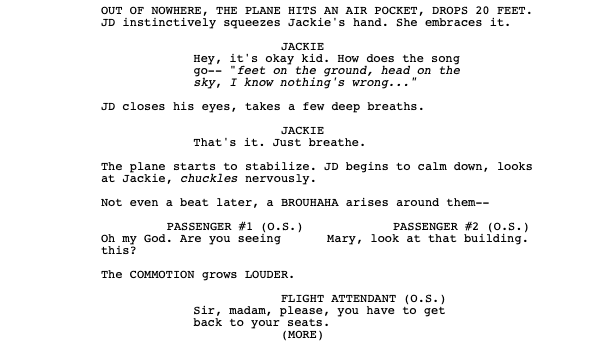
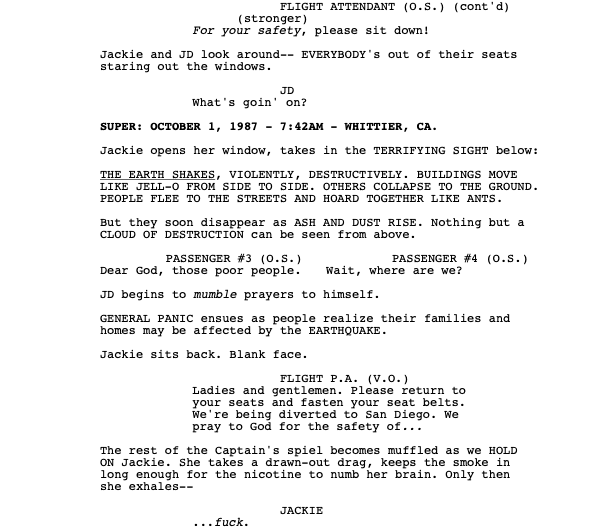
Scott: One thing that’s interesting… Of course there’s all this conventional wisdom about screenwriting, and so much of it is just not wisdom. It’s just convention. “Don’t include song titles in the script.”
You got songs all throughout here. You got, let’s see. It starts off with a quote from “Break On Through” by the Doors, Talking Heads, “This Must Be the Place,” Miles Davis, “Blue in Green,” Yoko Ono’s “Walking on Thin Ice.”
What was the thinking going on there in terms of using these songs? Thematically, you chose them for a specific reason and just sort of embraced it?
Filipe: Both Ben and I are tremendous lovers of music. I think it’s part of our identity in one way or another, how we relate and see the world. And we also believe in crafting a unique experience for the reader.
People talk a lot about music cues in scripts, that the music supervisor and the director will be the ones to choose them and all that. That’s fair enough, but we don’t see it quite that way. It’s different parts of the filmmaking process, and we’re focused on the writing. If you’re reading our script, we want you to experience what we’re experiencing. We want you to feel what we’re feeling. Of course, we’re not going to be lazy. If we put a song in the script, it’s not going to substitute atmosphere or feel or vibe. We’re still going to do our best to convey that through words.
Scott: The script you turned in for the lab, you have the links?
Ben: Yeah, we want the reader to have the option to listen to the song as they read the script with as much ease as possible. It’s the job of a screenwriter to bring the film to life as much as possible.
A lot of “convention” notes are just excuses to not give someone a real note. There’s no world that if someone actually thought a script was viable they would give two shits about a hyperlink or a photo that appears in it.
It’s about making the best thing you can.
Filipe: I think it’s also about specificity. Ben and I try to be as specific about details as possible without being overbearing. I think music plays a part in that. The script opens with “This Must Be The Place”, and it’s not just a vibe. It actually plays within the scene.
We could have simply written that JD is listening to a song, but that’s not as fun. Choosing the song allowed our characters to talk about it. It was a way that Jackie found to connect with JD. By engaging with him about David Byrne. If you just wrote he’s listening to music, we couldn’t have done that. For us, that’s more real, more like life.
Scott: I’m with you guys. If you got an asset, why not use it? Music is an asset. I tell my students, as long as there’s a point of dramatic connection or your understanding, it adds some understanding to the characters, go ahead and do it.
You should meet Scott Neustadter and Michael Weber because when they write, they talk music all the time. Have you met them?
Ben: No, we haven’t.
Scott: OK, because that’s all they do. Every day is talking about music. [laughs]
Filipe: I think we’ll get along. “(500) Days of Summer” is probably the most influential soundtrack of the past couple of decades.
Ben: Not only that, for our opening montage we studied the “(500) Days of Summer” script. We looked at it as a great example of creative inter-cutting and screen-splitting.
That’s another example of taking influence, almost out of necessity. Asking ourselves where to find creative montage influences and it just so happens that their postmodern rom-com was perfect for our neo-noir.
Scott: Real quick, I want to talk about your Black List lab experience, because that’s where I met you all. How meaningful was that experience for you, working with your fellow “labsters” and having that whole Black List support system?
Filipe: Transformational. It took our career to the next level. For one, we ended up finding a manager after the lab. Matt Rosen, who’s an incredible guy. And very, very creative. It’s so important to have the right representation, and we really found that in Matt, who was more than happy to take the swings we wanted to take.
He’s also one of the major reasons as to why we made the Black List, because he got us meetings with the people who ended up voting for our script.
The other great part of being in the lab is that we ended up forming a movie club, and a year and half later, we still meet every month without fail. Each person chooses a movie, and then we meet over Zoom and discuss it.
Scott: These are the lab people that you’re with?
Ben: Yeah, we have a movie club. We have one a week from Sunday.
Scott: Yeah, that’s awesome.

Ben: I think it’s good to hang onto the pearl moments in your career. By that I mean the special moments that can help get you through the tougher times. Working with our mentors, Beau Willimon; Jack Thorn; and Elliott Owen, were definitely examples of pearl moments and honestly, you too Scott. You compared us a lot to Shane Black and all the creative work he’s done, which was incredible to hear.
Having those positive moments with people you respect are irreplaceable.
We have a whole jewelry box from the lab. Sometimes when people ask or think about those events it is in the context of only focusing on what it did for your career. Which it did a lot of amazing stuff, but it also put a lot of renewable fuel in the tank.
Scott: Well, that’s great to hear. Let’s jump to December 13, last year, that Monday morning when the annual Black List rolled out. How was that experience?
Ben: We were talking with Matt about trying to make the list. It was the first time we had a rep in earnest really going after this with us and we would all do our best but it was still a crapshoot.
If you asked Filipe or I on December 12th if we thought it was possible to get 15 votes and be tied 12th for the year we would’ve thought you were crazy. We just wanted to make it on at all.
Filipe: The funny thing was that Matt unfortunately got struck with COVID that day, so he was having a terrible time health-wise. Ben was on the East Coast and also sick. And I didn’t sleep the night before and was feeling very overwhelmed. It was hard not to have any expectations, even if I kept telling myself I didn’t have them. Ultimately, I just wanted the whole thing to be over so that I could stop feeling anxious. Of course, the process took way longer than expected. The Black List did the announcement through videos on their YouTube channel. Broken down in categories, one at a time, and with a 30-minute break between them. Needless to say, “Whittier” came at the very end [laughs].
But when it happened, it was incredible. We love this story. So much. And we’ve written, I don’t know, more than 20 drafts. We had times when we’re like, “I never want to see this again. I never want to read these lines again.” Then someone gives you a good note and you go back into it. It’s a lot of hard work.
It’s good to be appreciated and recognized for your work and knowing that people care.
Scott: Frankly, it assures me that there’s no way you can game the system. To me, the fact that you did get as many votes as you did suggests very strongly that people responded to the material. It’s not easy material. It’s 130 some odd pages. It’s complex. You did something that made people notice it.
Ben: The best compliment we ever get, which we pretty consistently have gotten, is people being like, “We didn’t realize it was this long.” They read it and they’re just like, “It flew by.”
Scott: That’s a great compliment.
Filipe: Our dream– or maybe mine, I don’t know if I can include you in that, Ben– is to have a career like Eric Roth. Every script he writes is like 150 pages and up. That would be wonderful.
Ben: I just want to tell the best story possible. Doesn’t matter if it’s 90 pages or 130 pages. But man I do love Eric Roth.
Scott: Now, I can add a third thing, that you want a career like Eric Roth’s. I got these all down here, things I’m wishing for you.
[laughter]
Scott: Let’s focus on writing together. What’s the process like? Do you sit in a room together? Do you do remotely? Do you write scenes individually and pass them back and forth? How do you write?
Ben: For us, it’s about cracking the story. We’ll usually crack the story and craft the outline together. Whether that is in person or screen sharing if in person isn’t possible. Then, we’ll assign pages. So I may take the first five cards and Filipe takes the second five and once we’re both done we will swap pages. This is where revisions mode is helpful. We do our visions using revisions mode and basically send back a redlined version to the other person.
We then read the changes, approve whatever changes we agree with and chronologically decide on how to handle the rest. So, by the time we settle on any singular scene, it’s already been rewritten two or three times.
Scott: Do you have assessments like, “Filipe’s better with dialogue than I am, or I’m better with character ID” or are you in pretty much simpatico in terms of your understanding of your respective creative skill sets?
Ben: I think we’re pretty simpatico or what would you say, Filipe?
Filipe: Yeah, we’ve never divided scenes based on their content. In “Whittier’’, for example, there was a scene that I really wanted to write and I just asked, “Hey Ben, do you mind if I write this one? I think I have a really good feel for it.” Then, Ben will do the same thing. We try to respect what the other person is feeling. We’ve never got to a point where none of us wanted to write a scene, which is a good place to be.
Ben: I’ve never realized that, that’s wild.
Scott: That speaks to your breaking story. Every scene’s got to hit that level.
Ben: Exactly. For anything, it’s also what’s right for the moment. To make up an example, Filipe loves Joy Division. He has a tattoo of Joy Division. If there was a scene where someone was monologuing over Joy Division, I’d be like, “Filipe, you should write this scene.”
One of the first scenes in “Whittier” takes place in City Hall during a city council meeting. I’m a bit of a political junkie, so Filipe was like “You like this, wanna take a stab?” It’s not as simple as one of us is better at action sequences, so they write all the action sequences. It’s much more about what we feel in the moment.
Filipe: To be fair, the autopsy scene was another one. I told Ben, “Look, I’ll do it, but I really don’t want to see a bunch of pictures of dead bodies and insides and stuff like that.” I know Ben, who comes from the Cronenberg school, has seen it all, so I’m like, “You know what? You should lean into this.”
Ben: Oh, I’m a very sick person, so of course I said yes.
Scott: Both of you have directed short films. I’m assuming that at some point you’re thinking you want to direct something together?
Ben: Yeah. We’ve thought about it. Also, what I think works with us is that we also have our solo stuff that we work on as well. It’s a very open relationship in that way.
Filipe and I were talking about directing something together and then COVID hit.
Filipe: I mean, that’s the goal. We really want to direct. It’s the ultimate way of telling a story at the end of the day. Ben and I come from such different backgrounds, and it’s interesting to see where they align. I think when they mesh, something really great comes out. I think directing would be no exception.
Ben: Yeah. Filipe has this really cool video series that you should definitely throw a link up for. It’s an awesome “Lessons From the Screenplay” style series that he’s been working on with a really talented woman, Mónica Freitas
And I’ve been doing some music videos. I did one last summer and just finished another one with Ian, who introduced us. I love doing those as well, it’s such a fun creative outlet
Scott: That actually leads to the final question here: What key words of advice can you offer to someone who’s trying to learn the craft and break into the business?
Filipe: I think that you are your foremost champion and enemy. I think things don’t work when you stop believing. I’m a firm believer that if you keep at it, eventually it will happen. If you do the work, if you have the passion, if you sacrifice a bit, then it’ll happen.
Whittier is the perfect example of this. We never abandoned that script because we really believe in it. People will tell you, “Oh, but you wrote this a while back” or whatever. No, if you love the story that you’re working on, just keep pushing it. Push it, and push it, and push it.
Ben: I think Filipe would agree, that’s not saying to only work on one project. We’ve worked on so many things together and individually since “Whittier.” There’s also a weird thing that happens sometimes where a certain project continues to pop back up from the dead like “Whittier” did throughout the years.
For me, it’s important to understand that the process of writing is the job and you should find a way to love the process. That doesn’t mean you have to always love it but you should at least like it a lot of the time. A lot of writing is excavating, whether that’s through your own mind, through research, through scripts or through movies.
Another important thing, as you get deeper into your career or pursuit of the career, find a way to protect your fandom for the medium. In theory, you wanted to do this because you love it so much. That doesn’t mean taking it to a toxic level, but finding ways to protect the part of you that fell in love with this in the first place. If you protect that, your love for writing and creating will never die.
For my interviews with dozens of other Black List writers, go here.