Go Into The Story Interview: Callie Bloem and Christopher Ewing
My interview with the 2022 Nicholl Fellowships in Screenwriting winners.
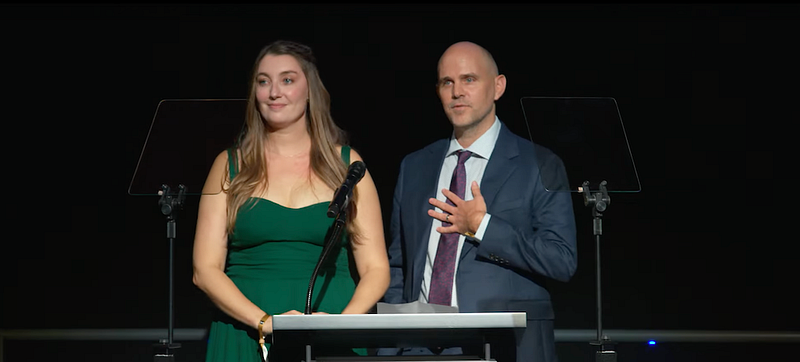
My interview with the 2022 Nicholl Fellowships in Screenwriting winners.
Callie Bloem and Christopher Ewing wrote the original screenplay “Tape 22” which won a 2022 Nicholl Fellowship in Screenwriting. I had the opportunity to chat with the couple about their creative backgrounds, their award-winning script, the craft of screenwriting, and what winning the Nicholl Award has meant to them.
Scott Myers: Congratulations, both of you for winning the Nicholl. It’s a great way to round out 2022 for you, I’m sure.
Callie Bloem: Yes. Absolutely.
Christopher Ewing: Thank you so much.
Scott: Let’s start off getting some background on you. Callie, you grew up in the DC area. Is that right?
Callie: I did. Yes, that’s correct.
Scott: Were stories a big deal in your family — movies, TV, books?
Callie: Books, definitely. My parents are huge readers. We always had books all over our house, but we didn’t watch very much TV or movies. The only TV shows that we watched as a family were “Murder, She Wrote.” We used to watch “Touched by an Angel,” which now, I’m like, “Huh.” I’ll have to revisit that. That seems strange.
Scott: Chris, how about you? You’re from the Chicago area.
Christopher: Yes, the suburbs of Chicago. I grew up in the same town that John Hughes grew up in. All of his movies where he has Shermerville as the town, a lot of that takes place in Northbrook, my town that I grew up in. It’s like the high school from “Ferris Bueller” is where I went to high school.
Scott: How about you? Were you much into stories when you were growing up?
Christopher: Yes. For me, my love of movies was always there, but it was always on the backburner after music. Music was always my first love from a very young age.
Up through high school, I thought I was going to be a touring guitarist for some indie rock band, but very quickly realized that that was maybe not the most sustainable lifestyle. I also couldn’t find a band that I liked being in quite enough.
Scott: That figures into a couple of questions I have later on because the script you wrote Tape 22, there’s such specificity there about the musical instruments and performance, I figured one of you two had to have had some interest in music. If I can extrapolate from your bios, did you both go to school at the University of Wisconsin?
Callie: We sure did.
Christopher: That is where we met.
Scott: That’s where you met?
Callie: Yeah, my first week of freshman year.
Christopher: I scooped her up.
[laughter]
Scott: I think Callie, you studied political science?
Callie: Yes. I studied poli sci and sociology, which were wonderful, but they’re like the basic catchall, not-exactly-sure-where-I’m-going-with-life majors. I did always anticipate working in healthcare, even with those random majors.
Scott: You did for a while later on.
Callie: I did. I worked in healthcare tech for around 10 years before I fully transitioned into entertainment. I very much was following the career path of my parents, and I like to say it was a wonderful career for someone else.
Scott: That’s straight out of Joseph Campbell world there. He talks about, if there’s a path you find laid out in front of you, that’s probably not your path. You got to create your own path.
Callie: Absolutely.
Scott: Chris, how about you? What did you major in at Wisconsin?
Christopher: I started as a business major because I had the wonderful idea of starting a record label/surf shop in Chicago, because I saw a need for it. There were no surf shops in Chicago, and I was like, “This is great. There’s a market that’s open.” Then I very quickly took one macroeconomics class and decided that was not my future.
I switched up and went into a journalism degree from there and also a creative writing degree. I finished both those degrees pretty fast and had my senior year mostly open. I wrote an essay on “Fight Club” that allowed me to bypass a few intro film classes.
I spent most of my senior year taking as many film classes as they would let me as I was finishing my thesis in my other majors.
Scott: Didn’t you get into music journalism for a while?
Christopher: Yes. At Wisconsin, I was the arts editor of the biggest independent student‑run newspaper in the country, “The Badger Herald.” That’s really where I fell in love with music journalism. I was going all over the place, interviewing bands on tour buses, going to gigs, doing tons of record reviews.
One of the big, life‑changing moments was when I was sent to a press junket to see “Eternal Sunshine of the Spotless Mind” and interview Charlie Kaufman and Michel Gondry. Seeing that movie and then getting to spend time with those two guys reoriented my whole world, and made movies and making movies a possibility.
Scott: That’s why you ended up going to film school in San Francisco?
Christopher: Yes. I spent the year after I graduated working in a warehouse, cutting out and laminating those big posters you see in Gap stores. At the same time, Callie and I made a movie that was going to be a feature. That was the idea of it. When I wrote it, it only turned out to be 43 pages.
It was a Richard Linklater‑style meandering, philosophizing, 43‑minute movie. That was the exact perfect length to not get into any festivals at all or never be seen. It only played one film festival. And that was right before a bank of amateur pornography.
Scott: At some point, you’re together. I think Callie, you went out to San Francisco, too. You were out there. Like you said, you had a nice office in the Presidio.
Callie: I did. It was so beautiful. It was right across from ILM. You could see sometimes the animators put their sketches up in the windows, which was really neat. It was an amazing place to work.
Scott: Sounds like the gravitational pull of entertainment was working its way into your life experience there.
Callie: I really think it was just not something I’d ever considered as a career growing up. As I said, I didn’t watch tons of movies growing up, but I always loved books. Then, weirdly enough, when Chris and I first met, the very, very first thing that we started talking about was he had a poster from the movie “Happy Campers,” which was a Sundance movie, on his wall.
I was like, “You have a Happy Campers poster?” Not a ton of people had seen that movie.
Christopher: No. I think it’s a relatively obscure film.
Callie: I’m not even sure how I came to see that movie. I think that’s when we immediately hit it off. Then movies became a huge part of our life together, and music. All of these shows he was going to, I was there, too.
Scott: You relocate to LA. At this point, Chris, you’re directing commercials and music videos. Callie, you’re doing the healthcare thing. Is that right?
Christopher: Yes. When we first moved to LA, I was not yet employable as a director of very many things, so we were making micro‑budget music videos. Callie was already producing those. She just has a mind for many aspects of the producing side that I don’t.
For other work, I was still working as a music journalist. I was trying to do unpaid internships at as many film production companies as I could. I was at Muse Productions for a while, while they were making a Michael Winterbottom film, just racking up that kind of experience.
I was also AD‑ing and boom‑operating on independent features and Web series. That was the heyday of Web series, so I was working on a lot of those. I also had a spec that had gotten me a little bit of attention. I was going into a lot of generals and had an initial manager for a little while. All of that wasn’t really generating enough money to live on by any means at all.
Eventually, what happened was I had a mentor who had seen my thesis film in grad school. A guy named Miguel Sapochnik, who went on to do “Game of Thrones,” and now, “House of the Dragon.” He took me under his wing for a couple of years. Eventually, he referred me to a job at Hulu. I got that job, and then I was there for the next nine years.
Scott: That worked out very nicely. Somewhere along the line, of course, you have this little girl. As I’m reading this bio, I thought, “Well, that’s an interesting choice that Callie made here.” It’s like, “You know what? I got this nice secured a gig in the healthcare business. I have a kid. Why not become a producer?” [laughs]
Callie: Right.
Scott: That’s counterintuitive. How did that work for you?
Callie: Ever since we moved to LA, Chris was always on various gigs. I would produce as many of them as I could. I got more and more interested in that world.
I also traveled a lot at my job. I was going back and forth from Canada every few weeks, and it was taxing. Chris and I would always daydream about wouldn’t it be amazing if we worked together someday?
Then, as I was going on maternity leave, I had my existential crisis of how can I be having a child that I want to tell to follow their own dreams when I’m not following my own dreams? Putting it that way made it pretty easy to give it up.
We also were pretty lucky. That was right when we got our first big gig for our own production company that we had started where we did a series of short films for Sega in support of their Yakuza 6 video game. Chris used his paternity leave to go direct them in Japan while I produced from here with a newborn.
I was like this is far better than going into an office every day. It is nice having a salary and benefits, but that’s OK.
Scott: I would say we’re back with Joseph Campbell. Follow your bliss.
Callie: It’s true.
Scott: Find that thing that enlivens you and energizes you, you got a talent for, you want to share with the world, do that. May not be the easiest life, but it’s going to be the chance you have to live your most authentic lives.
Callie: Absolutely.
Scott: What about screenwriting? You mentioned you’ve written some scripts. Were you learning that at Wisconsin? Did you pick it up along the way, Chris, then Callie?
Christopher: I was initially a short story writer, short fiction. That’s where the money is.
[laughter]
Scott: Big bucks.
Christopher: I kept making these short stories that…I had a teacher very early on that said, “This is a romp. This is very cinematic. This is like…” She kept using these buzzwords to describe what I was doing. It made me feel like, “Oh, you know…”
The stuff that I’m gravitating towards feels like it could be movie‑ish. I had always loved movies. It was like a secret obsession. The music obsession had been so strong and so much a part of my personality that I hadn’t realized how much film was affecting me.
In high school, I would stay up every single night, and watch two movies with my dad. Finding whatever was on HBO or Showtime. I had pretty quickly viewed way more movies than most people should by the age I was. That eventually led to starting independently to figure out how to write a screenplay.
Then, in grad school, that was when my formal screenwriting education kicked in. I had an incredible screenwriting teacher who, in one of her classes, she forced us all to write a feature by the end of the class. I put it off until the weekend before. I wrote a feature in three days, and then it was like, “Great. I can do this again.”
In between that very first one and “Tape 22,” there were six or seven other features that I had written before Callie and I started working together.
Callie: I had no formal education in writing. I always loved writing a lot. Actually, I would write for the student newspaper when Chris was the editor.
Christopher: She was always doing these great movie reviews.
Callie: I love reading. I read a ridiculous amount of books, and now, a ridiculous amount of screenplays. I’ve learned as I go along. A couple of years ago, Chris threw out the idea that we should try to read all of that year’s Black List scripts. We slowly made our way through everything.
Christopher: We only made it halfway through. [laughs]
Callie: I learned a lot from reading other people’s scripts in terms of formatting. I do as I think works, and then figure it out later if it’s not right.
Scott: Let’s talk about Tape 22, which is the script that won you a Nicholl Fellowship in Screenwriting. Here’s the plot summary for it.
“A music journalist, reeling from the death of his wife, discovers a mixtape that brings her back to life for four minutes and 23 seconds a day, exactly the length of her favorite song. Now, he’s determined to bring her back for good even if he might accidentally open a black hole in the middle of LA.”
What was the inspiration for that part of the story?
Christopher: Tape 22 originated many, many, many years ago. It was something I had started to write on my own. I wrote about five pages, and then put it away. Got busy doing stuff at Hulu, day job stuff.
Then, years later, when Callie and I were both deciding to work together, we both started…I started back in on Tape 22. Callie started in on another script that she wrote basically the entire thing of. They were both dead spouse movies. [laughs] I didn’t get past five pages of mine, but Callie finished hers.
Then, we looked at them and decided that at that point, we wanted to write full‑time together. We had written our first short film together, so that had been the very first experience. We decided to take these partial drafts of what we’d been working on and blend them together to create a super draft that would take over the world.
We had no idea anything was going to ever happen with it. It turned out to be very fortuitous that we combined our forces at that moment.
Scott: You had these two separate projects, both of them with a dead spouse. What is that about that, do you think, that drew you to that?
Christopher: It was being trapped with each other, and…
Callie: Yeah. The pandemic. Probably, what it comes down to is we like exploring the idea of what if you had to start your life over again from scratch. We’ve also been together for 20 years, so we don’t know anything else besides our life together. That’s always an intriguing idea to us.
Christopher: Then, that combined with the idea that music has this power to pull you back into memories, to make you feel supernatural in certain ways. We thought that it was a fun metaphor and a fun high‑concept way into talking about grief and pain and healing and all these big concepts.
We could make it more fun and weird and interesting by hiding those within a high‑concept idea.
Scott: Let’s talk about these two lead characters in the story. First, there’s Hutch. Could you describe who he is, what he does professionally, and where he is at the beginning of the story? Because it’s six months after his wife has died. Where is he in the grieving process?
Callie: Hutch’s life is on pause. It’s been about six months, and he’s retreated into his own little bubble. He’s not handling grief well. He’s become a recluse just staying inside his house, not knowing how to manage his life, because Sam did all of that for him. She paid the bills. He doesn’t know what credit cards are on auto pay or if he has to contribute to their health insurance policy.
He’s stuck. He was feeling a little bit stuck in his life before that because his career had been dwindling a little bit and…
Christopher: He’d had the fifth hottest music blog of 2013. He was on the decline a little bit. A little bit of like an Indie version of A Star Is Born. Sam’s career was skyrocketing as his was tapering off a little bit. He was already headed towards a bad place and then Sam’s death just pushed him over the edge into near‑comatose world.
Scott: Five stages of grief. Is he more in that denial stage at this point or depression?
Christopher: He’s probably in the depression stage. He has numbed himself to the world. We had early drafts where it was important that he never listened to any music, and he avoided hearing any music out in the world as a result of the trauma of losing Sam.
That idea didn’t stick, but that feeling of him retreating from the world and from having new experiences without Sam did stick and was the entry point for the audience to meet him.
Scott: Let’s talk about Sam who died six months previous to the beginning of the story. How would you describe who she was, what did she contribute to the partnership both creatively and personally? Give us a sense of who this character was?
Callie: Sam is a tough cookie. She is a music producer in a sea of mostly male producers. Her heart had been set on doing this ever since she was young. She doesn’t want to stop at anything before she gets this number‑one album someday. Hutch is her equal, her sparring partner.
Christopher: At the same time, Hutch has always had a more meandering life and career, whereas Sam has always been laser focused on her goals. Hutch was able to hitch a ride on her, in a way, that he was going to follow her through life. When she dies, all of a sudden he finds himself unmoored and lost without the one thing that was propelling him on a path toward anything.
What we love about Sam and Hutch, their relationship, is that it was forged in both of them being equally obsessive about music and having music be the guiding force in all things of their lives. That being said, it was always a stronger and clearer path for Sam. Hutch was the one that was a little more wayward.
Scott: There’s this inciting incident where he discovers samples of these mixtapes. Do you remember when you came up with that idea as a grieving spouse, he’s going to find these legacy items of the deceased member of the partnership?
Callie: That was actually probably the very, very first thing. We really like those high‑concept ideas. The first Tape 22 iteration was Chris jotting down a little note that said, “Man finds mixtape that brings his dead wife back to life” or something along those lines.
Christopher: It was partly because when Callie and I first met, I made her mix CDs that I’d send in the mail. I don’t think you ever sent me one…
Callie: I didn’t want to spend the time writing all of the little names.
Christopher: It’s true. I wrote little messages in between the tracklisting on the CD itself and all that kind of stuff. I think that the idea of mixtapes just being this special thing pre‑Spotify playlists, it’s like writing a love letter to someone, and having that physical thing that then has a power like Sam’s tapes in Tape 22, it’s kinda like the JJ Abrams mystery box.
Having an item that shouldn’t have any power and should be relegated to your garage or your attic, all of a sudden being this thing that can transcend time and space and life and death was a really fun idea because that’s how important those old mixtapes feel, even if they don’t have that currency in reality.
Scott: The format. It’s a cassette tape. It is like this thing when he’s listening to them, it brings the past into the present. You’ve psychologically got a little bit of time travel thing going on there. Question: Why 22? Does that number mean anything?
Christopher: The initial idea was that it was enough that you could find a box filled with that many tapes and it wouldn’t spill into a briefcase or something bigger and unwieldy that you would have to find. Then we also thought about famous movies with numbers in their titles, and we couldn’t think of a lot of 22. There’s “21 Grams,” and then Tape 22 and then…
Scott: There you go.
Christopher: I can’t think of a 23. I’m sure there is.
Scott: You got one in the script. The song is 4:23 in terms of its length. He’s listening to these tapes and he comes to the last one, the last tape, 22. Sam’s recorded voice saying, “This is my favorite song.” I’m wondering whether it’s that last tape, whether that was intentional on your part or maybe that’s Sam saying, there’s a sense of finality here because it is the last tape.
Christopher: Yeah. Our idea was that basically Sam was making these tapes until she had confirmation that this was going to be their forever relationship. That they were going to exchange I love yous and this was going to be it for them.
By her sharing her absolute favorite song with him as the last song on the last tape that she would ever make during this courting process, it was like her baring her soul and saying, “This is all of me.” Now, you know through how many of her songs you could fit on 22 tapes, whether that’s 672 songs, this is the biography of Sam. This is everything that you ever need to know about me.
Also, throughout these tapes, she’s also been leaving him messages in between the songs. Recording these messages onto the tapes herself. She’s basically created this in‑real‑time blog of her feelings about Hutch as they’re developing.
The idea that this is the last song, and she’s finally sharing it with him, this is the song that made her want to become a producer, it’s like now, we’re able to exist as Sam and Hutch.
Before she gave him that song, she was still Sam and had her own personal trajectory. By the time she shared with him that song and that final piece of her, now, it was Sam and Hutch. They were going to go together as a duo.
Scott: It helps, too. You do have a metaphysical element in the story, which I want to talk about in a second. The fact that that song is so much of what she is about, and what the couple was about, does lend itself to this metaphysical element. Which is that when Hutch plays this song, Sam appears to him alive.
I thought when I hit that part, I was like this could have been a drama about a grieving husband listening to tapes and memories, processing his pain. Wandering around the streets of LA, but no. The dead wife returns as a kind of ghost. So yeah, we are now into definitely high‑concept territory.
[laughter]
Scott: That little note that Chris wrote, was that there about the mixtapes? That was part of the thing from the very get‑go.
Christopher: Absolutely.
Callie: Yeah.
Christopher: 100 percent.
Callie: We love those high concepts. I feel like that’s the easiest way for us to start any project is to have that quick, little high‑concept sentence.
Our first short film that we did is called “Written By.” It’s about a woman who discovers that she’s fictional, and was written by a man. We start with these quick, brief, little ideas, then we can fill everything else out, and then it all falls into place.
Christopher: Whenever we’re writing our outline, and working together on figuring out the big ideas in the script and the big visuals, one of our go‑to processes is we always ask what is the trailer moment?
What’s the thing that you see in the cinema, and makes you say, “I have to go see that movie,” or you see online on your phone on silent for five seconds on Instagram? What’s the thing that hooks you into, “I need to go see that movie”? That, for us, the idea of her actually appearing, was the thing where you would sit up and take notice of the movie.
Scott: I have a theory that basically, all successful movies, they evoke memories of previous films that did well. When I read your script, I was thinking of the movie, Ghost, a big hit in 1990. There’s a similar thing where Molly, her husband has died. His name was Sam, by the way. I wonder if there was an homage there, or if that was unintentional.
Christopher: Yeah. I haven’t…
Scott: That was unintentional?
Christopher: That’s actually so interesting.
Scott: That may be a little bit of Jungian synchronicity or something there.
Callie: I desperately wanted my name to be Sam when I was little.
[laughter]
Scott: Another movie that I was thinking of which I enjoyed quite a bit was Palm Springs.
Callie: Yes.
Scott: I made that connection for a lot of reasons. First of all, there’s that fantastical element. Nyles and Sarah are stuck in reliving, like Groundhog Day. You’ve got this fantastical element where every time Hutch plays this song in this specific place, he gets Sam back for four minutes and twenty-three seconds.
Then, there’s also the romance dynamic between the two characters.
Also, there’s physics involved in both movies. Finally, you look at the narrative elements — a grieving husband, mixtapes, that’s drama territory, but Tape 22 is funny.
Christopher: Thank you.
Callie: Thank you.
Scott: Palm Springs did the same thing. You got this dark, cynical tone, but it’s also very funny. Was that your intention all along that it was going to have this tone? If so, how did you manage to pull that off, because it’s tricky?
Callie: We always knew we wanted it to have that tone. We call that the Callie and Chris tone. It’s a space that we’re comfortable in and we enjoy. We love everything to have a lot of depth and emotion, but also still be funny. We like to say it’s our funny drama about ghosts, grief, and great music.
Christopher: For us, our default is trying to write funny dialogue and funny situations no matter what kind of script we’re writing.
We usually find ourselves dialing back on the jokes a little bit to make more room for drama. Usually, our first drafts are terribly written laugh riots. Then, we scale it way back so it’s just not a ton of non‑sequitur jokes that no one cares about.
It was important for us that we always think even when terrible things are happening in life, humor is such a huge part of our lives. We always try to see the comedy in any situation. That’s a life thing that comes through in our writing, but I’m very happy that it was funny to you.
Scott: Let’s talk about the physics of this. You’re reading along, then suddenly there’s all this dialogue about dielectric-slab waveguides and Faraday cages.
It doesn’t seem that either of you got a background in science, yet it all sounds authentic. Did you have to do a lot of research?
Christopher: Some, yes.
Scott: Some.
Callie: Some.
[laughter]
Christopher: I personally am obsessed with physics, but I never fully understand it. I’ve never fully understood any physics book that I’ve finished reading. I love a lot of those ideas, and we wanted to play with some of that.
We wanted to make sure that what was happening wasn’t purely supernatural. It wasn’t purely a religious experience. We both feel that ‑‑ especially, during the time of the pandemic ‑‑ science is incredibly important and holds a lot of answers.
We always wanted it to be a scientific explanation, but in the same way that the idea of science takes a while for us to get answers. We usually can say we have an idea of why somethings happening many, many, many years before we know the actual reason.
We love the idea of having this be an inexplainable phenomena that scientists can’t quite explain yet. And because Hutch is a layperson, he really has no idea what’s happening around him.
It would be like if someone figured out fusion, but they weren’t one of those fusion scientists, they were like a sad rocker dude in Los Angeles. What’s he going to do with it? Probably going to maybe destroy Los Angeles accidentally.
Callie: We wanted to have enough science in it so it felt reasonable, like, “Yeah, that explains it.” We didn’t feel like we had to go so deep into it that it needed to be accurate.
Christopher: Most of the science is more audiology and audio science that might not have transcendent physics repercussions.
We wanted it to feel tangible, so it wasn’t like a ghost story where it’s like, “Oh, anything could happen.” We wanted it to feel like it had some rules, even if Hutch had no possible way of comprehending what those rules were.
Scott: I want to talk to you about the structure of the story because it’s a conventional screenplay structure. I don’t mean that in a derogatory way at all, because I have no problem with three‑act structure. You know … Aristotle.
By the end of Act One, there’s the protagonist Hutch. He knows what he wants to do. He’s going to try and bring Sam back to life. You got the classic active protagonist with a conscious goal. Act Two is him pursuing that goal, and then you got the big all‑is‑lost moment, the reversal at the end of Act Two, then into Act Three.
The thing is, this is why I love scripts like this because they can be conventional in terms of three act structure, but if the characters are unique and compelling, and the situation’s interesting, the story can feel fresh and have a unique structure.
Callie: We knew what the general structure was going to be when we started to make our scriptment. We knew it was going to be that standard three‑act structure.
Christopher: Our process has been to watch movies and read so many screenplays that almost is just…
Callie: Second nature.
Christopher: That it comes out of us sitting down writing that rough outline. I know we intentionally did a few things that hopefully felt surprising, bringing some characters in later than you might normally, or we have a sequence where we leave the main storyline and go to a brand‑new location around that midpoint.
We tried to break it up a little bit, but we always wanted to make sure that we were following that Pixar model of a really, really strong narrative structure, because I don’t think that’s necessarily the thing that we most gravitate towards. We love writing character, writing dialogue, and playing with these ideas.
By us sticking with a relatively strong structure, it allowed us to keep everything on the rails and not go off in a million different directions.
Scott: One of the things you did I thought was interesting was what I call Passing the Baton. The script has a series of female characters Hutch interacts with. It’s like, “OK, he’s going to be with this character for this sequence, and then the baton is going to get passed to this character for this sequence.” They’re shifting because some of them disappear for 30, 40 pages or 20 pages, and then come back.
I’d like to get your impressions of these characters. This is a way to avoid getting too much into the plot, but want to let people know that these characters are so interesting. There’s this character named Jenny or aka Jenny Three. Here’s how she’s introduced:
“Hutch turns and stares at Jenny Three mid‑30s. The human equivalent of an emotional support rabbit, never leaves home without her trusty young‑mom fanny pack.”
What’s Jenny Three’s deal, and what’s her function in the story?
Callie: Jenny Three was Sam’s best friend. Jenny Three is one of my favorites. This is very much inspired by our preschool time when we were writing this and we were with a lot of preschool parents.
Christopher: Jenny Three is Jenny Three because in Hutch’s world, Jenny Three is the third most important Jenny in his life.
Scott: One left and went to Chicago, then one went to Fox News, and they just stop talking about it.
Christopher: Exactly.
Callie: She very much represents someone who is at a crossroads in life and is settling into this routine that she’s not necessarily thriving in, and she’s trying to be there for Hutch and be that support rabbit. It’s not working out well.
Christopher: She and her wife are deep in the dark dungeons of…
Callie: Of sleep training.
Christopher: …sleep training their infant.
Scott: Sleep training.
Christopher: We’re like, “What’s the worst thing we could do to these people? Oh, here we go. Sleep training.”
Scott: Here’s another baton passing female character, Lainie. Her introduction:
“Hutch opens the front door and finds Lainie Juniper, 27, oozing pop star charisma, even in her totally, intentionally chill sweatpants and hundred dollar metal band tour tee.”
What’s Lainey like and what’s her function in the story?
Christopher: From the outside, she’s the most successful character. She’s a rising pop star. She’s on the cover of magazines and/or blogs. What she is there is to do is remind Hutch of everything that Sam accomplished, but also everything that she could have continued to do had she survived because Lainie is Sam’s big success story.
It’s like, if the one greatest things that you accomplished in your life was walking around and would show up randomly at your door to find their guitar. She’s the walking reminder of what Sam could have been, and also a reminder that Sam is no longer there, at least until Hutch finds the tape.
We also love the idea of having someone that could be a musical presence in the script that is making music that’s up to the minute, very much the music of 2022, or 2023, or whenever we go into production on this movie. We love the idea of being able to collaborate with someone to bring Lainie’s music to life.
Scott: Then there’s Joette. All your character introductions are good, but this one is especially so:
“She’s like Linda Hamilton in T2 that got sidetracked in Portland before she could save the world from self‑aware future robots.”
[laughter]
Christopher: Joette’s my absolute favorite character in the entire screenplay. Joette is the artist who recorded Sam’s favorite song. She is the recording artist that used to be in a band called Screaming Dream Girl, which is very hard to pronounce when you say it out loud.
She was this riot girl, brilliant musician who at the end of the ’90s and in the early 2000s broke through a glass ceiling and was set to be the next big thing, but she has some trouble. She has trouble working with her label, trouble with being sexually assaulted on stage.
She fights back and is who she is without any filter, which makes for amazing art, but it makes her life a little more difficult. She winds up making one album that bombs, and she also suffers a terrible personal tragedy that gets her stuck. If Hutch is on pause, then Joette is on eternal loop.
She finds herself doing the same thing over and over and over again without coming to any different conclusion. She’s the Ghost of Christmas Past of our movie, where she’s coming to…Actually, I guess she’s the Ghost of Christmas Future because she’s showing Hutch, if Hutch goes in a certain direction with his grief, he could become Joette.
Scott: End up like her.
Christopher: Exactly.
Scott: It’s like how Joseph Campbell talks about the journey the hero goes on as a journey they need to take. That extends beyond Hutch. It’s like all these characters need to go on this journey, including Clementine.
We get a few hints of this character earlier, but we don’t see her until 60 or so in the script. How would you describe Clementine and what her function is in the story?
Christopher: What we loved is that Clementine is representative of another path that Sam and Hutch’s life could have taken. Clementine is Sam’s daughter from a previous relationship who she gave up for adoption many, many years ago. Then Sam has spent her life forgetting about this, or trying to at least.
Clementine comes back into Hutch’s life after Sam has died. Clementine, she’s in love with this idea of her mom. She only knows about Sam from what she’s read on the Internet, and she’s decided that she needs to talk to Hutch to find out who Sam really was.
Like all children, Clementine is a little bit 50 percent carbon copy of Sam. It again puts Hutch in this weird situation where now here’s a different version of Sam that’s coming back to life, in a way, that’s coming to him.
It also opens up some possibilities that maybe Sam hadn’t been quite as truthful with herself about her feelings, about having kids and having Clementine and putting career first. Clementine gets to be this big can of worms for everybody. The best is that she’s a fun 15‑year‑old who happens into this weird metaphysical situation that she is barely aware of, but…
Callie: She’s just a walking representation of the hard choices that people have to make sometimes.
Christopher: Also a 15‑year‑old, that’s exactly the time when you most get into music and you start finding yourself. We thought that having a character that age would show all the other characters like, “Oh, this is what it’s like to fall in love with music and have a crush on somebody for the first time, and love skateboarding more than anything else.”
She’s like, all of music is, is trying to be that 15‑year‑old version of yourself. That’s all he’s trying to do.
Scott: The skateboard I think pays off pretty nicely, because there’s a metaphor sitting in the backyard of Hutch’s house, this swimming pool that got cracked by the earthquake, which is like OK. It’s just sitting there like he is and the tectonic plates of his psyche and all that.
He fixes it up and then there’s a big skateboard party there. That’s a nice little…
Brings to mind though, I used to own a house in Laurel Canyon. Laurel Canyon in the ’60s and ’70s was the place for music and LA. It’s like all the bands. Crosby, Stills and Nash, Joni Mitchell, Jim Morrison, The Monkeys, they all lived up there.
I was curious whether that played it at all? You were thinking about the location because Laurel Canyon has got this.
Christopher: 100 percent. Just like those stories about like, Frank Zappa would walk out into the middle of the street and play his guitar and Neil Young would go hang out with him in the middle of the street. It feels like such an idealized thing…It’s crazy to think that that ever happened.
Also, we don’t have that music story as much anymore. You don’t randomly see Billy Eilish hanging out with Taylor Swift in the middle of a street playing guitars. There’s something about that time period that feels really special. It also makes you feel life is very different in 2022 than it was then.
Scott: I got to say, because I follow David Crosby on Twitter. He tweeted today, “Yesterday I was sitting around playing with some people. Today we got together to jam. You know what, I think may have got a band and I’m going to head out on tour.”
Christopher: It is still that life for David Crosby.
Scott: I don’t want to give away the ending. I’m going through the thing and of course, I’m feeling stuff because they’re talking about a guy grieving and other people who’ve got their own tragedies. The ending is so bittersweet, but emotionally resonant. You know what I’m talking about? These little moments with individual characters.
I found myself getting emotionally moved more. The entire script I’m reading, but there I was like, “Wow, God, this is really powerful stuff.” I’m just curious what it was like when you were writing that the first time? Was anybody weeping when…?
Callie: That is music to my ears, because nothing makes me happier than making other people feel sad or emotional.
Christopher: That’s your business card. Nothing makes me feel happier than you feeling sad.
[laughter]
Callie: There definitely were some scenes that were hard to write, and I’m also a big feeler. There were some where I had tears. I felt like I was Sam or I was Hutch. I feel like Chris doesn’t actively cry, but I like to think inside he’s maybe crying a little bit while we’re writing this.
Christopher: What was so special about the back end was we, very early on, knew that Clementine…Because Hutch is the only person that can see Sam, we knew that Clementine was probably not going to have a lot of interaction with Sam.
We designed a scene to work toward that would be a way for her to have a moment with her mom. That became our guidepost to work toward as we were building the spine of the movie. That was a really early idea for a scene in the last act that we wanted to earn and get to.
Having those kinds of moments with big, emotional resonance allowed us to formulate what else there was going to be before it.
Also, knowing where we were going to end up was informative in terms of how hard we could push on certain elements in the early goings. Also, how much comedy we could have it get into, because we never wanted it to be funny at the sake of being dramatic and pull at the heartstrings.
It is a movie about grief, and it’s about healing. Those are the kinds of things that aren’t always the funniest. Hopefully, you’re a little disarmed by the humor and the magical realism of it that, when those emotions creep up on you, hopefully, they hit a little harder.
Scott: That’s probably right. It’s like you’re disarmed, and then all of a sudden, boom. Now, you’re realizing, “OK, this is where this is going. This is going to be quite emotional.
Speaking of emotional moments, what about winning the Nicholl? What was that like?
Christopher: It was very surreal.
Callie: It was insane.
Christopher: We had no expectations for the Nicholl Fellowship. When we got quarter‑final and semi‑final, we’re like, “That’s wonderful. That’s so nice.” We’ll wait for our rejection letter eventually, but this is lovely that they like it enough. Then, when we got the call that we were finalists, that’s when things firmed up and got real.
Callie: We still had zero expectation of winning because in general, I feel like our work is a little out there. I didn’t think we’d win. As soon as we got the finalist, we’re like, “We need to hustle so hard before anyone finds out that we lost. Maybe we can find a manager. We need to try to find meetings because we’ve only got a couple of weeks and then we’ll be losers.” Then it was actually a much shorter time period than expected.
Christopher: Absolutely. We didn’t capitalize on that. We are very lucky that we won for so many reasons. It was very surreal also when we found out that we won because we were in production on a short film. We basically had that long epic Zoom where we were waiting to find out if we had won or not.
Then we had to go right to a tech scout, and then we spent the next three days filming a short film about post‑apocalyptic Los Angeles. We didn’t have enough time to catch our breath for a little while. It was a slow dawning of how much our life and career were going to be affected by this.
Scott: The Nicholl week, did you participate in that?
Christopher: It’s incredible.
Callie: It was amazing. It was the most special, fantastic week. We met wonderful people. We love our fellow Fellows. The whole alumni group is amazing as well. The people we got to talk to on Zoom or in person, it feels like that was enough award in its own. It was just a magical experience.
Christopher: We had gotten a handful of reads on Tape 22 in the year prior, and then to have Eric Heisserer, who wrote Arrival, which is one of our favorite movies, email us and be like, “Oh, we were talking about you guys at a meeting.”
Callie: It’s truly life changing, and that’s not even exaggerating in the slightest. There’s life pre‑Nicholl and life post and…
Christopher: I wish there was a better word than life changing because it’s like…
Callie: Chris likes to say that it’s like “Candy Land.” You’re going like one, two spots at a time maybe, and the exposure you get becoming a Nicholl Fellow is that slide that takes you a whole bunch of spots closer to the end.
Christopher: It’s like pulling that card that sends you all the way to Choco Canyon or whatever is up at the top. Lollipop Lane.
Scott: Spoken like true parents of a five‑year‑old.
[laughter]
Scott: You mentioned management. Did you get management or representation out of this?
Christopher: Yes, we did. Right when the Nicholl was announced, this is probably true for everybody, you get a rush of emails and contacts. What we did was we held off on sending Tape 22 to anybody except for managers. We met with about seven management companies.
We took that first two, three weeks just to build a team around us and then come up with a strategy for getting Tape 22 out in the world.
Scott: It’s Grandview…
Christopher: Yes. We signed with Sam Warren and Joe Cavalier.
Callie: They’re wonderful.
Christopher: They were at LBI for about two weeks with us and then moved over to Grandview, so we are now at Grandview.
Scott: All right. Congratulations. I enjoyed the script a lot as I said. Let’s end with a few craft questions here. How do you come up with story ideas?
Christopher: Gosh, we literally stand in a room going, “Let’s come up with some story ideas.” Then we just talk until we get tired and need to nap. Then we write those down. We’re actually in that process now where we’re figuring the next thing.
Callie: Where it starts to get almost addictive, like throwing out crazy ideas. Chris’s family lives in Palm Springs, and we’re driving home and we’re in the HOV lane. I’m like, “Maybe we should write a script about people driving in the carpool lane.” It’s like you almost get desperate trying to think of anything could be a story.
Christopher: You’re unbuckling the child from the car seat and you’re like, “Maybe it’s a haunted car seat. Maybe that’s what it is.” It feels like now that we’ve started that process, it’s a waterfall of terrible ideas with a good one once in a while.
Scott: I’m glad to hear that because story ideation, that process is really important. There are people who drift along and something will pop. I do think that Linus Pauling, the Nobel Prize winner, he said, “The best way to come up with a good idea is to have a lot of ideas.” I’m sorry. Go ahead, Chris.
Christopher: I was going to say, one thing we actively do, is we watch a lot of movies, we read a lot of articles. We’re constantly listening to podcasts that aren’t about movies, that are about other things. Anything that sort of…
Callie: Sparks ideas.
Christopher: Yeah.
Scott: How important do you think the story concept is to the viability, commercial viability of the script?
Callie: Definitely, it’s extremely important. The reality is Chris and I both worked in marketing before.
Christopher: I’ve had to make trailers for things that were very character-focused and didn’t have any story to hook into. It’s hard. You see people glass over.
Callie: It’s a craft, but it’s also a business, and we want people to see our movies.
Scott: Did you see the trailer that dropped yesterday for 65? The new Beck and Woods movie?
Christopher: Yeah, we did watch it.
Scott: Talk about a strong story concept.
Christopher: I love the idea of like, “OK, it’s people lost in space, but then they land in prehistoric earth.” Great, boom.
Scott: Got it.
Christopher: One thing I liked about that trailer is that it literally says, “The future plus dinosaurs.” It literally says the pitch in the words of the trailer.
Scott: That’s what I was saying earlier is that the successful movies live on the shoulders of these previous movies. You get Aliens and Jurassic Park.
Christopher: Yeah.
Scott: Okay, let’s talk about your prep process. I thought I heard Callie mention the word scriptment.
Callie: Yes.
Scott: I’m curious, what do you do to break story?
Callie: Usually, we start by making the scriptment that’s ‑‑ I don’t know ‑‑ 20, 30 pages where we…I wouldn’t quite call it an outline. It’s like an outline, but some is very in‑depth and some is not. It gives us a general flow of what we want the story to be.
Then, also, sometimes, we’ll have ideas of a specific conversation. Like the Sam and Clementine moment that we wanted to work towards, or some more information about the characters. That’s usually where we start. We feel like if we have a really solid scriptment, then getting an actual outline and getting into a draft is an easier step.
Christopher: That scriptment is basically an organized version of our brainstorm notes. The very first version of it is out of order, like, “Oh, there will be a scene in the desert,” or, “Oh, we need a scene where he realizes this, or she does that.” It could be in service of plot, or in service of character.
Then, we sculpt that scriptment into a readable document that you get the full idea of the script. You dip into certain scenes that are written in prose.
Scott: You have some dialogue that you’re including in there?
Callie: Yeah.
Christopher: There’s probably more dialogue in it than there should be.
Scott: That’s another thing I want to talk to you about. It seems like you’re pretty character‑oriented.
Callie: Yes.
Scott: How do you go about developing the characters? How do you find them? How do you get them talking to you, and appearing to you?
Callie: A lot of that is in the scriptment process. We try to get on the same page about exactly who the characters are before we dive in, especially, since there are two of us. We need to make sure that our idea is the same of who these people are.
Definitely, very early on, that’s probably the first thing we focus on. Chris physically cannot start anything unless he knows exactly what the character’s name is.
Christopher: Yeah.
Callie: There are little things. I need to know how they talk, or other little characteristics. I feel like that’s always the first thing that comes is who the characters are.
Christopher: Then, that’s a process of refining and making sure that not everyone sounds exactly alike. I’m sure we always write a shitty first draft. Everybody sounds a little similar in that draft. Then, that’s where we dive into differentiating their voices.
Scott: The dialogue is so great in the script. It’s very entertaining. Obviously, the characters are different. They’re distinguishable. You say you have the shitty first draft, and they all sound the same. How do you then find those distinguishing elements?
Christopher: A big part of it is our second draft is always a page‑one rewrite off of a PDF. We don’t allow ourselves to ever copy and paste going to the second draft. That way we’re re‑reading every single line. If it’s good enough, we have to rewrite it. We also usually have a terrible third act in our first draft that doesn’t make any sense.
Callie: We’re still refining our process. The whole outlining the third act, we’re getting there.
Christopher: We’ll only half‑outline that act. We’re like, “Let’s get it on paper.”
Then, by that time, we usually have a better idea of where the characters need to end up. Then we go back and refine each character’s voice based on where they need to end up.
It’s certain things like knowing that Jenny Three is around a toddler all day. How does that change her voice? Lainey doesn’t have to worry about anything because she’s the super famous superstar. She doesn’t even have to have any kind of filter. Those are all fine‑tuning.
Then, with Joette, who has a much bigger personality, and can literally say anything, that was probably more in the first draft. She exploded, fully realized on our first draft. Whereas everybody else needs a little more fine‑tuning to make sure they don’t sound like anybody else.
Callie: I feel like for Jenny Three, as soon as we gave her a fanny pack, we knew who she was. I say this as a lover of fanny packs.
Christopher: She’s very snack‑oriented, and we knew also…
Callie: She’s in peak‑mom mode.
Christopher: By having that fanny pack, we also knew that she is a preparer. She’s a planner. She likes to take good care of people. She likes to know everything that’s going on. She’s the one that’s least accepting of the unknown. Then, of course, the most in need of getting dosed with mescaline.
Scott: That’s specificity. Immersing yourself in the lives of the characters so they become specific. That informs not only their dialogue, but who they are and how they act.
Callie: Yeah.
Scott: One last question. Imagine an aspiring screenwriter walks up to you, and says, “What advice do you have for me to develop my craft, and try and break into the business?”
Callie: We probably have different advice.
Christopher: Do you want to go first?
Callie: Sure. I would say, as someone who didn’t study this and didn’t go to film school, just start writing something. It doesn’t matter if it’s in the right format, or if you don’t know screenwriting rules. Start writing something, go from there, and then read as much as you can.
Then, in terms of breaking into the industry, I’d say network as much as you can, which is annoying advice. Beyond networking, find a great community. If you’re in LA, the Women in Film community is great. I’m a mentee this year in that program, and it’s been hugely beneficial to me. Find your community.
Christopher: I’ll say a couple of things. When we first talk about what we want to write ‑‑ and partly why we landed on Tape 22 ‑‑ was we looked around, and we said, “What is the movie we most want to see that we don’t see out there right now? That we can’t find on Apple TV. That’s not on Netflix. What is missing that we would be such huge fans of?”
That made it easy to say, “Tape 22, this is exactly what we would want to watch.” Instead of spending 23 minutes talking about what we’re going to watch on Netflix, if Tape 22 was there, we would know that’s number one. Writing the thing that you’re not seeing out there in the world that you want to watch.
Then watching and reading as much as possible. Film school has varying degrees of success for different people. One thing that I did when I went to film school, I made it a priority to watch a movie every single day for the entire time I was in film school.
It expanded my knowledge. It also made it easier to talk to anybody about film no matter what kind of film they were into. If they were into Godard, we can talk about Godard. If they were into just Francis Ford Coppola, we can talk about that.
In terms of Callie’s thing about networking, I also think it’s reaching out to people person‑to‑person, and not with a form email. In grad school, I did this thing called the mentor challenge. That was probably one of the best things I had ever done where I just called, emailed 10 writers and asked them for three conversations across my next semester.
I said, “I will never ask you to read or watch anything I’ve made, I just want to ask you questions about yourself.” That fit my personality for what I had been doing as a music journalist. When you show interest in other people and asking about them, you can learn so much more than when you’re asking for help.
People should definitely talk to other people before they’re in that position of needing help or needing to break through or needing rent money.
To learn more about the Nicholl screenwriting competition, go here.
For my interviews with every Nicholl Fellowships in Screenwriting winner since 2012, go here.